camshaft · 2026-06-16

Camshaft Renault Supplier: Sourcing Guide for Buyers

Selecting a camshaft Renault supplier is a technical sourcing decision, not just a catalogue match. Procurement teams need confirmed fitment, stable dimensional control, verified material input, repeatable heat treatment, and traceable inspection records before approving a vendor. Those requirements apply whether the part is intended for aftermarket distribution, OE service channels, repair networks, or private-label programmes. Driventus manufactures engine and powertrain parts in Taizhou, Zhejiang, and supplies B2B customers in more than 60 countries. Our operations follow IATF 16949:2016 and ISO 9001:2015 quality systems, with documented controls for machining, hardening, grinding, inspection, packing, and shipment. Driventus is an independent aftermarket manufacturer; Renault and other brand names are referenced for fitment identification only. When evaluating a camshaft Renault supplier, buyers should look beyond availability and compare fitment evidence, MOQ, lead time, packaging, audit readiness, and the documentation behind each production batch. A dependable source will support RFQ review, factory audit, cross-reference validation, sample approval, and repeat orders without relying on unverified claims.

Fitment first: how to confirm the right Renault camshaft

Before comparing prices, lock the application. Camshaft fitment depends on engine code, engine family, cylinder count, valve train layout, journal count, drive type, sensor trigger features, oil feed design, and whether the part is intake, exhaust, or combined. If any of those are off, the part may still look close on a catalogue page and still fail in the engine.

Use the RFQ to pin down the technical identity of the part:

  • OE cross-reference format: use the OE number only where it is already defined in your data set, for example `OE 06A107065`; do not mix unverified internet cross-references into the approval file.
  • Engine data: provide engine code, displacement, fuel type, model year range, market, VIN range if available, and camshaft position.
  • Critical dimensions: request journal diameter, lobe height, base circle, overall length, thrust width, runout, straightness, keyway or slot position, trigger feature position, and oil-hole location.
  • Tolerance control: ask for drawing-based limits, not generic “factory standard” claims, especially on journal diameter, lobe height, runout, and straightness.
  • Material and process: confirm chilled cast iron, ductile iron, forged steel, or billet steel according to the reference design, plus induction hardening, nitriding, carburising, or other specified surface treatment.
  • Compatibility: check followers, tappets, bearing caps, timing kits, seals, phasers where applicable, and lubrication path to avoid mixed-system failures.
  • Packaging: confirm VCI bag or oil coating, end protection, carton strength, barcode label, and pallet layout for export handling and warehouse picking.

A serious supplier should answer with drawings, samples, inspection records, or cross-reference data. If the answer is only that the part “fits Renault,” the buyer is still carrying the approval risk.

Spec deep-dive: what the drawing should really show

A camshaft is not a simple turned bar. The drawing should capture the surfaces and features that drive valve timing, durability, and installation stability. Buyers who only review the outside diameter and overall length often miss the details that generate comebacks later.

The specification pack should cover raw material control, casting or forging input where applicable, rough machining, stress relief if required, CNC machining, drilling, heat treatment, grinding, surface protection, final metrology, and packaging inspection. That is the chain the supplier must control, and it should be visible in the documents.

Ask for a document set that ties the quoted part number to production controls:

  • IATF 16949:2016 certificate scope and validity, including the manufacturing site named on the certificate.
  • ISO 9001:2015 certificate scope and validity, with expiry date and issuing body visible.
  • Material grade confirmation, incoming inspection record, supplier lot number, and chemical or mechanical property data where required.
  • Process flow showing material receipt, machining, heat treatment, grinding, washing, rust prevention, final inspection, packing, and shipment release.
  • Control plan listing critical characteristics such as journal diameter, lobe lift, base circle, cam timing feature, thrust width, oil-hole position, runout, surface finish, hardness, and visual condition.
  • Heat treatment chart, hardness results, and case-depth or hardened-layer data where the drawing or reference sample requires it.
  • Final inspection report with measured values, drawing tolerance references, sample size, inspector, instrument ID, and date.
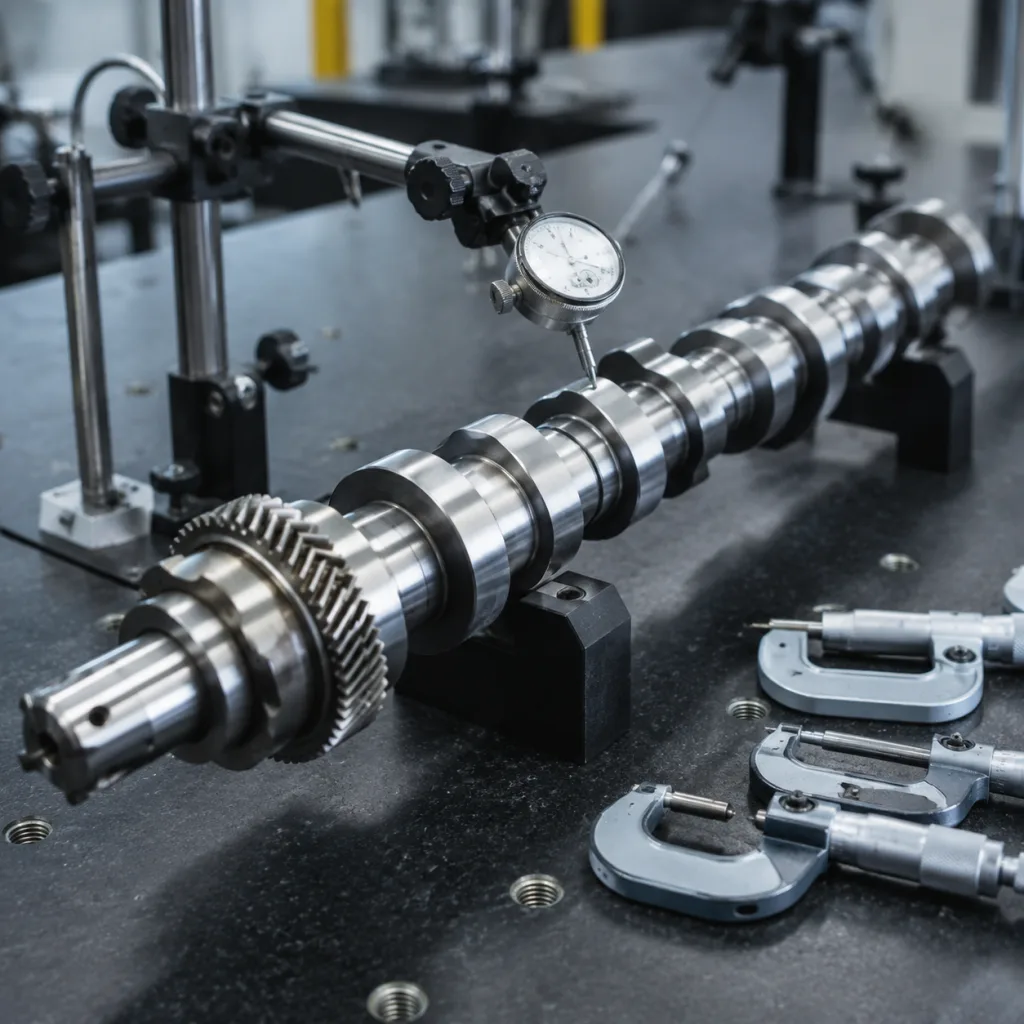
  • Gauge calibration records for micrometers, height gauges, dial indicators, hardness testers, CMM or contour measuring equipment if used.
  • Packing specification, VCI or anti-rust oil method, label format, carton quantity, gross weight, pallet size, and mixed-SKU rule.
  • PPAP, ISIR, first-article inspection, or equivalent submission package if your customer requires formal approval.

Inspection frequency should be agreed before production starts. A practical plan may include first-off approval after setup, patrol inspection during machining and grinding, hardness checks by heat-treatment lot, final dimensional sampling by batch, and 100% visual inspection for rust, burrs, cracks, missing plugs, damaged lobes, and incorrect labels. If the part will enter regulated markets, ask about compliance support for REACH (EC) No 1907/2006 and any customer-specific declaration format. Driventus can align inspection files, audit evidence, and approval documents to procurement requirements through our quality system.

Commercial trade-offs: where a low quote becomes expensive

The cheapest unit price is rarely the best sourcing decision. For a camshaft Renault supplier, buyers need to compare MOQ, sample lead time, mass-production lead time, inspection scope, payment terms, logistics route, and complaint response time together. A low quote can become expensive if it creates excess inventory, delayed replenishment, unclear warranty handling, high corrosion rates, or transit damage.

Use this comparison when reviewing suppliers:

</tr></thead><tbody> </tbody></table>For budgeting, separate unit price from landed cost. Add export carton cost, private-label printing, palletisation, inland freight, sea or air freight, insurance, import duty, customs clearance, local delivery, and expected inspection cost. For multi-location buyers, ask whether the supplier can support mixed-SKU shipments, carton-level labels, packing lists by destination, and export documents for the EU, UK, US, Canada, Australia, Brazil, and other active sales markets.

Failure modes: the issues that create returns

Most camshaft problems show up as avoidable failures in fitment, surface condition, or traceability. Buyers should ask a supplier how it prevents each one, not just how it reacts after a complaint lands.

Typical failure modes include:

  • Wrong engine application because the part was matched only by appearance or vehicle model, not engine code or OE reference.
  • Timing mismatch caused by trigger wheel position, keyway angle, thrust-face geometry, or sensor feature error.
  • Premature wear from poor hardening depth, low surface hardness, wrong material, or unstable grinding finish.
  • Oil starvation or noise from blocked oil holes, incorrect drilling, or poor cleanliness.
  • Corrosion during transit because the part was packed without VCI, oil protection, end caps, or carton strength suited to export.
  • Rework leaks caused by weak traceability, where one bad batch cannot be isolated quickly.
  • Installation complaints triggered by mixed-system parts, such as incompatible followers, caps, seals, or phasers.

A supplier that can explain its containment rules is usually safer than one that promises zero defects. Ask how suspect stock is quarantined, how heat-treatment lots are separated, and how a claim is traced back to material, machine, operator, and date. If the answer is vague, the risk usually reaches the buyer later.

Step by step: a practical sourcing workflow

A clean sourcing process reduces back-and-forth and exposes weak suppliers quickly. Keep the order of operations tight.

1. Send the RFQ with engine code, OE reference, application, annual volume, market, packaging needs, and required documents. 2. Ask the supplier to confirm fitment, material, process route, MOQ, lead time, and sample availability before pricing is final. 3. Review the dimensional drawing, control plan, and inspection method against your critical requirements. 4. Approve samples only after measuring the key features and checking installation against the target engine or a validated reference part. 5. Release pilot quantity, then confirm repeatability on the first production batch. 6. Lock the reorder rule, carton format, labels, and shipment documents for ongoing supply.

For repeat programmes, define the commercial rhythm early. Buyers can set reorder points, quarterly forecast quantities, approved packaging files, carton marks, and inspection documents required with each shipment. That is especially useful when the same platform is sourced in multiple markets and packaging must change by destination.

How Driventus runs Renault programme supply

Driventus supplies engine components through an integrated manufacturing setup in Taizhou, Zhejiang. For camshaft programmes, this supports tighter control over raw material selection, machining stability, heat-treatment consistency, grinding quality, inspection sequencing, and export packing than a fragmented trading model. It also gives buyers a clearer route for resolving technical questions during sample approval and repeat production.

Our buyers typically use three sourcing paths:

1. Standard catalogue supply for common applications through our catalog, where the buyer confirms OE reference, engine code, target market, annual volume, and packaging requirement. 2. Application-specific matching where the buyer provides OE data, sample parts, engine information, photos of timing ends and trigger features, or a technical drawing for dimensional comparison. 3. Custom manufacturing for private label, special packaging, customer-specific inspection plans, PPAP-style documents, carton artwork, barcode rules, or annual blanket orders.

A typical approval route is RFQ review, cross-reference check, feasibility confirmation, sample quotation, sample production or stock sample dispatch, dimensional report, buyer test fitment, pilot order, and repeat-order control. For repeat programmes, buyers can define reorder points, quarterly forecast quantities, approved packaging files, carton marks, and inspection documents required with each shipment.

We can also support broader engine programme sourcing through engine components when camshafts are purchased with related items such as timing sets, gaskets, water pumps, tensioners, followers, tappets, seals, or oil-control parts. This helps category teams consolidate suppliers, align documentation, simplify inbound logistics, combine MOQ across related engine families where feasible, and reduce the administrative load of managing separate vendors for closely related parts.

Audit checklist: what procurement teams should inspect on site

A factory audit should confirm that quality claims are backed by working controls on the production floor. For a camshaft supplier, buyers should review both the documented procedure and the way operators apply it during daily production. The audit should also check whether production, inspection, warehouse, and export teams follow the same traceability system.

Key points to verify on site include:

  • Material identification from receipt to finished goods, including heat number, supplier lot, internal batch card, and quarantine status.
  • Fixture control for turning, drilling, milling, grinding, deburring, washing, and finishing operations, with changeover approval recorded.
  • Setup approval records showing first-piece measurement before batch release and reaction rules when a dimension trends toward tolerance limits.
  • Gauge calibration status, interval records, storage condition, master gauge control, and operator access to valid measuring tools.
  • Hardness testing method, test location, sample frequency, acceptance criteria, and link to heat-treatment batch.
  • Control plan coverage for critical dimensions and special characteristics such as lobe lift, journal diameter, runout, trigger position, thrust width, oil holes, and surface finish.
  • Visual standards for lobe surface, journal finish, burr control, chamfers, cleanliness, rust prevention, edge damage, and handling marks.
  • Segregation rules for nonconforming parts, rework items, suspect stock, customer returns, and approved stock, with physical labels and system status aligned.
  • Packing release checks for VCI or oil coverage, end protection, carton quantity, label accuracy, pallet height, stretch film, and export marks.

Buyers should ask operators to trace one finished camshaft back to material lot, machining batch, heat-treatment batch, inspection report, and packing record. If the supplier cannot complete that trace within the audit, batch containment will be weak during a warranty claim. Buyers should also confirm complaint handling timelines, such as initial response within 24–48 hours, containment plan within 3–5 working days, and 8D or corrective action closure according to agreed evidence. Replacement, credit, scrap approval, and freight responsibility should be written into the supply agreement before the first mass-production order.

Frequently asked questions

Ask for certificate copies, dimensional inspection reports, material traceability, hardness results, process flow, control plan, gauge calibration evidence, and packing details. If your programme requires formal approval, request PPAP, ISIR, first-article inspection, or an equivalent submission pack.

Yes. We support private-label and customer-specific packaging through our OEM workflow. Share the OE reference, sample or drawing, engine code, target market, annual volume, carton artwork rules, barcode format, and required inspection documents so we can confirm feasibility, MOQ, lead time, and pricing logic.

No. Driventus is an independent aftermarket manufacturer; brand names are referenced for fitment only. We sell to distributors, wholesalers, repair networks, and OEM or Tier-1 customers where the programme requirements match our manufacturing, inspection, documentation, MOQ, and delivery capabilities.

If you are qualifying a camshaft Renault supplier, send your OE reference, engine application, target volume, packaging needs, required documents, Incoterms preference, and target delivery date through our request a quote page at /contact.html.

Request a Quote
Item What to confirm Practical buying logic
MOQPer part number, finish, and packaging typeCommon references may support 100–300 pcs; slow-moving or private-label items may require 300–1,000 pcs depending on tooling, material lot, and carton printing
Sample lead timeExisting stock, machined sample, or new-development sampleStock samples can often ship in 3–7 days; machined validation samples commonly need 15–30 days; new tooling or special hardening may need 45–60 days
Mass-production lead timePilot lot, repeat order, and peak-season timingRepeat orders are usually shorter than first production; confirm whether the clock starts after deposit, artwork approval, or sample approval
Price break100, 300, 500, 1,000 pcs or annual blanket orderUnit price should fall when setup, inspection, packing, and export costs are spread across larger batches
TraceabilityHeat lot, machining batch, hardening lot, grinding batch, and final inspection recordSupports warranty control, stock isolation, and recall containment by batch instead of full-SKU quarantine
PackagingAnti-rust method, inner support, carton strength, pallet specPrevents corrosion, lobe impact, bending risk, and mixed-SKU errors during sea freight and warehouse handling
IncotermsEXW, FOB Ningbo/Shanghai, CIF, DAP, or DDPChanges responsibility for inland freight, export clearance, insurance, customs, duty, tax, and delivery risk
After-sales processClaim evidence, response time, replacement rules, corrective action formatProtects distributors and repair networks from unresolved failures and unclear credit decisions