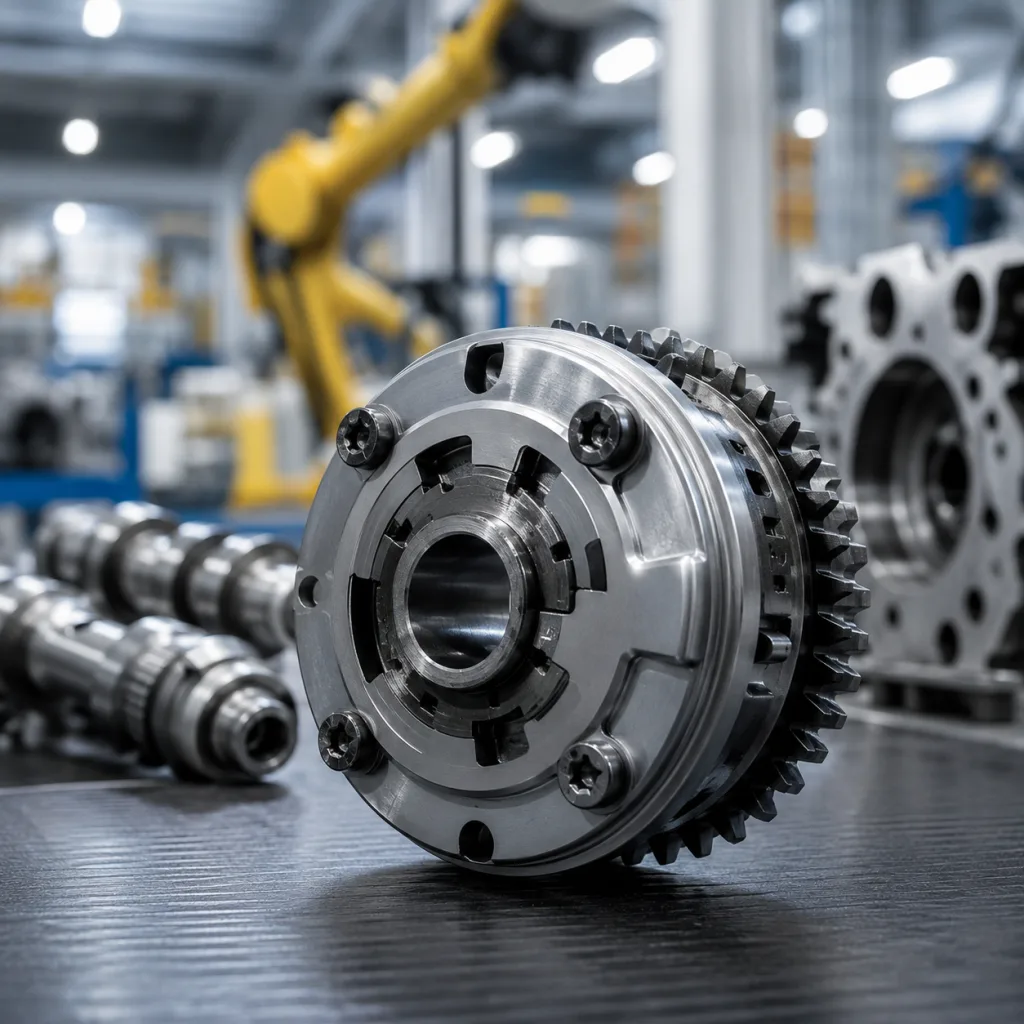
Camshaft Phaser Wholesale: Sourcing and QC Guide
Camshaft phaser sourcing is first a technical procurement job and only then a catalog exercise. In a camshaft phaser wholesale program, buyers need to lock down the OE reference, engine family, intake or exhaust side, locking strategy, trigger target, and required traceability before releasing volume. The stakes rise when the same part number moves across markets with different emissions rules, packaging specs, language needs, and label formats.
Driventus is an independent aftermarket manufacturer; brand names are referenced for fitment only. For procurement teams, the real test is not whether a part fits once, but whether a supplier can repeat the same critical dimensions, surface finish, hydraulic response, and functional performance in every shipment. A capable supplier should be able to show process control, sample approval records, export documentation support, and a clear way to manage engineering changes. This guide covers the checks that matter before a camshaft phaser wholesale order goes into production.
What buyers should verify before release
Before issuing a purchase order, confirm the application data at part level and lock the commercial file to the same technical record. For a camshaft phaser wholesale order, that means verifying the OE reference, engine code, bank position, intake or exhaust duty, oil-feed path, trigger target, and the connector or solenoid interface if the control valve is supplied with the assembly. Platform names alone are too broad, because closely related vehicles may use different phaser ranges, lock positions, or trigger targets across engine variants and model years.
The release file should also show who approved the sample, which drawing or application sheet was used, and which revision is being ordered. One common sourcing failure starts here: a sample is approved on one configuration, but production is launched on another because the order file does not clearly state the functional requirement.
Use these checks to reduce avoidable rework:
- Match the OE cross-reference and engine code, not just the platform name or vehicle badge.
- Confirm intake or exhaust side, bank position, and whether left-hand and right-hand parts share the same geometry.
- Verify the phaser lock position, default state, and phasing range required by the engine calibration.
- Check trigger wheel count, spline form, bolt pattern, mounting faces, and pilot dimensions.
- Confirm whether the order includes the phaser only or the phaser with the control valve, fasteners, or sealing components.
- Define traceability needs by market: serial, batch, inner-box, or carton level.
- Agree on packaging, label format, corrosion protection, pallet pattern, and barcode content before first shipment.
- Record the approved sample, inspection criteria, and revision status in the purchasing file.
If the application is already standardized, start with our catalog. For broader engine-family sourcing, the engine components page helps narrow the build path. For new programs, it is worth creating one internal approval sheet that ties together the part number, sample photo, OE references, test results, label format, and sign-off owner. That gives the team an auditable record of why the release decision was made later.
Materials and manufacturing controls
Phaser reliability depends on repeatable machining, clean assembly, and oil-control integrity. The housing, rotor, vanes, lock pin, spring pack, seals, and internal oil passages need to be controlled as one functional system rather than as isolated components. Buyers should expect material certificates, in-process inspection records, and final function checks on every production lot. Small variation in hardness, flatness, burr condition, or oil-port geometry can later show up as start-up noise, weak timing response, leakage, or lock failure.
The key question is repeatability across batches. That takes control of raw material, heat treatment where specified, machining capability on sealing and rotating interfaces, deburring standards, washing and cleanliness, and disciplined assembly of lock mechanisms and springs.
Process checks that matter
- Dimensional inspection on critical diameters, faces, spline or hub geometry, runout, and oil ports.
- Surface finish control on sliding and sealing interfaces where roughness affects oil retention and wear.
- Material verification for the housing, rotor, vanes, pin, and spring components, including certificate traceability by lot.
- Cleanliness control before assembly to protect the hydraulic circuit from chips, abrasive residue, or wash carryover.
- Functional rotation and lock or unlock verification after build, including confirmation of free movement through the designed phasing range.
- Leak-sensitive interface checks where seal geometry or machining quality can affect hydraulic response.
- Lot traceability from raw material to finished carton, with a clear link between inspection results and shipped batches.
A serious camshaft phaser wholesale supplier should also be able to explain how nonconforming parts are segregated, how process changes are approved, and how customer complaints are traced back to manufacturing records. Driventus operates an audited quality system aligned with IATF 16949:2016 and ISO 9001:2015. For materials and cross-border compliance, buyers can request documentation support aligned to REACH (EC) No 1907/2006. This is especially relevant when the part ships into the EU, UK, North America, or Australia and the importer needs a documented paper trail rather than a verbal assurance.
Specification matrix for procurement teams
The quickest way to compare suppliers is to make each one answer the same technical and commercial questions in the same format. That is especially useful in a camshaft phaser wholesale program, where apparent equivalents often differ in locking behavior, machining detail, or documentation support. A structured matrix keeps the comparison honest and exposes gaps before price discussions take over.
The table below is a practical first screen for sourcing teams evaluating a new or replacement supply source.
| Buyer check | Why it matters | Evidence to request |
|---|---|---|
| OE reference and engine code | Prevents fitment errors across similar platforms and mid-cycle engine changes | Cross-reference sheet, application list |
| Intake or exhaust side | The wrong side changes timing behavior and may not install correctly | Marked sample, drawing call-out |
| Bank position and handedness | Some V-engine applications are side-specific even when the catalog wording looks similar | Application note, sample photos |
| Locking and phasing behavior | Affects start-up noise, idle stability, and calibration compatibility | Functional test summary, engineering spec |
| Oil-port and seal geometry | Controls hydraulic response and leakage risk | Dimensional report, section drawing |
| Trigger target or reluctor details | Incorrect target geometry can affect cam signal quality | Drawing detail, tooth-count confirmation |
| Spline, hub, and mounting geometry | Small deviations here create assembly or torque issues | CMM report, go/no-go gauge results |
| Included hardware or solenoid scope | Prevents receiving the right phaser in the wrong supply configuration | BOM or packing specification |
| Packaging and traceability | Supports warehouse handling, importer checks, and field containment if needed | Carton spec, lot code format |
| Release documentation | Reduces disputes when the batch arrives at destination | Inspection record, sample approval file |