Camshaft Phaser Infiniti Aftermarket Replacement: Sourcing Guide
When procurement teams source a camshaft phaser Infiniti aftermarket replacement, fitment and validation matter more than brochure claims. The part has to match the OE unit in locking function, oil-control behaviour, tooth count, trigger geometry, connector interface where applicable, and overall envelope. In a variable valve timing system, even a small deviation can affect idle quality, cold-start performance, emissions, and scan-tool fault recovery.
Driventus supplies engine components for B2B programmes and validates parts against dimensional and functional requirements before export. Driventus is an independent aftermarket manufacturer; brand names are referenced for fitment only. For buyers supporting distributors, repair chains, or remanufacturing lines, the aim is straightforward: source a replacement that installs correctly, performs consistently, and passes routine QA checks without rework.
This guide walks through the technical points worth confirming before a purchase order is released, including OE cross-reference practice, application confirmation, materials, process controls, and acceptance tests aligned with IATF 16949:2016 and ISO 9001:2015.
What buyers should verify before ordering
Before issuing a purchase order, confirm the full application data instead of relying on a single interchange reference. For Infiniti applications, that usually means checking model, model year, engine code, displacement, VIN range where available, production date, and whether the phaser is for the intake or exhaust camshaft. Bank position also matters on V-engine layouts. A left-bank and right-bank component may look similar, yet differ in oil passage orientation, timing marks, or reluctor geometry.
A practical sourcing checklist should include:
- OE number and supersession history
- Engine family and camshaft position
- Tooth count and chain or sprocket profile
- Lock pin position and default park angle
- Oil feed port location, groove shape, and sealing land dimensions
- Trigger wheel or timing reference geometry where integrated
- Bolt pattern, centre bore, overall diameter, and installed height
- Surface finish, burr control, and cleanliness requirements
- Packaging, labelling, and traceability format for warehouse handling
It also helps to define the intended supply channel early. A distributor programme may prioritise broad coverage, carton labelling, barcode consistency, and low return rates across many SKUs. A repair network may need faster fitment confirmation and clear application notes for technicians. A remanufacturing or engine rebuilding line may require dimensional reports, sample approval, and repeatable batch documentation. Clear channel requirements reduce the risk of buying a visually similar camshaft phaser that causes installation problems later.
Driventus is an independent aftermarket manufacturer; brand names are referenced for fitment only. The buying decision should rest on verified compatibility, documented inspection, and repeatable manufacturing control, not assumptions based on appearance.
OE-equivalence and replacement fitment checks
OE-equivalence for a camshaft phaser is about more than matching the outside diameter. The replacement has to reproduce the mechanical timing relationship between the camshaft, chain drive, rotor, stator, and locking mechanism. If the phaser parks at the wrong angle, releases too slowly, or routes oil differently, the engine control module may detect slow cam response, over-advanced or over-retarded timing, startup rattle, poor idle stability, or diagnostic trouble codes.
For a camshaft phaser Infiniti aftermarket replacement, buyers should request a cross-reference review against the target OE number and, where possible, compare the aftermarket sample with an OE unit. The comparison should cover critical dimensions such as mounting face flatness, centre bore, bolt hole diameter, keyway or locating feature, sprocket tooth form, installed height, and clearance to nearby timing cover components. Any integrated sensor target or timing reference feature should be checked for angular position and profile consistency.
Functional fitment checks are just as important. The lock pin should engage securely at the designed park position and release under the specified oil pressure range. Internal vanes should move smoothly through the intended advance and retard range without sticking. Oil galleries need to align with the camshaft and control valve passages, while sealing lands should maintain pressure without excessive leakage. Where the application uses separate oil control valves, the phaser still needs to respond correctly to commanded oil flow. Where an assembly includes an electrical or control interface, confirm the connector form, terminal layout, and resistance specification.
Because OE numbers may supersede over time, sourcing teams should not treat every listed interchange as automatically equivalent. A controlled approval process should record the OE reference, replacement part number, sample inspection result, application notes, and any exclusions. That record makes future reorders easier and reduces the chance of mixing intake and exhaust units, early and late designs, or visually similar parts from different engine families.
Validation tests that reduce field returns
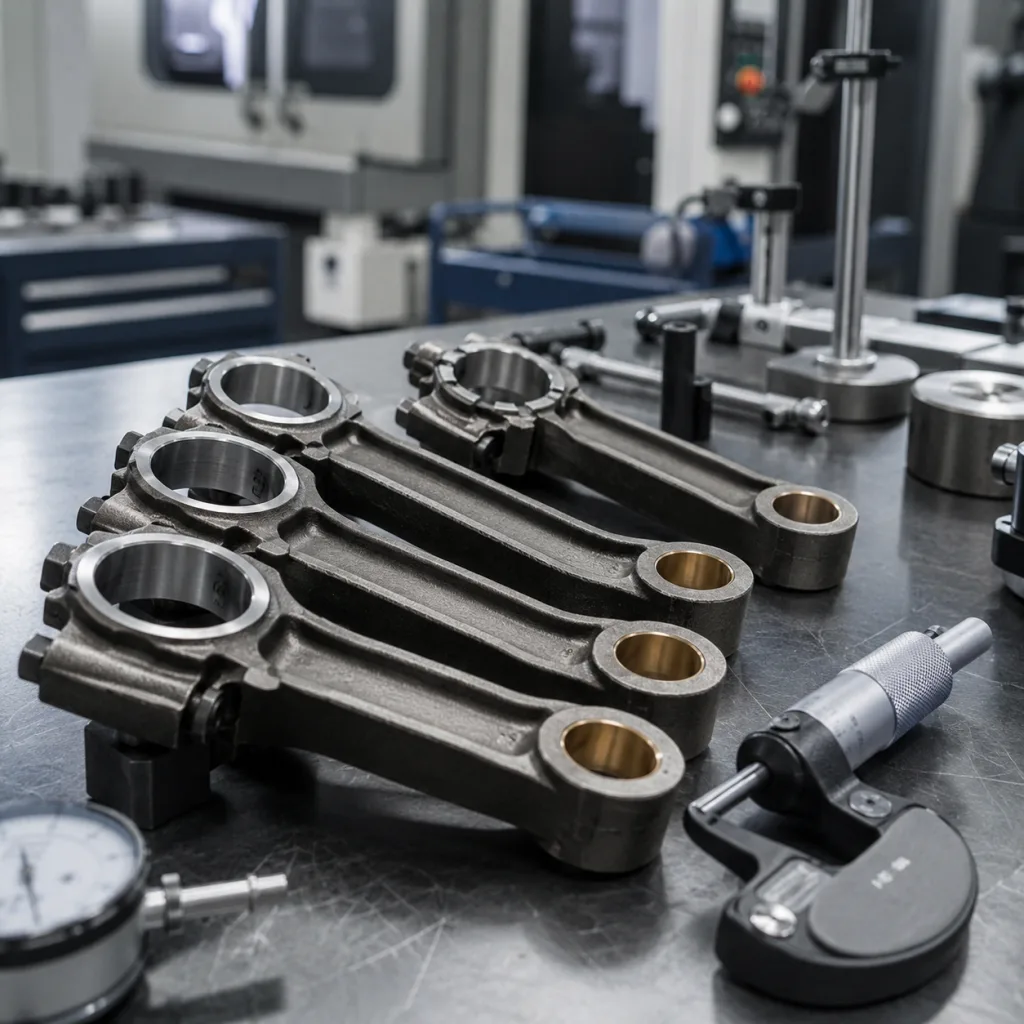
Field returns for variable valve timing components often trace back to small functional differences that basic visual inspection does not catch. A robust approval process should combine dimensional inspection, bench function testing, cleanliness checks, and packaging review before volume release. For B2B buyers, the goal is not only to confirm that the sample fits, but also to confirm that repeated production batches stay within the same acceptance window.
Recommended validation points include:
- Dimensional inspection against drawing or OE sample for all critical-to-fit features
- Tooth count, sprocket profile, and timing mark verification
- Lock pin engagement, holding force, and release behaviour
- Rotor rotation angle and smoothness through the advance and retard range
- Oil leakage and pressure retention checks at defined test conditions
- Response consistency when oil flow is applied through the control passages
- Hardness, coating, and surface finish checks on wear-related areas
- Cleanliness inspection for machining debris, burrs, and residual particles
- Packaging drop, corrosion protection, and label accuracy review
Noise and startup behaviour deserve particular attention. A phaser that unlocks too easily or drains oil too quickly can contribute to startup rattle, especially after the vehicle has been parked. A phaser that is too tight internally may respond slowly and trigger camshaft position performance codes. Where test equipment is available, response time and leakage should be measured across multiple samples rather than a single golden sample.
Driventus supports inspection and validation practices aligned with IATF 16949:2016 and ISO 9001:2015. Useful buyer documentation may include sample inspection reports, material or hardness records, functional test summaries, batch traceability, and pre-shipment inspection results. These records help purchasing, engineering, and quality teams approve a camshaft phaser Infiniti aftermarket replacement with fewer assumptions and clearer acceptance criteria.
Materials, machining, and contamination control
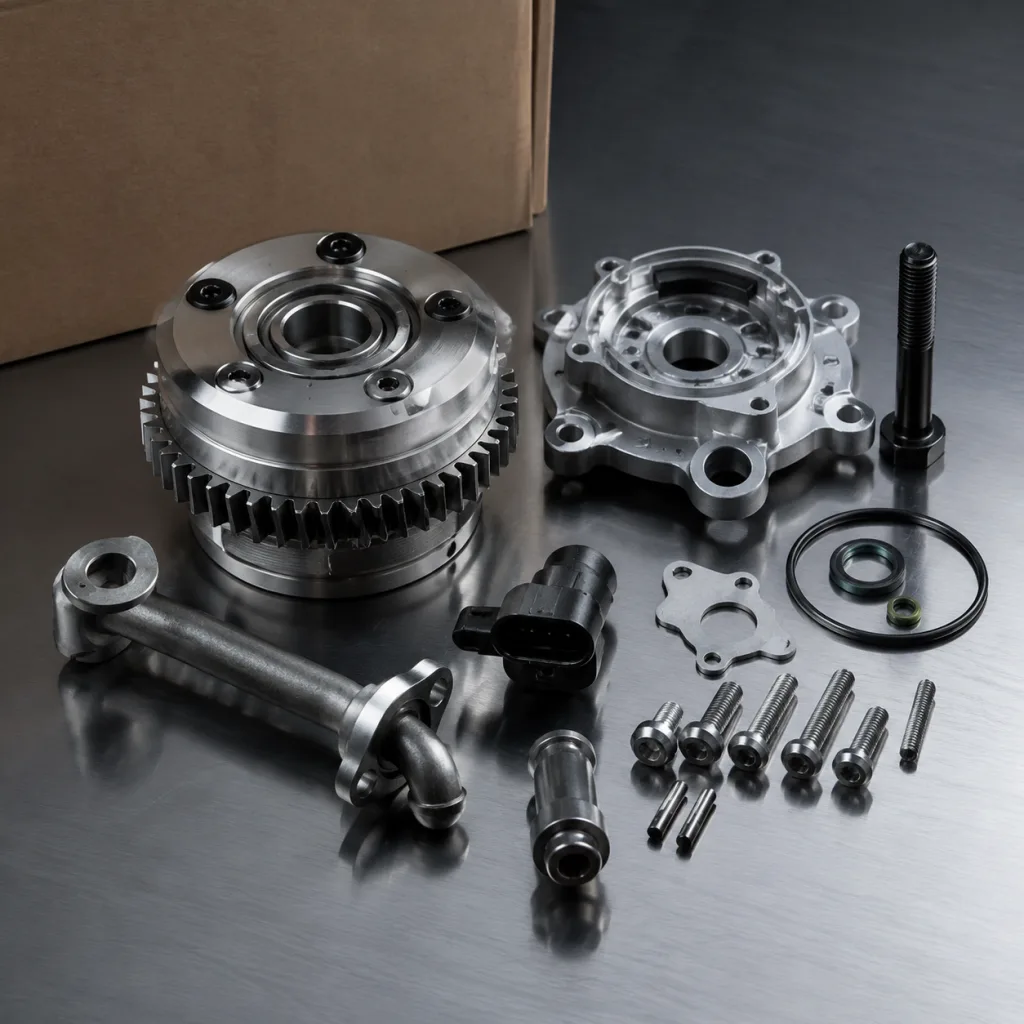
A camshaft phaser works in a hot, oil-fed, high-cycle environment, so material selection and machining accuracy have a direct effect on durability. Key components must resist wear, maintain dimensional stability, and preserve oil pressure across internal chambers. Depending on the design, the assembly may include powdered metal, steel, aluminium, sintered components, springs, pins, seals, and precision-machined internal passages. Each material choice should support the required strength, hardness, friction behaviour, and corrosion resistance.
Machining control is especially important around oil grooves, vane surfaces, sealing lands, sprocket teeth, and locking features. Burrs or sharp edges can break loose and circulate through the lubrication system. Poor surface finish can increase leakage or sticking. Incorrect heat treatment can cause premature wear at the sprocket, lock pin, or rotor contact surfaces. Even small deviations in angular machining can affect commanded valve timing, so critical features should be managed with suitable fixtures, gauges, and inspection plans.
Cleanliness deserves the same attention as dimensional accuracy. Variable valve timing components have narrow oil passages, and contamination can block flow or cause erratic movement. Buyers should ask how the supplier controls washing, drying, particle inspection, rust prevention, and final packaging. Protective caps, sealed bags, corrosion-inhibiting materials, and clean carton handling can all reduce the risk that a good part becomes problematic during storage or transport.
For distributor and repair-channel supply, the finished part should arrive ready for installation, with stable corrosion protection and no loose debris inside the packaging. For engine rebuilders and higher-volume programmes, additional requirements may include agreed particle limits, lot-level inspection records, and retained samples. These controls help the replacement phaser perform consistently after long shipping routes, warehouse storage, and technician handling.
Commercial terms for distributors and repair networks
Commercial evaluation should run alongside technical approval. A low unit price is not helpful if the programme creates high return rates, unclear application coverage, or inconsistent replenishment. Buyers should compare suppliers on total landed cost, minimum order quantity, lead time, packaging configuration, documentation support, and the ability to maintain the same specification across repeat orders.
For distributors, important terms often include private-label packaging, master carton quantity, barcode and label format, palletisation, country-of-origin marking, and mixed-SKU shipment options. Clear application data is equally important, because warehouse teams and catalogue managers need to distinguish similar camshaft phasers by engine, bank, and cam position. Part-number discipline reduces picking errors and helps sales teams quote with confidence.
Repair networks usually need dependable availability, fast identification, and practical warranty handling. A replacement that installs correctly the first time protects bay productivity and technician trust. For this channel, buyers may want sample support for pilot branches, application notes for common fitment questions, and batch traceability for claim review. Where a programme serves multiple markets, packaging language, label requirements, and import documentation should be confirmed before shipment.
Payment terms, forecast sharing, and safety stock planning also affect supply reliability. Camshaft phasers are not always fast-moving items, but when a repair job needs one, delay can immobilise the vehicle. B2B buyers should agree reorder points, production lead times, inspection windows, and shipment methods in advance. That gives the camshaft phaser Infiniti aftermarket replacement programme a stronger commercial foundation than one-off spot purchasing.
How Driventus supports sourcing teams
Driventus supports B2B sourcing teams with application confirmation, sample review, production control, and export-ready documentation for engine component programmes. For a camshaft phaser Infiniti aftermarket replacement, the process can begin with the buyer's OE reference, target vehicle applications, annual demand estimate, packaging requirements, and quality documentation needs. From there, Driventus can help review fitment details and identify the inspection points to confirm before order release.
Typical support may include OE cross-reference checking, dimensional comparison, sample submission, functional test reporting, and batch traceability. For customers building a catalogue or distributor line, Driventus can also align part numbers, labels, carton specifications, and application notes with the buyer's internal system. For repair networks or regional importers, the focus may be stable replenishment, clear communication, and claim analysis if a field issue occurs.
Driventus manufactures for the independent aftermarket and does not claim OEM approval or affiliation. Brand names are used only to identify vehicle fitment. The value for sourcing teams is practical: parts are reviewed against fitment and performance requirements, quality checks are documented, and commercial supply can be structured around B2B needs such as MOQ, lead time, private-label packaging, and repeat-order consistency.
When buyers provide accurate application data and target acceptance criteria, Driventus can move more quickly from enquiry to quotation, sample approval, and production planning. That keeps the sourcing process grounded in measurable requirements and helps procurement teams reduce avoidable installation issues, catalogue errors, and warranty exposure.
Frequently asked questions
Start with engine code, bank position, and OE cross-reference. Then confirm tooth count, lock position, oil port geometry, and overall dimensions against the OE sample or drawing.
Sometimes, but not always. Buyers should verify VIN application, build year, and intake or exhaust position before ordering, even when the OE reference looks similar.
No. Driventus is an independent aftermarket manufacturer; brand names are referenced for fitment only. Parts are supplied for B2B replacement use with documented inspection and validation support.
If you need fitment confirmation, sample support, or a quotation for volume supply, please [request a quote](/contact.html).
Request a Quote