Camshaft Phaser Cadillac Wholesale: Sourcing Guide
Wholesale buyers sourcing a camshaft phaser for Cadillac applications need more than a price list. The part must match OE geometry, phase travel, oil control response, and calibration limits, or the engine will show fault codes, cold-start noise, or poor torque control. For procurement teams, the main variables are fitment control, batch consistency, test coverage, packaging, and the supplier’s ability to support repeat orders without dimensional drift.
Driventus supplies engine and powertrain components from Taizhou, Zhejiang, with export experience in 60+ countries and quality systems built around IATF 16949:2016 and ISO 9001:2015. Driventus is an independent aftermarket manufacturer; brand names are referenced for fitment only. This article explains how wholesale buyers should evaluate a Cadillac camshaft phaser source, what to verify before purchase, and which documents reduce receiving risk. For product scope, see our catalog and our quality system.
What wholesale buyers should verify first
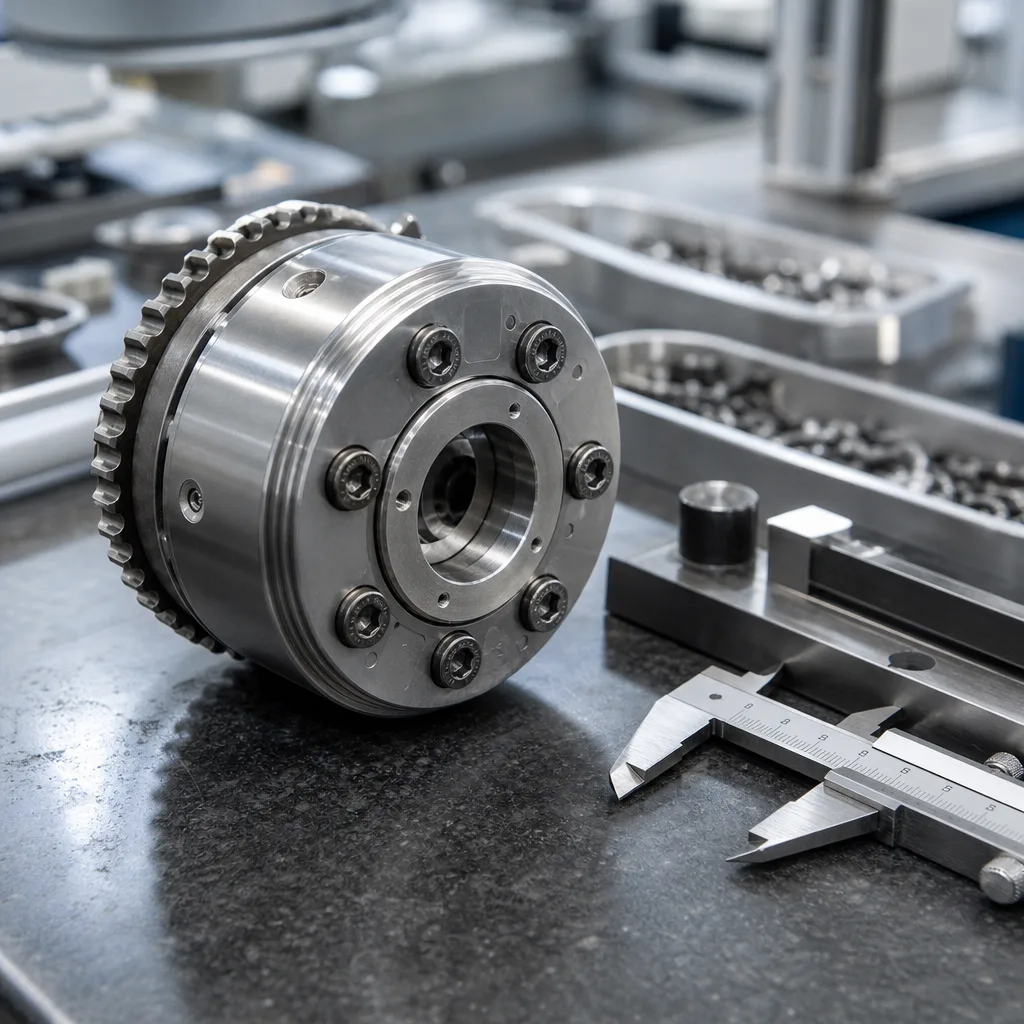
A camshaft phaser is not a generic rotating assembly. It is an oil-actuated control component that must fit the engine family, valve timing strategy, and ECM calibration.
For Cadillac applications, procurement teams should confirm:
- Engine code and model year range
- Intake or exhaust position
- OE cross-reference, for example OE 06A107065 when the buyer already has that number in the sourcing file
- Connector or locking feature, where applicable
- Phaser travel angle and lock position
- Bolt pattern, hub diameter, and oil feed port alignment
- Packaging and traceability requirements
If the supplier cannot confirm these items from a controlled drawing or validated sample, the risk moves to the buyer’s receiving line. For platform expansion or private-label programmes, custom manufacturing is appropriate when the catalogue part does not cover the target variant.
Technical specifications that matter in procurement
Buyers should compare samples on measurable attributes, not on appearance alone. The table below shows the typical control points used in supplier qualification.
| Control item | What to verify | Procurement note |
|---|---|---|
| Housing material | Aluminium alloy or cast iron, per application | Confirm corrosion protection and surface finish |
| Rotor and vanes | Heat-treated steel, controlled hardness | Hardness affects wear and timing stability |
| Phase travel | Match OE working range | Deviations can trigger DTCs |
| Lock pin function | Positive lock at rest position | Important for cold-start behaviour |
| Oil passage cleanliness | No burrs, chips, or trapped debris | Cleanliness affects spool response |
| Runout and concentricity | Measured against drawing limit | Needed for smooth actuation |
| Seal integrity | Leak-free under test pressure | Prevents oil loss and delayed response |