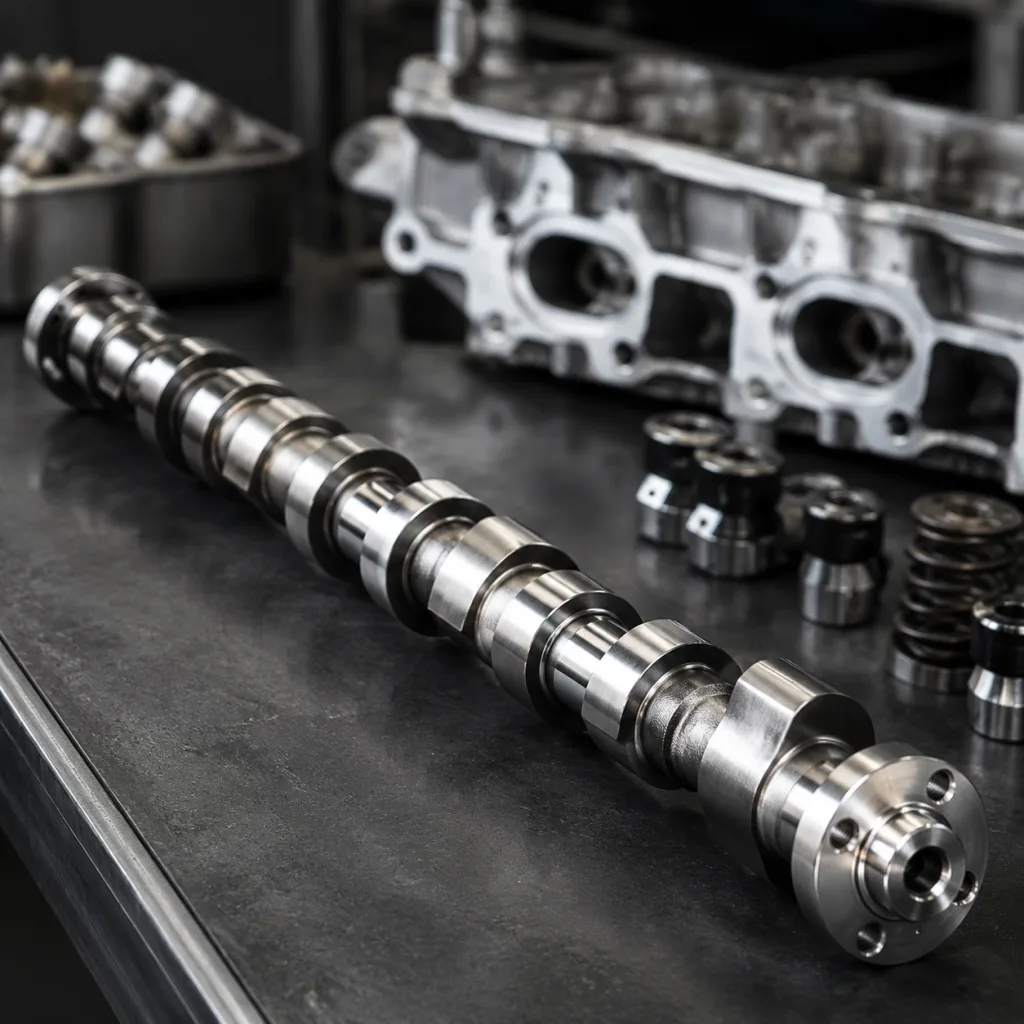
A camshaft phaser is a precision variable-valve-timing component. For an Alfa Romeo aftermarket replacement, close-enough fitment is not enough: the part has to match the OE unit in mounting geometry, hydraulic response, and phasing range. B2B buyers should verify the specification beyond catalogue fitment, including engine code, OE cross-reference, camshaft position, connector and oil passage layout, sprocket interface, and the ECU-commanded advance/retard window. Small changes in vane geometry, rotor stop angle, locking pin behavior, internal leakage, or oil pressure response can lead to DTCs, rough idle, cold-start rattle, or cam/crank correlation faults. In practice, a camshaft phaser Alfa Romeo aftermarket replacement should be treated as a validated timing-control assembly, not simply as a sprocket. The real question is whether it performs consistently under oil pressure, temperature changes, and repeated advance/retard cycles after installation. Driventus is an independent aftermarket manufacturer; brand names are referenced for fitment only. We support B2B sourcing with dimensional control, functional validation, batch traceability, and documented quality processes aligned to IATF 16949:2016 and ISO 9001:2015.
What a replacement camshaft phaser must match
A replacement phaser should be judged as a working assembly, not just as a rotating metal part. On Alfa Romeo applications, it must line up with the timing drive, communicate properly with the oil control system, and stay within the response window expected by the ECU. A unit may bolt on cleanly, yet still cause repeat repairs if it reaches a different stop angle, releases the locking pin too late, or loses oil internally.
For RFQ review and sample approval, procurement teams should confirm:
OE part-number cross-reference, including supersession or revision history shown in the catalogue
Engine code, model year range, camshaft position, and market-specific application notes
Number of vanes, rotor stop position, advance/retard travel, and total phase range
Locking pin design, release pressure, return-spring behavior, and rest position at start-up
Oil control valve interface, feed/return passage layout, sealing land dimensions, and leakage limits
Sprocket offset, bolt circle, center bore, fastener specification, and chain or belt alignment
Tooth profile, timing mark location, and relationship between sprocket indexing and rotor position
Material grade, heat treatment, surface hardness, and finish on vane, journal, and seal-contact areas
Hydraulic or electrical compatibility with the engine management strategy where the actuator system is integrated
If any one of these points is off, the engine may still run, but calibration drift can show up at hot idle, during cold start, or through high-load transitions. Dimensional match is the first gate. Functional validation on a test rig or engine dyno should follow. For a camshaft phaser Alfa Romeo aftermarket replacement, the most reliable approval route is to compare the replacement against a known OE sample, verify the critical dimensions, and then confirm repeatable phase movement under controlled oil temperature and pressure.
OE-equivalence checks for procurement teams
When sourcing a replacement, the central question is whether the part matches the OE control window and installation envelope. OE equivalence goes well beyond visual similarity. It includes the geometry that fixes timing position, the hydraulic features that govern response speed, and the durability characteristics that let the assembly survive repeated phase changes. Buyers should ask how the aftermarket replacement was benchmarked and which critical-to-function dimensions are controlled during production.
The table below outlines practical checkpoints for RFQ review.
Lot code, part label, handling protection, country requirements
Improves traceability and warehouse control
</tr></thead><tbody> </tbody></table>A suitable aftermarket replacement should also come with traceable inspection records for critical dimensions. Buyers supplying the EU, UK, US, Canada, Australia, and Brazil often need consistent documentation for sample approval, customs clearance, distributor onboarding, and incoming inspection. Checking these details before purchase helps avoid mixed applications, wrong-revision inventory, and field claims caused by catalogue coverage that was too broad.
Validation testing that matters
A camshaft phaser works in a harsh environment: oil contamination, pressure fluctuation, temperature cycling, and repeated phase changes are all part of normal service. Validation therefore needs both static and dynamic checks. Static inspection confirms the part matches the drawing and OE benchmark. Dynamic testing shows whether it behaves correctly as oil pressure, speed, and temperature change. Procurement teams need both views, because many phaser problems only appear after the unit is commanded through its operating range again and again.
Recommended tests include:
Dimensional inspection of center bore, bolt circle, sprocket offset, tooth geometry, and sealing lands
Functional phasing response under controlled oil pressure and temperature
Advance and retard travel measurement against the specified stop angles
End-stop repeatability after thermal soak and repeated cycling
Locking pin engagement at cold-start temperatures and release under defined oil pressure
Internal leakage and bleed-down assessment at low and high oil temperatures
Cycle durability under repeated advance/retard events
Torque retention or fastener interface checks where the sprocket assembly is bolted to the camshaft
Surface hardness, coating, or finish verification for wear-critical areas
Corrosion screening for exposed steel components and packaged stock
Noise and rattle review during start-up simulation where applicable
Relevant standards and frameworks may include IATF 16949:2016, ISO 9001:2015, REACH (EC) No 1907/2006, and the buyer’s own PPAP or control-plan requirements. For higher-volume orders, buyers may request initial sample inspection reports, material declarations, process flow documentation, control plans, and functional test summaries. If a supplier cannot provide test evidence, batch traceability, and measurement reports, procurement risk rises even when the part appears identical from the outside.
Where Alfa Romeo buyers see failure modes
Most replacement failures are tied to control accuracy rather than basic installation. A phaser can fit correctly and still miss the ECU’s expected timing response if internal leakage, stop position, locking mechanism behavior, or the oil control interface is wrong. For Alfa Romeo repair networks and parts distributors, that distinction matters: these problems can create repeat fault codes and warranty returns that are hard to diagnose by looking at the part alone.
Typical symptom to cause mapping
Rough idle after start-up: delayed locking pin release, weak pin engagement, varnish in the oil circuit, or internal leakage
Cold-start rattle: locking mechanism wear, insufficient oil pressure at start-up, or slow oil fill inside the phaser
Audible ticking from the front cover: worn vane edges, oil starvation, fastener movement, or contact caused by misalignment
Loss of top-end performance: phaser not reaching commanded advance or response lag under higher load
Sluggish throttle response: slow hydraulic actuation, restricted oil control valve, or excessive internal bleed-down
Intermittent faults after oil change intervals: contamination sensitivity, varnish build-up, incorrect oil viscosity, or debris entering the control circuit
Repeat DTC after replacement: wrong OE cross-reference, mixed engine-family application, or unverified solenoid condition
Before placing an order or approving a return diagnosis, check oil quality, filter condition, oil pressure, timing chain or belt condition, and the oil control solenoid. A new phaser will not solve low oil pressure, blocked galleries, worn timing components, or a faulty actuator. If the installed system is contaminated, the replacement should be supported by flushing and verification of the oil circuit. For bulk buyers, warranty-return data is especially useful when grouped by engine code, mileage, oil condition, and fault code. That data helps separate true product concerns from installation issues or vehicle-system faults.
Sourcing approach for distributors and repair networks
For aftermarket distributors, multi-location repair chains, and import managers, reliable supply is just as important as product fit. A camshaft phaser Alfa Romeo aftermarket replacement should be sourced with the same discipline used for other timing-critical engine parts: define the exact application, approve samples, confirm documentation, and control repeat orders by lot. That approach lowers the risk of receiving parts that look similar but belong to another engine family or camshaft position.
Use this sourcing checklist:
Confirm application by engine code, OE cross-reference, camshaft position, and market region
Check whether the OE number has supersessions or different revisions that affect fitment
Request dimensional report and functional test summary for the proposed part
Compare a sample against an OE unit for sprocket offset, timing marks, oil ports, and stop angles
Verify packaging, labeling, barcode, country-of-sale, and traceability requirements
Align MOQ, lead time, forecast volume, and safety-stock expectations before release
Ask for sample approval before mass purchase
Define acceptable documentation for incoming inspection and field-claim review
Confirm whether private-label packaging, neutral branding, or market-specific cartons are required
Establish communication rules for engineering changes, coating changes, machining updates, or supplier-lot changes
Driventus supports B2B sourcing with documented inspection, batch traceability, and export experience across 60+ countries. Our catalog is available at our catalog, and additional engine-related components are listed at /products/engine-components.html. For buyers needing non-standard variants, custom manufacturing is available for defined drawings and controlled revisions. Driventus is an independent aftermarket manufacturer; brand names are referenced for fitment only.
Quality controls before shipment
A replacement phaser should leave the factory with checks that reduce the chance of field returns. At a minimum, the quality system should cover incoming material review, in-process dimensional checks, final functional testing, packaging inspection, and lot traceability. Because camshaft phasers control timing, buyers should look closely at the controls around machining accuracy, cleanliness, surface finish, and functional response.
Before shipment, quality control should verify:
Material certificate review and incoming inspection for critical components
Dimensional checks for center bore, bolt pattern, sprocket offset, oil passages, sealing lands, and phase stops
Surface finish and hardness checks on wear and sealing areas
Cleanliness controls to reduce debris entering oil passages during installation
Functional movement under specified oil pressure, including advance/retard response and locking pin operation
Leakage or bleed-down limits where defined by the control plan
Visual inspection for burrs, corrosion, handling marks, and packaging damage
Lot coding, carton labeling, and traceability records for warehouse and warranty management
Gauge calibration records and operator inspection records for critical processes
Nonconformance handling, containment, corrective action, and controlled rework procedures
Buyers should review the supplier’s nonconformance process, corrective action response, and gauge calibration records before approving recurring shipments. For high-volume programs, shipment approval can also include retained samples, agreed AQL levels, first-article reports, and periodic revalidation.
Driventus publishes its quality system for procurement review. For high-volume programs, we can support controlled changes to machining features, coating specifications, and packaging format through request a quote. When the application requires tighter commercial or technical alignment, request a quote and provide the engine code, OE number, annual volume, target market, packaging requirements, and any inspection documents required by your receiving team.
Frequently asked questions
Yes, if the OE cross-reference, engine code, camshaft position, dimensions, oil interface, locking mechanism, and phase range match the original specification. Buyers should still verify dimensional and functional test data before release.
Most early failures are linked to oil contamination, low pressure, blocked galleries, incorrect oil viscosity, worn timing components, or a faulty control solenoid. Incorrect application matching can also create repeat faults.
Ask for dimensional reports, functional test results, material and traceability records, sample approval, packaging details, MOQ, lead time, and warranty-handling process. For OE cross-referenced parts, confirm the exact engine family, camshaft position, and revision.
If you are sourcing a camshaft phaser Alfa Romeo aftermarket replacement for distribution or workshop supply, send your OE number, engine code, camshaft position, target market, and volume target. Request a quote at /contact.html