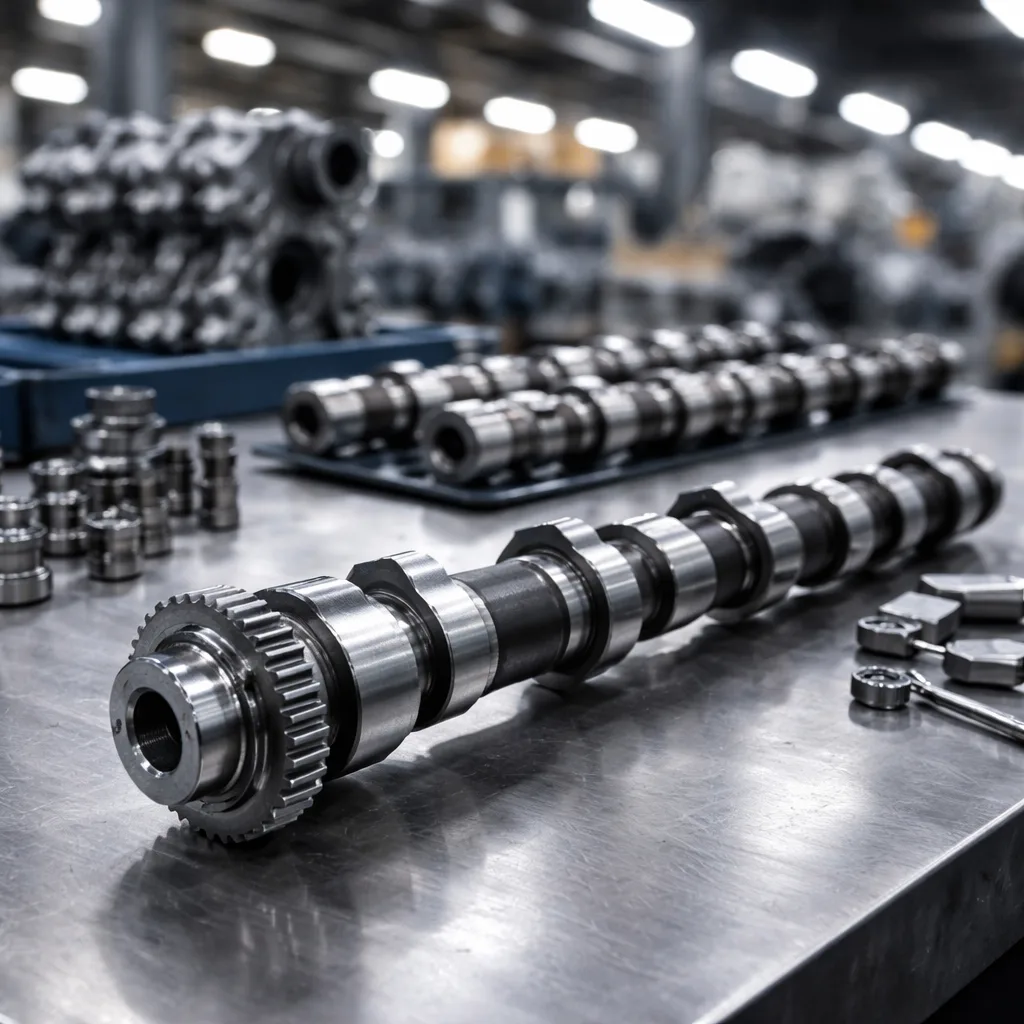
Camshaft for Mini Clubman Aftermarket Replacement Guide
A camshaft for Mini Clubman aftermarket replacement must match the engine code, valve timing strategy, journal dimensions, and surface finish of the original application. For procurement teams, the key question is not only whether the part fits, but whether it maintains lift, duration, base circle, lobe phasing, and timing tolerance within the limits needed for reliable operation. Driventus supplies camshafts as independent aftermarket components for B2B buyers who need dimensional consistency, repeatable hardening, and traceable quality control. Driventus is an independent aftermarket manufacturer; brand names are referenced for fitment only. Buyers should verify OE cross-reference data, material grade, and any required machining or balancing before placing volume orders. For product range and related engine parts, see [our catalog](/products.html), [our quality system](/quality.html), and [custom manufacturing](/oem-services.html).
Start with the fitment decision, not the catalog photo
For replacement sourcing, the camshaft must match the exact Mini Clubman engine variant, model year, and valve train layout. A correct part is one that preserves the original interfaces and timing behavior, not just the outward shape.
Journal diameter: hold to the drawing on critical bearing surfaces, often `±0.01 mm`
Overall shaft length and thrust face location: typically controlled within `±0.05 mm`
Lobe lift and base circle: confirm against the OE profile, commonly `±0.02 mm` on lift-critical features
Lobe separation and indexing: verify phase angle and cam-to-crank relationship, often within `±0.5°`
Sensor trigger wheel or reluctor geometry: confirm tooth count, angular window, and air-gap sensitivity where applicable
Surface hardness and finish on bearing and lobe areas: specify target hardness and `Ra` finish before order placement
Use OE part numbers only as fitment references, such as `OE 06A107065`. Do not assume interchangeability across turbocharged and naturally aspirated versions, or across emissions calibrations. If the engine code is uncertain, stop there and confirm it before sourcing. That single check prevents most returns.
Specification checks that prevent expensive returns
Procurement should request a dimensional and material declaration before approval. The goal is to compare suppliers on the same spec, not on vague replacement claims. For B2B buying, the quote should state acceptance criteria so both sides know what passes inspection.
Verification item
What to confirm
Base material
Alloy steel, chilled cast iron, or application-specific equivalent; ask for material spec and mill or heat cert
Hardness
Target surface hardness and case depth, if used; common purchase targets are `50-60 HRC` on lobes with defined core hardness
Lobe geometry
Lift, duration, flank profile, and indexing; request nominal values plus allowable deviation
Runout
Measured total indicated runout on critical journals; typical acceptance is `≤0.03 mm` unless the drawing is tighter
Finish
Journal and lobe surface roughness; specify `Ra 0.2-0.8 µm` as needed by the application
Balance
If the design requires dynamic balancing, define residual unbalance limit in grams-mm
Traceability
Heat lot, batch number, inspection record, and serialization if required
</tr></thead><tbody> </tbody></table>If the buyer needs a non-catalog specification, Driventus can support custom manufacturing for controlled changes to profile, coating, machining sequence, packaging, or inspection checkpoints. For RFQs, include target annual volume, first-order MOQ, and requested lead time so the supplier can quote the correct process route.
How to validate a replacement before release
A replacement camshaft should be validated against dimensional, metallurgical, and functional criteria before production release. The checks should follow the risk in the application: first geometry, then material, then assembly behavior.
1. Incoming inspection against the approved drawing, including journal diameter, lobe height, and thrust-face location. 2. Rockwell or equivalent hardness verification, with the inspection report tied to the batch number. 3. Profile measurement of each lobe using a cam analyzer or CMM against the nominal lift and duration curve. 4. Journal concentricity and runout check, with a common release target of `≤0.03 mm` TIR unless otherwise agreed. 5. Surface inspection for scoring, grinding burn, porosity, or decarburization. 6. Fit trial with matched bearings, lifters, or followers, including oiling and rotation checks. 7. If the program is performance-sensitive, verify timing scatter, phasing repeatability, and valve motion at operating temperature.
For durability, buyers commonly ask for bench or engine-level validation aligned with published methods such as IATF 16949:2016 and ISO 9001:2015 for process control. Where emissions durability or environmental exposure is relevant, reference standards such as REACH (EC) No 1907/2006 for material compliance and SAE J2527 for corrosion-related test context when applicable. Driventus does not claim vehicle-maker approval; it supplies aftermarket components validated to the agreed specification.
Commercial terms that matter in B2B supply
Mini Clubman replacement demand often comes from distributors, repair chains, and importers that need stable supply rather than one-off availability. So the quote has to answer more than price. It should show MOQ, packaging, lead time, and lot consistency in one place.
Ask for minimum order quantity by SKU and by engine family; for new tooling or private label, MOQ is commonly `50-200 pcs` depending on machining complexity
Confirm whether parts are supplied finish-ground or semi-finished, because semi-finished parts can reduce unit price but add downstream finishing cost
Require inspection reports for the first production lot and define whether `100%` dimensional screening or sampling to `AQL` is used
Check packaging to prevent lobe or journal damage in transit; ask for VCI wrap, end caps, and partitioned cartons for bulk shipment
Confirm country-of-origin marking and export documentation, including commercial invoice, packing list, and HS code support
Request a price break table at `100`, `500`, and `1,000+` pcs so you can model distributor margin and replenishment cost
Ask for lead time by order stage: sample, first article, pilot lot, and steady-state production
A practical quote structure is sample in `7-15` days, pilot lot in `15-30` days, and mass production in `30-45` days after drawing approval and deposit, depending on heat treatment and grinding capacity. For multi-market programmes, ask whether the supplier can hold dimensional control across repeated runs and whether change control is documented. That matters when the same camshaft for Mini Clubman aftermarket replacement is sold into the EU, UK, US, Canada, Australia, and Brazil under different distribution channels.
Why independent aftermarket control reduces program risk
A camshaft is a precision rotating part, so small deviations can affect idle quality, oil pressure, valvetrain noise, and long-term wear. The main risk is not the label on the box; it is weak control of metallurgy, grinding, and final inspection.
Driventus builds under an integrated manufacturing and inspection workflow in Taizhou, Zhejiang, with quality control aligned to IATF 16949:2016 and ISO 9001:2015. Buyers can review the process at our quality system and request application-specific support through request a quote.
For programme-level supply, buyers may also combine camshafts with related engine components from our catalog to consolidate sourcing and reduce inbound inspection workload. If your program needs a locked specification, ask for a control plan that defines critical-to-quality dimensions, sampling frequency, reaction plan, and approved deviation limits before the first shipment.
Frequently asked questions
No. Driventus is an independent aftermarket manufacturer; brand names are referenced for fitment only. The part is supplied as a replacement component matched to the agreed OE cross-reference and specification, with dimensional and material acceptance criteria defined in the purchase order.
Provide engine code, model year, valve train type, and any OE cross-reference such as `OE 06A107065` when available. A drawing or sample is preferred for tight-fit applications, and buyers should also share target hardness, finish, and quantity so MOQ and lead time can be quoted accurately.
Yes. Through [custom manufacturing](/oem-services.html), Driventus can support agreed changes to profile, machining, packaging, or documentation for B2B programmes, including target tolerances, inspection reports, and serialized traceability if required.
If you need a verified replacement camshaft or a controlled OE-equivalent quotation, send your application details, target volume, and required tolerance sheet through [request a quote](/contact.html).