Camshaft for Nissan Sentra OE Equivalent: Fitment Guide
Sourcing a camshaft for Nissan Sentra applications takes more than matching a model name. Procurement teams need to confirm the engine family, camshaft position, lobe profile, journal geometry, timing-end features, hardness specification, and surface finish before releasing a purchase order. An OE-equivalent part should match the functional drawing or validated master sample, not just the visible casting shape. It should also arrive with traceable inspection data that supports incoming QC, warranty review, and repeat orders.
Driventus is an independent aftermarket manufacturer; Nissan and Sentra names are used for fitment reference only. For B2B buyers, the useful questions are concrete: does the camshaft match the target engine code and cylinder-head layout, are bearing journals controlled for diameter, roundness, runout, and finish, is the lobe profile consistent with the intended valve-train and timing strategy, and is heat treatment stable across the production batch? This guide walks through the sourcing checks, documents, and approval evidence needed to compare replacement options without relying on vague catalogue claims.
What OE-Equivalent Means For This Part
For a camshaft, OE-equivalent means the part reproduces the original functional geometry and performance envelope for the intended engine variant. Controlled features normally include lobe lift, base-circle diameter, opening and closing ramp form, lobe separation angle, cam timing index, journal diameters, thrust faces, oil grooves or feed holes where applicable, and the relationship between intake and exhaust lobes. A camshaft for Nissan Sentra OE equivalent sourcing programme should therefore be approved against the engine code and valve-train architecture, not the vehicle name alone.
An acceptable replacement is not defined by packaging, visual similarity, or a catalogue interchange claim. It is defined by fit, durability, and repeatability in service. The camshaft must rotate freely in the cylinder head or carrier with the specified end play, maintain hydrodynamic oil-film conditions at the journals, deliver the intended valve events, and resist lobe and follower wear during break-in and normal operation. Even small changes in ramp rate, base circle, or timing index can affect idle quality, emissions behaviour, valve-train noise, fuel economy, and post-installation diagnostic complaints.
For Nissan Sentra applications, the buyer should first confirm the exact engine family and market version, then check the camshaft against a controlled drawing, measured OE sample, or validated cross-reference. Sentra programmes across different years and markets can involve different cylinder heads, single or dual overhead cam layouts, separate intake and exhaust shafts, variable valve timing interfaces, timing-sprocket or phaser mounting details, and cam-position sensor references. Those features need to be part of the equivalence review.
A practical procurement rule: if the supplier cannot state the dimensional basis for equivalence, the part is not ready for approval. Ask which master reference was used, which dimensions are controlled as critical-to-function characteristics, how lobe profile was verified, and what inspection evidence will ship with production batches.
Fitment Checks Before You Place An Order
Do not rely on model name alone. One nameplate can cover multiple engine codes, emissions calibrations, production years, regional specifications, and valve-train layouts. A safer approval flow is to verify the engine family, compare measured features, and confirm the installation hardware before issuing a purchase order. This matters especially when the buying brief simply says camshaft for Nissan Sentra OE equivalent, because the same vehicle family may use different intake, exhaust, timing, and sensor configurations.
| Check | What to confirm | Why it matters |
|---|---|---|
| Engine family | Exact engine code, cylinder-head layout, valve count, fuel system, and market version | Model year alone is not a reliable identifier |
| Camshaft position | Intake, exhaust, SOHC, DOHC, front/rear orientation, and handedness where applicable | Similar shafts may not interchange |
| Lobe profile | Net lift, cam lift, base-circle diameter, duration at the specified checking height, ramp form, and phasing against the approved reference | Affects torque, idle quality, emissions behaviour, valve-train noise, and ECU adaptation |
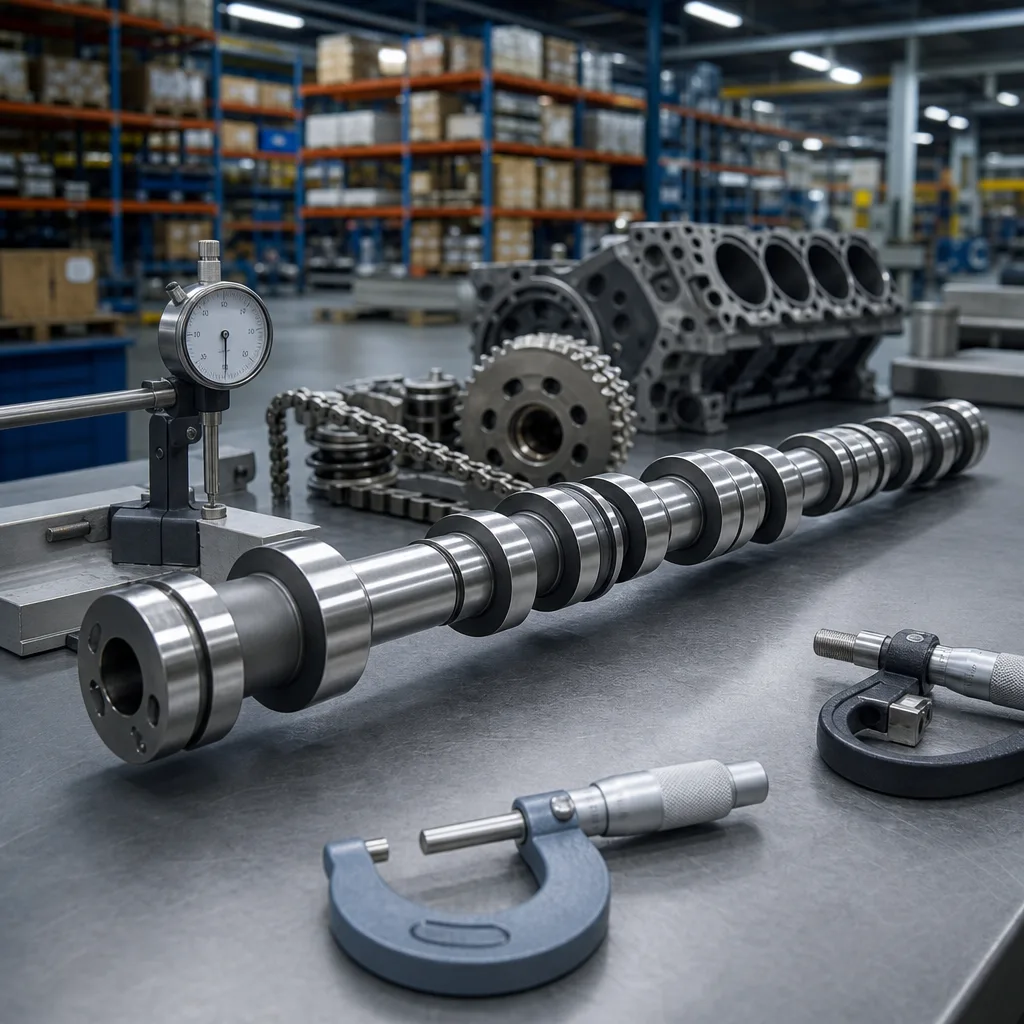
| Journal geometry | Diameter, roundness, cylindricity, straightness, and runout to the defined datum structure | Protects bearing life and oil-film stability |
| Thrust control | End-play target, thrust face width, shoulder location, and thrust face finish | Prevents axial movement, timing instability, and abnormal noise |
| Timing interface | Sprocket, gear, keyway, dowel, phaser/VVT interface, bolt pattern, or reluctor feature | Incorrect indexing can cause poor running, fault codes, or no-start conditions |
| Sensor reference | Cam-position trigger slots, teeth, flats, or reference surfaces | Supports ECU synchronization and diagnostic accuracy |
| Surface finish | Journal Ra, lobe Ra/Rz, edge break, and cleanliness after final grinding | Reduces scuffing during break-in and protects oil galleries |
| Installation hardware | Bolts, caps, seals, plugs, phaser fasteners, and related service parts | Prevents workshop delays and incorrect reuse of torque-to-yield hardware |
| Traceability | Heat number, batch record, inspection lot, and packing-list linkage | Supports inbound QC, warranty sorting, and repeat procurement |