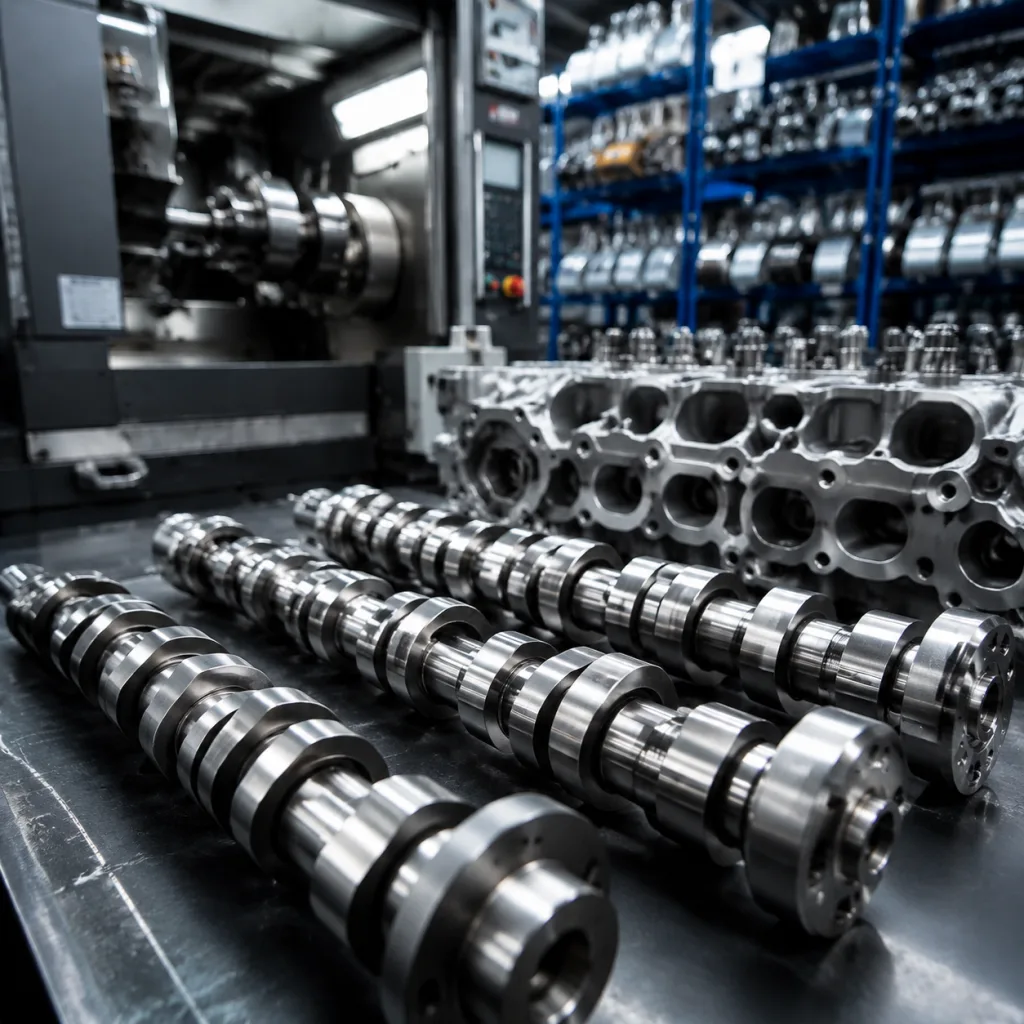
Finding the right **camshaft mitsubishi manufacturer china** source is usually less about chasing the lowest unit price and more about confirming process capability, metallurgy, fitment accuracy, and lot-level traceability. For Mitsubishi-fitment programmes, procurement teams need proof that a factory can repeatedly hold critical features such as journal diameter, lobe profile, phase angle, runout, and hardened-layer consistency across serial batches, not just on an initial pilot lot. They also need clear answers on MOQ, lead time, export packaging, PPAP-style documentation where required, and destination-market compliance.
That is why supplier evaluation should centre on measurable controls instead of brochure language. A factory may offer attractive pricing, but if it cannot demonstrate capability on hardness, lobe lift deviation, total indicated runout, or revision-controlled fitment data, the real sourcing risk remains high. This applies whether the buyer is an aftermarket distributor, an OEM or Tier-1 purchasing team, an engine rebuilder, or a repair-chain sourcing department.
This guide explains what to check when evaluating a camshaft mitsubishi manufacturer china partner for Mitsubishi-related applications, including blank-production route, machining capability, validation evidence, commercial terms, documentation, and audit priorities. Driventus is an independent aftermarket manufacturer; brand names are referenced for fitment only.
What procurement teams should verify first
When screening a camshaft source, the first goal is to understand how the supplier controls the part from raw material through to final packed shipment. For Mitsubishi-fitment aftermarket programmes, buyers usually need repeatability across multiple engine families and long reorder cycles, not just one acceptable sample lot. A supplier that performs well on first samples but cannot maintain the same geometry, hardness window, and surface condition in later batches can create far more cost than any small unit-price saving ever offsets.
Start by asking the factory to walk through its full manufacturing route step by step. Procurement and quality teams should be able to see where the blank comes from, how material is identified, how heat treatment is controlled, which operations are completed in-house, what is subcontracted, and what release criteria apply before packing. If the explanation is vague, inconsistent, or changes between meetings, that is already a warning sign.
Key items to verify:
Certification scope: Ask for current certificates to IATF 16949:2016 and ISO 9001:2015, and confirm that the scope actually covers automotive engine, valvetrain, or precision-machined powertrain components rather than unrelated metalworking categories.
Material declaration: Confirm the base material grade, such as alloy chilled cast iron or forged alloy steel where applicable, and whether the supplier can issue chemistry reports traceable to heat number, furnace batch, or foundry lot.
Heat treatment control: Review the target hardness range, hardening method, effective case depth or hardened-layer depth where relevant, quench and temper parameters, and the containment procedure for suspect lots.
Dimensional capability: Check documented tolerances for journal diameter, lobe lift, base-circle diameter, runout, straightness, phase angle, and surface finish rather than accepting broad claims like “OE quality.”
Traceability: Each production lot should be traceable to raw material source, blank batch, heat-treatment batch, grinding batch, inspection record, packing date, and ideally machine or operator record for critical operations.
Fitment reference management: Cross-references should be controlled under internal part numbers with revision history, especially when customer labels, neutral labels, or export cartons display OE-style references.
Procurement teams should also confirm who owns the master technical data. In practice, many field issues come not from grinding error but from reference confusion: the wrong engine code, incorrect trigger-feature orientation, wrong end-feature geometry, or an aftermarket cross-reference copied from an uncontrolled catalogue source. A capable supplier should be able to show how it approves a new Mitsubishi-fitment reference, what master documents are retained, and how obsolete revisions are blocked from release.
If you are comparing several suppliers, ask each one for the same document pack and technical response template. A standardised comparison sheet makes it easier to assess a camshaft mitsubishi manufacturer china candidate on evidence rather than presentation quality alone.
Camshaft manufacturing routes and why they affect supply risk
Camshaft durability and dimensional stability depend heavily on how the blank is produced and how the lobes and journals are finished. Two suppliers may quote to the same drawing or sample yet deliver very different wear resistance, fatigue behaviour, lead-time stability, and batch-to-batch consistency. That is why buyers should not treat a camshaft as a simple finished item; the production route itself is a core sourcing variable.
The first distinction is usually between cast blanks and forged blanks. Cast camshafts are common in many aftermarket and OE-service applications, especially where chilled-cast lobe surfaces or induction-hardened areas are specified. They can be cost-efficient at scale, but they also demand disciplined control of melt chemistry, inoculation, solidification, and hardness distribution. Forged steel routes may be chosen for applications requiring higher core strength, a different hardening response, or a specific design architecture. The key point is not to assume one route is automatically better, but to confirm that the selected route fits the application and is controlled consistently.
The finishing route matters just as much. Cam lobes and bearing journals are functional surfaces, so profile grinding accuracy directly affects valve timing, lift repeatability, oil-film behaviour, and wear. Suppliers with CNC cam grinding, controlled wheel dressing, and profile-measurement capability generally offer better repeatability than those relying heavily on manual setup correction. Post-heat-treatment straightening, final lobe and profile verification, and journal finish control all influence assembly performance and service life.
Manufacturing factor
What to check
Why it matters to buyers
Blank type
Cast blank or forged blank
Affects mechanical properties, hardening route, and cost structure
Raw material source
Approved foundry or steel mill with heat traceability
Determines chemistry consistency and recall capability
Lobe/journal hardening
Induction hardening, chill casting, nitriding, or other defined process
Directly influences wear resistance and hardness variation
100% critical checks or statistically validated sampling plan
Determines outgoing quality confidence
</tr></thead><tbody> </tbody></table>### Typical control points
A credible supplier should be able to state not just general capability but actual target values or internal control limits for:
Journal diameter tolerance, often in the low-micron range depending on design and bearing requirement
Total indicated runout after final grind
Lobe profile accuracy and lift deviation versus approved master data
Phase angle accuracy between intake and exhaust lobes or indexed features
Base-circle consistency
Hardness range after heat treatment or hardening
Effective hardened depth or case depth where applicable
Surface roughness on bearing journals and lobe flanks
Straightness after final grinding and cleaning
Buyers should also ask which operations are completed in-house and which are subcontracted. A factory may present itself as a manufacturer, but if hardening, finish grinding, or metrology is outsourced without controlled supplier approval, batch traceability, and incoming reinspection, the supply risk increases. Subcontracting is not automatically negative, but it should be managed through approved vendor lists, audit records, lot traceability, and documented accountability.
For export programmes, packaging control is part of the manufacturing risk assessment. Camshafts shipped by sea can be exposed to salt air, condensation, and transit times of 30–60 days, so corrosion protection should be specified and repeatable. VCI bagging, rust-preventive oil, desiccant use, carton compression strength, pallet wrapping, and label durability should all be reviewed, especially for programmes shipping to the EU, UK, Canada, Australia, the Middle East, or South America. A strong camshaft mitsubishi manufacturer china partner should treat packaging as a controlled quality step, not a warehouse afterthought.
MOQ, lead time, and audit questions for China sourcing
Commercial terms only make sense when they line up with the technical route and real factory capacity. A low MOQ may help with market testing or initial validation, but small batches often carry a higher unit cost when dedicated masters, checking fixtures, private-label cartons, or setup-intensive grinding programmes are involved. Buyers should therefore assess MOQ and lead time in context rather than as stand-alone pricing points.
MOQ should be clarified at three levels: by part number, by packaging format, and by order combination. Some suppliers can support lower trial quantities for existing running references but impose higher minimums for new Mitsubishi-fitment items, custom laser marking, or customer-specific corrosion-prevention packs. Others may allow mixed orders across camshafts, rocker arms, tappets, or related engine components to reach an economic production batch or export threshold. That matters for distributors building a broader engine-components basket rather than buying a single camshaft SKU.
Lead time also needs to be broken into stages. Sample preparation is not the same as first production, and first production is not the same as repeat replenishment. A realistic quotation should define:
Technical review and cross-reference confirmation time
Sample production or sample dispatch timing
Time required for buyer approval or validation
First mass-production lead time
Repeat-order lead time under normal scheduling
Contingency for blank shortages, Chinese holiday closures, or subcontract bottlenecks
Typical sourcing questions include:
What is the MOQ by part number for standard aftermarket supply?
Is there a different MOQ for private label, custom laser marking, or customer-specific export cartons?
What is the lead time for first order versus repeat order?
Are safety-stock arrangements or forecast-based stocking programmes available for high-runner references?
Can the factory support mixed-container shipments across camshafts and adjacent engine components?
What is the policy for engineering change notification, drawing revision control, and supersession of older fitment data?
How are delayed subcontract processes such as heat treatment, nitriding, or coating communicated to customers?
What Incoterms are standard, and who manages export documentation, trucking, and booking coordination?
For factory audits, buyers should look beyond the sales presentation and review objective operating evidence from the shop floor and quality office. Key audit points include:
1. Incoming material inspection records and supplier approval status 2. Calibration status of cam grinders, micrometers, roundness gauges, hardness testers, and profile-measurement equipment 3. SPC or equivalent monitoring on critical dimensions such as journal diameter, runout, and lobe height 4. First-off, in-process, and final inspection discipline 5. Non-conformance containment, segregation, and corrective-action workflow 6. Finished-goods traceability by inner pack, carton, and pallet label 7. FIFO control for packed stock and rust-protection shelf-life management 8. Sub-supplier control for heat treatment or blank production if not done in-house
A supplier with a documented quality system should be able to show control plans, inspection standards, calibration logs, gauge R&R evidence where required, retained samples where relevant, and proof that corrective actions are verified after closure. If the programme requires tailored timing profiles, package design, customer branding, or specific shipping labels, ask early about custom manufacturing support. That alignment reduces the risk of late commercial changes after technical approval.
For anyone sourcing from a camshaft mitsubishi manufacturer china base, the best approach is to tie commercial negotiation to a clear audit checklist. That way, MOQ and lead-time promises are backed by real process capacity rather than optimistic quoting.
Documents and compliance data buyers commonly request
Camshafts are mechanical components, but international sourcing still depends on disciplined documentation. The exact document pack varies by customer channel, destination market, product-liability expectations, and whether the supply is for conventional aftermarket, OE service, reman support, or a fleet-maintenance programme. Buyers should define document requirements early so the supplier can build them into batch control and export preparation.
At minimum, commercial and shipping paperwork must match the physical goods exactly. Errors in part description, country of origin, carton quantity, or label references can delay customs clearance or disrupt warehouse receiving. For higher-control customers, technical documents matter just as much because they provide objective evidence that the shipped lot conforms to the approved specification.
Common request list:
Commercial invoice and packing list
Certificate of origin where applicable
Material certificate by batch, heat number, or foundry lot
Dimensional inspection report for critical features
Hardness report
Heat-treatment record or summary, if required by the customer
Corrosion-protection verification for packaging, if specified
REACH declaration referencing REACH (EC) No 1907/2006
Substance compliance statement aligned with customer restricted-substance requirements
Product liability and recall contact procedure
Pallet and carton label format approval for warehouse integration
In some markets, buyers also request tariff-classification support, export-carton marking standards, and packaging-material compliance. If wood packaging is used, the supplier should confirm ISPM 15 treatment where applicable. These details may seem minor, but they often affect customs efficiency and receiving performance more than the component itself.
Where customers require stronger launch control, the supplier may be asked for selected PPAP-style documents such as:
Process flow chart
PFMEA summary
Control plan
Measurement system evidence for key gauges
Initial sample inspection report
Capability evidence on critical dimensions
Approved sample retention record
This level of discipline is more common for OEM service, remanufacturing support, specialist fleet programmes, and high-accountability private-label projects than for general wholesale aftermarket supply. Even so, a reliable camshaft mitsubishi manufacturer china supplier should be ready to provide at least a simplified version of these controls on request.
If you are building a broader engine-components sourcing basket, it can also be useful to review our catalog and, where relevant, the engine range under /products/engine-components.html. Consolidating documentation expectations across several related products often improves supplier coordination and reduces administrative friction.
How to assess fitment accuracy without relying on claims
Fitment claims should never be accepted on marketing language alone. For Mitsubishi-related applications, geometry differences between engine codes, production revisions, trigger features, dowel or key indexing, and market variants can be significant. A dependable supplier should validate each reference against controlled data such as an approved drawing, OE sample, customer master, or validated reverse-engineering record. Without that discipline, the risk of mixing similar-looking but incompatible camshafts is high.
The practical question for buyers is simple: how does the supplier know the part is correct? A strong answer should include controlled measurement methods, revision-controlled part approval, and retained validation records. It should not rely on generic statements such as “matches OE” or broad vehicle compatibility lists copied from public catalogue databases.
A practical evaluation checklist includes:
Base-circle diameter and lobe geometry measured on calibrated equipment
Journal alignment and runout checked after final grinding
Lobe phase angle verified against approved reference data
Keyway, dowel, or trigger-feature position confirmed where applicable
Overall length and end-feature dimensions checked to drawing or master sample
Oil-hole or oil-passage cleanliness inspected before packing
Hardness consistency checked per batch or defined control frequency
Trial assembly feedback recorded for new or revised references
Revision history maintained for any dimensional or fitment updates
Buyers should also request examples of how a new part number is approved internally. For example, does the supplier issue an internal inspection report tied to a master sample? Are photos of key identification features archived? Are packaging labels locked to an approved internal part code? These controls matter because many fitment failures start in data handling rather than pure machining error.
When OE-style cross-references are used, they should be listed in a neutral and controlled format such as OE XXXXXXXX only where applicable to the buyer’s validated reference set. Cross-reference management is useful for sourcing communication, but it should never replace dimensional verification, profile measurement, or sample approval.
It is also important to confirm that the supplier does not publish broad compatibility claims without revision control. Mitsubishi-related applications often differ by engine code, timing arrangement, production-year split, emissions-market variation, or associated sensor or trigger configuration. A reliable factory will usually ask for the exact part number, engine code, technical drawing, or physical sample before confirming production. That caution is typically a positive sign, not a weakness.
In short, when evaluating a camshaft mitsubishi manufacturer china supplier, the best indicator of fitment reliability is not how many applications the factory claims to cover, but how rigorously it validates each reference.
When Driventus is a practical sourcing option
Driventus supports B2B buyers sourcing engine and powertrain components for export programmes that require stable documentation, lot traceability, and repeatable production control. For customers evaluating a camshaft mitsubishi manufacturer china option, we are typically considered when the sourcing requirement goes beyond unit price and includes structured technical review, controlled packaging, and dependable communication across both development and repeat-order stages.
Buyers usually engage us for three main reasons:
Multi-part sourcing across engine-component categories
Need for documented production under IATF 16949:2016 and ISO 9001:2015
Requirement for private label, specification review, or controlled export packaging
In practical sourcing terms, that means the conversation usually starts with a technical-commercial review rather than a price-only request. We recommend confirming annual volume, target Mitsubishi-fitment applications, sample or drawing availability, labelling requirements, destination market, and expected documentation level before quotation finalisation. That information helps define MOQ, inspection level, preservation method, and shipment planning up front.
For distributors and importers, Driventus can also be a practical option when freight efficiency matters. Combining camshaft enquiries with adjacent engine components can improve container utilisation, simplify supplier rationalisation, and reduce the management burden of dealing with multiple factories for related items. That is often valuable for customers building a broader engine programme rather than placing a single-reference purchase order.
Where programmes involve private label, customer-specific cartons, or destination-market packaging controls, early alignment is especially important. Export packing, pallet format, barcode labels, anti-rust method, and pack count should be agreed before production planning begins, not after finished stock is ready. This is one reason many buyers prefer a supplier that can coordinate both technical and commercial execution under one documented process.
Driventus is an independent aftermarket manufacturer; brand names are referenced for fitment only. To discuss a current RFQ, sample review, sourcing audit, or ongoing camshaft mitsubishi manufacturer china requirement, use request a quote.
Frequently asked questions
MOQ depends on whether the reference is a standard running item, a private-label programme, or a customer-specific configuration. Established aftermarket references may support lower trial quantities, while new fitment validation, dedicated packaging, or custom marking usually increases the minimum. Buyers should confirm MOQ by part number, by pack format, and by combined-order options across related engine components.
Repeat-order lead time depends on blank availability, grinding capacity, hardening schedule, final inspection, and export packing. Buyers should request separate timings for sample approval, first production, and repeat production under normal forecast conditions. For high-runner references, safety stock or forecast-based planning can reduce replenishment time and improve continuity.
For most B2B programmes, the main baseline is **IATF 16949:2016** or **ISO 9001:2015**, supported by lot traceability, calibration records, and actual inspection evidence. However, certification alone is not enough. Buyers should also review process controls, subcontractor management, corrective-action discipline, and the supplier’s ability to validate Mitsubishi-fitment data under revision control.
If you are reviewing camshaft supply options for Mitsubishi-fitment programmes, send your RFQ, annual volume, or sample details to Driventus for a technical review. Contact our team here: /contact.html