Camshaft Mini Aftermarket Replacement: Sourcing Guide
A camshaft mini aftermarket replacement must match the original profile, journal geometry, and timing specification closely enough to preserve valve events and engine stability. For procurement teams, the main risks are dimensional drift, surface finish variation, and inconsistent heat treatment. Those issues can show up as noisy valvetrain operation, misfire under load, or premature wear in the journals and lobes. Driventus supplies camshafts for aftermarket and B2B replacement programmes with documented inspection, material traceability, and validation against supplied samples or OE references. Driventus is an independent aftermarket manufacturer; brand names are referenced for fitment only. If you are sourcing for distributors, repair networks, or engine rebuilders, the decision should be based on measurable equivalence, not packaging claims. This article sets out the key checks to use when evaluating a replacement camshaft, including fitment data, inspection points, and compliance documents.
What a mini replacement camshaft must match
For a camshaft mini aftermarket replacement, the critical requirement is dimensional match to the intended engine variant. Buyers should verify the following before approving a part:
Journal diameter and concentricity
Overall length and thrust face width
Lobe lift, base circle, and lobe separation
Timing index position relative to the drive end
Surface hardness and case depth
Fillet radii and chamfer quality
A part can look correct externally and still fail during installation if the timing phasing or bearing journal tolerances are outside specification. For replacement programmes, the target is OE-equivalent function, not visual similarity. If you also source related engine parts, see our catalog and the engine range in engine components.
Material, heat treatment, and wear performance
Most replacement camshafts use alloy steel or cast iron blanks, depending on engine design and production volume. The buyer should confirm the material route before ordering, because grindability, lobe wear resistance, and cost differ by construction.
Item
What to verify
Why it matters
Base material
Alloy steel or cast iron
Affects fatigue strength and machining route
Surface hardness
Measured and documented
Controls lobe and journal wear
Case depth
If induction hardened or carburised
Protects the working surface
Runout
Measured on key journals
Affects valve timing stability
Surface roughness
Reported on critical faces
Reduces break-in risk
</tr></thead><tbody> </tbody></table>Driventus can validate hardness, runout, and lobe geometry against sample parts or customer drawings. For custom variants, our custom manufacturing service supports private-label or programme-specific requirements.
Validation checks before purchase order release
Replacement procurement should include a technical approval step before mass order release. The minimum checks are straightforward:
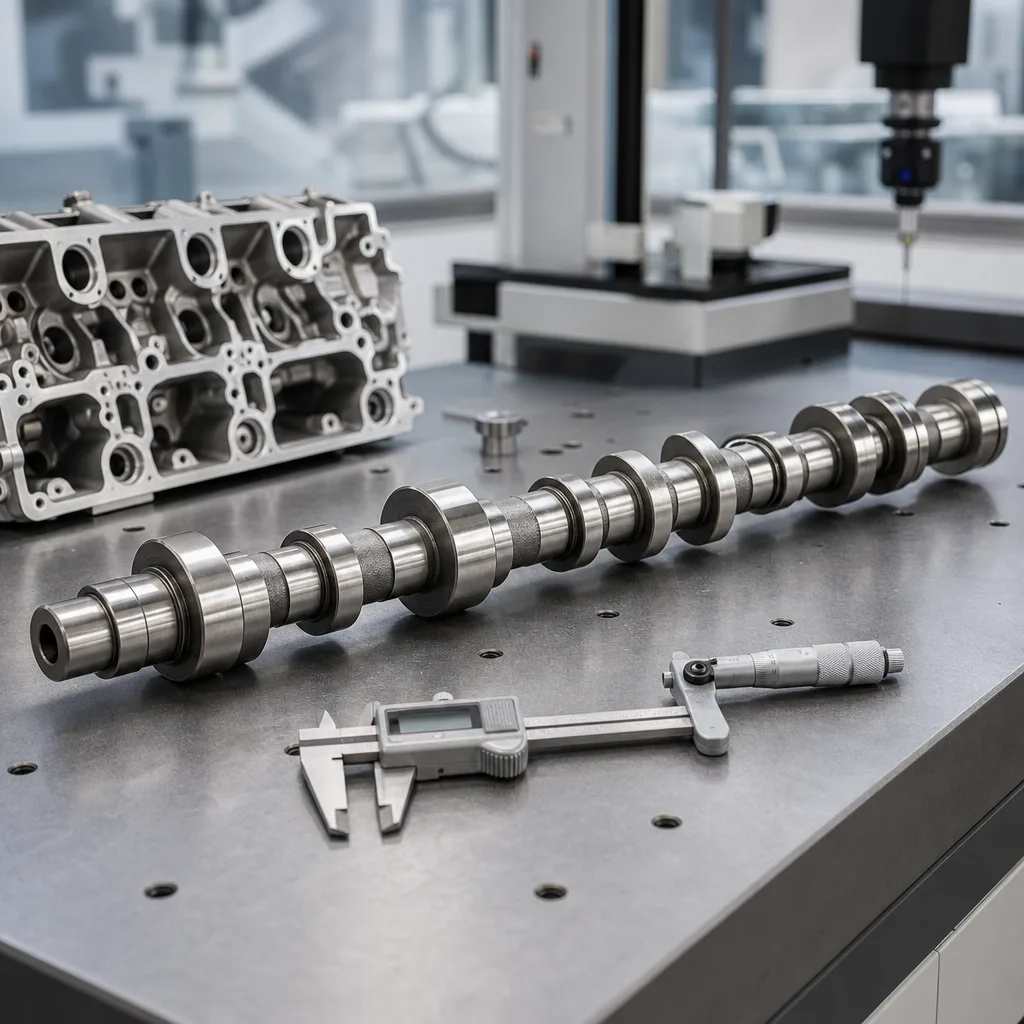
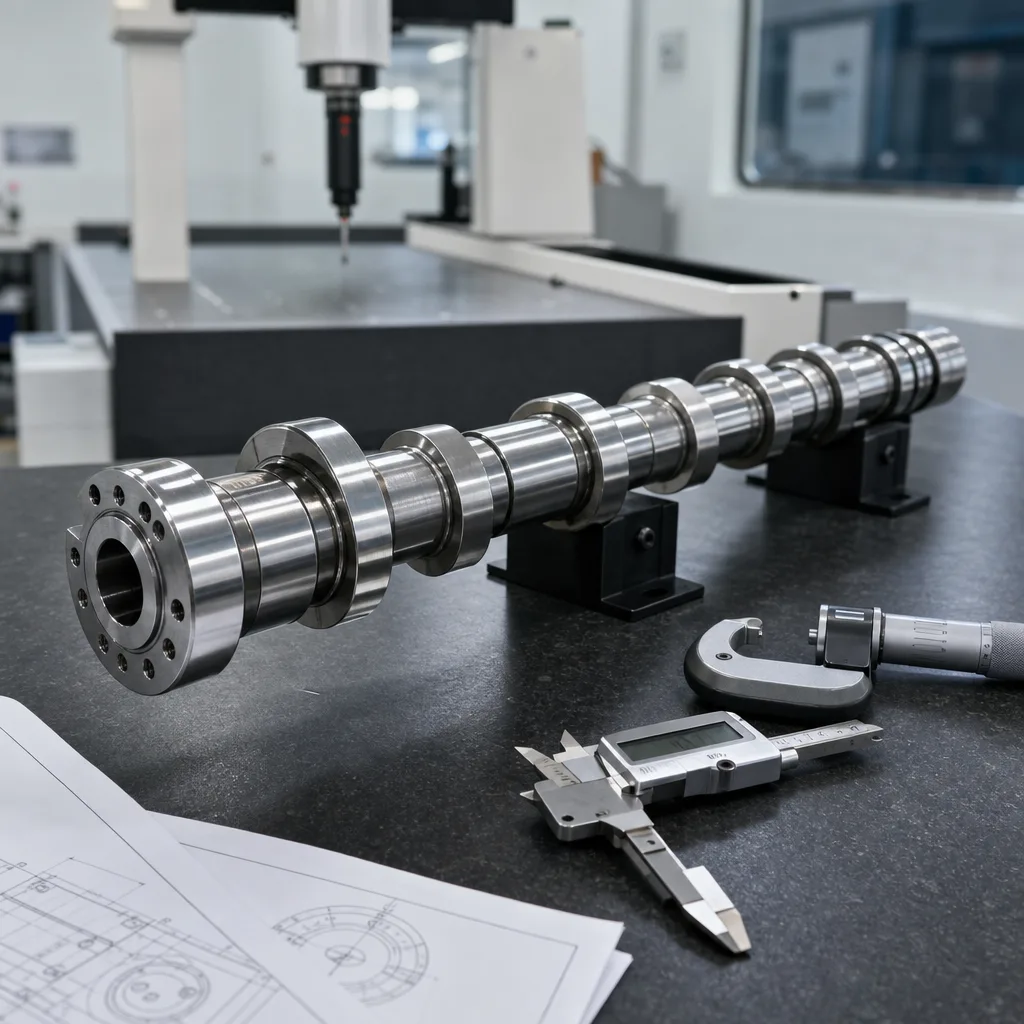
1. Confirm engine code, displacement, and application year range. 2. Match the part against OE reference data or a retained sample. 3. Check key dimensions with a CMM, micrometer, and V-block runout setup. 4. Review heat-treatment records and hardness test results. 5. Confirm packaging, corrosion protection, and label traceability.
If the supplier cannot provide dimensional reports, the risk shifts to your warehouse and workshop network. That is usually more expensive than a controlled validation batch. Buyers should also request confirmation of compliance with IATF 16949:2016 and ISO 9001:2015 for production control, plus REACH (EC) No 1907/2006 where material declarations are required in the destination market.
Fitment risks that cause returns
The most common return reasons are not catastrophic defects. They are small mismatches that appear only during assembly or initial run-in.
Typical return drivers
Incorrect timing index position
Excess journal clearance
Lobe profile not matching the intended engine family
Burrs or poor surface finish on oil-contact areas
Incomplete part numbering or label mismatch
Missing preservation oil or inadequate rust protection
These problems increase installation time and damage distributor confidence. A controlled replacement programme should include sample fitment on the exact engine code, plus visual inspection after first start-up. If the replacement is used in regions with emissions testing, note that engine timing stability can affect compliance with local inspection rules such as ECE R-83 where applicable to the vehicle platform.
How Driventus supports procurement teams
Driventus supplies camshafts as part of a controlled aftermarket programme from Taizhou, Zhejiang, with export experience across 60+ countries. Our process is built for procurement review, not consumer retail.
Incoming raw material verification
In-process dimensional checks on journals and lobes
Final inspection on runout, profile, and finish
Batch traceability and packing control
Document support for quality and export review
You can review our quality system for certification scope and production controls. For quotation work, use request a quote and share the engine code, target market, annual volume, and any OE 06A… or 11251… cross-reference already in your internal records. We do not claim OEM approval or endorsement; fitment references are used only to identify application compatibility.
Procurement checklist for repeatable replacement supply
Before placing repeat orders, buyers should lock the technical and commercial definition of the part.
Engine family and exact application window
Accepted dimensional tolerance band
Required hardness range and test method
Packaging and corrosion-prevention standard
Label content, batch code, and traceability format
First-article approval requirement
Sample retention policy for disputes
A stable camshaft programme depends on the same part being reproduced the same way across batches. That is where documented controls matter more than catalog descriptions. If your team manages multiple warehouses or service networks, a formal replacement specification reduces returns and prevents cross-shipment errors.
Frequently asked questions
Only if the engine family, timing index, journal sizes, and lobe profile are confirmed as equivalent. Small differences can change valve timing and bearing wear.
Ask for dimensional inspection data, hardness results, material traceability, batch coding, and confirmation of IATF 16949:2016 and ISO 9001:2015 production control.
No. Driventus is an independent aftermarket manufacturer; brand names are referenced for fitment only. Compatibility should be verified against the application data you supply.
If you need a verified replacement programme with dimensional control and export-ready documentation, send your application details and target volume through our contact page: /contact.html