A BMW camshaft replacement is usually a dimensional and functional sourcing task, not just a parts lookup. For procurement teams, the main risk is ordering a shaft that fits the engine family but misses the profile, timing, surface finish, or trigger geometry required for stable operation. That leads to extended validation, avoidable returns, and installation delays. This guide focuses on replacement-grade sourcing for distributors, repair chains, and import managers who need OE-equivalent fitment and repeatable supply. Driventus is an independent aftermarket manufacturer; brand names are referenced for fitment only. We manufacture engine and powertrain parts in Taizhou, Zhejiang, under IATF 16949:2016 and ISO 9001:2015 systems, with export supply to 60+ countries. The same approach used for other precision components applies here: verify OE cross-reference, check critical dimensions, confirm heat treatment and surface finish, and request test data before purchase.
What replacement buyers need to verify first
For a BMW camshaft replacement, fitment starts with the engine code and OE reference, not the model badge. The same chassis can use different cam profiles, sensor trigger layouts, and cam lobe timing depending on displacement, valve train type, and production date.
Minimum checks before ordering:
Engine family and displacement
Intake, exhaust, or paired set requirement
OE cross-reference number, for example OE 11B... or OE 11... where supplied by the buyer
Cam sensor and trigger wheel configuration
Bearing journal count and journal diameter
VVT or non-VVT application
Valve lift, base circle, and duration where available
If the buyer cannot provide an OE number, a reliable supplier should confirm the application using the engine code, photos, measured dimensions, and existing part markings. For catalog browsing, see our catalog and the engine range in engine components.
OE-equivalence depends on measurable dimensions
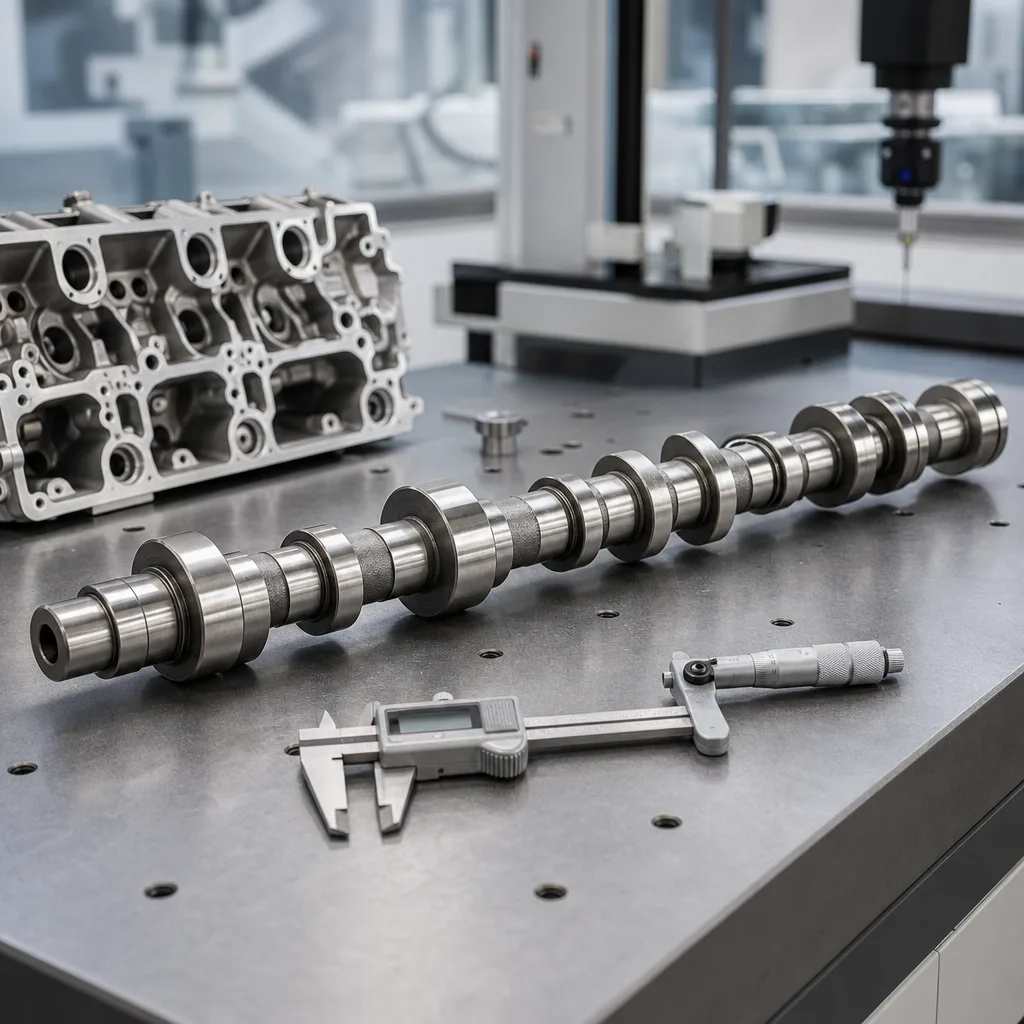
A replacement camshaft should match the original part in all functional dimensions. A small deviation can change timing, idle quality, emissions, and wear patterns.
Check point
What to verify
Why it matters
Journal diameter
Measure each bearing seat
Prevents oil film loss and seizure
Overall length
Compare against OE sample
Avoids end-float and installation issues
Lobe lift and profile
Check against OE data or master sample
Maintains valve timing and airflow
Trigger geometry
Tooth count, angle, and index position
Ensures correct sensor signal
Surface hardness
Confirm heat treatment report
Reduces scuffing and premature wear
Runout
Measure on V-blocks or equivalent fixture
Protects valve train stability
</tr></thead><tbody> </tbody></table>For replacement programmes, we recommend dimensional inspection against a retained OE sample or a verified drawing. Buyers who need mixed-model coverage often use the same process across their catalog, with shared inspection methods and incoming QC records.
Materials, heat treatment, and surface finish
Camshafts can be made by cast, forged, or machined processes depending on the engine family and duty cycle. The procurement question is not only material type, but whether the finished part holds hardness, wear resistance, and geometry over service life.
Replacement-grade supply should specify:
Base material and manufacturing route
Hardened lobe and journal surfaces where applicable
Case depth or hardness range from the test report
Anti-corrosion protection for storage and transit
Packaging that prevents nicks on lobes and journals
A good supplier should be able to provide traceability to batch, furnace lot, or production lot under a controlled quality system. Driventus operates under IATF 16949:2016 and ISO 9001:2015, and can support custom manufacturing when a buyer needs a non-catalog profile, special packaging, or application-specific marking.
Validation testing before bulk purchase
For bulk replacement programmes, sample validation is essential. The goal is to reduce installation risk before container or pallet release.
Recommended validation set:
Dimensional inspection against OE sample
Visual inspection for casting marks, burrs, or machining defects
Hardness verification on lobe and journal surfaces
Runout and straightness checks
Surface roughness review where specified
Fitment trial on a controlled engine sample
If the application is emission-sensitive, request documentation aligned to the relevant market requirements, such as REACH (EC) No 1907/2006 for chemical compliance in the EU, and any regional requirements tied to the engine system. For road-use verification, many buyers also reference ECE R-83 or SAE J2527 when discussing durability or emissions-related validation, depending on the programme. The exact test plan should match the buyer’s market and application.
How to reduce sourcing risk on BMW applications
Replacement sourcing fails most often when buyers rely on partial data. A model name alone is not enough. The safer process is to build a verified part record and reuse it across locations and suppliers.
Practical sourcing controls: 1. Lock the OE cross-reference and engine code. 2. Save photographs of the old camshaft, including end faces and trigger features. 3. Record measured dimensions from a retained sample. 4. Require PPAP-style evidence or equivalent inspection records for repeat orders. 5. Confirm carton labelling, preservation oil, and transit packaging. 6. Recheck the first production batch on arrival.
For multi-location repair chains and importers, this reduces returns and avoids mixed-stock errors. If a buyer needs a special profile, special packaging, or private-label programme, our custom manufacturing team can support controlled revisions without changing the declared application.
When to choose a direct replacement versus a redesigned part
Most buyers should specify a direct replacement when the goal is fast service restoration and minimal validation time. A redesigned camshaft is only suitable when the buyer is intentionally changing performance characteristics, emissions strategy, or durability targets.
Direct replacement is the better choice when:
The vehicle is in standard service use
The buyer wants OE-equivalent installation and timing behaviour
The repair chain needs predictable labour time
The distributor wants low return risk
A redesigned part may be considered when:
The application is outside the original specification
The buyer has written engineering approval for a revised profile
The customer accepts new validation work
For standard replacement supply, Driventus focuses on dimensional match, controlled process documentation, and repeatable inspection. To review available engine parts, visit our catalog.
Frequently asked questions
Use the engine code, OE cross-reference, and a measured sample if possible. Model name alone is not reliable because the same vehicle may use different cam profiles across production dates.
Ask for dimensional inspection data, material or heat-treatment evidence, batch traceability, and packaging details. For regulated markets, request any relevant compliance declarations such as REACH (EC) No 1907/2006.
Yes. Through our custom manufacturing capability, we can support application-specific profiles, marking, or packaging when the buyer provides technical requirements and validation targets.
If you need OE-match sourcing, sample validation, or a supply quote for a replacement programme, please [request a quote](/contact.html).