Camshaft for Mercedes-Benz S-Class Replacement: OE Match Guide
A camshaft replacement for Mercedes-Benz S-Class applications must match the original valve timing profile, journal geometry, and surface finish closely enough to preserve idle quality, torque delivery, and emissions performance. For procurement teams, the main issue is not just fitment. It is whether the replacement part can hold dimensional stability across batches, meet the correct hardness and runout targets, and pass validation testing before release to the market. Driventus supplies engine components for B2B buyers who need OE-equivalent parts for the aftermarket. Driventus is an independent aftermarket manufacturer; brand names are referenced for fitment only. For S-Class programmes, buyers typically cross-check engine code, OE reference, and production range before placing orders. That process is especially important where one model line uses multiple camshaft profiles, phasing systems, or cylinder head revisions. The sections below explain what to verify, what specifications matter, and how to reduce returns when sourcing replacement camshafts.
What matters in a replacement camshaft
A replacement camshaft must reproduce the functional geometry of the original part. For S-Class applications, that usually means matching:
Base circle and lobe lift
Lobe separation and timing events
Journal diameter and bearing spacing
Overall length, drive-end features, and thrust surfaces
Surface hardness and wear resistance
If the camshaft profile is wrong by even a small amount, the engine may show rough idle, reduced vacuum, misfire codes, or valve train noise. For procurement, the question is whether the supplier can control these variables consistently. Driventus uses production controls aligned with IATF 16949:2016 and ISO 9001:2015. That matters because camshafts are not simple turned parts; they are functional components that depend on machining accuracy, heat treatment, and final inspection.
When a customer sends an OE number, we verify the application against engine family, valve train layout, and model year before supplying a replacement.
OE-equivalence checks buyers should request
Before purchasing a camshaft for Mercedes-Benz S-Class replacement, buyers should ask for the same data they would use in a controlled sourcing file. The minimum checklist is below.
Check point
What to verify
Why it matters
OE cross-reference
OE 06A107065 or other application-specific reference
Prevents incorrect fitment
Dimensional report
Journal diameters, lobe lift, overall length
Confirms physical interchangeability
Runout
Measured at defined support points
Protects bearing life and oil film stability
Hardness
Surface and core hardness after heat treatment
Controls wear and lobe durability
Material traceability
Heat number, batch record
Supports warranty and recall control
Packaging
Corrosion prevention, part labelling
Reduces transit damage
</tr></thead><tbody> </tbody></table>For European-bound aftermarket supply, material declarations should also align with REACH (EC) No 1907/2006 where applicable. If the target programme is export-sensitive, ask for inspection records, not just a fitment statement. A supplier can claim compatibility; procurement should require evidence.
How Driventus validates camshaft production
Camshaft manufacturing requires controlled machining and inspection after heat treatment. Driventus validates parts with process checks that focus on repeatability, not sample approval only. Typical controls include:
Incoming material verification
CNC profile machining checks
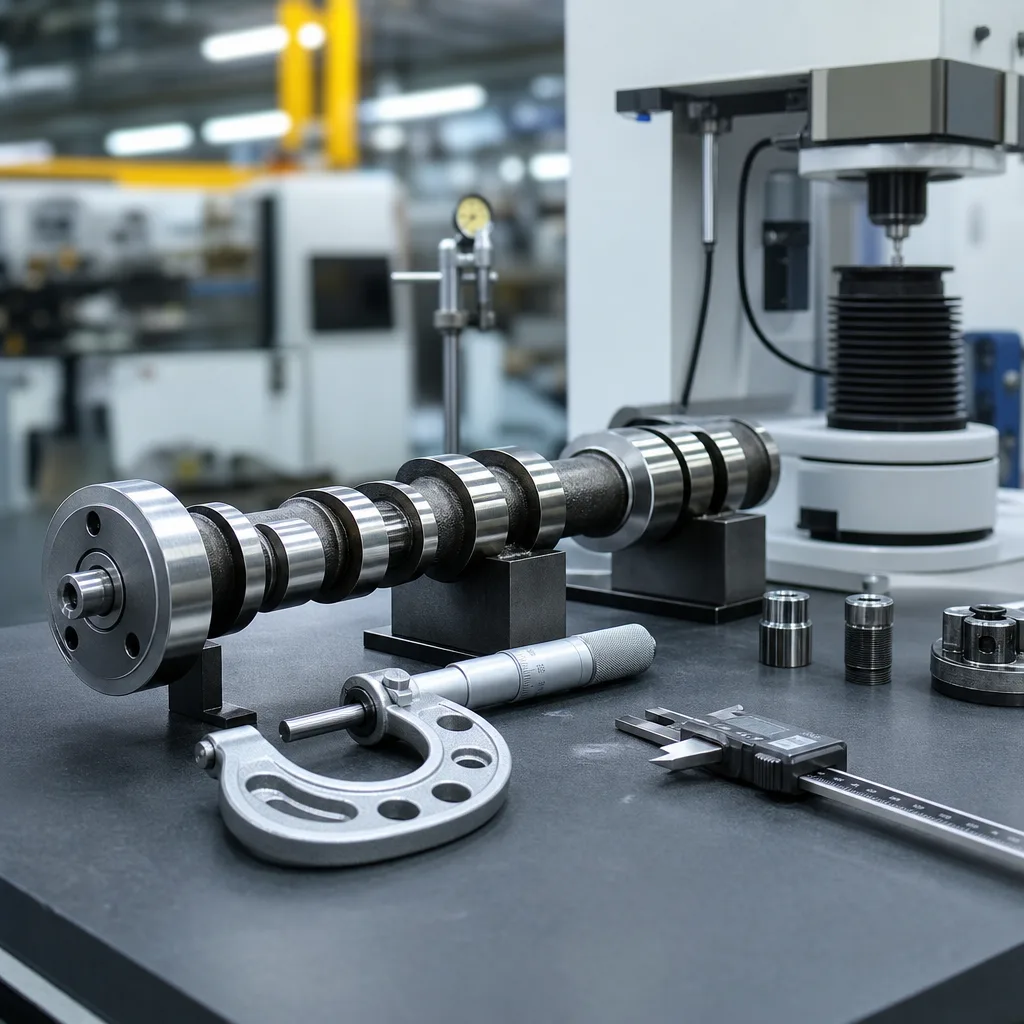
Journal and lobe measurement on dedicated gauges and CMM inspection
Post-heat-treatment hardness testing
Final runout and concentricity inspection
Visual check for nicks, burrs, and oxidation
For buyers, the important point is that the part must remain stable from lot to lot. A single acceptable sample is not sufficient for a programme that ships to multiple warehouses or repair networks. We also support documentation requests for private-label or engineered-fit programmes through custom manufacturing.
If your team manages a broader powertrain range, our our catalog can be used to compare camshafts with gaskets, water pumps, and other engine parts in one sourcing cycle.
Common S-Class sourcing errors and how to avoid them
Replacement projects often fail because the buyer matches only the model name. The Mercedes-Benz S-Class has multiple engine variants, facelift changes, and cylinder head revisions. The most common errors are:
1. Matching by vehicle model only, without engine code. 2. Ignoring whether the engine uses variable valve timing or phased cam operation. 3. Overlooking single- and dual-camshaft layouts. 4. Ordering without confirming OE number revision. 5. Accepting parts without dimensional inspection data.
A correct sourcing process starts with the engine designation, then checks the OE reference and production date range. If the application uses OE 06A107065 or a similar cross-reference pattern, confirm the exact engine family before release. This is especially important for importers supplying mixed-fitment inventories across the EU, UK, US, Canada, Australia, or Brazil.
Driventus is an independent aftermarket manufacturer; brand names are referenced for fitment only.
Specifications procurement teams should request
For a camshaft programme, the purchase order should define the inspection and quality package, not just the part number. Recommended specification fields include:
Material grade and heat-treatment condition
Lobe lift, base circle, and timing datum
Journal tolerance and bearing surface finish
Total indicated runout limit
Packaging standard and corrosion protection
Test report format and lot traceability
Where the application is emission-sensitive, buyers may also request validation aligned to relevant vehicle or durability expectations, such as ECE R-83 where applicable to the platform context. For aftermarket durability screening, some teams specify environmental exposure tests such as SAE J2527 for related component validation programmes, especially when comparing coatings or corrosion resistance requirements.
If you need a non-catalogued variant, Driventus can review drawings and production samples through custom manufacturing. For standard replacement demand, request a quote with the OE number, engine code, annual volume, and target market.
Why B2B buyers choose an OE-matched replacement strategy
A replacement strategy based on OE equivalence reduces returns, reduces workshop downtime, and simplifies warehouse planning. For distributors and repair chains, it also makes cross-border sales easier because the application logic is tied to the original reference, not a marketing description.
Benefits for procurement include:
Lower risk of wrong-application claims
Easier catalogue indexing by OE and engine code
More stable warranty control
Faster technician acceptance at point of installation
Cleaner comparison between supplier batches
For companies sourcing a broader engine programme, our catalog and the engine family overview at engine components can support bundled purchasing. The matching quality system page explains how Driventus structures inspection, traceability, and corrective action handling for export customers.
Frequently asked questions
Use the engine code, OE reference, production range, and valve train layout. Do not rely on model name alone. Ask for dimensional data and inspection records before purchase.
Yes. We supply OE-equivalent aftermarket camshafts with dimensional checks, traceability, and production controls aligned to IATF 16949:2016 and ISO 9001:2015.
Yes. If your programme needs a special finish, packaging, or a controlled variant, we can review it through our custom manufacturing process and quotation workflow.
If you need a camshaft replacement quotation, send the OE number, engine code, and target annual volume, and we will review the fitment data with you. Start here: /contact.html