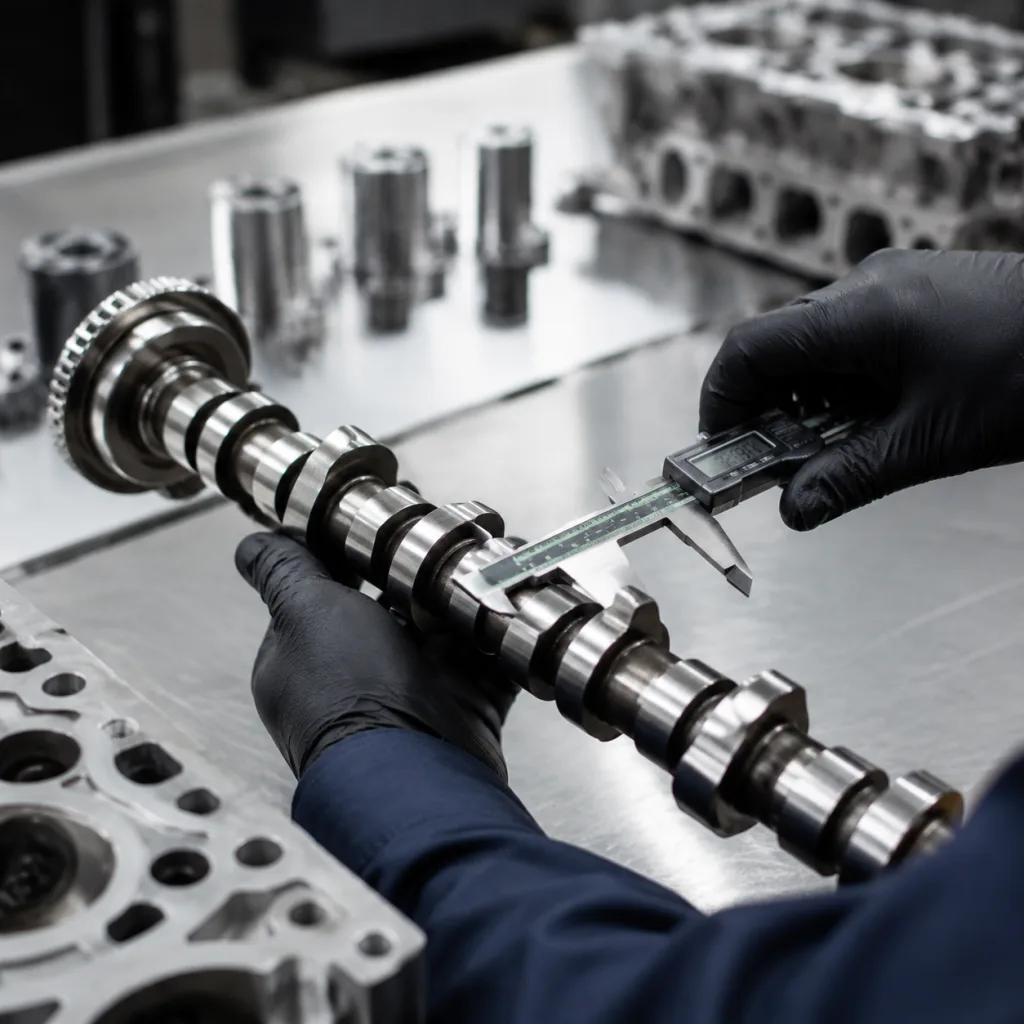
Sourcing a **camshaft for Mercedes-Benz E-Class OE equivalent** applications involves more than matching a catalogue listing. The part needs to replicate the OE component’s critical functional characteristics closely enough to preserve valve timing, hydrodynamic journal lubrication, follower contact behaviour and long-term wear performance. For distributors, importers and repair networks, the real question is not the label on the box. It is whether the replacement camshaft can consistently meet OE-level dimensional, metallurgical and application-control requirements with traceability and manageable field risk.
For E-Class applications, that usually means checking journal diameters and form, lobe lift and phasing, surface hardness, microstructure, surface finish, oil-feed machining and validation records linked to the supplied batch. It also means reviewing preservation, packaging, cross-reference discipline and engine-code accuracy so the correct intake or exhaust camshaft reaches the correct engine variant. Because the E-Class range spans multiple generations, petrol and diesel engines, and long production runs with design revisions, many sourcing mistakes come from weak fitment governance rather than obvious machining faults.
This article explains what procurement teams should verify when assessing aftermarket camshafts for E-Class programmes, how OE-equivalent claims should be backed by measurable evidence instead of generic marketing language, and which supplier controls matter most for durable, low-return B2B supply.
What OE-equivalent means for an E-Class camshaft
In replacement programmes, OE-equivalent should mean the camshaft matches the original part’s critical functional characteristics within controlled tolerances and validated process limits. It does not mean the part is supplied by the vehicle manufacturer, and it should not be presented as OE genuine unless that is formally true. In B2B sourcing, the term only has value when it is supported by drawings, inspection records, material certification, process control and clear application mapping.
For a camshaft for Mercedes-Benz E-Class OE equivalent supply programme, buyers should ask for evidence covering the following points:
Base material grade appropriate to the original design, commonly alloyed chilled cast iron for many overhead-cam applications or forged/alloy steel for specific engine families
Lobe profile accuracy including valve-lift curve, flank geometry and opening/closing ramp form
Lobe phase angle/indexing relative to datum features, because even small angular error can shift valve timing events
Journal diameter, roundness and cylindricity compatible with cylinder-head bearing bore and oil-clearance requirements
Total indicated runout (TIR) across support journals and critical lobes to limit uneven loading and timing variation
Surface hardness and effective hardening depth where applicable, especially at lobe contact zones
Surface finish on journals and lobes, typically controlled in low-micron Ra range according to design requirement
Oil passage drilling, deburring and cleanliness to support start-up lubrication and stable oil supply in service
Sprocket, reluctor or trigger-feature positional accuracy on engines using cam position sensing or variable valve timing control
Intake/exhaust differentiation where separate camshafts are used
Functionally, an OE-equivalent camshaft should operate in the target engine without introducing avoidable risk in these areas:
valve timing deviation
abnormal follower or rocker contact stress
unstable lubrication at journals or lobe interfaces
inconsistent cam-position sensor signal where trigger geometry is integrated
early wear such as scuffing, pitting or spalling under normal service intervals
Commercially, OE-equivalent also means batch consistency. A pilot sample that passes inspection is not enough if later lots drift in profile, hardness or surface finish. For fleets, repair chains and import distributors, that kind of variation quickly becomes warranty cost and stock risk. Buyers should therefore look beyond the sample itself and assess whether the supplier can hold the same geometry, metallurgy and surface condition across repeat production runs.
That matters in E-Class replacement business because many applications support older vehicles still serviced by independent workshops, where first-time fit and low rework are expected. The closer the aftermarket camshaft stays to original functional requirements, the lower the risk of ticking noise, timing-related fault codes, abnormal valvetrain wear or installation delays.
Driventus is an independent aftermarket manufacturer; brand names are referenced for fitment only.
Key technical checks before approving a supplier
Supplier approval should rest on measurable characteristics, not simply catalogue coverage. For camshafts, the main checks are dimensional, metallurgical and functional. A capable supplier should be able to show how the part is controlled from raw material through finish grinding, cleaning and final packing, and how each controlled characteristic connects to field performance.
The table below summarises the main checks buyers should review before approving a supplier.
Check point
Typical requirement to review
Why it matters
Journal diameter
Controlled to drawing tolerance, typically in the micron range
Directly affects oil clearance, bearing load and seizure risk
Journal roundness/cylindricity
Verified on roundness or form-measurement equipment
Poor form disrupts oil film stability and increases wear
Lobe lift/profile
Measured against drawing data, master profile or CMM/profile trace
Determines actual valve motion and opening duration
Lobe indexing
Verified angularly relative to datum
Incorrect phasing changes timing events and engine performance
Total runout
Checked on V-blocks or dedicated fixtures with dial/CMM measurement
Excessive runout can cause noise, uneven wear and timing scatter
Surface roughness
Measured on lobes and journals, often in controlled low-Ra ranges
Influences break-in behaviour and lubrication film retention
Hardness
Verified by Rockwell, Vickers or equivalent method per feature and process
Confirms wear resistance and heat-treatment consistency
Microstructure
Metallographic validation of chill depth, martensitic layer or carbide distribution as applicable
Confirms that hardness is structurally supported, not only surface-deep
Oil-hole geometry and cleanliness
Deburring, passage verification and cleanliness inspection
Prevents lubrication restriction or debris-related failure
Trigger/sprocket interface
Checked for geometry, concentricity and positional accuracy
Important for cam sensor readings and timing control
Coating/preservation
Corrosion protection validated for storage and export transit
Reduces rust risk during sea freight and warehouse dwell time
</tr></thead><tbody> </tbody></table>### Why these checks matter in practice
A camshaft is not just a rotating shaft with lobes. It is a timing-critical, contact-loaded component that converts rotational motion into a defined valve-event curve. Small deviations in lobe form, phase angle, journal geometry or surface condition can create field symptoms that are expensive to diagnose after installation. In workshop use, those problems may show up as valvetrain noise, rough idle, loss of performance, accelerated follower wear or engine-management faults linked to camshaft position.
That is why buyers should not accept a broad statement such as "tested before shipment." A better approach is to ask how the supplier measures lobe profile, whether runout is checked 100% or by sampling, how often hardness is verified per lot, what acceptance limits apply, and what reaction plan is triggered when process drift appears.
Validation records to request
Ask the supplier for:
Control plan and inspection flow under IATF 16949:2016
Quality management evidence under ISO 9001:2015
Material certificates and heat-treatment records
Dimensional inspection reports for pilot and mass-production batches
Profile comparison data against drawing, master sample or validated benchmark
Runout inspection records
Hardness and, where relevant, effective case-depth or chilled-layer verification
Cleanliness or preservation verification where sea freight is common
Substance compliance declarations where required under REACH (EC) No 1907/2006
Sample approval versus ongoing production control
A common sourcing mistake is approving a camshaft from a strong sample without confirming how that quality is maintained in serial production. Buyers should verify:
whether the approved part came from production tooling rather than prototype tooling
whether the grinding programme and profile master are revision-controlled
whether gauges, roundness instruments and fixtures are calibrated at defined intervals
whether process capability is monitored on critical characteristics such as journal diameter or lobe height
whether nonconforming lots are quarantined and traceable
If the supplier also offers related engine parts in one programme, it can be useful to review our catalog or a dedicated engine range such as /products/engine-components.html to consolidate sourcing.
Cross-reference discipline and fitment control
Cross-reference management is especially important in E-Class replacement business because one model line can span multiple petrol and diesel engines, production years, emissions stages and valvetrain revisions. A camshaft may look similar at a glance and still differ in lobe phasing, trigger windows, lubrication drillings, journal layout, nose geometry or installation position. In many aftermarket returns, the root cause is not poor manufacturing quality but incorrect application mapping.
A dependable aftermarket supplier should manage cross-references at three levels:
1. OE reference mapping - Recording each OE number exactly as used in customer and market data - Internal supersession control for replaced or revised references - Separation of obsolete, replaced and region-specific numbers
2. Engine code fitment - Mapping by engine family, displacement, cylinder count and valvetrain configuration - Distinction between intake and exhaust camshafts where both are offered - Recording production breakpoints where design changed during model lifecycle
3. Production traceability - Batch code linked to material lot, machining route, heat treatment and final inspection record - Ability to isolate affected stock by production date and lot in the event of a claim
Why E-Class fitment control needs extra care
The E-Class range covers a long production span and several engine technologies. Depending on the application, the correct camshaft may vary by:
generation and chassis family
engine code
fuel type
intake versus exhaust position
number and position of trigger features
presence of variable valve timing hardware
revised lubrication or machining details introduced mid-production
associated sprocket or adjuster interface geometry
Because of this, catalogue description alone is rarely enough for higher-volume B2B purchasing. A more reliable approval process combines OE reference, engine code, production range and physical feature verification before a purchase order is released.
Fitment data buyers should request
In practical terms, buyers should ask for a fitment matrix showing:
associated bolts, seals, followers or mating parts where replacement practice requires them
Warehouse and returns implications
Strong cross-reference discipline is not just a cataloguing issue. It directly affects warehouse accuracy, workshop productivity and return rates. When fitment data is incomplete, the usual consequences include:
picking errors in distribution centres
workshop downtime during strip-down and comparison
opened-box returns that cannot be resold as new
avoidable warranty disputes caused by wrong-application supply
For that reason, buyers should favour suppliers that maintain revision-controlled cataloguing and can explain exactly how a part number was mapped to a specific engine family. That helps reduce warehouse errors, lower installer frustration and separate fitment problems from true product defects.
Manufacturing controls that affect service life
Camshaft durability depends as much on process discipline as on nominal material selection. Two suppliers may quote the same material family, yet differences in melting or casting stability, grinding control, hardening uniformity and cleaning discipline can lead to very different wear behaviour in service. For buyers, the key issue is whether the supplier can repeatedly reproduce the required geometry, hardness distribution and surface condition closely enough to support full service life.
Important manufacturing controls include:
Material and heat treatment
Controlled chemistry for casting or forging input material
Stable hardening process to achieve target lobe wear resistance and structural consistency
Hardness mapping across multiple lobes and journals, not single-point checking only
Metallographic checks for graphite form, carbide distribution, chilled layer or case characteristics as relevant to design
Lot segregation so material deviations can be traced and contained
Material quality affects both strength and wear response. Local variation in hardness or microstructure can accelerate pitting, scuffing or lobe-edge distress even when basic dimensional checks pass. That is why buyers should ask for more than a generic material declaration; they should request actual incoming-material and post-treatment verification records.
Machining and finishing
CNC profile grinding or equivalent precision finishing for lobe geometry
Controlled wheel dressing and compensation to maintain profile over tool life
Journal roundness and cylindricity control
Chamfer consistency at oil-feed entries and edges
Surface finish verification to reduce break-in scuffing risk
Datum control between lobes, journals and trigger features
Burr removal after drilling, milling and grinding operations
Profile grinding quality is especially important. A camshaft can look acceptable and still carry small deviations in ramp shape, peak lift or lobe-to-datum angular relationship that affect valve motion. Precision finishing, controlled tool condition and regular profile measurement are therefore strong indicators of process capability.
Cleanliness and lubrication-related details
Inspection of oil passages for blockage, burrs or residual chips
Verification that drilled passages align with intended lubrication points
Controlled washing, drying and cleanliness checks before preservation and packing
These details are easy to overlook, but they matter in service. Debris left in a lubrication passage can create a delayed field failure that is difficult to diagnose because installation may appear normal at first before abnormal wear develops.
Final inspection and packing
100% visual check for edge damage, rust staining and burrs
Anti-corrosion oil or VCI protection matched to export route and storage duration
Individual packaging that prevents lobe-to-journal or part-to-part contact damage
Part marking or label control for lot traceability and warehouse identification
Packaging is part of product quality control, not just a cosmetic matter. A correctly machined camshaft can still reach the customer in non-saleable condition if journals are dented in transit or preservation is inadequate for long sea-freight cycles.
Process discipline and corrective action
A robust supplier should also be able to explain:
what the critical control points are in production
which dimensions are checked in-process and which are checked at final inspection
what reaction plan applies when a reading moves outside target or tolerance
how process changes are approved and documented
how customer complaints are converted into corrective and preventive action
A robust quality system should show how these controls are documented, audited and corrected when drift appears. For private-label or application-specific programmes, custom manufacturing may also be relevant where buyers need packaging, laser marking or controlled specification alignment.
How procurement teams should compare aftermarket offers
When comparing offers for E-Class camshaft replacement lines, buyers should assess total programme risk rather than unit price alone. A lower piece price can quickly be offset by higher return rates, inconsistent batch quality, weak documentation or poor fitment control. In B2B aftermarket sourcing, the real cost of a part includes claims handling, urgent resupply, warehouse disruption, installer downtime and reputational damage with trade customers.
Use the checklist below during supplier comparison:
Dimensional evidence: first-article report, lobe-profile inspection, runout data, journal-form records
Metallurgical evidence: material certificate, hardness report, heat-treatment or chill-depth control
System evidence: certification to IATF 16949:2016 and ISO 9001:2015
Compliance evidence: declarations for REACH (EC) No 1907/2006 where applicable
Supply evidence: MOQ, standard lead time, replenishment stability, safety-stock options, export packaging
Traceability evidence: lot coding and field-containment process
Commercial evidence: warranty workflow, claim-response timing and agreed nonconformity handling
Cataloguing evidence: application matrix by engine code, production range and intake/exhaust position
Service evidence: responsiveness to technical queries, sample requests and drawing-based confirmation
Compare the offer at programme level
A useful procurement approach is to score each supplier across four categories:
1. Technical conformity - Does the supplier provide credible inspection data? - Are profile, hardness, runout and journal-form controls clearly defined?
2. Application accuracy - Is fitment mapping specific enough for E-Class engine families? - Can the supplier distinguish revisions, intake/exhaust variants and trigger-feature differences?
3. Operational reliability - Are lead times realistic and repeatable? - Is export packaging suitable for route, humidity exposure and storage period? - Can the supplier support stable replenishment rather than only one-off supply?
4. Commercial risk - How are claims handled? - Is there a documented response window? - Is traceability strong enough to limit exposure if a batch issue occurs?
Questions worth asking during quotation review
To move beyond a simple price comparison, procurement teams should ask:
Was the quotation based on a confirmed OE reference and engine code, or only a generic vehicle description?
Is the offered part from current serial production?
What is the sample approval process before mass-order release?
Are inspection reports supplied routinely or only on request?
What packaging format is standard for distributor handling and export shipment?
Can the supplier support private label, barcode requirements or customer-specific marking?
Consider sourcing consolidation where practical
For distributors, it is also worth reviewing whether the supplier can support broader engine-component bundling. Combining camshafts, gaskets, timing components and related hard parts may simplify inbound logistics, improve planning accuracy and reduce supplier-management effort. However, bundling only helps if the supplier can maintain the same level of technical control across the wider range.
The most reliable decision model is straightforward: approve only suppliers that can demonstrate repeatable conformance, documented process control and clear fitment governance. That is the practical basis for any camshaft for Mercedes-Benz E-Class OE equivalent claim in the aftermarket.
Frequently asked questions
Ask for dimensional inspection reports, lobe-profile or runout data, journal-form results, material and hardness records, fitment cross-reference data, batch traceability details, and certification status for IATF 16949:2016 and ISO 9001:2015. For EU-bound supply, request REACH compliance declarations where relevant. If the programme is higher volume, also ask how serial-production quality is controlled after sample approval and whether process-capability data is available for critical characteristics.
No. Visually similar camshafts may differ in lobe phasing, trigger geometry, oil-feed drilling, journal layout, adjuster interface or intake/exhaust configuration. Approval should be based on engine-code mapping, OE cross-reference control, dimensional verification and feature-by-feature comparison, not visual appearance alone.
Not unless there is formal published approval from the vehicle manufacturer. Aftermarket suppliers should describe the part as OE-equivalent or fitment-compatible only when supported by technical evidence, without implying vehicle-manufacturer endorsement or genuine OE supply.
If you are reviewing E-Class camshaft supply options, we can provide fitment mapping, inspection data and programme details for B2B sourcing. To discuss your requirement, please [request a quote](/contact.html).