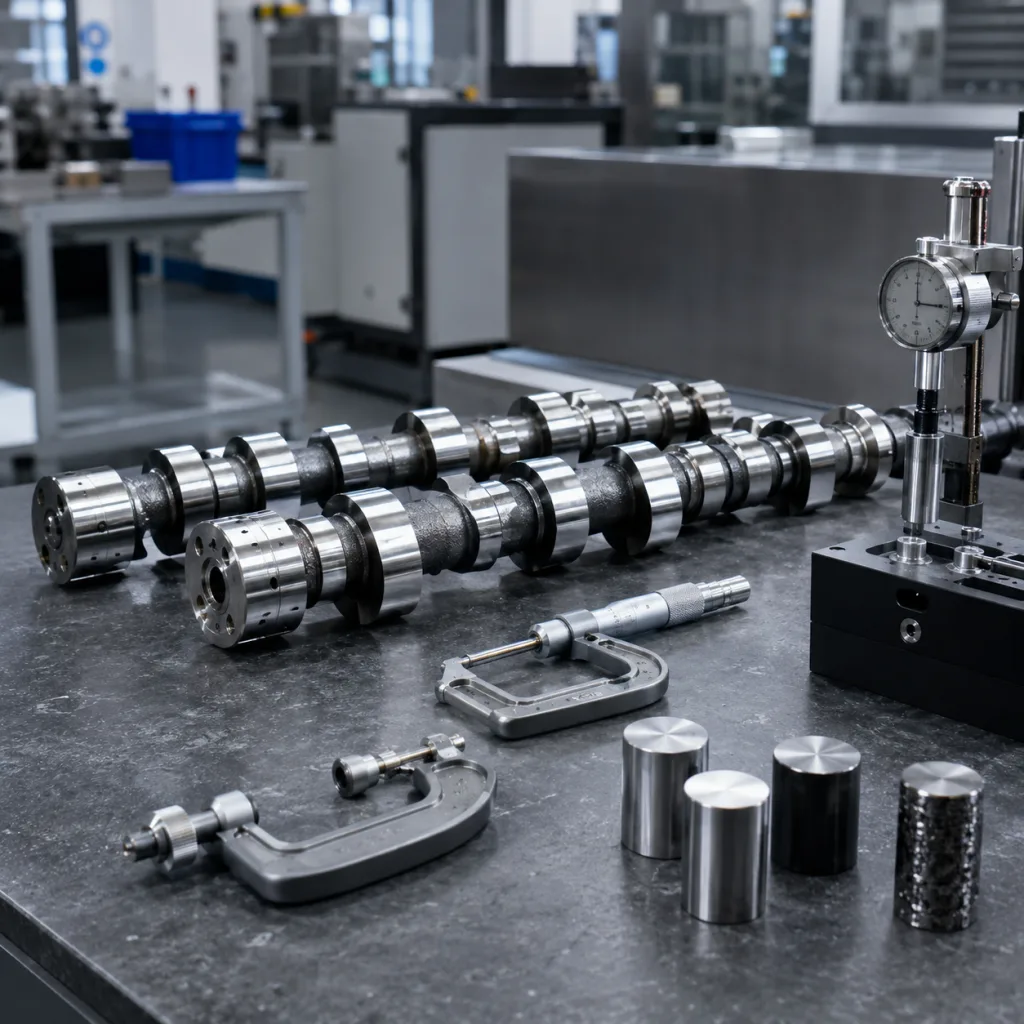
A camshaft for Kia Sorento aftermarket replacement has to do more than fit into the cylinder head. It must reproduce the intended valve timing, journal geometry, lobe profile, oil-feed layout, and surface durability required by repair chains, wholesalers, and export distributors. Small errors in lobe height, hardness depth, trigger geometry, or lubrication features can lead to valve-train noise, misfire complaints, accelerated follower wear, installation delays, and warranty returns.
For procurement teams, the main sourcing question is process control: can the manufacturer manage casting or forging quality, precision machining, heat treatment, traceability, inspection records, and packaging consistency across repeated batches? Driventus manufactures engine and powertrain components in Taizhou, Zhejiang, and supplies B2B aftermarket and OE-service customers in more than 60 countries. Camshaft programmes are managed under IATF 16949:2016 and ISO 9001:2015 procedures, with dimensional, material, and packaging requirements agreed before production release. Driventus is an independent aftermarket manufacturer; brand names are used for fitment identification only.
Replacement fitment and OE-equivalence requirements
For Kia Sorento applications, buyers should confirm the engine family, fuel type, model year range, valve-train layout, and whether the required camshaft position is intake or exhaust. A camshaft with the correct overall length may still be unsuitable if the trigger pattern, oil passage, thrust face, locating feature, or cam phaser interface differs from the target application.
A reliable aftermarket replacement programme should verify the following before release:
Application mapping by engine code, fuel type, and production date range
Intake or exhaust position identification
Journal diameter, lobe lift, base circle, and overall length
Cam sensor, trigger wheel, or phaser interface geometry where fitted
Oil-hole diameter, location, and passage alignment
Thrust surface width and end-float control features
Lobe and journal surface finish after final polishing
Surface hardness and hardness depth after heat treatment
Packaging protection for lobes and journals during storage and sea freight
Procurement teams can review related engine parts in our catalog and the engine component range at /products/engine-components.html. Where a buyer needs a private-label version, revised packaging, controlled interchange data, or application-specific documentation, Driventus can evaluate custom manufacturing requirements.
Critical dimensions buyers should specify
A replacement camshaft must preserve valve timing and valve motion within a narrow process window. Even small deviations in lobe profile, base circle, or runout can affect idle stability, emissions performance, hydraulic tappet operation, and long-term wear. Buyers should therefore avoid approving parts based only on sample appearance, broad interchange claims, or matching external length.
Control item
Typical verification method
Procurement relevance
Overall length
Caliper, height gauge, CMM
Confirms installation envelope and thrust alignment
Journal diameter and roundness
Micrometer, roundness tester
Controls oil film stability and bearing wear
Lobe lift and base circle
Cam profile measuring equipment
Maintains valve opening and closing behaviour
Runout
V-block and dial indicator or CMM
Reduces valve-train vibration and abnormal wear
Oil passage position
Pin gauge and fixture check
Supports correct lubrication to journals and followers
Surface roughness
Profilometer
Helps reduce friction, scuffing, and break-in wear
Surface hardness
Rockwell or Vickers test
Confirms wear resistance after heat treatment
Timing interface
Dedicated functional gauge
Prevents timing errors, sensor faults, and installation mismatch
</tr></thead><tbody> </tbody></table>Driventus normally defines inspection plans with incoming material checks, in-process machining controls, final dimensional inspection, and sample retention. For higher-volume programmes, capability studies can be agreed for key characteristics such as journal diameter, lobe lift, surface roughness, and runout.
Materials, heat treatment, and surface durability
Camshaft material selection depends on engine design, production route, expected volume, and cost target. Common options include chilled cast iron, ductile iron, forged steel, and assembled camshaft construction. The right specification must balance wear resistance, machinability, weight, fatigue performance, and compatibility with the matching followers or tappets.
For an aftermarket replacement camshaft, the critical issue is not only the base material but also the repeatability of the full process. Melting control, casting cleanliness, forging consistency, machining allowance, straightening, heat treatment, and final polishing all influence service life. Lobe and journal surfaces must resist adhesive wear under mixed lubrication conditions, especially after cold starts, extended drain intervals, or operation with marginal oil quality.
A buyer should request evidence for:
Material grade specification and chemical composition range
Heat-treatment process route and inspection frequency
Hardness values at lobes, journals, and other working surfaces
Hardness depth or case-depth confirmation where applicable
Microstructure review where required by the control plan
Surface roughness values on journals and working lobe faces
Batch traceability from raw material to finished goods
Nonconforming-material handling and rework control procedures
Environmental and market-access requirements may also apply. For EU supply, material declarations and restricted substance controls should align with REACH (EC) No 1907/2006 where relevant. For complete engines or emissions-critical assemblies, vehicle-level compliance may involve regulations such as ECE R-83; however, a replacement camshaft is normally validated as a component within a defined application and customer specification.
Validation testing for replacement confidence
A camshaft for Kia Sorento aftermarket replacement should be supported by a validation plan that matches the risk level of the programme. Distributor stock typically prioritises fitment accuracy, consistent batches, corrosion control, packaging protection, and low return rates. Repair-chain supply adds further pressure around noise, vibration, installation time, technician confidence, and warranty monitoring.
Typical validation activities include:
First-article dimensional report against the approved drawing or reference sample
Material certificate review and hardness mapping
Lobe profile comparison against an approved reference sample
Runout and straightness inspection after heat treatment and finishing
Surface roughness inspection on journals and working lobe faces
Trial assembly with mating components such as followers, caps, sprocket, or phaser where applicable
Rotation and oil-passage verification on sample parts
Packaging drop, abrasion, or corrosion-risk checks where shipment conditions require them
Pre-shipment batch audit against the agreed inspection plan
Driventus manages these activities through its quality system, based on IATF 16949:2016 and ISO 9001:2015. Buyers can request production control plans, inspection summaries, sample approval records, and packaging specifications during supplier qualification. Driventus does not claim approval or endorsement by any vehicle manufacturer.
Sourcing checklist for importers and repair-chain buyers
A structured sourcing checklist reduces the risk of receiving visually similar but functionally different camshafts. This is especially important when consolidating several Kia Sorento model-year applications into one purchasing programme or when building a catalogue entry for multiple destination markets.
Before issuing a purchase order, confirm:
Target application list, including engine code, fuel type, and production years
Required intake or exhaust position coverage
Sample reference, drawing, or agreed interchange file
Photos or measurements of timing interface, sensor feature, oil holes, and journal layout
Expected annual volume, release schedule, and safety-stock requirement
MOQ, carton quantity, pallet configuration, and shipping mode
Marking method and traceability label requirements
Warranty return analysis process and evidence-retention expectations
Private-label packaging artwork, language, and barcode requirements
Destination-market documentation, including material declarations where required
For B2B importers, consistent batch control is usually more valuable than the lowest single-unit price. A poorly controlled camshaft can create labour claims and customer dissatisfaction that exceed the part cost many times over. Repair chains also need stable availability because a missing intake or exhaust position can interrupt workshop scheduling. Driventus supports distributors, wholesalers, and multi-location service networks with application review, sample validation, production planning, export documentation, and aftersales feedback loops.
Commercial notes for aftermarket programmes
For new camshaft programmes, Driventus normally starts with application confirmation and reference-sample review. If the part is already in the active range, quotation can proceed once the target quantity, packaging format, destination port, and documentation requirements are clear. If tooling, fixture development, or reverse engineering is required, the timeline depends on drawing availability, sample condition, machining complexity, and validation scope.
Buyers may request:
Neutral, Driventus, or customer private-label packaging
Batch inspection reports for first shipments
Consolidated shipment with other engine parts
Application data in spreadsheet format for cataloguing teams
Pre-shipment photos, marking confirmation, and carton-label review
Long-term supply planning for high-turnover repair-chain SKUs
Published standards guide the management system and documentation process, including IATF 16949:2016 and ISO 9001:2015. Product-specific performance requirements are agreed by drawing, inspection plan, approved sample, and customer acceptance criteria. For price, lead time, and current application coverage, buyers can request a quote with engine details, target volume, packaging preference, and destination market.
Frequently asked questions
Provide engine code, model year range, fuel type, intake or exhaust position, target annual volume, destination market, packaging requirement, and any reference sample or drawing. If available, include interchange data and photos of the timing interface, sensor feature, oil holes, thrust face, and journal layout.
Yes. Driventus can support neutral or private-label packaging for qualified B2B programmes. Packaging structure, label format, carton quantity, palletisation, barcode content, language requirements, and traceability rules should be agreed before mass production and shipment booking.
No. Driventus is an independent aftermarket manufacturer; brand names are referenced for fitment identification only. Driventus does not claim approval or endorsement by any vehicle manufacturer. Parts are supplied to agreed aftermarket specifications, inspection plans, and customer acceptance criteria.
For current coverage, validation documents, and commercial terms for a camshaft for Kia Sorento aftermarket replacement programme, contact Driventus with your application list, target volume, and destination market. Start a sourcing discussion at /contact.html