Camshaft Kia Replacement: OE-Equivalent Sourcing Guide
For procurement teams, a camshaft replacement for Kia applications is not a generic stock item. The important checks are profile geometry, journal diameter, lobe timing, surface finish, hardness, and the engine code behind the application. Driventus is an independent aftermarket manufacturer; brand names are referenced for fitment only. We supply camshafts for passenger car and light-duty engine programmes where OE-equivalent dimensions and stable batch repeatability matter more than marketing claims. The practical question is not whether a part looks similar, but whether it matches the original lift curve, base circle, bearing interfaces, and sensor features within the tolerances your workshop or assembler can accept. This article sets out the replacement criteria, the validation checks, and the documents that should sit behind a purchase order.
When a Kia camshaft should be replaced
A camshaft should be replaced when wear is measurable, not only when it is visibly damaged. Common triggers include lobe pitting, scoring, abnormal tappet noise, unstable idle, misfire on one bank, metal in the oil filter, and low cylinder filling that does not respond to ignition or injector changes.
Before ordering, confirm the failure mode:
- Measure lobe lift against the service limit.
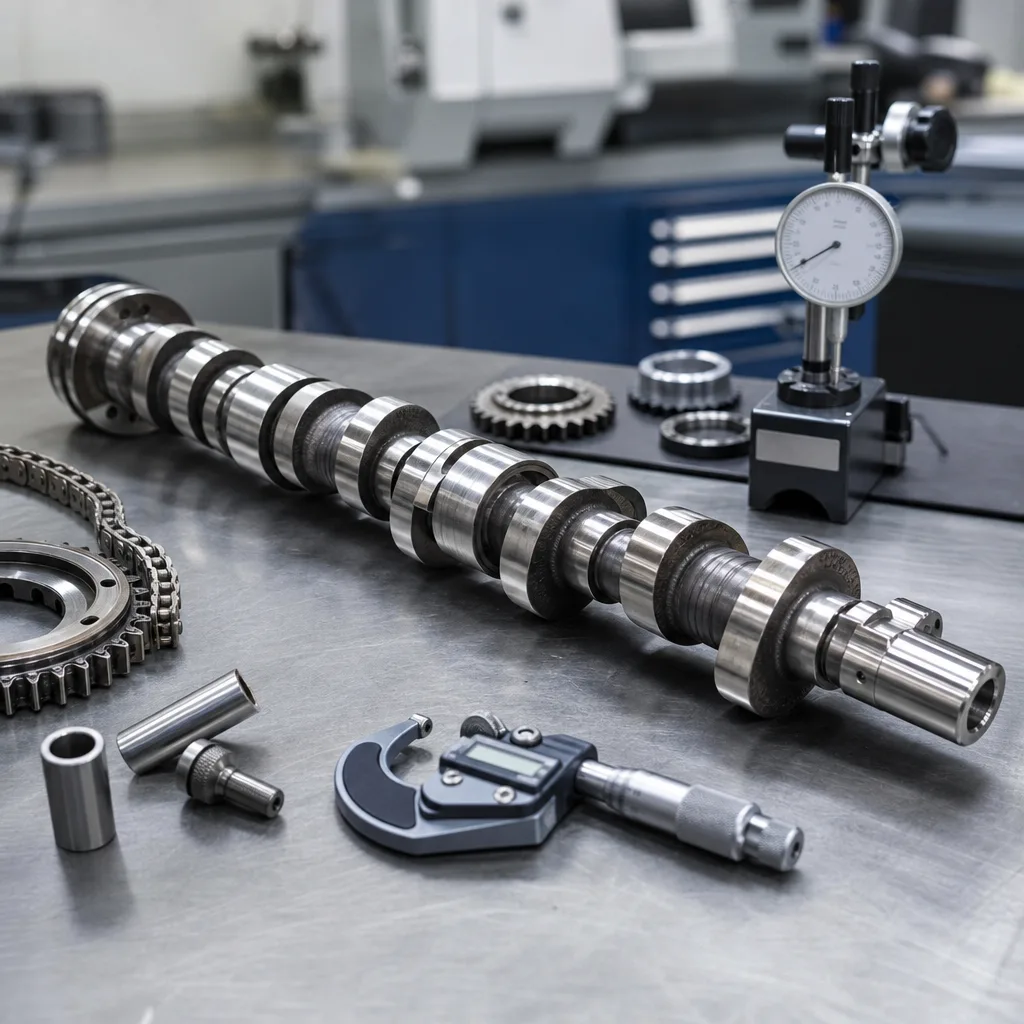
- Check journal wear and ovality with a micrometer.
- Inspect thrust faces, sprocket seats, and keyway condition.
- Review lifters, followers, and rocker contact patterns.
- Check timing chain or belt condition if the camshaft has been running out of phase.
If the lobe surface has spalled, the surrounding valvetrain often carries damage as well. In that case, replacing the camshaft alone may be acceptable for a rebuild, but only if the mating components are measured and cleared for reuse.
What must match for OE-equivalent fitment
For replacement procurement, the goal is dimensional and functional equivalence. The part does not need an OEM logo; it needs the same geometry, interface points, and durability envelope.
The main fitment items are:
- Overall length and bearing spacing
- Journal diameter and thrust-face geometry
- Lobe lift, duration, and separation geometry
- Sprocket, hub, or VVT actuator interface
- Cam position sensor target pattern, if fitted
- Surface hardness and finish on wear surfaces
- End-play and runout within the engine builder's acceptance range
If the application is tied to a specific engine family, request the engine code, model year, and photos of the original shaft. That reduces the risk of ordering by vehicle name alone, which is too broad for many Kia platforms with multiple variants across markets.
Key dimensions to check before ordering
A clear dimensional comparison prevents avoidable returns. The table below is the minimum set we ask buyers to confirm before a repeat or new cross-reference order.
| Parameter | Why it matters | Procurement note |
|---|---|---|
| Journal diameter | Controls bearing clearance and oil film | Measure all journals, not only one sample |
| Lobe lift | Directly affects valve opening | Match the target engine spec, not a similar engine |
| Base circle | Affects effective timing and lash | Critical when comparing re-ground parts |
| Thrust face | Governs axial location | Check end-play with the mating hardware |
| Sprocket interface | Ensures timing alignment | Confirm tooth count, bolt pattern, and keying |
| Sensor target | Supports ECU timing input | Required on engines with cam position sensing |
| Runout | Indicates shaft straightness | Reject shafts outside the rebuild limit |