Blue Smoke From Exhaust: Exhaust Manifold Gasket Checks
Blue smoke at the tailpipe usually means oil is entering the combustion chamber. An exhaust manifold gasket failure is a different fault: it more often causes an exhaust leak, ticking noise, soot around the flange, and a burnt smell near the cylinder head or turbo. The two issues are often confused, so diagnosis should start with the smoke source, the driving condition when it appears, and whether there is oil on the manifold, heat shield, or nearby hardware. If the problem is the gasket, the repair is usually a dimensional replacement matched to the engine family and flange geometry, followed by flatness checks and torque verification. Driventus is an independent aftermarket manufacturer; brand names are referenced for fitment only. For workshops and procurement teams, the objective is simple: verify the symptom, confirm the leak path, and choose a gasket that can survive the thermal load of the application.
What blue smoke usually means
Blue smoke from the tailpipe is normally a combustion issue, not a flange seal issue. The exhaust manifold gasket sits outside the combustion chamber, so it does not usually create oil-burning smoke by itself.
Symptom
Most likely source
What it means for the gasket
Blue smoke after idle or on cold start
Valve stem seals, turbo seals, PCV system
The gasket is usually not the root cause
Blue smoke under acceleration
Piston rings, turbo oil seal, oil control issue
Inspect the engine first, then the manifold
Ticking sound and soot at the flange
Exhaust manifold gasket leak
The gasket may need replacement
Smoke from the engine bay after shutdown
Oil or fluid on hot exhaust parts
The gasket may be intact, but contamination must be found
</tr></thead><tbody> </tbody></table>If the vehicle has both blue smoke and a manifold leak, treat them as separate faults until proven otherwise. A leaking manifold can make the underhood smell worse, but it does not normally explain oil burning inside the cylinders.
How to inspect the leak path
Start with a cold engine. A cold start makes exhaust leaks easier to hear, and it reduces the risk of touching hot components.
1. Look for soot trails around the manifold-to-head joint. 2. Check for a ticking sound at idle, especially during the first minute after start-up. 3. Inspect the valve cover, turbo oil feed and return lines, and nearby coolant hoses for seepage. 4. Use a mirror or borescope to inspect the lower flange, where cracks and gaps are easy to miss. 5. Confirm whether smoke is coming from the tailpipe or from the engine bay. The location matters.
If oil is dripping onto the manifold or turbo housing, the smoke may appear blue even though the exhaust manifold gasket is not the source. That distinction saves time and prevents unnecessary part replacement.
When the gasket is the cause
A failed gasket usually follows one of four patterns: heat cycling, flange distortion, corrosion, or fastener loss of clamp load. Multi-cylinder engines with long manifolds are more sensitive because the flange can warp after repeated thermal expansion.
Common replacement triggers include:
Soot line at one port only, which points to a local seal failure.
Burnt smell after hard driving, which suggests a leak near the exhaust port.
Visible cracking, delamination, or compression set in the old gasket.
Warped mating surfaces that do not seal even with fresh hardware.
If the manifold is cracked, or if the cylinder head face is outside the service limit, a new gasket alone will not solve the problem. The repair needs a clean sealing surface, correct alignment, and the right fasteners for the application.
Replacement checks before fitment
Before installing a new gasket, verify the full stack-up, not just the gasket itself.
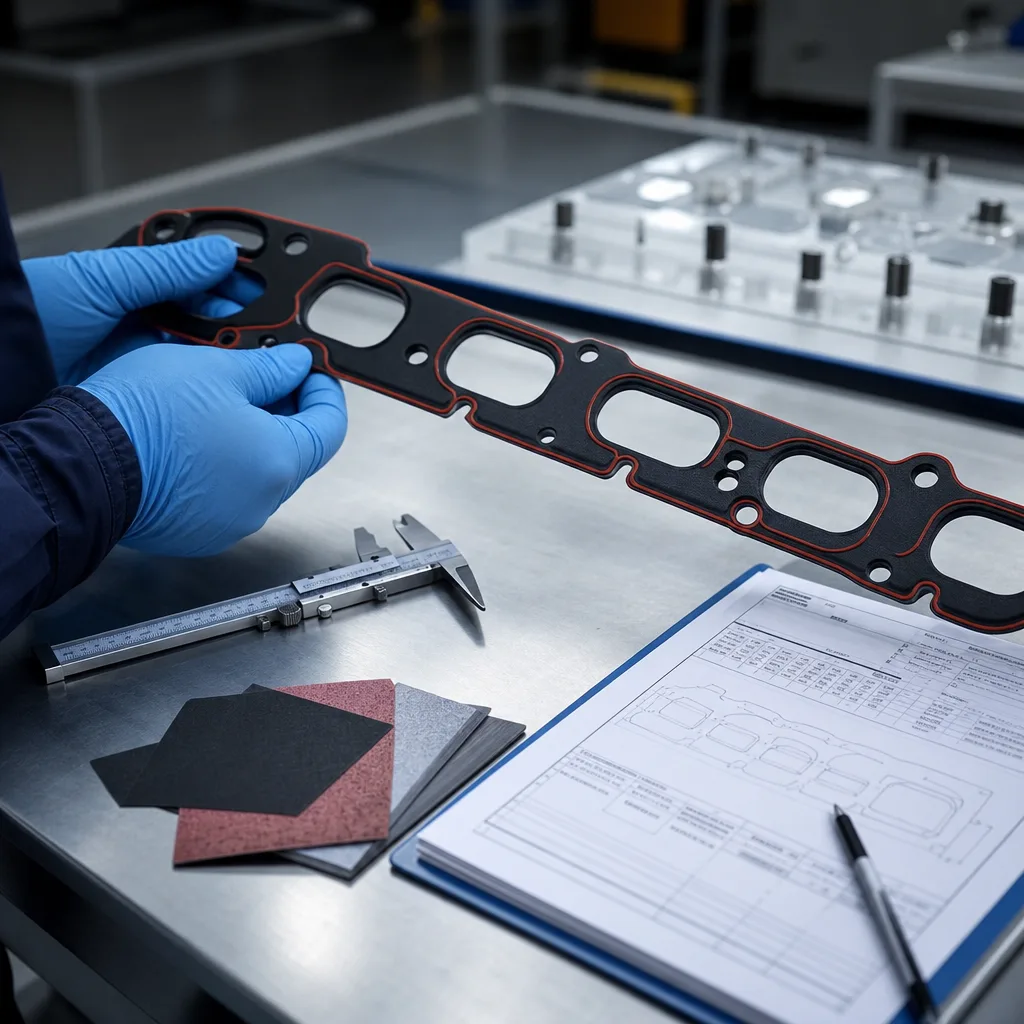
Confirm the port count, bolt pattern, and flange thickness against the removed part.
Check the manifold and head for flatness with a straightedge and feeler gauge.
Replace stretched or corroded studs and any damaged nuts.
Clean carbon and old sealant from the mating surfaces without gouging the metal.
Follow the correct tightening sequence and torque value from the engine data.
Do not reuse torque-to-yield fasteners unless the service data explicitly allows it.
For high-temperature applications, ask whether the gasket uses graphite, multi-layer steel, or a steel core with sealing beads. The material must match the heat profile, clamp load, and surface finish of the engine family. That matters more than appearance.
What procurement teams should ask for
For B2B sourcing, the part should be evaluated as a controlled component, not a generic sheet-metal cutout. A well-matched exhaust manifold gasket should match the OEM geometry, withstand repeated heat cycles, and maintain clamp load after installation.
See our catalog for engine-component coverage, and review the quality system for traceability and inspection controls. For non-standard thickness, coating, bead profile, or packaging needs, custom manufacturing is the right path.
Ask suppliers for:
Drawing or sample match to the engine family
Material declaration and REACH (EC) No 1907/2006 compliance
Production control under IATF 16949:2016 and ISO 9001:2015
Leak test or thermal cycle data tied to the application
Clear fitment notes for the manifold, turbo, or heat shield layout
If the vehicle programme has emissions-related inspection requirements, include the leak concern in your validation plan. A poor seal can affect noise, smell, and fault-code behaviour, even when the smoke source is elsewhere.
Frequently asked questions
Usually not. Blue smoke normally means oil is burning inside the engine. A manifold gasket leak more often causes ticking, soot, and a burnt smell. If oil lands on the hot manifold, smoke from the engine bay can look blue.
Inspect the manifold and cylinder head for flatness, cracks, and carbon tracks. Check studs, nuts, and nearby oil leaks from the valve cover or turbo system. Replace the gasket only after the leak path is confirmed.
Request dimensional match, material data, REACH compliance, and production controls aligned with IATF 16949:2016 and ISO 9001:2015. For export programmes, ask for thermal-cycle and leak-test evidence for the target engine family.
If you need a gasket matched to a specific engine family or test requirement, send the flange photo, engine code, and target volume through [request a quote](/contact.html).