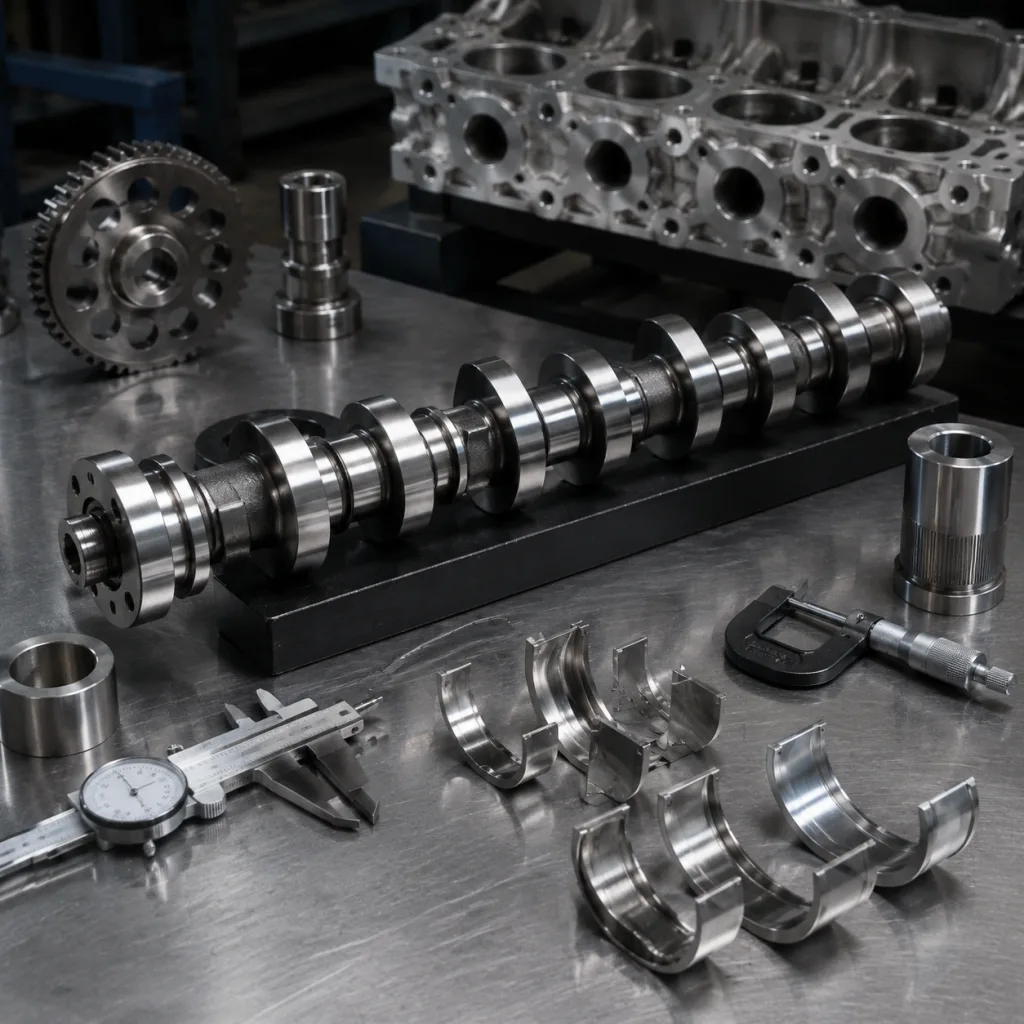
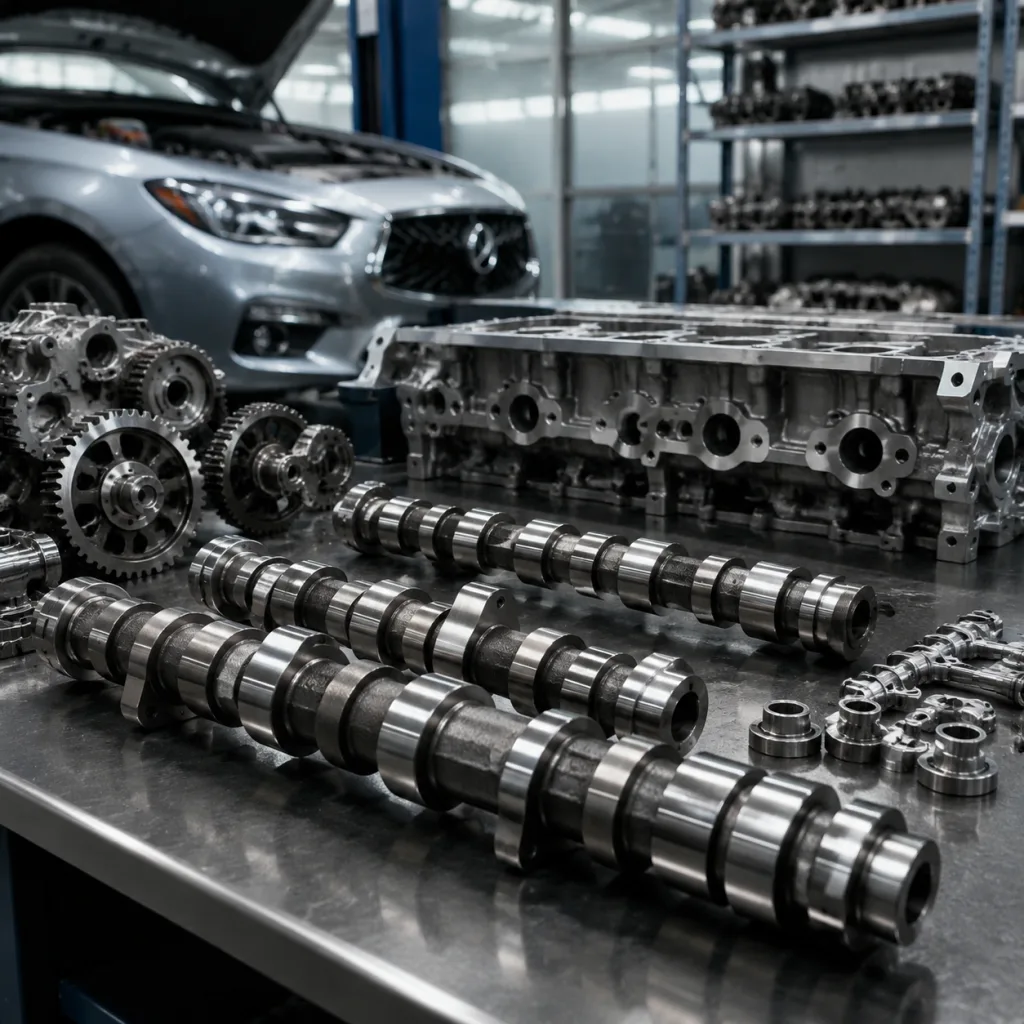
A camshaft infiniti aftermarket replacement programme should begin with geometry, metallurgy, validation evidence, and supply consistency—not price alone. For distributors, repair-chain buyers, and sourcing engineers, the commercial risk is clear: a camshaft may install in the cylinder head yet still alter valve timing, lifter contact, oil delivery, or sensor signalling. Those differences can create noise complaints, fault codes, premature wear, and warranty exposure across many service locations. Driventus manufactures camshafts and related engine components in Taizhou, Zhejiang, with export supply to more than 60 countries. We support B2B aftermarket distributors, wholesalers, OEM and Tier-1 programmes, private-label brands, and multi-location repair networks. This guide outlines the checks procurement teams should use when sourcing Infiniti-fit aftermarket camshafts, including OE-equivalent geometry, material and surface controls, validation steps, inspection records, packaging, and RFQ data. Driventus is an independent aftermarket manufacturer; vehicle brand names are referenced for fitment identification only.
What OE-equivalent camshaft replacement means
For procurement teams, OE-equivalent does not mean a generic casting that merely belongs to the same engine family. It means the replacement camshaft is engineered to match the functional dimensions, timing behaviour, and durability envelope required for the applicable Infiniti engine application.
Key equivalence points should be defined as measurable items, not general claims:
Cam lobe lift, base circle, nose radius, flank profile, opening/closing ramp, and phase relationship
Journal diameter, roundness, taper, concentricity, and bearing surface finish
Overall shaft length, thrust face location, thrust width, and end-play control surfaces
Sprocket, phaser, keyway, dowel, bolt-hole, or timing drive interface geometry
Sensor trigger features, reluctor tooth position, slot width, or signal reference features where applicable
Heat treatment depth, surface hardness, chilled layer or case condition, and core toughness
As a working RFQ baseline, buyers commonly request critical dimensional tolerances such as journal diameter within ±0.010–0.020 mm, journal roundness below 0.005–0.010 mm, lobe lift within ±0.020–0.030 mm, total indicated runout on journals below 0.030–0.050 mm, and bearing surface roughness around Ra 0.2–0.4 µm depending on the original design. Exact limits must be confirmed by drawing, master sample, or approved inspection plan because intake/exhaust, left/right bank, and phaser-equipped shafts may use different specifications.
Even a small deviation in lobe profile, journal geometry, or timing interface position can affect valve lift, timing repeatability, idle quality, emissions behaviour, oil-film stability, and wear rate. A 1°–2° timing error at the camshaft can be enough to create drivability complaints or fault-code investigations on sensitive applications. The risk is higher when one catalogue reference covers multiple model years, banks, or intake/exhaust positions.
Driventus uses controlled drawings, master samples, dimensional inspection plans, and batch release checks before replacement camshafts are approved for export orders. Buyers can review standard engine component ranges through our catalog, including camshafts, crankshafts, pistons, gaskets, water pumps, and related powertrain parts.
Fitment data and cross-reference control
Infiniti applications often share engine architecture with Nissan-group platforms, but catalogue accuracy still depends on disciplined cross-reference control. Sourcing only by engine code, model name, or a partial OE-style reference increases the chance of supplying a visually similar but functionally different shaft. A safer approach confirms model year, engine displacement, valve train layout, camshaft position, bank orientation, timing drive type, sensor feature, and the reference convention used by the buyer.
Driventus maintains fitment files for aftermarket distribution programmes and can align item data with TecDoc-style structures, buyer ERP templates, and private-label catalogues. When an OE reference is supplied by the buyer, it is used as an application and dimensional reference only, not as a claim of vehicle manufacturer approval.
Typical cross-reference checks include:
Check item
Procurement purpose
Risk if omitted
Engine family, displacement, and market
Confirms basic application scope
Wrong shaft supplied for a similar engine
Model year range and production split
Captures mid-cycle design changes
Returns from only part of the vehicle parc
Intake or exhaust position
Prevents position or bank mix-up
Incorrect timing and installation failure
Bank 1/bank 2 or left/right convention
Aligns catalogue wording with installer practice
Correct-looking shaft packed under wrong side
Camshaft sensor feature
Confirms trigger wheel, slot, or signal detail
No-start condition or diagnostic fault codes
Timing interface
Confirms sprocket, phaser, keyway, dowel, or bolt-hole detail
Incorrect valve timing or assembly conflict
Journal count and diameter
Confirms cylinder head compatibility
Binding, oil pressure loss, or seizure
Oil feed and groove layout
Confirms lubrication path compatibility
Journal scoring or accelerated lobe wear
Packaging label and barcode
Supports warehouse traceability
Picking errors, returns, and catalogue disputes
</tr></thead><tbody> </tbody></table>For high-volume aftermarket launches, buyers should provide an application table with at least model, year, engine code, displacement, position, OE-style reference, buyer SKU, packaging brand, and target annual demand. Driventus can then return a cross-reference confirmation, note unclear applications, and separate common catalogue lines from references that require sample verification.
If a buyer’s enquiry includes a reference such as OE 06A…, Driventus can use it for fitment mapping and dimensional comparison. Brand names and OE-style references are used for identification only.
Material, machining, and surface requirements
A camshaft works under mixed lubrication, repeated contact stress, and high local load at the lobe-to-follower interface. A reliable aftermarket replacement therefore needs consistent material selection, controlled heat treatment, accurate grinding, clean oil passages, and corrosion protection—not just visual similarity.
Common production routes include chilled cast iron, ductile iron, forged steel, and assembled steel designs, depending on the original application. The selected route must match the functional requirement of the valve train, including follower type, spring load, lubrication method, and expected contact stress. Typical control targets may include lobe hardness in the range of about 55–62 HRC for hardened steel designs, chilled cast-iron contact hardness verified by approved method, induction case depth around 1.0–3.0 mm where specified, and core hardness/toughness sufficient to prevent shaft fracture. Final values must follow the drawing, sample benchmark, and agreed metallurgy route.
A typical Driventus camshaft control plan may include:
Incoming material verification by heat number, chemical composition analysis, and supplier certificate review
Casting or forging inspection for cracks, shrinkage, porosity, decarburisation, or surface defects
Rough machining of datum features before heat treatment where the process requires distortion control
Hardness testing on lobes, journals, thrust faces, and relevant contact surfaces
Case depth, induction-hardened zone, nitrided layer, or chilled layer assessment where applicable
CNC grinding of lobes, journals, thrust faces, and timing-related features using controlled fixtures
Lobe profile inspection against drawing data or approved master sample, including lift curve and phase angle
Runout and straightness inspection across bearing journals after finish grinding
Surface roughness checks on bearing and contact faces, commonly targeting Ra 0.2–0.4 µm on journals and Ra 0.4–0.8 µm on lobe contact faces unless otherwise specified
Magnetic particle, visual, or process-specific defect inspection where required
Oil-hole deburring, passage brushing/flushing, compressed-air verification, and residual contamination control
Anti-corrosion oil, VCI paper or bagging, end protection, and export packing before shipment
For B2B programmes, inspection criteria can be agreed during quotation and sample approval. Buyers may request a first-article report covering 10–30 critical dimensions, hardness points, roughness readings, runout, oil-hole position, and packaging checks. Driventus operates under IATF 16949:2016 and ISO 9001:2015 quality management principles, with inspection records linked to production batches. More detail is available on our quality system page.
Driventus is an independent aftermarket manufacturer; brand names are referenced for fitment only.
Validation checks before mass procurement
Before placing a container-level order, annual blanket order, or private-label launch, buyers should validate sample parts in a controlled sequence. This reduces downstream warranty cost, avoids catalogue disputes, and confirms that the part can move through the buyer’s warehouse and installation network without avoidable friction.
Recommended validation workflow:
1. Confirm fitment list, engine codes, market coverage, buyer cross-references, and any production-date splits. 2. Compare the sample camshaft to a known-good OE part or approved master sample, including lobe sequence and sensor feature orientation. 3. Measure journals, lobes, thrust faces, oil holes, sensor features, and timing interfaces with calibrated micrometers, height gauges, CMM, contour equipment, or dedicated gauges. 4. Check hardness, surface finish, runout, straightness, and visible machining quality against agreed specifications. 5. Flush or inspect oil galleries and verify that no burrs or chips remain in cross-drilled passages. 6. Complete trial installation in a representative cylinder head or validated fixture with correct caps, fasteners, lubricant, and torque sequence. 7. Check camshaft end play, free rotation torque, journal oil clearance, follower contact pattern, and axial thrust face contact. 8. Rotate the valve train manually through at least two crankshaft revolutions to confirm clearance, timing alignment, and smooth operation. 9. Run engine, rig, or bench validation where programme volume and risk justify it; for higher-risk launches, buyers often require 20–50 hours of bench/engine running or a controlled road/field trial before release. 10. Review packaging, label fields, barcode format, carton strength, pallet pattern, moisture protection, and corrosion protection after simulated handling.
For distributors and repair chains, dimensional approval should be separate from packaging approval. A part may pass installation checks but still create operational issues if label fields, barcode logic, carton strength, or palletisation do not match the destination warehouse process. Common packaging criteria include scannable EAN/UPC or Code 128 labels, buyer SKU and cross-reference fields, individual oil/VCI protection, double-wall export cartons for heavier shafts, and pallet heights compatible with the receiving warehouse.
Regulatory and customer requirements may also affect the supply programme. For example, REACH (EC) No 1907/2006 can apply to substances in articles supplied into the EU, and customer-specific restricted substance lists may be stricter than baseline legislation. Camshafts are not normally evaluated under brake-specific standards such as SAE J2527, so buyers should define the relevant material, quality, traceability, and import documentation requirements during RFQ instead of relying on unrelated test standards.
Commercial factors for Infiniti aftermarket programmes
A camshaft infiniti aftermarket replacement project is usually sourced within a wider engine components category rather than as a single isolated line. Combining camshafts with gaskets, timing components, oil pumps, water pumps, overhaul kits, or related engine parts can reduce per-line logistics cost and simplify supplier management.
Important commercial points include:
Minimum order quantity by part number and mixed-SKU order value
Sample lead time, approval timeline, and production lead time after sign-off
Tooling, fixture, or development cost for low-volume or uncommon references
Neutral, Driventus, or buyer private-label packaging requirements
Carton strength, pallet dimensions, label placement, and export packing method
Incoterms, pre-shipment inspection terms, and document requirements
Batch traceability, claim process, evidence requirements, and response timeline
Forecasting method for slow-moving references and seasonal demand changes
As practical planning guidance, existing active references may be quoted from MOQ levels around 50–100 pieces per SKU, while slower or newly developed references may require 100–300 pieces per SKU or a mixed-order value threshold to cover setup, inspection, and export packing. Sample quantities are commonly 1–5 pieces per reference. Standard sample preparation is often 10–20 working days for stocked or current-production items, while new development using buyer samples or drawings may require 30–60 days before first samples. After sample approval, production lead time is typically 35–55 days depending on material availability, heat-treatment queue, packaging complexity, and order size.
Price logic should be reviewed by total landed cost rather than unit price alone. A low piece price can be erased by high warranty rate, poor carton strength, airfreight recovery, mixed-SKU picking errors, or excessive inspection at destination. For repeat B2B programmes, Driventus can discuss annual forecast pricing, staged release orders, combined engine-parts shipments, and private-label packaging amortisation. If tooling or dedicated gauges are required, the quotation should state whether the cost is charged upfront, amortised into unit price, or waived after an agreed cumulative volume.
Driventus supports aftermarket catalogue supply, private-label programmes, and engineered-to-sample development. For part families not currently in the standard range, buyers can discuss custom manufacturing using drawings, samples, benchmark parts, or agreed performance specifications.
A clear RFQ shortens quotation time, improves technical review, and reduces the risk of sampling an incorrect camshaft. The following information is usually sufficient for a first commercial and engineering assessment:
Target application: Infiniti model, year range, engine code, displacement, and destination market
Camshaft position: intake, exhaust, bank 1, bank 2, left, or right where applicable
OE-style reference, aftermarket reference, or buyer internal part number if available
Photos, drawings, CAD files, or samples for references with unclear catalogue data
Critical dimensions if known: lobe lift, journal diameters, overall length, thrust width, keyway/dowel location, oil-hole position, and sensor feature detail
Annual volume, first order quantity, forecast by quarter, and expected order frequency
Target price basis if available, including Incoterm, currency, and packaging assumption
Required packaging: neutral, Driventus, or private label, with label artwork and barcode specification
Destination country, port, shipment mode, and required import documentation
Required standards, restricted-substance rules, or customer-specific documentation
Sample quantity, test method, approval procedure, target approval date, and decision owner
Any warranty return data from the current supplier, including wear pattern photos, oil analysis, dimensional reports, fault codes, or installer comments
Where buyers have failed samples from another source, Driventus can review wear marks, hardness data, dimensional reports, oiling observations, and installation feedback to identify likely root causes. This is useful when the issue is not basic fitment alone, but lobe wear, journal scoring, start-up noise, fault codes, or timing deviation. Photos should include the complete shaft, each lobe, each journal, oil holes, timing end, sensor feature, packaging label, and any damaged carton.
For the fastest quote cycle, send a spreadsheet with one line per SKU and columns for reference number, application, position, annual demand, first order quantity, packaging type, destination, and required documents. Driventus can usually screen standard-range feasibility first, then separate items requiring sample comparison, drawing review, or new tooling assessment.
To start a quotation file, prepare the above details and request a quote.
Frequently asked questions
Yes. Driventus supports neutral, Driventus, and buyer private-label packaging for qualified B2B orders. Label format, barcode structure, carton strength, anti-corrosion packing, and pallet requirements can be agreed during quotation and sample approval.
Depending on project scope, Driventus can provide batch inspection records, material information, dimensional reports, packaging specifications, traceability data, and quality management certificates. Requirements should be confirmed during the RFQ stage.
No. Driventus is an independent aftermarket manufacturer; brand names are referenced for fitment identification only. OE-style references are used to identify application and dimensional requirements, not to imply endorsement or vehicle manufacturer approval.
For Infiniti-fit camshaft sourcing, send your application list, OE-style references, target volumes, sample requirements, and packaging specifications. Driventus will review feasibility and return a B2B quotation through /contact.html