camshaft · 2026-06-10

Camshaft for Hyundai Elantra Replacement: OE Fit Checks

A Hyundai Elantra camshaft replacement is only correct when the profile, bearing journals, drive end, sensor phasing, and installed height match the engine code and model year. Elantra applications span multiple petrol engines and regional variants, so visual similarity is not enough. Buyers should confirm OE cross-reference by VIN, cam type, and valve-train layout before release. For procurement teams, the main risk is not price; it is dimensional drift that changes valve timing, idle stability, and long-term wear. Driventus is an independent aftermarket manufacturer; brand names are referenced for fitment only. Our approach is to match the original geometry, machine the critical surfaces consistently, and validate production with controlled inspection records. This article explains what to check, what documents to request, and how to source a replacement part without relying on guesswork.

Start With the Engine Code

The Elantra nameplate covers multiple engine families, so a replacement camshaft has to be matched to the exact application, not just the badge. Intake and exhaust cams may differ, and some versions use different sensor triggers, drive ends, or variable valve timing hardware.

Use the VIN, engine code, model year, and market specification as the first filter. If the supplier cannot separate intake from exhaust variants, or cannot confirm the valve-train layout, the part should not be released.

Use our catalog and the engine components category to narrow the part family before you request samples or pricing.

For procurement, the practical rule is straightforward:

  • Match engine code first.
  • Match cam position second.
  • Match sensor and drive features third.
  • Confirm the OE cross-reference only after the above items align.

OE-Equivalent Checks Before Purchase

A camshaft can look correct and still fail in service if one critical dimension is off. The buyer should compare the supplier sample or drawing against the OE geometry, then confirm the measured values with a dimensional report.

</tr></thead><tbody> </tbody></table>If a supplier only provides a photograph or a generic fitment note, that is not enough for a production order. Ask for a signed dimensional report, a sample seal, and the exact OE-equivalence basis used for the match.

Material and Machining Matter

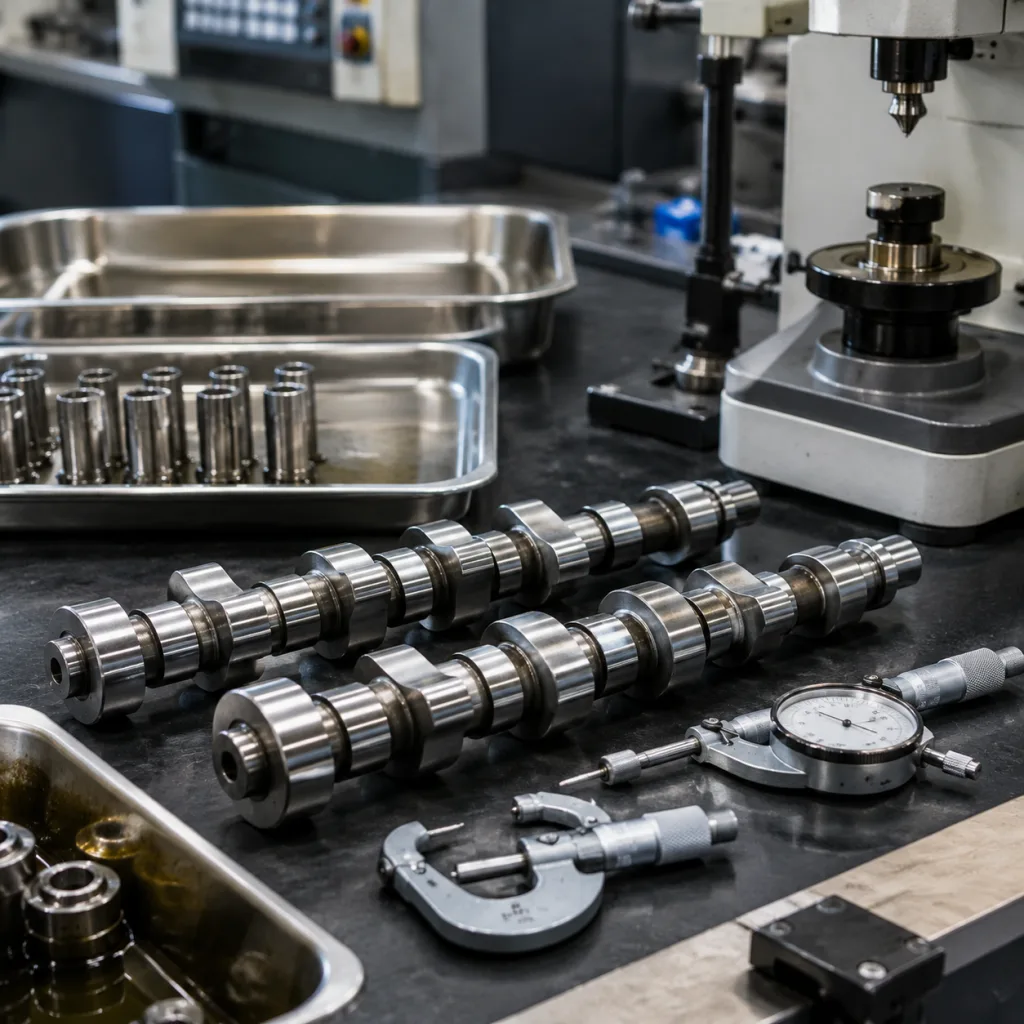
Camshaft life depends on the base material, heat treatment, and grinding control. Depending on the application, the part may be produced in chilled cast iron, cast steel, or another engineered steel grade specified by the engine family. The correct choice is the one that meets the original design intent and the buyer's durability target.

The machining sequence should control the following points:

  • Lobe geometry after grinding, not before.
  • Journal concentricity and surface finish.
  • Runout across the full shaft length.
  • Cleanliness before packing and shipment.
  • Corrosion protection for ocean freight and storage.

For EU and UK supply chains, ask for a REACH (EC) No 1907/2006 declaration where required. For broader commercial control, request the material certificate, heat number traceability, and the internal inspection standard used for the lot.

Validation and Quality Control

Process control matters because a camshaft is a timing-critical component, not a simple turned part. Buyers should look for production systems built around IATF 16949:2016 and ISO 9001:2015, then confirm that the part family has been validated by dimensional inspection and controlled release.

At minimum, a serious supplier should be able to provide:

  • First-article or sample inspection data.
  • Lot traceability and packaging records.
  • Hardness or case-depth evidence where applicable.
  • Incoming and final inspection checkpoints.
  • Photo records that show the drive end, lobes, and journals.

Certification is necessary, but it is not a substitute for fitment validation. Ask for the quality system details on our quality system before you place a reorder. If your organisation needs PPAP-style support or plant-level documentation, that should be agreed before the first production lot is released.

How to Source the Right Replacement

For distributors, repair chains, and importer programmes, the most efficient sourcing process is to standardise the data package before you ask for price. That reduces mismatch claims, returns, and avoidable downtime at the workshop level.

Send these inputs with the enquiry:

  • VIN and engine code.
  • Intake or exhaust position.
  • Model year and market.
  • Old-part photos from both ends.
  • Measured dimensions if the OE number is unavailable.
  • Label, carton, or casting photos if the part is already removed.

If you need a private-label programme, lot-controlled packaging, or a form factor that matches a local distribution channel, use custom manufacturing to define the scope before sampling. For routine replenishment, a validated standard part is usually the fastest route. For fleet or multi-site repair groups, the main objective is repeatability: the same geometry, the same packing, and the same documents on every shipment.

Frequently asked questions

Use the VIN, engine code, model year, and intake or exhaust position first. Then compare journal sizes, sensor features, and overall length against the OE drawing or a verified sample before ordering.

Yes, if it is dimensionally matched, traceable, and backed by inspection records. Ask for material data, hardness evidence where applicable, and a lot-level dimensional report before release.

Request the dimensional report, material certificate, traceability details, packaging specification, and quality-system references such as IATF 16949:2016 or ISO 9001:2015. For EU supply, ask for REACH documentation if required.

If you need a verified supply route for this part family, send the VIN, engine code, and sample photos through [request a quote](/contact.html)

Request a Quote
Check Why it matters What to request
Journal diameter and spacingControls oil film and bearing fitMeasured report against the OE drawing
Lobe lift and base circleDetermines valve timing and liftProfile data or master comparison
Overall length and drive endAffects installation and timing alignmentFull-length inspection record
Sensor trigger featuresAffects ECU signal qualityPhoto and dimensional confirmation
Surface finish and hardnessDrives wear lifeMaterial and hardness certificate