Camshaft Honda Manufacturer China: Sourcing Checklist
Buying a Honda-fit camshaft from a Chinese supplier is a technical sourcing task, not a commodity purchase. Buyers need the right lobe profile, journal geometry, surface hardness, and traceable lot control, then they need proof that the factory can hold those requirements at export volume. Driventus is an independent aftermarket manufacturer; brand names are referenced for fitment only. For procurement teams, the main questions are simple: can the supplier hold drawing dimensions, can it document heat treatment and inspection, and can it ship consistently on the agreed schedule? The answer should be visible in the factory's quality records, not in sales claims. This guide covers the sourcing points that matter for repeat business, including fitment review, material route, validation tests, and the documents a buyer should ask for before placing a trial order.
What buyers should verify before placing an order
For a camshaft programme, fitment is only the starting point. Buyers should confirm the engine code, valve layout, bearing count, drive type, and whether the part is for intake, exhaust, or a matched pair. The supplier should also state the drawing revision, surface finish target, and packaging requirement.
A practical supplier review should cover:
- Dimensional control on journals, lobe height, base circle, and overall length
- Hardness and heat-treatment records tied to batch numbers
- Traceability from raw material heat to finished carton
- Sample approval method for first article and production release
- Export documentation and carton marking for multi-warehouse distribution
For broader engine sourcing, see our catalog and engine components. If you need a process review, the quality system should show how inspection, calibration, and nonconformance handling are controlled. If the fitment is confirmed but the profile needs adjustment, custom manufacturing is the right route.
Material, heat treatment, and geometry
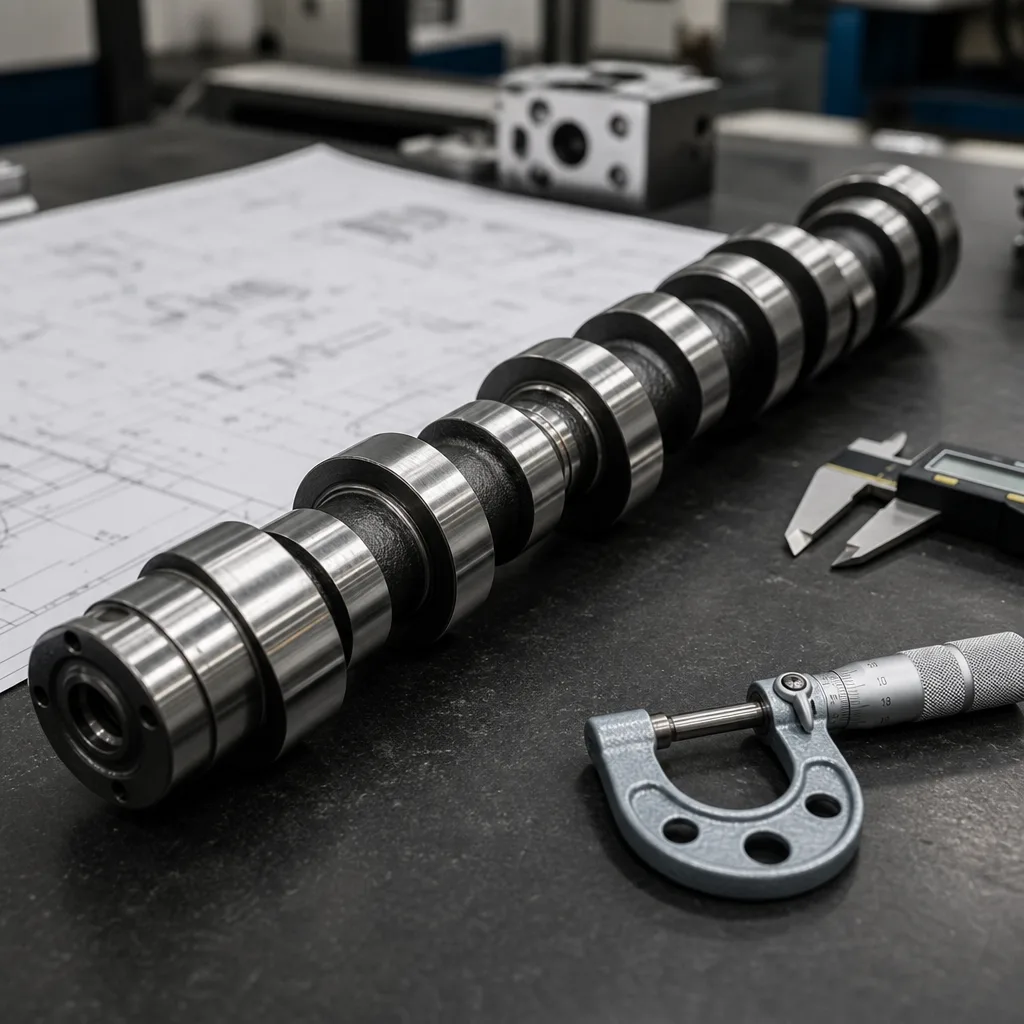
The right material route depends on the duty cycle and the target cost. Many replacement camshafts use chilled cast iron or alloy steel; higher-load applications may require a forged or billet route. What matters is whether the supplied geometry survives the duty profile without premature wear or loss of lift.
Key control points include:
- Lobe lift and base circle consistency
- Journal diameter and concentricity
- Runout across the full shaft
- Surface hardness and case depth where specified
- Roughness on bearing and follower contact areas
A buyer should ask the factory to show the heat-treatment method, the hardness test location, and the inspection plan for every batch. The process needs to fit the drawing, not the other way around. If a supplier cannot connect the measured hardness and dimensions to a lot number, the part is not ready for stable B2B supply.
For EU and UK buyers, REACH (EC) No 1907/2006 should also be considered when coatings, oils, or packaging materials are specified.
Production routes compared
The right production route depends on volume, engine duty, and the level of dimensional repeatability required. The table below shows the usual trade-offs buyers evaluate when sourcing a Honda-fit camshaft from China.
| Production route | Main strength | Main limitation | Typical use |
|---|---|---|---|
| Chilled cast iron | Good wear resistance and stable cost | Less flexible for custom profiles | High-volume replacement lines |
| Forged steel | Strong fatigue margin under load | Higher cost and more machining | Performance or heavy-duty applications |
| Billet steel and CNC finishing | Fast tooling change and profile control | Lowest cost efficiency at scale | Low-volume, prototype, or special-order runs |