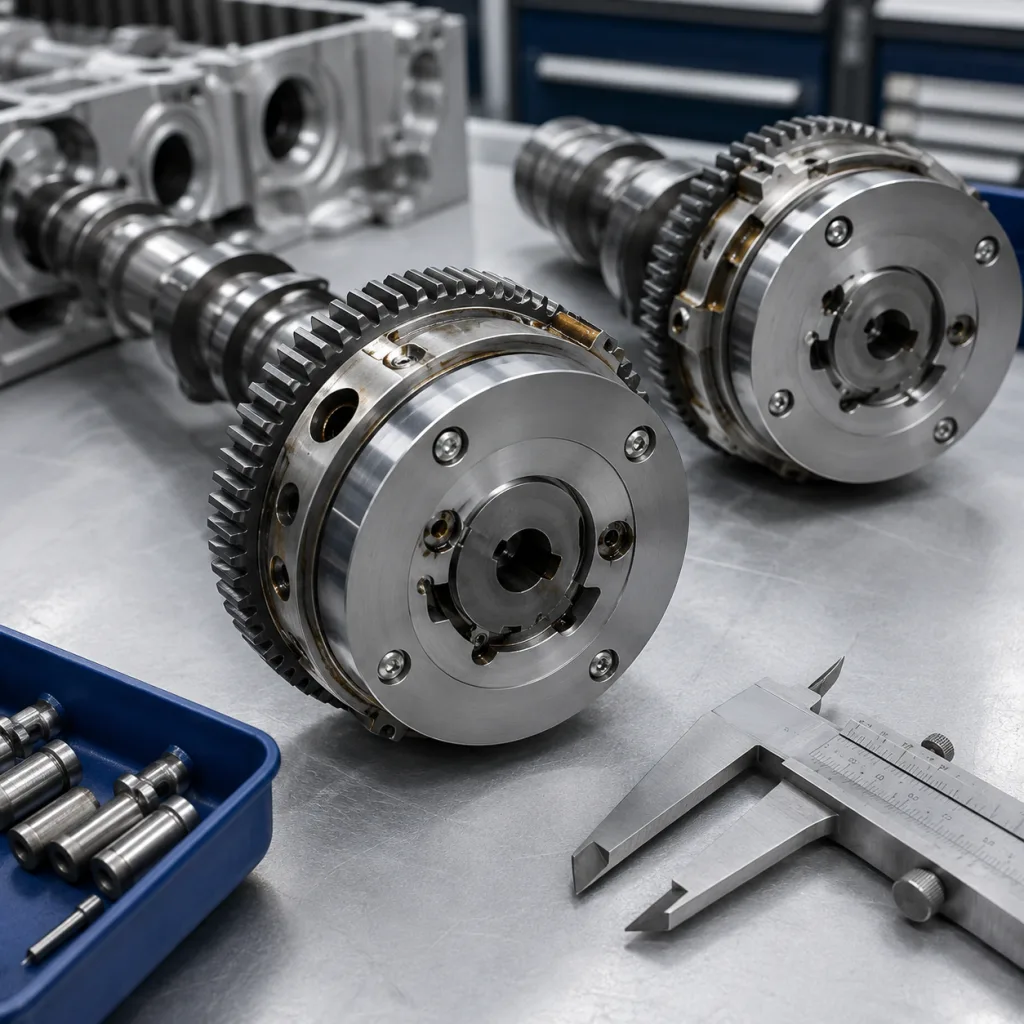
A camshaft for Honda Accord OE equivalent replacement has to match far more than lobe count and overall length. For distributors, repair-chain buyers and import managers, warranty exposure often starts with small deviations: journal diameter, cam lobe lift, thrust face width, oil-hole location, surface hardness, runout, or phasing at the sprocket or phaser interface. These details influence valve timing, idle quality, lubrication, wear rate and installation confidence.
This article explains how Driventus evaluates OE-equivalent camshafts for Honda Accord engine applications, what procurement teams should confirm before ordering, and which production controls help reduce batch-to-batch variation. Driventus manufactures engine and powertrain components in Taizhou, Zhejiang, and exports to more than 60 countries. Our IATF 16949:2016 and ISO 9001:2015 quality-management framework supports dimensional inspection, material traceability and process control for aftermarket and private-label programmes. Driventus is an independent aftermarket manufacturer; brand names are referenced for fitment identification only.
What OE-equivalence means for Accord camshafts
OE-equivalence means the replacement camshaft is engineered to fit and function in the intended engine application without requiring changes to mating components. It does not mean the part is genuine, original equipment, or approved or endorsed by the vehicle manufacturer.
For Honda Accord applications, buyers should treat the camshaft as a precision valve-timing component rather than a commodity casting. The design must correspond with the cylinder head, valve train, cam gear or phaser interface, oil feed layout, thrust control and position sensor target where applicable. A visually similar shaft can still create timing, lubrication or noise issues if the profile or interfaces are not controlled.
A sourcing file should normally include:
Engine application and model-year range, not only the vehicle name
Market region, because the same model name may cover different engines
Intake or exhaust camshaft position, where separate shafts are used
Verified OE part-number cross-reference, when available from the buyer’s data
Material grade and heat-treatment or hardening route
Key dimensions and the agreed inspection method
Packaging requirement for export handling and corrosion prevention
Warranty return analysis and corrective-action process
A camshaft for Honda Accord OE equivalent supply programme should start with controlled sample measurement. Matching the appearance of an original part is not enough. Journal and lobe geometry must be checked against drawings, approved master samples or reverse-engineered data accepted by the buyer.
Check point
Why it matters
Typical inspection method
Journal diameter and roundness
Controls oil clearance, bearing support and lubrication stability
Micrometer, air gauge, roundness tester
Cam lobe lift and base circle
Determines valve opening, valve lift and timing behaviour
Cam profile measuring system
Lobe phasing
Maintains valve timing accuracy across cylinders
CMM or dedicated cam gauge
Thrust face width
Helps prevent axial movement, noise and accelerated wear
Vernier, CMM, fixture gauge
Oil-hole position
Supports correct lubrication to journals and lobes
Optical inspection, pin gauge, fixture check
Sprocket or phaser interface
Ensures timing component fit and correct angular location
Spline, keyway, dowel or bolt-pattern gauge
Runout and straightness
Reduces vibration, binding and uneven journal loading
Dial indicator, V-block fixture, CMM
Surface roughness
Affects wear-in behaviour and oil film retention
Surface roughness tester
</tr></thead><tbody> </tbody></table>Driventus can support dimensional reports for agreed characteristics before mass production. For mature aftermarket references, buyers often specify first-article inspection on multiple pieces from the pilot run, followed by batch inspection under an agreed sampling plan. Where tolerances are controlled by the buyer, Driventus follows the approved drawing or validated master sample rather than substituting unverified catalogue values.
Material, hardness and surface finish controls
Camshaft durability depends on the base material, casting or forging control, machining stability and final surface treatment. Depending on the engine design, camshafts may use chilled cast iron, alloy cast iron or steel. The selected route must be compatible with the follower design, lubrication regime and expected service environment.
Procurement teams should request a clear material and process statement, including:
Material grade or buyer-approved equivalent
Casting, forging or billet route, where relevant to the part design
Heat treatment or induction hardening parameters where applicable
Surface hardness range on lobes and journals
Case depth requirement if specified by the drawing
Straightness and runout controls after machining and heat treatment
Final cleaning, rust prevention and packaging method
Surface finish is especially important because the cam lobe and follower interface carries high contact stress. Excessive roughness can accelerate wear during break-in, while unsuitable polishing may reduce oil retention. Driventus applies controlled machining, grinding and inspection steps according to part design and customer requirement.
For regulated export markets, material declarations and substance controls may be requested under REACH (EC) No 1907/2006 or other customer compliance programmes. Driventus can align documentation requirements during quotation and production planning so the commercial offer matches the destination-market requirements.
Validation testing for replacement programmes
A replacement camshaft should be validated before a distributor commits to a large replenishment order. The most useful validation process combines dimensional review, bench checks and application-level feedback from controlled installations. This is particularly important when a catalogue reference covers several model years, engine variants or regional specifications.
Common validation steps include:
Drawing or master-sample comparison
First-article inspection report
Hardness and metallographic checks where required
Runout and straightness verification
Cam profile measurement across all lobes
Trial assembly with mating components
Confirmation of sprocket, phaser, sensor target or dowel alignment
Packaging drop or vibration review for export shipments
Field monitoring of early warranty returns
Driventus operates under a quality system structured around IATF 16949:2016 and ISO 9001:2015. These standards do not certify a specific camshaft as vehicle-manufacturer-approved, but they define management-system requirements for process control, traceability, corrective action and continual improvement.
For repair-chain buyers, the validation target is consistent fitment and predictable service life. For importers and wholesalers, the priority is reducing mixed-stock risk, mis-boxing, corrosion during transit and avoidable returns caused by dimensional variation or unclear application data.
Sourcing checklist for importers and distributors
Before placing a production order, buyers should align the commercial file with the engineering file. This reduces disputes when the same vehicle name covers multiple engines, emissions specifications or regional variants. It also helps suppliers quote the correct inspection scope instead of pricing only against a part description.
Recommended purchasing checklist:
Confirm engine code, application years and market region
Identify intake, exhaust or single camshaft requirement
Share OE cross-reference only when available from verified data
Confirm whether a drawing, sample or previous supplier reference will control the order
Approve packaging label format, barcode content and carton strength
Define inspection characteristics and AQL or sampling method
Confirm rust-prevention period for ocean freight and storage
Agree MOQ, lead time and spare stock policy
Request batch traceability and lot marking
Define warranty claim evidence required for analysis
Driventus can supply standard aftermarket references and support custom manufacturing for private-label or buyer-controlled drawings. For a camshaft for Honda Accord OE equivalent programme, customisation may include packaging, inspection documentation, surface treatment confirmation, corrosion protection, or adaptation to a specific regional application list.
A stable sourcing programme also needs clear change control. If a machining fixture, material supplier, heat-treatment route, inspection gauge or packaging specification changes, the buyer should be notified according to the agreed production approval process.
How Driventus supports OE-equivalent camshaft supply
Driventus is a vertically integrated Chinese manufacturer of engine and powertrain components, including pistons, crankshafts, gaskets, water pumps, turbochargers and camshaft-related engine parts. The company is based in Taizhou, Zhejiang, and supplies B2B customers in the EU, UK, US, Canada, Australia, Brazil and other markets.
For camshaft sourcing projects, our team can support:
Application confirmation against buyer data
Sample development from drawing or approved master sample
Dimensional inspection reports for key characteristics
Material and process traceability by batch
Export packaging suitable for long-distance logistics
Private-label carton and label configuration
Corrective action support for verified quality claims
Documentation planning for buyer-specific compliance needs
Driventus does not claim approval or endorsement by any vehicle manufacturer. The objective is OE-equivalent fit, function and durability for independent aftermarket replacement channels. Buyers comparing multiple supply options should evaluate more than unit price: tooling condition, measurement capability, packaging reliability, communication speed, traceability and willingness to document process controls all affect total landed cost.
If your team is building a camshaft programme for Accord applications, prepare the engine list, annual volume, target market and any available drawings or samples before quotation. A clearer technical file allows faster feasibility review, more accurate pricing and fewer changes after sampling.
Frequently asked questions
No. OE-equivalent means the aftermarket camshaft is designed to match the intended fit and function of the original application. It does not indicate genuine-brand supply, vehicle-manufacturer approval or endorsement. Driventus is an independent aftermarket manufacturer; brand names are referenced for fitment identification only.
Provide the engine code, model-year range, market region, intake or exhaust position, expected annual volume, packaging needs and any verified OE cross-reference or sample. Drawings or master samples help confirm dimensions, lobe profile, oil-hole position, runout requirements and sprocket or phaser interface.
Yes. Driventus can support private-label cartons, labels and export packaging requirements for distributors and repair-chain programmes. Packaging details should be agreed during quotation so carton strength, corrosion protection, barcodes and batch identification match the buyer’s logistics process.
For dimensional review, sample discussion or programme pricing, send your application list and sourcing requirements to Driventus and [request a quote](/contact.html).