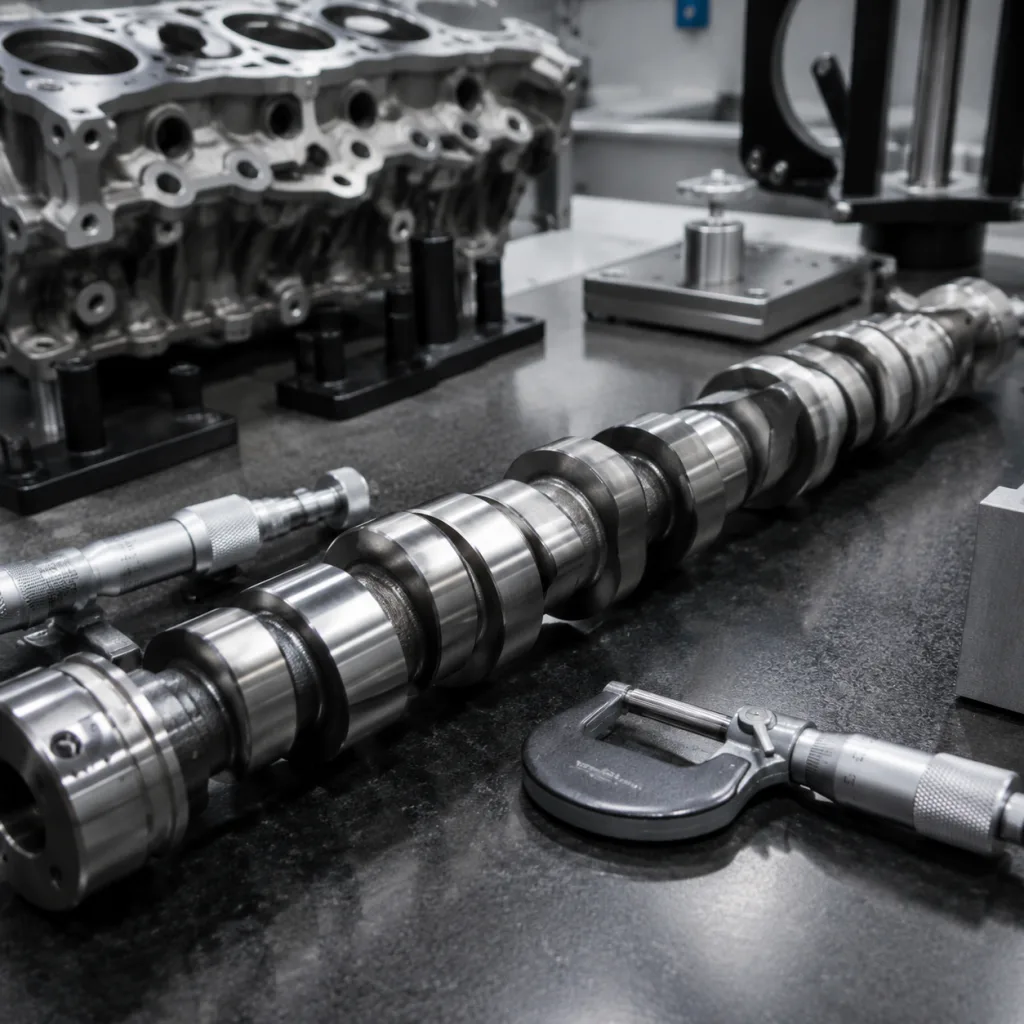
A camshaft for Genesis G70 OE equivalent replacement has to do more than look like the original part. It must match the required valve timing geometry, bearing journal dimensions, lobe profile, oil-feed design, surface finish and camshaft position sensor interface for the specified engine application. For importers, wholesalers and repair-chain buyers, the sourcing risk is not only fitment at installation; it is whether the supplier can hold metallurgy, machining, heat treatment and inspection standards across repeat production lots. Driventus manufactures engine and powertrain components in Taizhou, Zhejiang, for aftermarket distributors, wholesalers, OEM/Tier-1 programmes and multi-location repair networks. Our camshaft supply process is built around drawing review, sample verification, production control plans and documented inspection under IATF 16949:2016 and ISO 9001:2015. This guide outlines the technical checks procurement teams should use when evaluating an OE-equivalent Genesis G70 camshaft, including cross-reference discipline, material validation, timing accuracy, compliance awareness and packaging controls for international distribution.
What OE Equivalence Means for This Camshaft
For a camshaft application, OE equivalence means the replacement part is engineered to match the functional requirements of the original component for the stated engine, production period and valve-train layout. It does not mean approval, endorsement or licensing by the vehicle manufacturer. Driventus is an independent aftermarket manufacturer; brand names are referenced for fitment identification only.
A Genesis G70 engine camshaft must maintain the intended valve lift, duration, phase relationship, journal alignment and oiling path within the engine family it is supplied for. Small deviations can affect idle quality, emissions performance, oil pressure at the journals, variable valve timing response or diagnostic sensor readings. This is especially important where visually similar intake and exhaust camshafts, or left-bank and right-bank versions, differ by trigger wheel orientation, oil passage detail or lobe indexing.
For a replacement programme, procurement teams should confirm at least the following before moving from quotation to order release:
Intake or exhaust position, including left/right bank where applicable
Engine code and model year range covered by the cross-reference
OE-style part-number mapping, stated generically where required, such as OE 24100… or OE 24200…
Camshaft position sensor trigger design and angular reference
Lobe lift, base circle diameter and journal diameter tolerances
Oil feed holes, grooves and end-feature configuration
Surface hardness and case depth after heat treatment
Packaging protection against corrosion and impact during ocean freight
Fitment tables should be checked against VIN-level or market-specific application data before bulk ordering. A distributor that supplies mixed engine variants should avoid treating all Genesis G70 camshafts as interchangeable, even when catalogue descriptions appear close.
Critical Dimensions and Validation Checks
Dimensional matching is the main control point for an OE-equivalent camshaft. A visual match is not sufficient because the functional differences may be measured in microns or degrees. The part should be measured against an approved drawing, master sample or reverse-engineered specification, and those measurements should be linked to lot-level inspection records that can be reviewed after shipment if a field question arises.
Control item
Typical procurement requirement
Why it matters
Journal diameter
Drawing tolerance, commonly controlled in microns
Maintains oil film and bearing clearance
Cam lobe lift
Matched to OE functional profile
Controls valve opening and engine breathing
Base circle runout
Measured on precision centres
Helps prevent valve-train noise and uneven wear
Sensor trigger angle
Verified against reference datum
Avoids cam/crank correlation fault codes
Straightness
Checked before and after heat treatment
Reduces binding in the cylinder head
Surface roughness
Controlled on journals and lobes
Supports oil-film stability and wear resistance
Surface hardness
Confirmed by batch test
Improves durability under boundary lubrication
</tr></thead><tbody> </tbody></table>Driventus uses incoming material checks, machining in-process inspection, heat-treatment verification and final dimensional inspection before shipment. For larger B2B orders, PPAP-style documentation can be prepared where the customer requires it, although the exact submission level depends on the programme agreement and the technical data available.
Where emissions-related operation may be affected by valve timing, buyers should also consider the regulatory environment of the target market. Standards and regulations such as ECE R-83 and US emissions frameworks are vehicle-level requirements, not camshaft component approvals. However, replacement parts must not introduce avoidable timing, drivability or diagnostic deviations that would compromise compliant vehicle operation.
Material, Heat Treatment and Surface Control
Camshaft durability depends on material selection, casting or forging quality, surface treatment and lubrication compatibility. Depending on the engine design and customer specification, an OE-equivalent camshaft may use chilled cast iron, alloy cast iron, forged steel or assembled steel construction. The correct option is determined by the original component architecture, contact stress, follower type and expected load conditions.
Typical technical controls include:
Chemical composition verification by heat batch
Microstructure checks after casting or heat treatment
Induction hardening or equivalent lobe hardening process control
Surface roughness measurement on journals and lobes
Crack inspection where specified by the control plan
Straightness and runout checks after key thermal processes
Anti-corrosion oiling and sealed packaging before export
The cam lobe surface must resist scuffing during start-up and low-lubrication conditions, when boundary lubrication can occur before stable oil film is established. Journal surfaces need consistent roughness so oil film formation is not disrupted and bearing clearance remains predictable. If the camshaft uses a pressed or assembled design, concentricity, axial location and torque resistance of the assembled features become additional inspection points.
Driventus aligns its production documentation with IATF 16949:2016 process discipline and ISO 9001:2015 quality management requirements. Buyers can review the broader quality system before supplier qualification, sample approval or factory audit planning.
Cross-Reference Discipline for Genesis G70 Programmes
Cross-referencing is where many replacement camshaft errors enter the supply chain. A catalogue record should connect the part to engine code, production period, intake/exhaust position, valve-train configuration and market region. A generic OE reference such as OE 24100… can help procurement teams align fitment families, but final validation should be done against the customer application list and, where available, a confirmed sample or drawing.
Driventus maintains application and product data for engine components in our catalog, with related engine component families available under engine components. For customers with private-label catalogues, we can support cross-reference mapping, carton labelling data, barcode structure and master sample comparison.
Procurement checks before order release
Before confirming a camshaft for Genesis G70 OE equivalent supply, buyers should ask for:
Application list by engine code, year range and market
Intake/exhaust and bank-position identification
Drawing, sample or measurement confirmation method
Inspection report format and AQL plan
Minimum order quantity and forecast assumptions
Packaging specification for sea freight, air freight or regional warehousing
Batch traceability format on cartons and product labels
Any private-label, barcode or cross-reference data requirements
Clear cross-reference control reduces returns, installation delays and inventory write-offs. It also helps wholesalers avoid mixing near-identical parts that differ only in trigger wheel orientation, oil passage layout, end feature or production-period detail.
Testing, Compliance and Export Packaging
A replacement camshaft should be validated before volume shipment. The exact test scope depends on the customer programme, but a credible supplier should be able to show how fitment, dimensions and durability-related features are controlled from sample approval through repeat production.
Common validation evidence includes dimensional reports, hardness readings, material certificates, runout data, surface roughness records, coating or anti-rust confirmation and installation trial feedback where applicable. For high-volume programmes, sample parts can be inspected against a retained master sample before production release. Where customers need a special material, surface treatment or package configuration, Driventus can support custom manufacturing based on drawings, samples or agreed technical specifications.
Export controls should also cover chemical and packaging obligations. For EU-bound supply chains, REACH (EC) No 1907/2006 is relevant to substance declarations and restricted substances management. Depending on the destination and sales channel, buyers may also request material declarations, country-of-origin documentation or packaging details for customs and warehouse intake.
Packaging should protect lobes and journals from contact damage, corrosion and condensation during long transit. Individual sleeves, VCI protection, separators, end protection and reinforced cartons are commonly used for camshafts. For palletised shipments, cartons should be arranged to prevent crushing and movement during container handling.
A well-specified shipment should arrive with stable part identification, protected machined surfaces and documentation that links the goods to the production batch.
How Buyers Should Compare Supplier Offers
Price comparison is useful only when the technical scope is the same. A lower quotation may exclude hardness testing, individual packaging, traceable inspection data, sample approval, corrosion protection or market-specific labelling. For importers serving the EU, UK, US, Canada, Australia and Brazil, these omissions can create costs later through claims, rework, relabelling, delayed customs clearance or customer returns.
A practical supplier comparison should cover:
Confirmed OE-equivalent geometry and engine application data
Manufacturing route and material specification
Quality certification, including IATF 16949:2016 and ISO 9001:2015
Inspection record availability by batch
Sample approval process before mass production
Lead time for trial order and repeat order
Export carton strength, corrosion protection and palletisation
Support for private-label, barcode and cross-reference data
Communication process for engineering changes or fitment questions
Driventus can quote replacement camshafts as individual SKUs or as part of broader engine component sourcing. Buyers managing multiple product lines often combine camshafts with pistons, crankshafts, gaskets, water pumps and turbochargers to simplify supplier qualification, consolidate shipments and improve container planning.
For a sourcing file, the strongest offer is usually the one that makes the technical assumptions visible before production starts. That means the buyer can compare not only unit price, but also inspection scope, packaging standard, documentation level and the supplier’s ability to support repeat orders consistently.
Frequently asked questions
Yes. Driventus can review generic OE-style references, engine code, intake/exhaust position, market application and sample data to confirm the correct replacement camshaft. Brand names are used only for fitment identification.
Depending on the programme, Driventus can provide dimensional inspection reports, material records, hardness data, surface roughness or runout records, packaging specifications and batch traceability information. PPAP-style submissions can be discussed for qualified projects.
No. OE equivalent means the replacement part is designed to match original functional requirements for the intended application. Driventus is an independent aftermarket manufacturer; brand names are referenced for fitment only.
For application confirmation, sample review or a landed-cost quotation for Genesis G70 replacement camshafts, send the engine code, target market and forecast volume. You can [request a quote](/contact.html).