Camshaft Ford Wholesale: Supplier Specs and Sourcing
Buying a Ford camshaft for wholesale supply is not only a price exercise. Procurement teams need repeatable dimensions, stable lead times, clean documentation, and a supplier that can support both catalogue buying and drawing-based production. For aftermarket distributors, repair networks, and OEM-linked programmes, the main risks are variation in lobe geometry, inconsistent heat treatment, and weak traceability across batches. This article explains what to verify before placing an order, how to compare material and inspection data, and how to reduce landing cost without losing control of quality. Driventus is an independent aftermarket manufacturer; brand names are referenced for fitment only.
What buyers should verify before placing an order
A camshaft is a precision rotating component, so the first check is fitment data, not unit price. Before you issue a PO, confirm the engine code, valve train layout, journal count, thrust face design, overall length, base circle, lobe lift, and trigger features if the application uses cam sensing.
For wholesale supply, buyers should ask for the following at the quotation stage:
Drawing or OE cross-reference on the application sheet
Nominal dimensions and critical tolerances
Material grade and heat-treatment route
Surface finish or coating specification
Packaging method and rust-prevention method
Inspection report format and lot traceability
If you are consolidating engine-family sourcing, it helps to review our catalog alongside the broader engine components range so you can compare related parts on one purchasing cycle.
Material and dimensional control
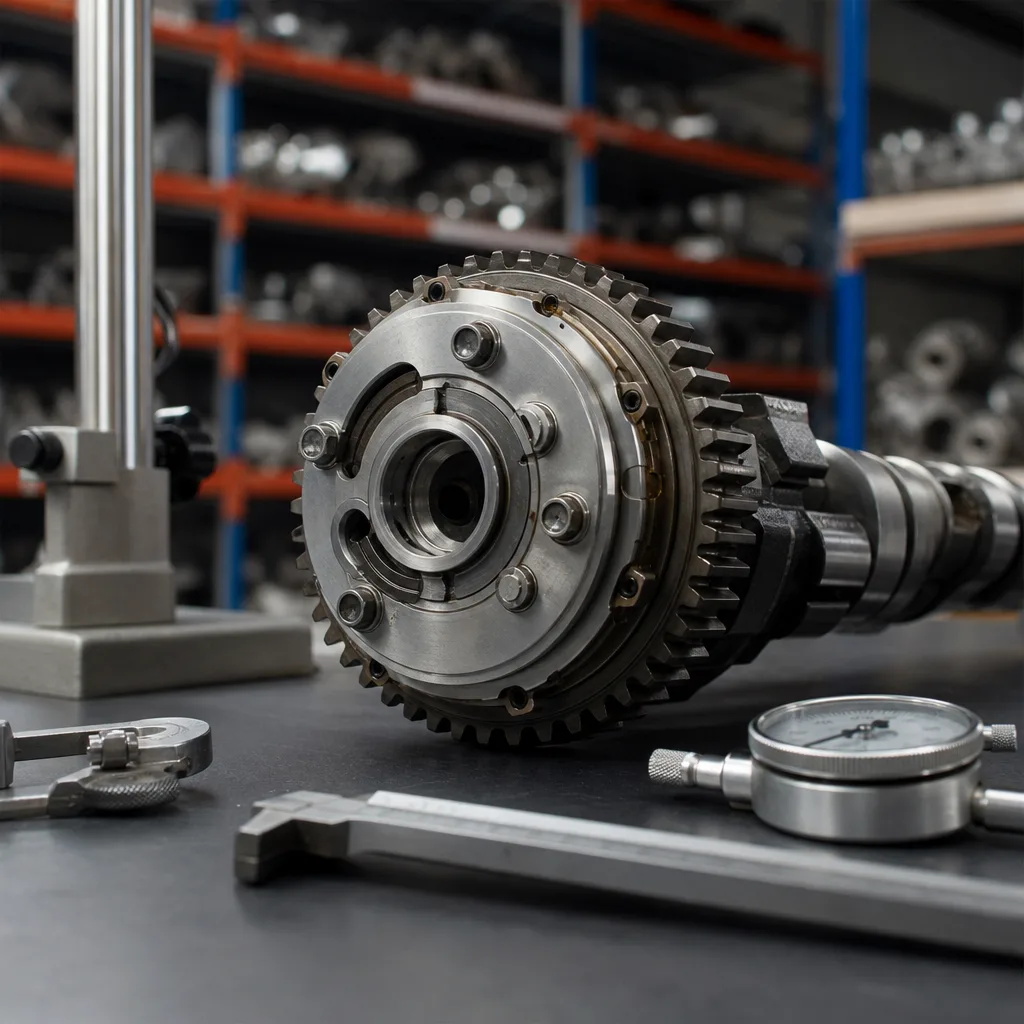
The best wholesale programme is one where the buyer can see how the part was made, not just what it costs. For camshafts, dimensional control should cover journal diameter, lobe height, lobe index, runout, and surface finish. Heat treatment should be controlled by process, not by guesswork, because hardness variation can change wear rate and valve timing stability.
Check item
What to verify
Why it matters
Base material
Casting, forging, or billet route
Affects stiffness, machinability, and cost
Hardness profile
Core and surface hardness records
Supports wear resistance and fatigue life
Runout
Measured on key journals
Limits vibration and timing scatter
Lobe geometry
Lift, duration, and index consistency
Protects valve event repeatability
Surface condition
Finish quality and coating data
Reduces break-in wear and scuffing
</tr></thead><tbody> </tbody></table>For export programmes, request process records aligned with IATF 16949:2016 and ISO 9001:2015, plus material declarations for REACH (EC) No 1907/2006. If a coating is specified, ask for the applicable test method and validation data, including SAE J2527 where relevant.
Common inspection points
A practical inspection plan usually includes first-article inspection, in-process checks on critical diameters, and final verification of lobe profile, concentricity, and packaging integrity. If the supplier cannot explain where each measurement is taken, the programme is not ready for production supply.
Fitment, OE cross-references, and validation
Wholesale buyers often work from OE references, but the part should be validated by application, not by name alone. Cross-reference data is useful for filtering, yet the final approval should be based on engine family, emissions version, and physical confirmation of the cam profile. That is especially important when the same platform has multiple lifter types, sensor patterns, or calibration variants.
Do not treat an OE reference as endorsement. Instead, use it to build a fitment matrix that includes engine code, model year, emissions family, and any changes to valve lift or timing. For emission-sensitive applications, buyers may also need to check local requirements and engine family documentation against rules such as ECE R-83 where applicable.
A robust validation package should include:
Dimensional report from a calibrated measurement system
Material certificate and heat-treatment summary
Photographic packing record for incoming inspection teams
Label traceability back to the lot or batch number
Sample retention plan for dispute resolution
This approach lowers the risk of returns, missed timing events, and field failures after installation.
Wholesale terms that affect total landed cost
The quote is only one part of the sourcing decision. Buyers should compare MOQ, lead time, tooling ownership, packing specification, and documentation burden. A low unit price can become expensive if the supplier cannot hold the same profile across repeated orders or if the packaging fails during sea freight.
When you compare suppliers, ask these questions:
Can the supplier support blank supply, machining, heat treatment, grinding, and final inspection in one programme?
Is the shipment packed with corrosion protection, edge separation, and lot labels that survive transit?
Can the supplier support audit requests and corrective-action follow-up?
Are samples, mass-production parts, and replacement runs built to the same control plan?
If you are comparing suppliers side by side, review our quality system and custom manufacturing before you issue an RFQ. That makes it easier to separate a true manufacturing partner from a trader that can only move stock.
Why Driventus fits procurement-led sourcing
Driventus is set up for B2B buyers who need predictable supply, not speculative spot buying. We work on programmes that require stable specifications, documented inspection, and export-ready packing for distributors, wholesale channels, and technical buyers.
For buyers sourcing a Ford camshaft at scale, the operational advantages are straightforward:
Clear application control by drawing or fitment reference
Repeatable batch documentation for incoming QA teams
Support for private-label or drawing-based production
Export packing designed for container and pallet handling
Responsive quotation based on volume, documentation, and finish requirements
Our target is to make sourcing simpler for procurement teams that need one supplier to support multiple engine families and repeat orders. Use request a quote when you need pricing against a drawing, an OE cross-reference, or a monthly demand plan.
Frequently asked questions
Send the engine code, application details, target annual volume, drawing or cross-reference data, required finish, and packaging requirements. If you have a sample, include photos and key dimensions.
Yes. Drawing-based production is suitable when you need a controlled profile, a private-label programme, or a replacement part that must match an existing spec. We review the drawing before confirming process and inspection points.
Typical documents include the commercial invoice, packing list, and batch or lot traceability records. On request, we can add inspection reports, material declarations, and other quality documents needed by your receiving team.
If you need a controlled Ford camshaft supply line, send your drawing, engine code, target volume, and packaging requirements. Start with [request a quote](/contact.html).