cylinder sleeve · 2026-06-16

Cylinder Sleeve Audi Supplier: B2B Sourcing Guide

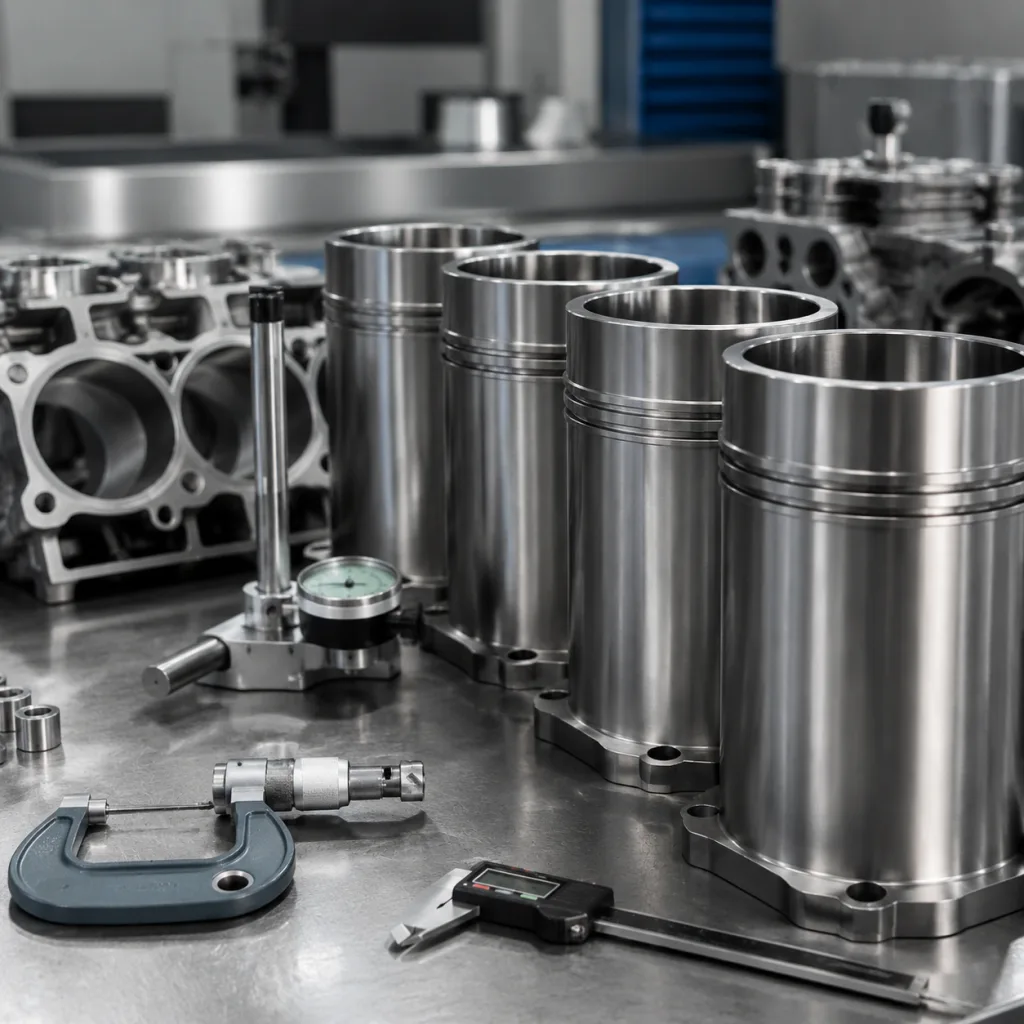
Choosing a cylinder sleeve Audi supplier is less about finding a part that fits once and more about finding a process that repeats. For procurement teams, the real questions are whether the supplier can hold metallurgy, bore geometry, traceability, packing, and lead time across batches—not just on a sample. Driventus manufactures cylinder sleeves and related engine components in Taizhou, Zhejiang, supporting distributors, engine rebuilders, repair-chain supply teams, and OEM or Tier-1 buyers. Typical sourcing discussions cover casting grade, centrifugal casting controls, finish-machining allowance, flange design, outside-diameter tolerance, inner-bore roughness, anti-corrosion protection, and batch documentation. Buyers should also define acceptable tolerance bands, MOQ by SKU, mixed-order logic, sample approval timing, and whether prices are quoted for semi-finished or finished-bore sleeves. This guide focuses on how to avoid the usual sourcing traps, compare suppliers on evidence, and lock down specifications before you place an order. Driventus is an independent aftermarket manufacturer; brand names are referenced for fitment only.

Start With the Failure Modes

The fastest way to mis-source a sleeve is to treat every Audi-fit application as interchangeable. In practice, the failure modes are predictable: the sleeve is quoted as finished when it is actually semi-finished, the OD tolerance is stated without the block measurement method, the material is acceptable on paper but unstable in production, or the packing fails after export transit.

Before asking for pricing, confirm the variables that drive fit and cost:

  • Engine application, bore family, sleeve length, flange requirement, and installation method
  • Semi-finished or finished inner diameter condition, including final machining allowance if semi-finished
  • Cast iron grade, hardness range, graphite structure, and any buyer-specific microstructure requirement
  • Outside-diameter tolerance, wall-thickness control, and target interference after block measurement
  • Critical dimensions such as OD, ID, flange OD, flange thickness, overall length, chamfer, and radius
  • Batch size, annual volume, release frequency, and delivery schedule by destination market
  • Packaging standard, palletisation requirement, corrosion protection period, and carton label format
  • Required documentation, such as inspection report, material certificate, process flow, control plan, and packing list

If the RFQ does not include a drawing, a sample, or a confirmed reference measurement, expect supplier quotes to vary. That is usually a specification problem, not a pricing problem. For many dry sleeves, buyers specify OD tolerance in the 0.01–0.03 mm range and use their own interference standard, commonly around 0.03–0.08 mm depending on block material, sleeve diameter, and installer practice. Those figures should only be used as a procurement reference until the buyer validates them against the actual engine block.

A competent supplier will push back on incomplete data. If a quote arrives without questions, that is not always a good sign. It can mean the supplier is pricing from assumption rather than process control. Driventus does not claim vehicle manufacturer approval or endorsement.

Compare Supplier Capability, Not Just Price

A low EXW number is easy to quote and hard to trust. The better comparison is whether the supplier controls casting, machining, inspection, and packing under one system—or whether those steps are split across subcontractors and corrected only at final inspection. Driventus is vertically integrated for engine and powertrain components, which helps align process control, traceability, and packing under one quality system.

Use the same audit lens for every candidate supplier:

</tr></thead><tbody> </tbody></table>The strongest suppliers can explain why two sleeves with the same nominal size may still require different machining or packaging controls. They can also show whether they sort parts to pass inspection or actually hold the process stable. Those are not the same thing.

Ask for at least one recent production traveller from blank to packed carton. It should show heat or batch number, machining sequence, in-process checks, final inspection status, and sign-off. For repeat business, request trend data for OD, ID, and hardness; even a simple lot summary is useful if it shows capability is stable, not merely screened.

Driventus operates under IATF 16949:2016 and ISO 9001:2015. Buyers can review our quality system when preparing a supplier file or pre-audit checklist.

Spec Deep-Dive: Material, Machining, Inspection

Cylinder sleeve performance depends on details buyers often under-specify. Material stability, wall consistency, and bore geometry after installation matter more than a clean-looking sample. Most Audi-fit aftermarket sleeve projects use pearlitic cast iron with controlled graphite structure and hardness suitable for honing, oil retention, and piston-ring seating. Common project targets may include hardness around 180–240 HB, tensile-strength class agreed by drawing, and microstructure limits for free ferrite, carbides, porosity, or abnormal graphite.

Typical inspection points include:

  • Chemical composition check by batch or heat, with C, Si, Mn, P, S and alloying elements recorded where required
  • Hardness test, often specified as an agreed HB range with sampling per heat, batch, or shift
  • OD, ID, flange diameter, flange thickness, shoulder height, total length, chamfer, and radius measurement
  • Roundness and cylindricity control where required by drawing, commonly controlled within 0.01–0.03 mm for critical finished features
  • Wall-thickness check at multiple clock positions to reduce risk of local weak sections after boring
  • Visual inspection for casting defects, burrs, dents, rust, chipped flange edges, and handling damage
  • Surface-finish verification for finished-bore sleeves, with Ra and honing-angle targets stated in the drawing
  • Fitment review against sample, drawing, or buyer-approved reference before production release

Two specification choices drive the rest of the job. First, is the sleeve finished or semi-finished? A finished-bore sleeve needs the final honing pattern, Ra target, and any plateau-honing requirement defined up front. A semi-finished sleeve needs a clear machining allowance so the local machine shop can reach final bore size after installation; many buyers request 0.20–0.50 mm ID allowance and 0.05–0.15 mm on selected faces, depending on installation distortion and the rebuilder’s process.

Second, what is the measurement method? OD tolerance without a defined measuring setup leads to disputes. A three-point bore gauge, temperature-controlled inspection area, and agreed measurement depth reduce those disputes and make incoming inspection defensible.

For broader engine-component sourcing, buyers can review our catalog and the engine-component range at /products/engine-components.html.

Step-by-Step: MOQ, Lead Time, and Order Plan

The commercial side of sourcing is easiest when you split the order into stages. MOQ and lead time depend on whether the sleeve uses an existing tool, a modified drawing, or a new casting and machining specification. Aftermarket distributors usually care about mixed-reference availability, stable labelling, and replenishment speed. OEM and Tier-1 buyers usually need a longer approval path because documentation and capacity planning affect the schedule.

A practical order plan looks like this:

1. Approve the drawing, sample, or confirmed reference data. 2. Request sample pieces for dimensional and installation checks. 3. Release a pilot quantity once measurement and fit are confirmed. 4. Move to scheduled replenishment only after claim rate and receiving inspection are stable.

Typical sourcing framework:

Audit item What to verify Procurement risk if missed
Casting controlMelt records, chemical composition checks, inoculation control, hardness samplingBore wear, cracking, inconsistent machinability
Centrifugal casting processPouring temperature control, rotation parameters, cooling records, blank identificationPorosity, segregation, wall-thickness variation
Machining capabilityCNC turning, boring, OD grinding, chamfer control, tool-life recordsInstallation interference variation, rework cost
Measurement systemCalibrated bore gauges, micrometers, height gauges, CMM where applicableUnstable dimensions between batches
TraceabilityHeat or batch coding, inspection records, operator route cards, packing batch linkDifficult containment after field complaints
PackingVCI protection, sleeve separation, export cartons, pallet wrappingRust, transit dents, mixed references
Corrective action8D response, non-conformance records, sorting and containment processSlow response to distributor claims

</tr></thead><tbody> </tbody></table>Price is usually built from three drivers: material and casting yield, machining cycle time, and inspection or documentation burden. A flanged sleeve with tight OD grinding and individual inspection is not comparable to a semi-finished straight sleeve sold in bulk. Buyers should also ask whether the quoted unit price includes VCI packing, private label, carton printing, inspection report, certificate of origin, and sea- or air-export packing.

A useful way to protect margin is to compare total landed cost, not unit price. A slightly higher unit cost can still win if the supplier reduces claim risk, sends cleaner carton labeling, and avoids receiving disputes. Driventus can discuss mixed-SKU consolidation, staged shipments, and private-label packing where legally permitted.

Q&A on Documentation and Export Readiness

When sourcing across borders, the paperwork matters almost as much as the sleeve itself. Import managers in the EU, UK, US, Canada, Australia, Brazil, and other active repair markets usually need both technical and commercial documentation. The goal is simple: customs should clear the shipment, receiving should verify it quickly, and any later complaint should be traceable to one lot.

Common documents include:

  • Commercial invoice, packing list, and bill of lading or airway bill
  • Certificate of origin where required by the destination market or trade agreement process
  • Batch inspection report with critical dimensions, sampling quantity, instrument ID, and inspection date
  • Material certificate or chemical composition summary when specified in the purchase order
  • Hardness report and surface-finish report for drawings that define HB, Ra, or honing requirements
  • Carton label format with part reference, quantity, batch, country of origin, and buyer SKU where applicable
  • Packaging photos before shipment when requested, including carton marks, pallet layout, and VCI method

A common question is whether export packing can be assumed. It should not. For precision sleeves, a workable standard is individual separation or sleeve wrapping, VCI bag or VCI paper, desiccant where the route justifies it, 5-ply export carton, pallet strapping, corner protection, and stretch wrap. For sea freight, buyers often request 6–12 months corrosion protection under normal storage conditions; for humid destinations, anti-rust oil type, VCI grade, and carton moisture resistance should be agreed before production.

For EU-market buyers, material and chemical compliance discussions may reference REACH (EC) No 1907/2006 where applicable to substances in articles and packaging. Quality-management expectations should be aligned with IATF 16949:2016 and ISO 9001:2015, but certification does not replace part-level validation, incoming inspection, or installation-process control.

If the sleeve you need does not match a standard catalog item, Driventus can support custom manufacturing based on drawings, samples, agreed tolerances, and a defined validation plan.

Scenario: How Buyers Should Shortlist Suppliers

A useful shortlist is built from evidence, not presentation. Request the same information from every supplier so the comparison highlights process control, documentation quality, and service readiness instead of a polished sales deck.

Use this checklist when comparing candidates:

  • Confirm whether the supplier manufactures the sleeve or only trades it
  • Request process flow, control plan, and sample inspection report for the target reference
  • Ask for casting and machining capability evidence, not only product photos
  • Review certificate validity for IATF 16949:2016 and ISO 9001:2015
  • Check response quality on OD tolerance, ID allowance, flange geometry, chamfer, and drawing interpretation
  • Confirm MOQ by SKU, mixed-order policy, sample cost, tooling cost, and replenishment lead time
  • Verify export packing, carton strength, pallet height, corrosion prevention, and label data fields
  • Ask how non-conforming goods are contained, reported, credited, replaced, or reworked

Imagine two quotes for the same sleeve. Supplier A gives the lowest unit price, but requires 500 pieces per SKU, provides no batch report, and treats packing as optional. Supplier B quotes slightly higher, accepts mixed 200-piece orders, includes OD/ID/flange inspection data, and ships with private-label cartons. In most procurement teams, Supplier B is the easier choice to manage because the hidden cost of uncertainty is lower.

A qualified cylinder sleeve Audi supplier should be able to explain the difference between dimensional conformance before shipment and functional fit after engine-block installation. Final performance still depends on the rebuilder’s block preparation, interference specification, pressing or cooling method, and honing process.

Driventus is an independent aftermarket manufacturer; brand names are referenced for fitment only.

Frequently asked questions

Yes. Driventus manufactures cylinder sleeves for Audi-fit aftermarket and project-based requirements, subject to confirmed engine application, drawing, sample, or specification. We do not claim approval or endorsement by any vehicle manufacturer.

Provide engine application, sleeve dimensions, flanged or non-flanged type, finished or semi-finished bore condition, target OD/ID tolerances, annual volume, destination market, packaging requirement, and any inspection documents required by your receiving team.

Yes. Custom sleeve projects can be reviewed from drawings, samples, or agreed dimensional targets. Tooling, sample inspection, material requirements, trial quantity, tolerance targets, and approval steps are confirmed before production.

If you are qualifying a cylinder sleeve Audi supplier for distributor stock or programme sourcing, send your drawing, sample details, target quantity, delivery market, required tolerances, and preferred packing standard. You can [request a quote](/contact.html).

Request a Quote
Sourcing case Indicative MOQ driver Typical lead-time factor Notes
Existing Audi-fit reference50–200 pcs per SKU or mixed carton batch2–4 weeks if stock or tooling is availableSuitable for distributor replenishment
Modified dimension100–300 pcs, depending on setup and inspection4–6 weeks including drawing review and sample runRequires dimensional approval before bulk order
New sleeve design300–1,000 pcs or project MOQ6–10 weeks for tooling, samples, inspection, approvalBest handled as a project order
Programme supplyForecast-based, often monthly releasesCapacity reservation plus safety-stock agreementRequires demand visibility and agreed packaging