Camshaft for Land Rover Defender Replacement Sourcing
A camshaft for Land Rover Defender replacement programs must do more than physically fit the cylinder head. For aftermarket distributors, repair-chain buyers and import managers, the part has to match the correct engine family, valvetrain layout, journal geometry, lobe profile, timing reference features, surface hardness and packaging standard. A wrong profile or marginal journal dimension can lead to hard starting, low power, valvetrain noise, accelerated follower wear and avoidable warranty claims.
The first sourcing decision is not price; it is fitment certainty. A workable file usually includes engine code, target application years, OE or reference number, measured drawing, sample-approval plan, packaging requirement and commercial terms such as MOQ, unit-price breaks and lead time. For example, a standard replacement program may quote a 50-100 piece MOQ for stocked designs, 300-500 pieces for private-label packaging, 15-25 days for samples and 35-60 days for production after approval, depending on raw material and machining queue.
This sourcing guide explains how Driventus evaluates Defender replacement camshaft projects for B2B customers. It covers application confirmation, OE-equivalent dimensional control, material and heat-treatment requirements, validation testing, packaging, traceability and supplier documentation. It is intended for procurement and quality teams assessing aftermarket supply, not for retail installation advice. Driventus is an independent aftermarket manufacturer; brand names are used only to identify fitment.
Start with the fitment decision, not the part number
Defender vehicles span multiple diesel and petrol engine families across model years, production periods and regional markets. That means sourcing by vehicle name alone is a weak filter. A reliable request for quote should start with the engine code, model year range, emissions market, drive configuration and the camshaft position in the engine architecture.
For a camshaft for Land Rover Defender replacement program, compatibility should be confirmed through buyer-approved fitment data and OE part-number cross-references where applicable. Generic OE formats such as OE 06A… or OE 11251… should be used only when they appear in the buyer’s reference data or agreed interchange list. A cross-reference is an identification aid, not proof of manufacturer approval.
Before quotation, buyers should lock the following inputs:
Engine family and displacement, including turbocharged or naturally aspirated variant.
Intake, exhaust or combined camshaft position, where relevant.
Timing drive interface: gear, chain or belt-driven layout.
Sensor trigger profile and dowel or keyway position.
Journal count, journal diameter and thrust-control design.
Lobe count, lobe lift and base-circle diameter.
Follower type and any matched valvetrain components.
Required surface treatment and hardness range.
Packing unit, country labeling and private-label requirements.
Commercial intent matters too. A fleet buyer may want 200-500 units per release with fixed quarterly call-offs. A distributor may want 100-unit cartons and mixed-SKU palletization. If the customer needs exclusivity, barcode labels, inserts or branded boxes, that should be specified at the quotation stage because it affects cost and lead time.
Driventus supplies engine hard parts through our catalog, including camshafts and related valvetrain components under the engine components range at /products/engine-components.html.
When a camshaft is close, and when it is wrong
A replacement camshaft should be specified by measured engineering features, not by visual similarity. Small deviations in lobe geometry, journal roundness, base circle or timing-reference location can alter valve events, reduce oil-film stability or create noise after installation. For B2B programs, those characteristics should be controlled before price approval, not discovered through field claims.
Typical dimensional controls for Defender replacement camshafts include:
Feature
Procurement check
Typical control method
Why it matters
Journal diameter
Drawing-specific tolerance, often ±0.01 mm
Micrometer and roundness gauge
Controls oil clearance and seizure risk
Journal roundness
Typically ≤0.005-0.010 mm deviation
Roundness tester
Reduces bearing noise and wear
Lobe lift
Drawing-specific value, often ±0.02 mm
Cam profile measuring machine
Maintains valve opening and cylinder filling
Base circle
Matched to follower design, often ±0.01 mm
CMM or profile measurement
Prevents lash and follower loading issues
Runout
Typically ≤0.03 mm total indicator reading
V-block and dial indicator or CMM
Protects timing stability and bearing life
Keyway/dowel position
Angular location tolerance, often ±0.5°
Optical or CMM inspection
Maintains cam timing accuracy
Sensor trigger feature
Profile and angular position
Fixture inspection
Prevents starting and diagnostic faults
</tr></thead><tbody> </tbody></table>There are two common failure modes here. First, the part fits mechanically but changes valve timing enough to create noise, power loss or diagnostic faults. Second, the geometry is close enough to pass a casual check but still causes accelerated wear because the lobe profile, base circle or journal finish is not matched to the engine’s valvetrain. Either problem becomes expensive after the shipment is already in the channel.
For distributor programs, Driventus normally recommends pre-production sample approval. Samples are checked against buyer drawings, reference samples or approved master data. Where drawings are unavailable, reverse engineering can be performed from agreed reference parts, with dimensional reporting and buyer confirmation before mass production. A standard approval pack should include a first-article report, measured lobe map, journal data, runout report, hardness report and photos of critical features.
As a commercial rule, tighter tolerances increase cost. A part made to a held drawing and inspected with 100% critical-feature checks will usually cost more than a basic catalog replacement, but it reduces returns and avoids hidden rework costs. When comparing offers, ask the supplier to quote at three volume points, such as 100, 500 and 1,000 pieces, so the effect of setup amortization is visible.
Driventus can support custom manufacturing when buyers require a private specification, controlled branding, special packaging, consolidated kits or application coverage beyond current catalog items.
Specify the material stack, not just the metal
Camshaft durability depends on the combined quality of the base material, casting or forging route, heat treatment, straightening control and final grinding. For Defender replacement applications, common production routes include chilled cast iron or alloy cast iron for many engine types, and steel or assembled camshaft designs for selected architectures. The correct choice must follow the original engine design, follower interface and load conditions.
A technical sourcing spec should define:
Material grade or approved equivalent.
Microstructure requirements where applicable.
Surface hardness range on lobes and journals.
Effective hardened depth for treated surfaces.
Surface roughness target after grinding and polishing.
Oil-hole drilling and deburring requirements, where present.
Crack inspection method after heat treatment and final machining.
Corrosion protection for sea freight and warehousing.
Typical buyer-controlled targets for a replacement camshaft program are lobe hardness in the 55-62 HRC range for hardened steel or equivalent treated surfaces, journal surface hardness matched to bearing design, and ground surface roughness around Ra 0.2-0.4 μm on journals and Ra 0.4-0.8 μm on lobes depending on follower type and engine family. Runout should be checked after heat treatment and after finish grinding, because post-heat-treatment movement can invalidate an earlier inspection.
If hardness is too low, lobe wear climbs quickly, especially where contact stress at the follower interface is high. If hardness is too high, or the transition depth is wrong, brittleness and cracking risk rise. Grinding burn, residual stress, poor straightening control and unremoved burrs around lubrication features can also shorten field life. Buyers should therefore request both the hardness number and the test method, including reading location, number of readings per lot and acceptance bands for within-batch variation.
A useful commercial spec also separates standard product from special-process items. If the part is phosphate-coated, nitrided, induction-hardened or supplied with anti-corrosion oil and VCI wrap, those treatments should be line-itemed so the buyer can compare price impact. That matters because a low quote may exclude the treatment that actually controls durability.
Driventus process controls are managed under an IATF 16949:2016 and ISO 9001:2015 quality framework. Buyer-specific requirements can include control plans, process flow diagrams, inspection records, material certificates, heat-treatment charts and production part approval documentation where contractually agreed. More detail is available through our quality system.
Validate before volume, or pay for it later
Procurement teams should ask how a replacement camshaft is validated before releasing volume orders. A low unit price has limited value if the part generates installation noise, misfire or timing codes, premature wear claims or repeated technical disputes with repair networks.
For camshafts, validation usually combines dimensional inspection, material verification and functional durability checks. Depending on the engine family and buyer requirements, Driventus can define a validation plan including:
100% visual inspection for casting defects, oil-hole blockage and handling damage.
Batch hardness testing on lobes and journals, typically one piece per heat lot or a buyer-agreed sampling level.
Metallographic checks for microstructure and treated layer condition.
Magnetic particle or other crack inspection after key processes where applicable.
Cam profile measurement against master data.
Runout inspection after heat treatment and final grinding.
Surface roughness checks on journals and lobes.
Salt spray or corrosion-resistance assessment for packaging validation where specified.
Engine bench, rig or endurance coordination through buyer-agreed test protocols.
A practical approval sequence is usually: drawing review, prototype sample, dimensional report, process sign-off, pilot run of 20-50 units, then volume release. If the customer wants PPAP-style control, the submission package can include material certs, heat charts, capability data for key dimensions, IMDS or substance declarations where required and an agreed control plan. For high-risk accounts, a buyer may request Cpk evidence on journal diameter, runout and lobe lift; a common internal target is Cpk ≥1.33 for regulated characteristics, with tighter thresholds possible for critical timing features.
In emissions-regulated markets, replacement engine components must not create non-conformity with applicable vehicle emissions obligations. Buyers selling into Europe, the UK, North America, Australia or Brazil should assess how engine repair parts interact with local compliance requirements. Published references such as ECE R-83 for vehicle emissions and REACH (EC) No 1907/2006 for chemical substance control may be relevant to importers, depending on market and product scope.
Driventus is an independent aftermarket manufacturer; brand names are referenced for fitment only.
Packaging is part of the product, not an afterthought
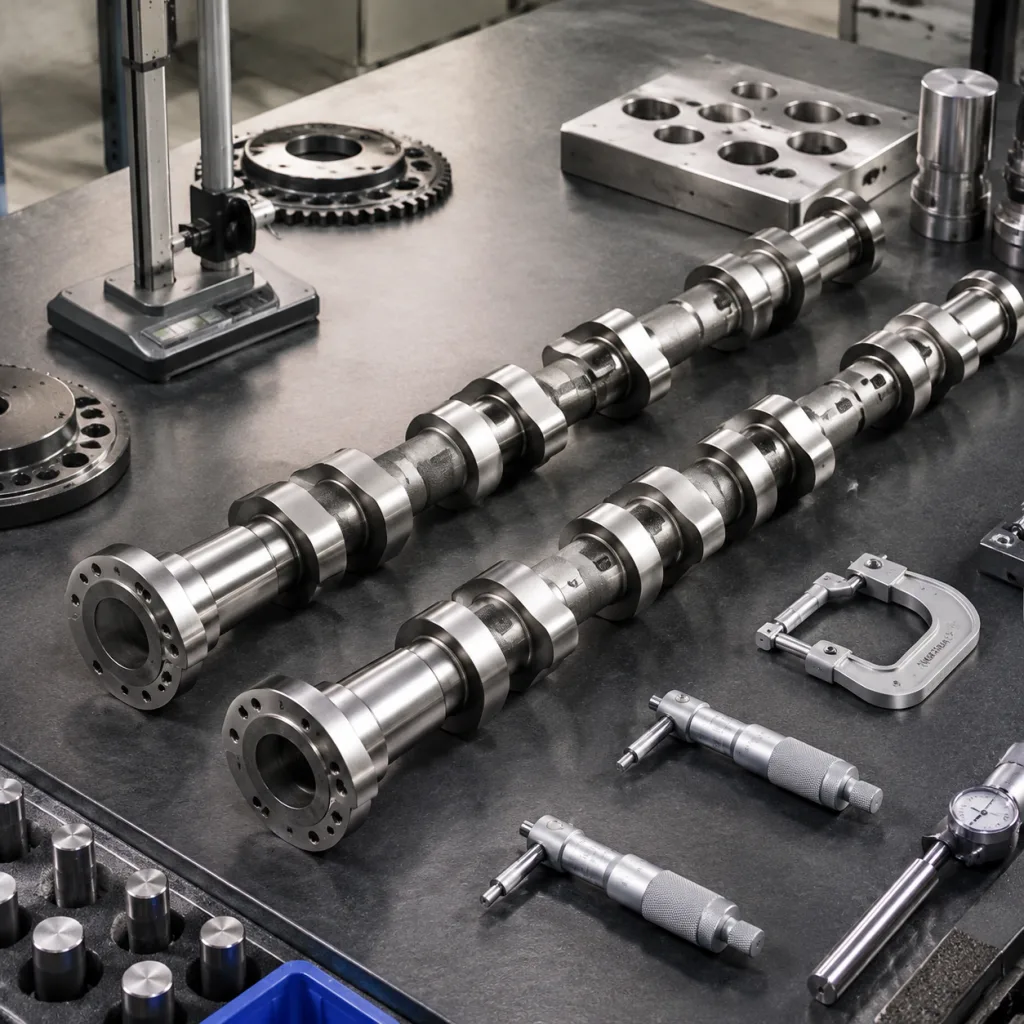
Camshafts are long, machined components with precision-ground journals and lobes. Transit damage, corrosion or bending can create the same failure symptoms as a manufacturing defect, so packaging should be treated as part of the product specification rather than a separate purchasing detail.
Recommended packaging controls include:
Individual anti-rust bag or VCI protection for machined surfaces.
Rigid internal support to prevent bending and impact on lobes.
End protection for dowels, sensor wheels and threaded features.
Carton compression strength matched to pallet height, typically enough to survive stacking without carton collapse.
Desiccant or corrosion inhibitor for long ocean shipments.
Batch label with part number, quantity, production date and traceability code.
Outer carton marking aligned with importer and market requirements.
For a replacement camshaft, define acceptable shipping conditions upfront. A machined shaft should not contact the carton wall directly, and the packaging should prevent metal-to-metal contact between units. If the product is shipped by sea for 30-45 days, it is sensible to require VCI bagging plus desiccant and a sealed inner wrap. If the shipment is air freight, lighter packaging may be acceptable, but end protection and traceability labels should still remain mandatory.
For multi-location repair chains, kitting can reduce installation errors and simplify inventory handling. A camshaft program may be supplied with matched followers, seals, gaskets or timing-related parts when the buyer defines the kit bill of materials. For wholesale distributors, carton dimensions, pallet pattern and barcode format are often as important as the component itself because they affect warehouse handling, receiving accuracy and chargeback risk.
Warranty analysis should separate part defects from installation variables such as lubrication failure, incorrect timing, blocked oil galleries, reused worn followers, contaminated oil or debris introduced during engine repair. Clear installation notes, batch traceability and retained inspection records help buyers respond consistently to claims and contain suspect stock quickly. In a commercial contract, it is wise to define claim windows, photo evidence requirements, sample retention periods and chargeback handling before the first shipment.
Packaging can also move landed cost more than buyers expect. A standard bulk pack may be the cheapest option, while private-label carton printing, multilingual inserts, barcode serialization and kitting can add cost and extend lead time by 5-10 working days. Ask suppliers to quote packaging as a separate line item so standard, retail and fleet-ready configurations can be compared on a like-for-like basis.
Use a supplier scorecard before you place the order
A structured checklist helps avoid sourcing decisions based only on sample appearance or initial price. For a camshaft for Land Rover Defender replacement line, the supplier should be able to provide evidence for application accuracy, engineering control, manufacturing repeatability and export documentation.
Evaluation area
What to request
Acceptance focus
Application data
Engine code, fitment range, OE cross-reference record
Avoids wrong-application shipments
Drawing control
Controlled drawing or approved reverse-engineered data
Prevents unapproved profile changes
Process control
Flow chart, control plan, inspection plan
Confirms repeatability
Certification
IATF 16949:2016 and ISO 9001:2015 certificates
Supports automotive quality governance
Material evidence
Material certificate and heat-treatment record
Confirms durability inputs
Inspection data
Profile, hardness, runout and journal reports
Verifies functional match
Traceability
Batch code and production record
Supports claim containment
Compliance
REACH (EC) No 1907/2006 declarations where applicable
Supports import documentation
Commercial terms
MOQ, lead time, incoterms, packaging specification
Aligns supply with forecast demand
</tr></thead><tbody> </tbody></table>When evaluating commercial terms, ask three questions. First, is the MOQ based on one part number, one engine family or one packaging configuration? Second, does the quoted lead time begin from order confirmation, drawing approval or sample approval? Third, does the price include surface treatment, final inspection, packaging and export cartons, or are those excluded? Those details can change the real landed cost more than the headline unit price.
A useful benchmark is to request pricing at 100, 300 and 1,000 units. Standard items often show a modest price reduction at 300 units and a more visible drop at 1,000 units because setup and inspection costs are spread across more pieces. Private-label requirements, custom inserts or low-volume mixed-SKU orders may keep the unit price higher and can push MOQ upward. Typical sample timing is 10-20 days for existing tooling and 20-35 days for reverse-engineered or newly approved profiles; production lead time is often 35-60 days depending on machining load, heat-treatment schedule and packaging complexity.
Driventus exports engine and powertrain components to more than 60 countries from Taizhou, Zhejiang. For replacement programs, our team can review buyer samples, drawings and target market requirements before quoting. Buyers can request a quote with the engine code, annual volume estimate, packing requirement and any current warranty issue data.
Frequently asked questions
Provide the engine code, model year range, camshaft position, reference sample or drawing, OE cross-reference if available, target market, annual volume, packaging requirement and any validation documents required by your quality team. Also state whether you need standard packing or private-label cartons, because that affects MOQ, price and lead time.
Yes. Driventus can reverse engineer from agreed reference samples, then submit dimensional data and pre-production samples for buyer approval before mass production. Buyer confirmation is required before release. For sampled projects, it is normal to supply a first-article report with journal diameter, runout, lobe lift, hardness and surface finish data before pilot production.
No. Driventus is an independent aftermarket manufacturer; brand names are referenced for fitment only. Parts are supplied as OE-equivalent aftermarket components according to agreed specifications and buyer requirements. Commercial terms such as MOQ, unit price and lead time are negotiated with the buyer and should be confirmed in writing on the order.
If you are evaluating a camshaft for Land Rover Defender replacement sourcing project, send your fitment data, drawings or sample requirements for technical review. Contact Driventus here: /contact.html