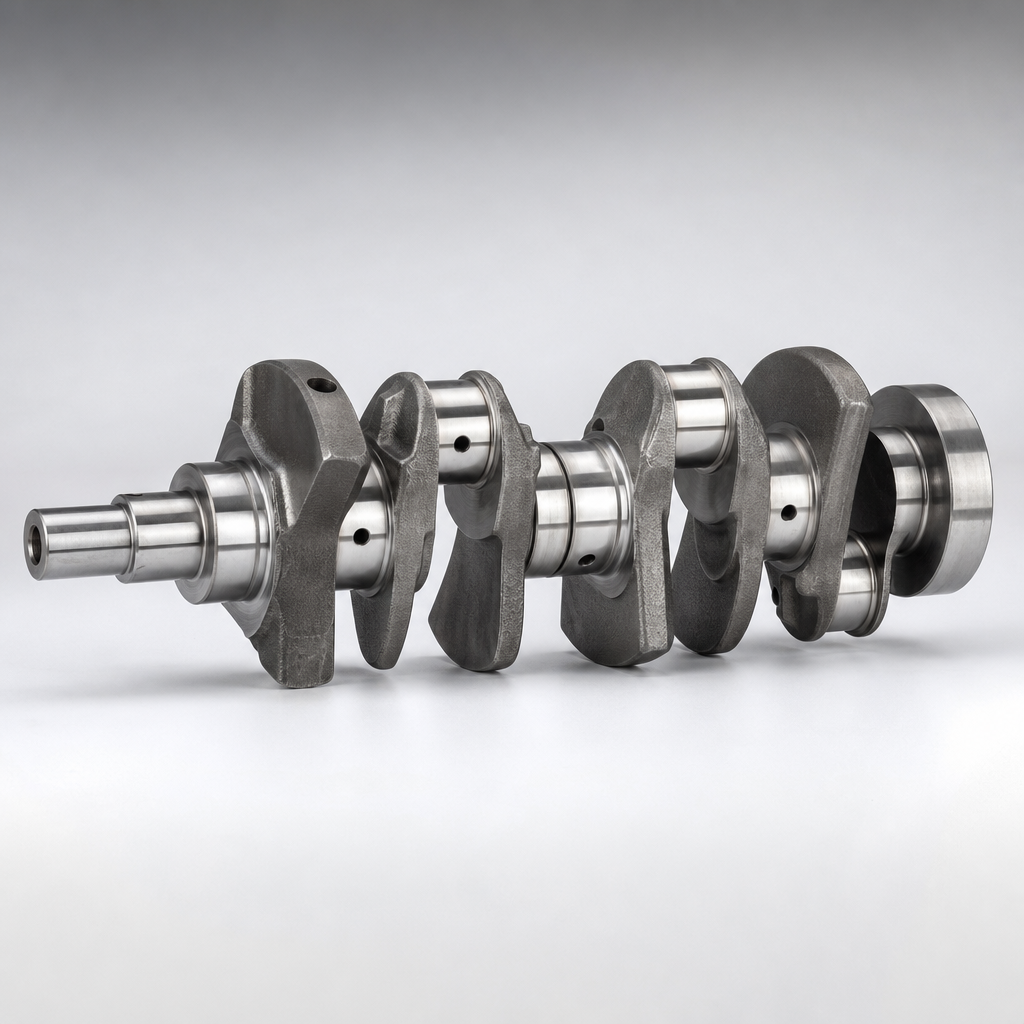
Camshaft for Renault Master Aftermarket Replacement
Buying a camshaft for Renault Master aftermarket replacement is not a catalogue exercise. It is a risk-control decision that sits at the intersection of fitment, wear life, and supplier discipline. A part can match a broad application listing and still miss the details that matter in service: lobe geometry, journal size, hardness pattern, oil-feed cleanliness, or runout across the shaft. In fleet repair, distribution, and engine rebuilding, those small misses turn into noise, timing instability, abnormal wear, and warranty cost.
The practical buying lens is straightforward. First, confirm OE-equivalent dimensions and functional interchangeability. Second, confirm that material and heat treatment are controlled batch to batch. Third, confirm that the supplier can prove it with inspection records, traceability, and a usable release package. Beyond the part itself, buyers should also lock down MOQ, tooling status, sample timing, production lead time, packaging standard, and shipment inspection points before issuing volume orders. Driventus is an independent aftermarket manufacturer; brand names are referenced for fitment only.
Decision Framework: what to clear before you approve a supplier
Treat the camshaft as a precision rotating component with several stacked risks, not as a simple machined part. On Renault Master applications, the common failure in sourcing is not one dramatic defect. It is cumulative tolerance drift across lobes, journals, drive features, and oil-feed details.
A useful approval framework is to divide the review into four gates:
Fit gate: Does it install and locate correctly without modification?
Function gate: Do lobe form, phasing, and runout support correct valve timing and stable operation?
Durability gate: Are material grade, hardness, and hardening depth suitable for commercial-duty service?
Control gate: Can the supplier show lot traceability and inspection discipline, not just one good sample?
The core checks usually include:
Base material grade and metallurgical consistency across lots, commonly chilled cast iron or forged/alloy steel depending on programme design
Lobe profile accuracy versus drawing or approved sample, including lift, flank radius, and nose geometry
Journal diameter tolerance and surface finish for proper oil film formation
Total indicated runout across the shaft, often expected around 0.03 to 0.08 mm depending on design and length
Surface hardness and effective hardening depth after heat treatment, with lobe hardness often controlled around HRC 55-62 where applicable
Oil-hole drilling, chamfer condition, and passage cleanliness after machining and washing
Keyway, thread, dowel, or drive-end feature accuracy where required by the engine design
Compatibility with mating valvetrain parts such as followers, rockers, hydraulic lash elements, and timing components
Traceability records tied to lot number, raw material batch, and heat-treatment batch
For EU and UK buyers, material declaration and chemical compliance should also be available where relevant. REACH (EC) No 1907/2006 is still a common baseline in aftermarket supply chains.
The point is simple: buyers are not just asking whether the part looks right. They are asking whether it behaves like an OE-equivalent service part over time. That is why experienced procurement teams also ask which characteristics are checked 100%, which follow a sampling plan such as ANSI/ASQ Z1.4 or equivalent, and what the supplier does when a result trends toward a limit.
Comparison View: OE-equivalent fit versus catalogue-level fit
A camshaft can match overall length and still be wrong in service. The real standard is functional interchangeability.
Here is the difference buyers should keep in mind:
Feature
Catalogue-level match
OE-equivalent match
Overall dimensions
Broadly similar
Verified to controlled tolerances
Journal geometry
Basic diameter check
Diameter, roundness, and surface finish controlled
Lobe form
Assumed from application label
Measured against drawing or approved reference
Lobe phasing
Often not discussed
Angular relationship checked and documented
Runout
Sometimes omitted
Defined limit and inspection method stated
Drive-end details
Visual match
Gauge or fixture verification
Documentation
Generic claim of "OE standard"
Reported dimensions, gauges, sampling, reaction plan
</tr></thead><tbody> </tbody></table>The features that usually decide whether the part truly interchanges are these:
Check point
Why it matters
Typical control method
Overall shaft length
Affects end float and assembly position
Vernier or CMM check
Journal diameter
Controls bearing fit and oil film
Micrometer measurement
Journal roundness/cylindricity
Affects oil stability and wear pattern
Roundness tester or CMM
Lobe lift profile
Affects valve opening event and breathing
Profile gauge or CMM scan
Lobe phasing
Controls timing relationship cylinder to cylinder
Fixture-based angular inspection
Runout
Influences noise, wear, and timing stability
Dial indicator
Surface roughness
Affects lubrication and wear-in
Roughness tester
End-face and drive feature geometry
Affects timing assembly and axial location
Gauge fixture or CMM
</tr></thead><tbody> </tbody></table>In aftermarket programmes, buyers often work with control windows such as journal diameter tolerance within +/-0.010 to +/-0.020 mm, surface roughness around Ra 0.2-0.8 um on bearing areas, and lobe phase angle control within about +/-0.5 degree to +/-1.0 degree versus reference. The exact numbers depend on the engine design, but a capable supplier should be able to speak in those terms instead of replying only with "OE standard".
Also ask what the reference actually is. Is the part validated against an OE sample, an approved reman reference, or a controlled engineering drawing? If an OE reference is available, it should be shown in a normal cross-reference format, for example OE 06A107065. Informal number matching is where avoidable sourcing mistakes start.
A supplier working to IATF 16949:2016 and ISO 9001:2015 should be able to back this up with gauge calibration, controlled inspection stages, and a clear non-conformance process.
For buyers sourcing a camshaft for Renault Master aftermarket replacement, OE-equivalence is therefore not one dimension. It is the combination of accuracy, repeatability, and evidence.
Spec Deep-Dive: material, hardness, and why low-cost parts fail early
Commercial-duty vans are hard on valvetrain parts. Cold starts, mixed loads, long service intervals, and stop-start use all work against marginal material or weak heat treatment.
The technical review should focus on a short list of durability drivers:
Core material integrity for bending and torsional resistance
Lobe and journal surface hardness for scuff resistance and wear control
Hardening depth or induction depth where applicable
Microstructure verification after heat treatment
Residual burr removal at oil passages and machined edges
Corrosion protection such as phosphate, anti-rust oil, or VCI packaging
Common camshaft manufacturing routes in the aftermarket include chilled cast iron, ductile iron, and alloy steel with induction hardening. The right route depends on the original design and intended duty cycle. Buyers do not need a long metallurgy discussion, but they do need the supplier to define the route clearly and hold it consistently.
A typical statement might be: lobe hardness HRC 55-62, journal hardness HRC 50-60, with effective hardening depth controlled around 1.0-2.5 mm, subject to drawing requirements. That is useful. A vague claim that the part is "hardened" is not.
Low-cost failures usually show up in predictable ways:
Lobe surface wear that accelerates follower damage
Journal finish issues that disturb oil film stability
Burrs or contamination in oil passages
Uneven hardening from poor process control
Corrosion after shipment or storage because packaging was underspecified
In the field, that becomes irregular idle, power loss, top-end noise, metallic debris in the lubrication system, or early wear claims.
The better buying question is not the headline hardness value. It is the consistency window across production lots. Ask whether hardness is checked per furnace lot, per induction lot, or per machining batch, and whether destructive microstructure checks are done every batch, every shift, or on a reduced frequency after process approval. One sample certificate proves very little about repeat-order stability.
Where camshafts are sourced alongside related engine components, buyers can reduce mismatch risk further by aligning adjacent wear parts within one controlled programme.
Step-by-Step Validation: the shortest path to fewer returns
A practical validation process should be lean but not superficial. Most buyers do not need engine dyno data for every part number. They do need a release standard that catches the mistakes that later become workshop claims.
Use this sequence before moving to serial orders:
1. Confirm the technical reference: drawing, OE sample, or approved master sample 2. Request first article inspection: full-balloon report on critical dimensions 3. Review hardness data: test position, range, and batch frequency 4. Check runout evidence: lot-based measurement or a defined sampling plan 5. Verify cleanliness: oil passages, washing result, burr removal, blow-through confirmation 6. Review metallographic evidence where heat treatment is a controlled characteristic 7. Confirm trial-fit or assembly verification with mating parts where practical 8. Validate packaging for export transit and warehouse storage 9. Lock traceability format: batch code, date code, line or operator reference
That process is usually enough to expose weak suppliers early.
Packaging deserves more attention than it gets. Export orders can spend 30 to 60 days in transit and another 60 to 180 days in local stock. A camshaft can arrive dimensionally correct and still be rejected for corrosion, poor presentation, or contaminated packaging. Buyers should therefore confirm rust preventive oil, VCI protection, sealed bag format, and carton stability.
It also helps to ask how the supplier handles failure analysis. A supplier with real aftermarket experience should be able to separate manufacturing defects from lubrication damage, timing installation errors, or failures caused by mismatched followers and related components.
For repeat orders, a simple release package often works well: key dimension report, hardness summary, packing photo, and batch number list. That is usually enough control for aftermarket supply without requiring a full OEM-style PPAP on every shipment.
Driventus maintains a documented quality system aligned with IATF 16949:2016 and ISO 9001:2015, with batch traceability and process controls relevant to engine and powertrain components.
RFQ Q-and-A: the questions that expose real process capability
Price matters, but RFQs fail when they stop at piece price.
Use questions that force the supplier to show how the programme actually runs:
What is the standard MOQ for this camshaft programme?
What first-article or PPAP-style documentation is available for B2B orders?
Are lobe profile and runout checked 100%, or by sampling plan?
What anti-corrosion packaging is used for sea freight?
Can the supplier support private label or carton customisation?
Then make the commercial side concrete. Broad estimates are hard to compare. Ask for ranges such as:
Sample MOQ: often 1-5 pcs if tooling already exists
Trial order MOQ: often 20-50 pcs for validation or market testing
Standard production MOQ: commonly 50-200 pcs per item, depending on setup time and packaging format
Sample lead time: often 7-15 days from technical confirmation if stock blanks are available
Mass production lead time: commonly 30-45 days, extending to 45-60 days if heat-treatment capacity or custom packaging is involved
Price logic: compare 50 pcs, 100 pcs, and 300 pcs tiers instead of asking for one headline number
A serious supplier should also be able to show adjacent product coverage through our catalog, especially for parts commonly replaced in the same repair cycle.
For distributors serving fleets and workshops, this matters commercially. Sourcing camshafts, gasket sets, and timing-related components from one manufacturing group can simplify incoming inspection, reduce supplier count, and make warranty analysis cleaner when a field issue appears.
This is especially relevant when sourcing a camshaft for Renault Master aftermarket replacement for export programmes. Stable repeat supply across several markets depends as much on documentation, packaging, and response speed as it does on the machined part itself.
A disciplined RFQ should therefore also ask for Incoterm, port of loading, gross and net weight per carton, pieces per carton, and whether the quoted price includes VCI bag, rust preventive oil, inner tray, and barcode label.
Commercial Scenario: when the aftermarket option is actually the better buy
An aftermarket replacement is commercially viable when three things hold at the same time: the part installs without modification, the supplier can document process control, and total landed cost stays competitive after freight, duty, inspection, and claim risk are counted.
In Renault Master repair channels, buyers usually fall into three groups:
Aftermarket distributors stocking multi-brand van engine parts
Engine rebuilders that need repeatable machining quality
Repair chains that measure downtime and comeback rates closely
Each group sees the same trap: a cheaper unit price can lose money fast if fitment variation adds labour time or pushes up return rates.
A simple landed-cost model keeps the decision honest:
unit price + tooling amortisation if any + freight + duty + local inspection cost + expected warranty cost per piece
That formula often changes supplier ranking. A camshaft quoted 8-12% lower may still be worse value if it needs tighter incoming inspection, ships more slowly, or carries even a 1-2% higher field claim rate.
Replenishment logic matters too. If the supplier can hold semi-finished stock or finished safety stock, repeat-order lead time may drop from 45 days to 15-20 days. For van repair channels, that difference is operational, not cosmetic.
Before a trial order, buyers should ask for dimensional reports, hardness data, packaging specification, current export market references, and lead-time by quantity break. That gives enough information to judge whether the supplier is built for repeat business or only for occasional spot orders.
Driventus is an independent aftermarket manufacturer; brand names are referenced for fitment only. For application review or commercial terms, use the request a quote page.
Frequently asked questions
At minimum, ask for dimensional inspection records, material or hardness reports, batch traceability details, packing specification, and quality certificates such as IATF 16949:2016 and ISO 9001:2015 where applicable. For a trial or first order, it is also practical to request first-article data, runout report, key critical-dimension sheet, and photos of export packaging.
Yes, provided the part has OE-equivalent dimensions, controlled heat treatment, stable runout, and documented lot inspection. For commercial vehicles, process consistency matters more than catalogue description alone. Buyers should also confirm the supplier's MOQ, repeat-order lead time, and claim-analysis process before approving fleet or workshop supply.
Usually yes. Bundling adjacent wear parts such as gasket sets, followers, or timing-related components can reduce fitment mismatch, simplify receiving inspection, and support clearer warranty analysis across the repair package. It can also improve freight efficiency and reduce per-order administrative cost when MOQ is spread across one repair set.
If you need dimensional review, batch documentation, MOQ and lead-time confirmation, or a quotation for this camshaft programme, contact Driventus through /contact.html.