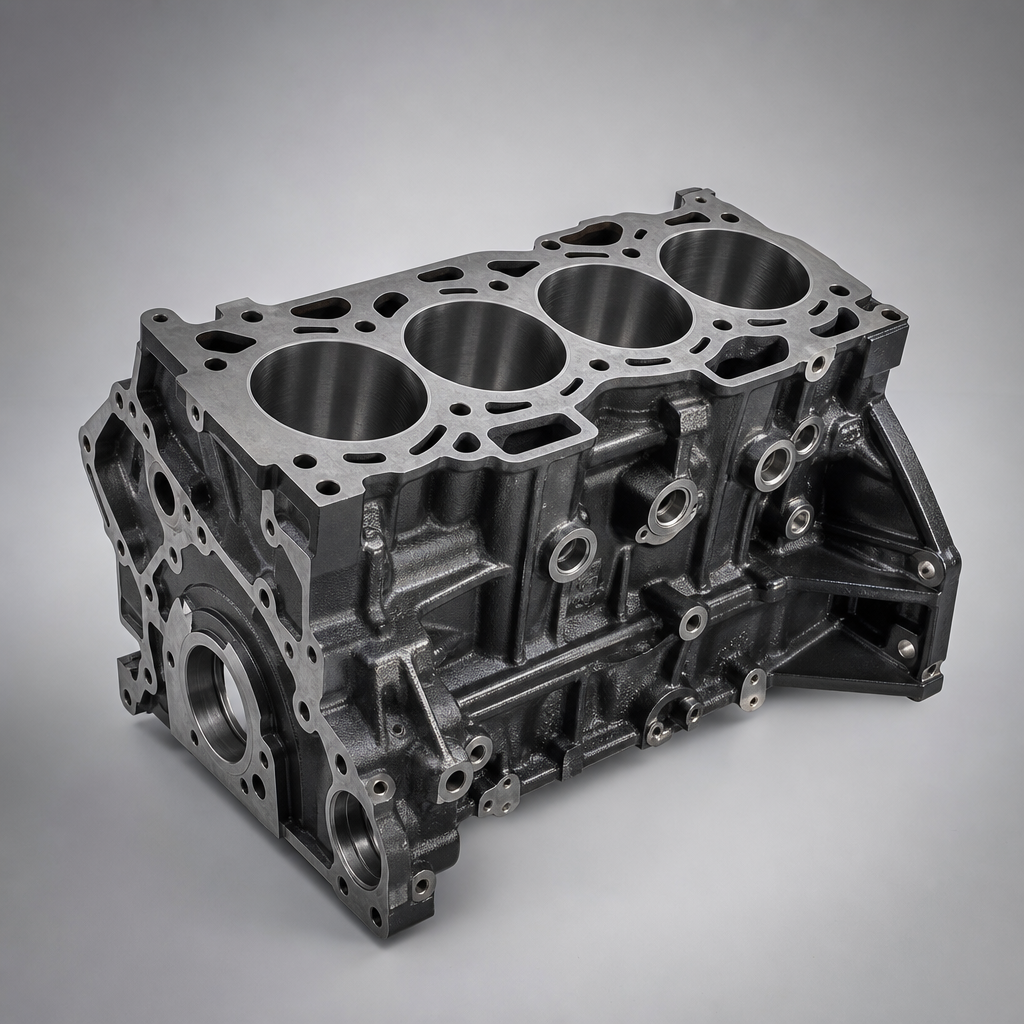
For B2B buyers, water pump material is not a cosmetic spec. It drives claim rate, fit consistency, corrosion performance, freight cost, and how much confidence you can place in a supplier's quote. A competitive pump may combine a cast aluminium or cast iron housing, a steel or reinforced polymer impeller, a hardened steel shaft, mechanical seal faces in carbon, ceramic, or silicon carbide, and standard bearing steel rolling elements. The problem is that these choices only make sense when reviewed together. A good housing paired with a weak seal system, unstable resin, or poor hardness control still fails in the field. This article breaks the topic into the decisions buyers actually make: which material stack fits the duty cycle, where substitutions usually go wrong, what to put on the RFQ, and what evidence makes one quotation more credible than another. Driventus is an independent aftermarket manufacturer; brand names are referenced for fitment only.
Start with the decision frame, not the headline material
A water pump is a mixed-material assembly, so approval should happen at subcomponent level. Buyers who sign off on a single broad declaration such as "alloy pump" or "metal impeller" usually miss the real risk.
Impeller: coolant flow efficiency, cavitation resistance, mass balance, shaft load
Shaft: torsional strength, surface hardness, seal running surface quality
Mechanical seal: leak control under temperature cycling and abrasive coolant conditions
Bearing: radial and axial load capacity, grease retention, fatigue life
Gasket or O-ring: compression set resistance and coolant/temperature compatibility
For sourcing, the minimum document pack should state the base grade for each critical part, any heat-treatment or hardness condition, coating specification where used, and validation results from the finished pump. Buyers should ask for actual callouts, not generic labels: ADC12 or AlSi9Cu3 for the housing, EN-GJL-200 or ASTM A48 class equivalent for grey iron, HRC 58-62 on the shaft seal track, EPDM for elastomers, and 100Cr6 or AISI 52100 equivalent for bearing steel where applicable. Those records should sit inside an auditable quality system aligned to IATF 16949:2016 and ISO 9001:2015.
Then check whether the stated water pump material stack is tied to the dimensions that control service life and fitment. Typical checkpoints include mounting-face flatness within 0.05-0.10 mm, pilot-diameter tolerance within +/-0.03-0.05 mm, shaft runout at the seal track within 0.02-0.04 mm TIR, and impeller-to-housing clearance often around 0.20-0.50 mm depending on design. If the supplier cannot connect material choice to those assembly tolerances, the declaration is incomplete.
That is the practical rule: approve the system, not the headline term. Many field failures come from silent substitutions in resin, seal-face grade, hardness control, or casting quality rather than from the broad design concept itself. Lot traceability matters for the same reason.
Compare the main water pump material options by component
Component
Common materials
Typical advantages
Typical risks
Housing
Cast aluminium, cast iron
Good machinability; aluminium lowers mass, cast iron gives rigidity
Aluminium can pit in poor coolant; cast iron adds weight and may rust externally
Wrong face pair can raise cost or accelerate wear under dirty coolant
Bearing rings/balls
Bearing steel
Proven rolling fatigue performance
Contamination or poor grease selection shortens life
Elastomers
EPDM, HNBR in some applications
Coolant and temperature resistance
Wrong compound increases swelling or compression set
</tr></thead><tbody> </tbody></table>Here is the comparison buyers usually need at RFQ stage.
Cast aluminium housings are common in modern passenger vehicle pumps because they reduce mass, machine cleanly, and fit well with high-volume casting routes. They work best when wall thickness, porosity control, and machining stock are stable enough to hold bearing-bore and gasket-face tolerances.
Cast iron housings still make sense where the OE design already uses iron, where rigidity matters more than weight, or where the architecture was never optimised around aluminium. They cost more to ship, but they are often less sensitive to thread pull-out and local pitting.
Stamped steel impellers remain common in cost-sensitive programmes. The buying question is not whether steel is acceptable; it is whether thickness, corrosion resistance, and balance are controlled. In light-duty designs, a practical check is thickness around 0.8-1.2 mm, plus weld integrity or forming consistency where the vane profile is built in stages.
Reinforced polymer impellers can be fully viable, but only when the resin system and moulding process are specific and validated. Buyers should ask whether the grade is, for example, PA66 GF30-GF35, PPS-based, or another engineering resin, and whether moisture conditioning is part of dimensional validation.
Silicon carbide seal faces are usually a step up for severe duty, dirty coolant, or longer service intervals. They cost more than carbon/ceramic pairs, but the wear margin is often better where the operating environment is harsh.
If the programme is tied to an existing application family, request cross-reference mapping to the aftermarket number or cited OE pattern. If the enquiry specifies something like OE 06A107065, the supplier should confirm fit, dimensions, and any material deviations separately.
Commercially, water pump material also changes MOQ and tooling logic. Shared steel impeller tooling may support lower MOQs, while a new polymer impeller or revised casting often means dedicated tooling and a higher break-even point. In many aftermarket programmes, buyers see pilot orders around 200-500 pcs, regular MOQs around 500-1,000 pcs per SKU, and stronger price breaks above 2,000-5,000 pcs, though bearing source, seal-face grade, and existing tool availability can shift that range.
Where water pump material choices usually fail in the field
Most early-life failures land in three buckets: corrosion, cavitation damage, or seal distress under thermal cycling. Each one is shaped by the water pump material combination, but also by process control and geometry.
Corrosion resistance
Coolant chemistry matters immediately. Aluminium performs well in maintained coolant, but depleted inhibitors or mixed chemistries can trigger pitting. Steel impellers need enough thickness and, where specified, stable corrosion protection. Any coating has to survive coolant exposure without flaking into the system. Buyers should ask whether the supplier has salt-spray or cyclic corrosion data for exposed external surfaces, often 240-480 hours NSS where that forms part of the agreed spec.
Cast iron housings are robust mechanically, but poor surface protection can create external rust during storage or service. That may not stop the pump on day one, yet it can drive appearance claims and long-term durability concerns. For ocean freight, packaging becomes part of the material discussion because 30-45 day transit plus humid storage can create corrosion claims before installation.
For EU and UK supply, chemical compliance records should also cover REACH (EC) No 1907/2006 where applicable to coatings and constituent substances.
Cavitation behaviour
Geometry is the main driver, but material still influences stability. Thin stamped impellers can deform if forming control drifts. Cast or sintered metal designs may hold shape better. Reinforced polymer can reduce rotating mass and sometimes lower cavitation noise, but only if stiffness is retained at operating temperature.
Buyers should look for flow-head data, impeller dimensional checks, and endurance testing at elevated speed, where cavitation tendency is more visible. A label alone tells you very little.
Thermal cycling
The pump expands and contracts across the housing, shaft, seal, and gasket interfaces. Aluminium expands more than steel, so press fits, machining tolerances, and seal design must account for that mismatch. Seal face pairing matters too; weak flatness retention or poor thermal compatibility can shorten life fast.
Ask for test evidence on the complete assembly, not on raw materials in isolation. In practice that often means a thermal-cycle regime such as -40 C to 120 C or an application-relevant equivalent, plus 200-500 hours of endurance running at defined speed, pressure, and coolant conditions. Leakage acceptance should be explicit, for example 0 visible leakage during test with a stated post-test seepage threshold.
The pattern is consistent: weak water pump material choices rarely announce themselves in the quote. They show up as storage corrosion, noisy operation, seal seepage, or early warranty returns.
Build the RFQ so suppliers cannot hide behind generic wording
A good RFQ forces comparability. A weak RFQ invites vague offers, soft substitutions, and post-award arguments.
Recommended RFQ points:
Housing base material and casting route
Impeller material, forming or moulding process, and balance requirement
Shaft material, hardness range, and surface finish on seal track
Seal face pairing and elastomer type
Bearing type, grease specification, and sealing arrangement
Dimensional tolerances on mounting face, pilot diameter, and pulley interface
Leak test method and pressure threshold
Corrosion and endurance test requirements
Chemical compliance declaration for coatings, sealants, and elastomers
Packaging protection against corrosion during ocean shipment
Numeric acceptance criteria matter. Typical examples include shaft surface roughness on the seal track such as Ra 0.2-0.4 um, housing-bore and bearing-fit tolerance to drawing class, impeller balance to a validated residual unbalance limit, and end-of-line air leak testing at 1.0-1.5 bar for 10-30 seconds. If the design uses a gasket land or O-ring groove, call out the compression-critical dimensions directly.
If water pump material is commercially sensitive, state in the RFQ that substitutions are prohibited without written approval and that any deviation requires revalidation.
The commercial structure belongs in the same pack, because material changes often look attractive only when hidden costs are omitted. The quote template should request:
MOQ by SKU: prototype, first order, and regular production MOQ
Price break table: for example 500 / 1,000 / 3,000 / 5,000 pcs
When comparing suppliers, use a matrix that exposes gaps fast:
RFQ item
Supplier A
Supplier B
Supplier C
Housing material declared
Impeller material declared
Seal face combination
Bearing origin/spec stated
Test report supplied
REACH statement supplied
PPAP-style package available
</tr></thead><tbody> </tbody></table>For buyers expanding their sourcing list, material review should sit alongside the product range in our catalog.
Audit the process in sequence before you nominate the supplier
Material declarations only matter when the process can repeat them. Before nomination, audit the manufacturing flow in the same order the pump is built.
Useful audit questions include:
Are raw material certificates matched to production lots?
Are critical dimensions measured on every batch or by defined sampling plans?
Is impeller balance verified?
Are seal press-in and bearing press-fit forces controlled and recorded?
Is end-of-line leakage tested on 100% of units?
Are endurance tests run on representative samples after engineering changes?
A capable supplier should be able to walk through the actual line: incoming verification of casting chemistry or resin lot, machining of datum faces and bearing bores, shaft grinding, washing and cleanliness control, bearing press-fit with force monitoring, mechanical seal press-in, impeller installation, torque or height check, rotation check, and 100% end-of-line leak or pressure test. If press-fit force, impeller height, or shaft end play are not recorded or controlled by a documented sampling plan, drift will be hard to catch.
Sampling logic should also be specific. Many buyers accept dimensional inspection to ISO 2859-1 or an equivalent internal plan for non-safety characteristics, while keeping leak testing at 100% and using capability targets such as Cpk >= 1.33 on critical machining features after stabilisation. For PPAP-style submissions, request control plans, PFMEA, material certs, dimensional layouts, leak-test records, and endurance summaries tied to the exact part number and revision.
A supplier offering custom manufacturing should also be able to explain drawing control, APQP discipline, traceability by batch or date code, and formal change management.
One final check is easy to miss: ask what triggers resubmission. A small change in elastomer compound, seal-face source, coating, resin supplier, or shaft hardness window can materially change durability even if the outer dimensions do not move. The supplier should define notice periods and whether such changes require new samples or partial revalidation.
That answer tells you as much about future risk as the initial water pump material declaration.
The buying call: which material stack is defensible for your programme?
There is no universal best water pump material package. The right stack depends on duty cycle, coolant condition, target price, service-life expectations, and the dimensional limits of the original design.
In many passenger car applications, a cast aluminium housing with a controlled steel or reinforced polymer impeller, bearing steel rolling elements, EPDM sealing elements, and a validated mechanical seal package is a sensible baseline. In heavier-duty or legacy applications, cast iron housings and different seal-face combinations may be the better call.
The procurement mistake is to treat this as a simple unit-price exercise. A pump quoted 3-8% cheaper can become the expensive option once you account for corrosion claims, longer lead times, higher tooling exposure, or weak change control.
A practical nomination decision usually comes down to five questions:
1. Does the water pump material stack fit the application and duty cycle? 2. Can the supplier hold the stated tolerances consistently? 3. Is the validation evidence current and tied to the quoted build? 4. Do MOQ, tooling, and lead-time assumptions fit the programme? 5. Is change-control discipline strong enough to prevent silent substitution?
If one of those answers is weak, the quote is not really complete.
That is the useful conclusion for B2B buyers: water pump material selection is a sourcing and risk-control decision first, and only then a cost discussion.
Frequently asked questions
No. Aluminium reduces mass and machines well, but cast iron can offer better rigidity in some designs. The correct choice depends on the original application, corrosion environment, mounting loads, and total assembly validation.
Yes, if the resin grade, reinforcement, and moulding process are controlled and the finished pump passes endurance and thermal-cycle testing. Buyers should request validation data rather than relying on the material label alone.
Ask for material declarations by subcomponent, raw material certificates where relevant, dimensional inspection records, leak-test results, endurance data, and chemical compliance statements such as REACH declarations for applicable substances and coatings.
If you are qualifying a new pump programme, we can review your drawing, target material stack, and test requirements. Contact Driventus to discuss options or **[request a quote](/contact.html)**.