Camshaft for Renault Kadjar aftermarket replacement: sourcing guide
For procurement teams sourcing a camshaft for Renault Kadjar aftermarket replacement, the main requirement is dimensional and functional equivalence to the original part. A camshaft must match journal diameters, lobe profile, phase timing, surface finish, and material specification closely enough to preserve valve timing and durability. Small deviations can affect idle quality, emissions performance, fuel consumption, and valvetrain wear. Driventus supplies engine and powertrain components for B2B replacement markets, with production controlled under IATF 16949:2016 and ISO 9001:2015. Driventus is an independent aftermarket manufacturer; brand names are referenced for fitment only. For buyers in the EU, UK, US, Canada, Australia, and Brazil, the practical questions are fitment confirmation, repeatable quality, traceability, and export-ready documentation. This article explains what to verify before placing a purchase order, how to compare supplier claims, and which inspections matter most for a replacement camshaft.
Fitment requirements for Renault Kadjar replacement projects
A replacement camshaft must be selected by engine code, valve-train layout, and OE cross-reference, not by vehicle model alone. Renault Kadjar applications vary by engine family and market, so procurement teams should confirm the following before order release:
- Engine code and displacement
- Intake or exhaust position
- Number of lobes and cam phasing configuration
- OE part-number cross-reference, where available
- Sensor drive features, trigger wheels, or VVT interfaces
- Bearing journal count and end-play control method
If the item is listed as OE 06A107065-style cross-reference, use that only as a fitment reference when the application data confirms compatibility. A supplier should provide dimensional drawings or measured samples, not only a catalogue description. For mixed-market programmes, build an application matrix by engine code and year range to prevent substitution errors.
What OE-equivalent means in camshaft sourcing
For aftermarket replacement, OE-equivalent means the part meets the functional and dimensional requirements needed to perform like the original in the same engine family. It does not mean OEM approval. Buyers should ask for measurable evidence, not generic quality claims.
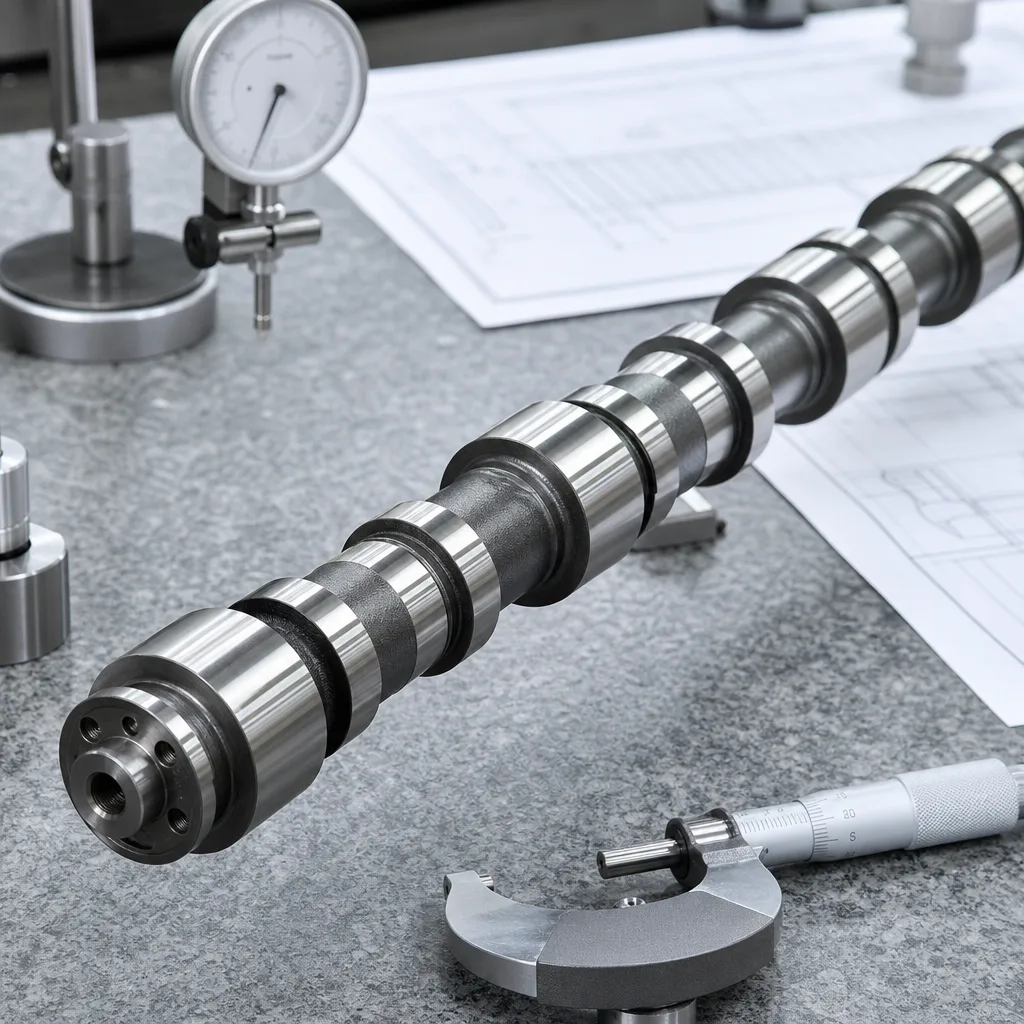
| Checkpoint | What to verify | Why it matters |
|---|---|---|
| Journal diameter | Matches drawing tolerance and bearing clearance targets | Controls oil film and wear |
| Lobe height and profile | Measured against master data | Affects valve lift and duration |
| Base circle | Within specified range | Protects lash and timing accuracy |
| Surface hardness | Verified by heat-treatment records and test report | Improves wear resistance |
| Runout | Measured on V-block or equivalent fixture | Reduces vibration and timing error |
| Surface finish | Controlled Ra on critical surfaces | Supports oil retention and durability |