Camshaft for Mini Cooper Replacement: OE Match Checklist
Procurement teams sourcing a camshaft for Mini Cooper replacement need more than a part that “fits”. The key checks are OE-equivalent geometry, correct base circle and lobe profile, journal finish, hardness, and compatibility with the engine code and model year. A camshaft that misses one of these points can create idle quality issues, valve timing deviation, or premature wear. For aftermarket supply, the buying decision should also include material route, heat treatment, runout control, packaging, and traceability. Driventus is an independent aftermarket manufacturer; brand names are referenced for fitment only. We supply engine components from Taizhou, Zhejiang, with production controls aligned to IATF 16949:2016 and ISO 9001:2015. The notes below are written for sourcing engineers, category buyers, and import managers who need a replacement part that matches the technical and commercial requirements of their market.
What to verify before ordering
A correct replacement starts with engine identification. Mini Cooper applications vary by engine family, model year, and valve-train layout. Confirm the engine code, fuel system, and whether the vehicle uses intake-only variable timing, dual VANOS, or a different cam drive arrangement.
Use the following checklist before placing an order:
Engine code and displacement
Model year and production month
Intake or exhaust cam position
Number of lobes and journal count
Cam sensor trigger features
OE cross-reference, when available
Packaging and label traceability
If the OE number is known, compare the requested part against the same reference format used in purchasing records, for example OE 06A107065 when a customer provides a valid cross-reference. Do not rely on the vehicle badge alone. For mixed fleets and imported vehicles, the same model name can cover different camshaft dimensions across markets.
Replacement criteria for dimensional match
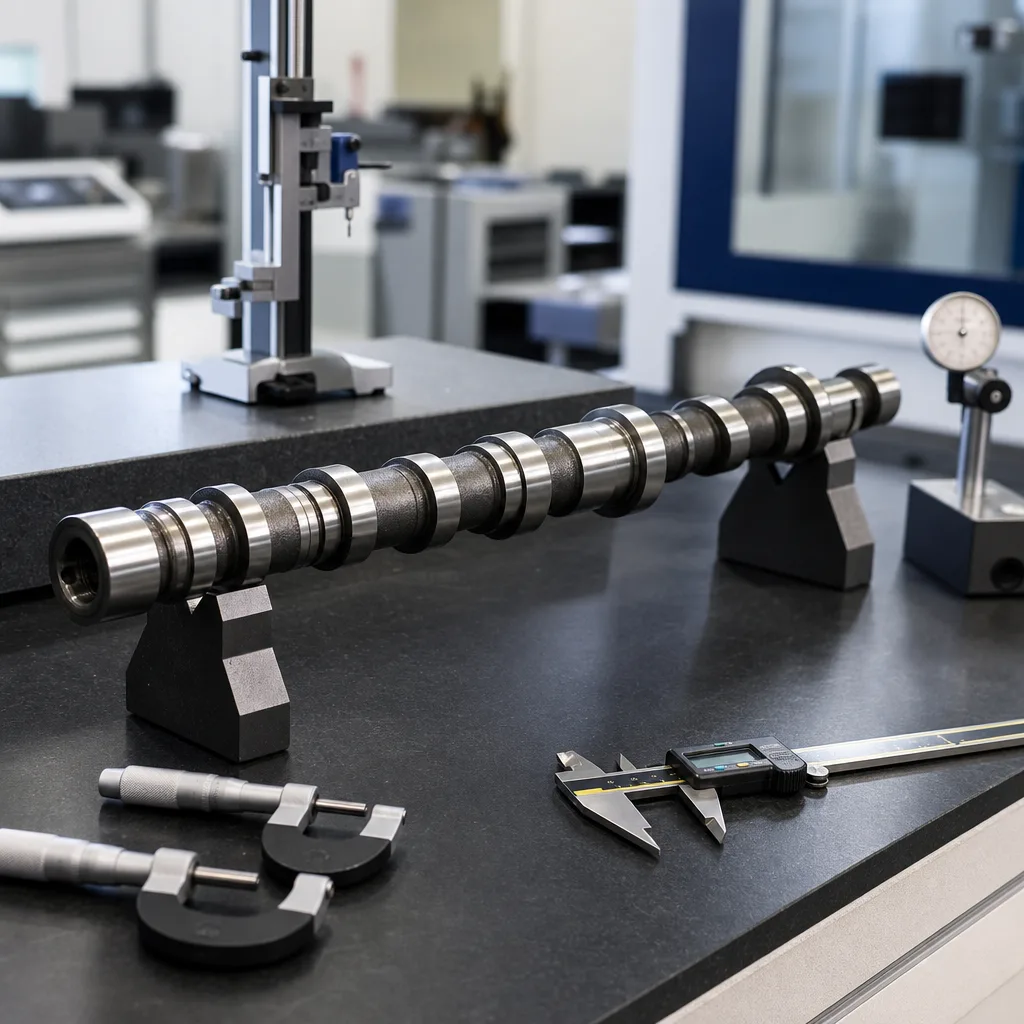
A replacement camshaft should match the original part in the dimensions that control valve timing and durability. The most important features are lobe lift, lobe separation, base circle, journal diameter, overall length, thrust face position, and timing sprocket interface.
Inspection item
What to confirm
Why it matters
Journal diameter
Matches OE drawing tolerance
Controls bearing clearance and oil film
Lobe profile
Same lift and duration window
Preserves timing and airflow targets
Base circle
Same nominal size
Prevents lash and timing errors
End play surfaces
Correct width and finish
Limits axial movement
Sensor / trigger features
Same position and geometry
Supports ECU signal accuracy
Surface hardness
Verified after heat treatment
Reduces scuffing and wear
</tr></thead><tbody> </tbody></table>For replacement supply, dimensional match is more important than appearance. Two camshafts can look similar and still differ in lobe height by a small amount that changes valve lift enough to affect emissions, idle stability, and noise.
Material, heat treatment, and finish
Mini Cooper replacement camshafts are commonly produced in chilled cast iron or forged steel, depending on the design and duty cycle. The correct material route depends on the engine family and OE specification. For procurement, the key point is not the marketing description but the validated metallurgical result.
Typical controls include:
Chemistry verification for each heat or batch
Hardness testing after heat treatment
Journal surface finish control
Lobe profile grinding accuracy
Runout inspection on critical centers
Magnetic particle or equivalent crack detection where specified
Surface finish affects break-in and bearing life. A camshaft with poor lobe polish or rough journal finish can accelerate wear during the first hours of operation. For buyers in export markets, documentation should also support REACH (EC) No 1907/2006 where relevant to chemical compliance in the supply chain. If your program requires a different substrate or coating, Driventus can support custom manufacturing based on the print, sample, or validated reference part.
Validation testing used for aftermarket supply
For replacement parts, validation should be focused on dimensional consistency and functional stability rather than laboratory claims alone. A serious sourcing file should include the test methods and the acceptance basis.
Common validation items:
CMM or gauging report for journal and lobe dimensions
Runout measurement on setup fixtures
Surface roughness check on journals and lobes
Hardness survey after heat treatment
Fitment verification in representative engine assemblies
Packaging and corrosion protection check after transit simulation
Where the application requires it, noise, vibration, and durability checks can be aligned with customer test plans or published vehicle-related methods. For emissions-related development, references such as ECE R-83 and SAE J2527 may be used in adjacent validation work, but the part itself must still be assessed against the engine programme requirements. Buyers should request documented traceability under the supplier quality system before release to production.
Commercial points for procurement teams
Replacement sourcing is not only a technical exercise. Buyers should define the commercial terms that protect the programme.
Key points to confirm before award:
MOQ and forecast flexibility
Lead time by order size
Batch traceability and serial or heat number control
Corrosion protection and export packaging
Sampling procedure for PPAP-style review where required
Label format for warehouse scanning and intake
For distributors and repair-chain supply, stable carton configuration and clear cross-reference labelling reduce receiving errors. For OEM and Tier-1 buyers, the preferred path is a controlled development flow using master samples, target dimensions, and written acceptance criteria. Our catalog covers engine and powertrain parts including camshafts, and our engine components page can help teams map related parts in the same programme.
How Driventus supports Mini Cooper replacement sourcing
Driventus manufactures engine and powertrain components in Taizhou, Zhejiang, with export experience in more than 60 countries. For a camshaft programme, we support drawing review, sample comparison, dimensional inspection, and production planning for B2B buyers.
We focus on:
OE-equivalent geometry for replacement demand
Consistent machining and heat treatment controls
Batch traceability and documented inspection
Packaging suitable for international freight
Support for private label or programme-specific requirements
Driventus is an independent aftermarket manufacturer; brand names are referenced for fitment only. If you need a quotation, technical review, or a sample comparison against a target reference, use our request a quote page and include the engine code, OE number if available, and annual volume forecast.
Frequently asked questions
Match the engine code, model year, intake or exhaust position, and OE reference if available. Do not order from the vehicle model name alone, because Mini Cooper applications vary by engine family and market.
Request dimensional inspection data, hardness results, batch traceability, and a clear cross-reference sheet. For regulated markets, ask for a compliance statement covering REACH where applicable.
Yes. We support custom manufacturing for programme-specific requirements, including sample-based development, drawing review, and controlled production for B2B buyers.
If you are sourcing a replacement camshaft and need OE-equivalent confirmation, dimensional data, or a sample review, send your specification and volume target via /contact.html.