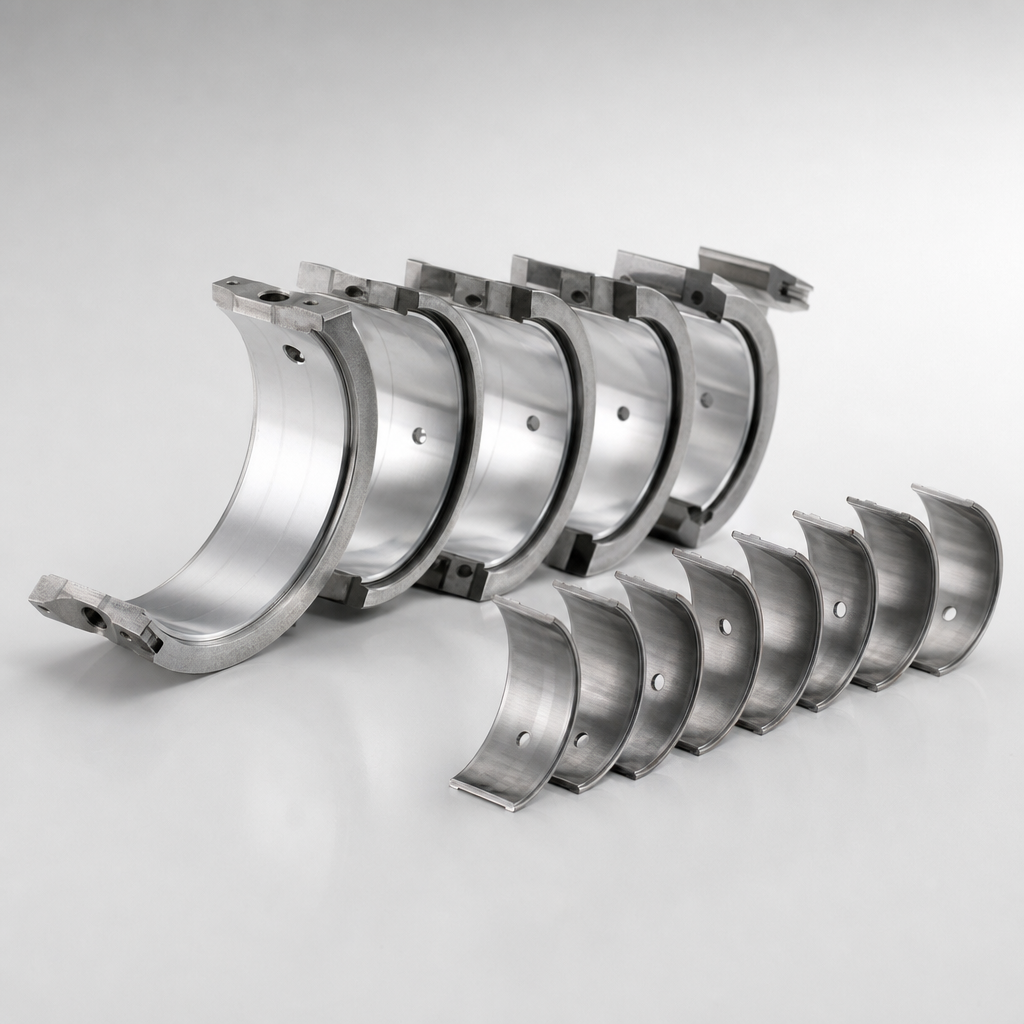
Camshaft for Jaguar XF Replacement: How Buyers Separate OE-Fit Supply From Return Risk
A **camshaft for Jaguar XF replacement** is not a part to buy on catalogue confidence alone. It sits at the center of valve timing, lubrication stability, wear behavior, and installation success. For B2B buyers, the real question is simple: can the supplier prove that each lot will behave like the intended OE part, not just resemble it on paper?
That means reviewing measurable controls. Journal diameter may need to hold within +/-0.005 to +/-0.015 mm depending on feature. Lobe profile deviation is often managed in the 0.01 to 0.03 mm range. Total indicated runout is typically kept at <=0.03 to 0.05 mm. Lobe surface hardness commonly targets 58-62 HRC or an equivalent design requirement. Miss those windows and the result can be oil-film instability, timing error, noise, or accelerated wear.
This article approaches sourcing from several angles rather than repeating a generic checklist. It covers the approval decision, the specs that matter most, the failure modes that create claims, the document pack worth requesting, and the commercial terms that shape landed cost. Driventus is an independent aftermarket manufacturer; brand names are referenced for fitment only.
Approval first: the decision framework buyers should use
Do not start with price. Start with risk.
When evaluating a camshaft for Jaguar XF replacement, the fastest way to make a bad buy is to treat it as a simple interchange item. A better framework is to approve in four gates:
1. Fitment logic: confirm engine code, build year, displacement, fuel type, bank position where relevant, and timing-system configuration 2. Critical-dimension evidence: verify journals, lobes, end faces, runout, and timing interfaces against controlled data 3. Process repeatability: confirm how the supplier holds those values across production lots 4. Commercial stability: review MOQ, lead time, packaging, traceability, and claim handling
At the technical gate, a visual comparison is not enough. Buyers should ask for documented conformity on the features that directly affect assembly, lubrication, timing accuracy, and service life:
Overall length and end-face geometry to match the target engine build and related drive components, commonly checked to +/-0.05 mm on critical stack-up faces
Journal diameters and roundness within drawing tolerance, typically controlled in the low-micron range such as +/-0.005 to +/-0.010 mm with roundness often <=0.003 mm
Lobe lift, lobe phasing, and separation geometry to preserve valve-event accuracy, with profile deviation commonly limited to 0.01-0.03 mm against the master curve
Total indicated runout across the shaft, frequently targeted at <=0.03 mm and usually not more than 0.05 mm depending on design
Surface roughness on journals and lobes for lubrication behavior and controlled wear-in, for example Ra 0.2-0.4 um on journals and Ra 0.4-0.8 um on lobes after finish grinding
Core material and heat-treatment route, such as chilled cast iron or forged/alloy steel depending on application requirements
Lobe surface hardness, case depth, and consistency, often around 58-62 HRC on functional surfaces with effective case depth in the 0.8-2.0 mm range where applicable
Sensor, trigger, sprocket, or phaser interface dimensions where variable valve timing is present
Batch traceability and inspection records linked to each production lot, carton label, and part mark
A capable supplier working under IATF 16949:2016 and ISO 9001:2015 should be able to show process-control records, calibration status, and non-conformance procedures through its quality system.
A practical release path is straightforward: request 3-5 first-article samples, inspect all critical dimensions, then approve a pilot order only after the supplier shows the same control on a production lot. For imports, define incoming inspection rules in advance, such as AQL 0.65 or 1.0 for critical defects and AQL 1.5 or 2.5 for major visual or packaging issues.
Where replacements fail: OE-equivalence gaps that trigger returns
This is where many sourcing programmes go wrong. The part number cross-reference looks correct, but the installed part does not behave like the original.
Jaguar XF programmes span multiple engine families, so equivalence has to be controlled by application data and by measurement. Buyers should ask suppliers to validate a camshaft for Jaguar XF replacement against OE drawing logic or against reverse-engineered master samples measured by CMM, profile tracing, and functional gauging.
Incorrect valve lift or duration, poor wear pattern
Profile trace, master comparison
Runout
Noise, friction, abnormal bearing load
TIR report from inspection fixture
Hardness and case depth
Premature lobe wear under contact stress
Hardness report, metallographic section
Material chemistry
Inconsistent strength or heat-treatment response
Material certificate
Timing interface geometry
Synchronisation errors with chain or phaser system
Functional gauge result
</tr></thead><tbody> </tbody></table>If a supplier says only "OE quality," keep pushing. The comparison method matters.
A robust validation route usually includes:
1. Master sample or OE print review to establish control dimensions 2. CMM measurement for journals, end faces, bolt patterns, and datums 3. Cam profile measurement on a dedicated camshaft checker or form tracer at each lobe 4. Runout check between centres or on a dedicated fixture 5. Functional fit simulation for phaser, sprocket, trigger wheel, or sensor interfaces
Typical acceptance values used in sourcing decisions include journal diameter variation of <=0.01 mm, lobe-to-lobe phasing error of <=0.5 degrees, and face/location features within +/-0.02 to +/-0.05 mm where they affect timing stack-up. Exact limits depend on the Jaguar XF engine programme, but buyers should expect stated control values, not marketing language.
Where the sourcing brief includes a specific OE number, use the OE-style cross-reference exactly, for example OE 06A107065. Where it does not, avoid speculative listings. Catalogue overreach is a common cause of returns.
For aftermarket procurement, this evidence helps separate real manufacturers from traders who can offer a nominal application match but no dimensional correlation to the target engine.
Spec deep-dive: material, hardness, and machining controls that decide service life
Two camshafts can look identical and still behave very differently in the field. The difference usually comes from metallurgy, heat treatment, grinding control, and surface integrity.
What to examine beyond the quotation
Material route: cast or forged according to application load, speed, and design intent
Heat treatment: controlled hardening for lobes and journals where specified by the part design
Grinding process: final lobe and journal finishing after heat treatment to maintain profile accuracy
Surface finish control: journal and lobe roughness measured lot by lot
Balance and straightness checks: especially relevant for longer shafts and high-speed operation
In sourcing terms, buyers should ask whether the shaft is produced from alloy chilled cast iron, ductile iron, or forged/alloy steel, and whether hardness is achieved by induction hardening, chill casting, carburising, or another route. Each route changes distortion risk, wear response, and process sequence.
For example, induction hardening may require tighter post-hardening straightness control. Cast routes depend heavily on metallurgy consistency and chill depth. Those are not small details. They affect claims.
Useful process questions include:
What is the incoming chemistry control on each heat or melt?
Is hardness checked 100% on setup and then by defined sampling per lot?
Is lobe grinding compensated for wheel wear and verified by profile trace at set intervals such as every 50-100 pcs?
What Cp/Cpk target is used on critical dimensions such as journals and phaser interfaces, for example Cpk >=1.33 for serial supply and >=1.67 on special characteristics where feasible?
How is shaft straightness corrected after heat treatment, and is that correction rechecked before packing?
A capable supplier should define inspection frequency for each critical characteristic and retain records by batch number. For exports to the EU and UK, supporting compliance documentation on substances is also relevant. If coatings, rust preventives, oils, or preservation materials are used, buyers may request declarations aligned with REACH (EC) No 1907/2006.
For parts used in emission-related engine systems, dimensional stability matters because valve timing variation can influence combustion control, idle behavior, and drivability. While ECE R-83 applies to vehicle emissions rather than direct camshaft approval, it still underlines the point: variation in engine components affects broader system performance.
Driventus produces engine and valvetrain-related components under controlled manufacturing and can support programme reviews through custom manufacturing where private-label or drawing-based supply is required.
What to request before you place the pilot order
If the supplier cannot assemble a clean technical file, treat that as a warning sign.
For a replacement sourcing decision, ask for objective validation data before commercial approval. This matters even more when moving from a local regrind source to imported new production, or when adding a second supplier for continuity.
Recommended document pack:
Dimensional inspection report with critical-to-function features identified
Material certificate linked to heat or melt batch
Hardness test report for functional surfaces
Runout and straightness report from final inspection
PPAP-style submission elements where agreed for OEM or Tier supply programmes
Packaging specification covering corrosion prevention and impact protection
Traceability format for carton, inner pack, and part marking
Warranty and claim-handling process with response times
If you are sourcing at scale, also review whether the supplier can hold stable output across multiple lots. Ask about tooling life, gauge R&R, calibration intervals, process capability on critical dimensions, and containment procedures for suspect stock. These are standard expectations under IATF 16949:2016.
For higher-confidence approval, buyers can request a structured sample dossier with:
FAI/ISIR report on the first production batch
Hardness map showing test points on lobes and journals
Metallographic section confirming microstructure or case depth where relevant
Surface roughness readings from the finished grinding process
Salt-spray or preservation validation for export packaging where sea transit exceeds 25-40 days
Gauge R&R study showing measurement system variation typically below 10% on critical dimensions
A workable release gate for many aftermarket buyers is this sequence: sample approval first, then a pilot order of 100-300 pcs, then serial release after field feedback and incoming inspection results are acceptable. When annual demand is higher, buyers may ask for PPAP Level 3-style content even outside an OEM launch because it reduces dispute time later.
Distributors may also need neutral packaging, barcode standards, pallet configuration details, and clear labelling logic for warehouse handling. Relevant product families can be reviewed through our catalog and, where suitable, broader engine components.
Importer, distributor, or repair chain? Compare suppliers by operating model, not quote alone
Once technical approval is in place, supply execution becomes the real differentiator. A camshaft for Jaguar XF replacement that passes inspection but arrives late, corrodes in transit, or creates avoidable claim friction is still a weak sourcing choice.
Points to confirm before nomination:
MOQ by part number and whether mixed-container consolidation is allowed
Lead time for repeat orders, including peak-season capacity
Packaging count per carton and export pallet dimensions
Storage and corrosion-protection method for sea freight and warehouse conditions
Part marking method for warehouse identification and traceability
Return and claim procedure for suspected machining, hardness, or catalogue issues
Change-notification process covering tooling, material source, or process changes
The commercial discussion should be specific. Typical checkpoints are:
Sample stage: often 3-5 pcs chargeable or refundable against first order
Trial MOQ: commonly 50-100 pcs per SKU if existing tooling is available
Serial MOQ: often 100-300 pcs per SKU for standard aftermarket supply, or higher if dedicated tooling or packaging is required
Tooling recovery: may be built into piece price for larger annual volumes, or charged separately for low-volume programmes
Lead time: roughly 30-45 days for repeat production with stable raw material, and 45-75 days if new tooling, special packaging, or sea-freight booking is involved
Price break logic: unit pricing usually improves at higher annual volumes because setup, grinding, inspection, and packaging costs are spread over more pieces
Different buyers should weight those factors differently.
For repair chains, consistency usually matters more than headline price because installer rejection and repeat labor drive the real cost. For distributors, accurate catalogue data, stable replenishment, and low return incidence usually matter more than saving a small amount per unit. For importers managing broad SKU ranges, packaging density, mixed-load flexibility, and lead-time discipline can materially affect working capital.
A practical landed-cost comparison should include:
unit price
tooling or development charges
inspection cost at origin or destination
export packing cost
freight mode and transit time
duty, brokerage, and local delivery
expected return or warranty exposure
When comparing suppliers, request the same evidence set from each and score them against dimensional control, traceability, responsiveness, packaging reliability, and landed cost. That method is more dependable than comparing FOB price alone.
If you need a formal quotation or technical review for a specific programme, use request a quote.
Frequently asked questions
The main risk is uncontrolled variation in lobe profile, runout, hardness, or interface geometry. Those issues may not appear during basic receiving inspection but can lead to noise, abnormal wear, timing deviation, drivability complaints, or installer rejection after fitment. In practice, a small unit-price saving disappears quickly if return rates move above even **1-2%**.
Yes, for recurring programmes. Batch-level hardness and runout records improve traceability, support claim analysis, and shorten dispute resolution if field failures occur. That is standard practice for critical valvetrain components. At minimum, the lot report should identify batch number, inspection date, sample size, measured values, and the instrument or fixture used.
Many B2B buyers require that option. The supplier should confirm tooling control, inspection capability, packaging customisation, change control, and document retention before launch. Buyers should also verify MOQ, sample timing, artwork approval steps, and whether private-label marking is laser, ink, or label based.
If you are reviewing **camshaft for Jaguar XF replacement** supply for aftermarket or private-label programmes, Driventus can provide technical and commercial data for evaluation, including fitment review, inspection documents, MOQ guidance, lead-time planning, and packaging options. Contact the team to discuss fitment scope, documentation requirements, and volume planning at /contact.html