camshaft · 2026-06-06

Camshaft for Fiat Doblo Replacement: Fitment and QA

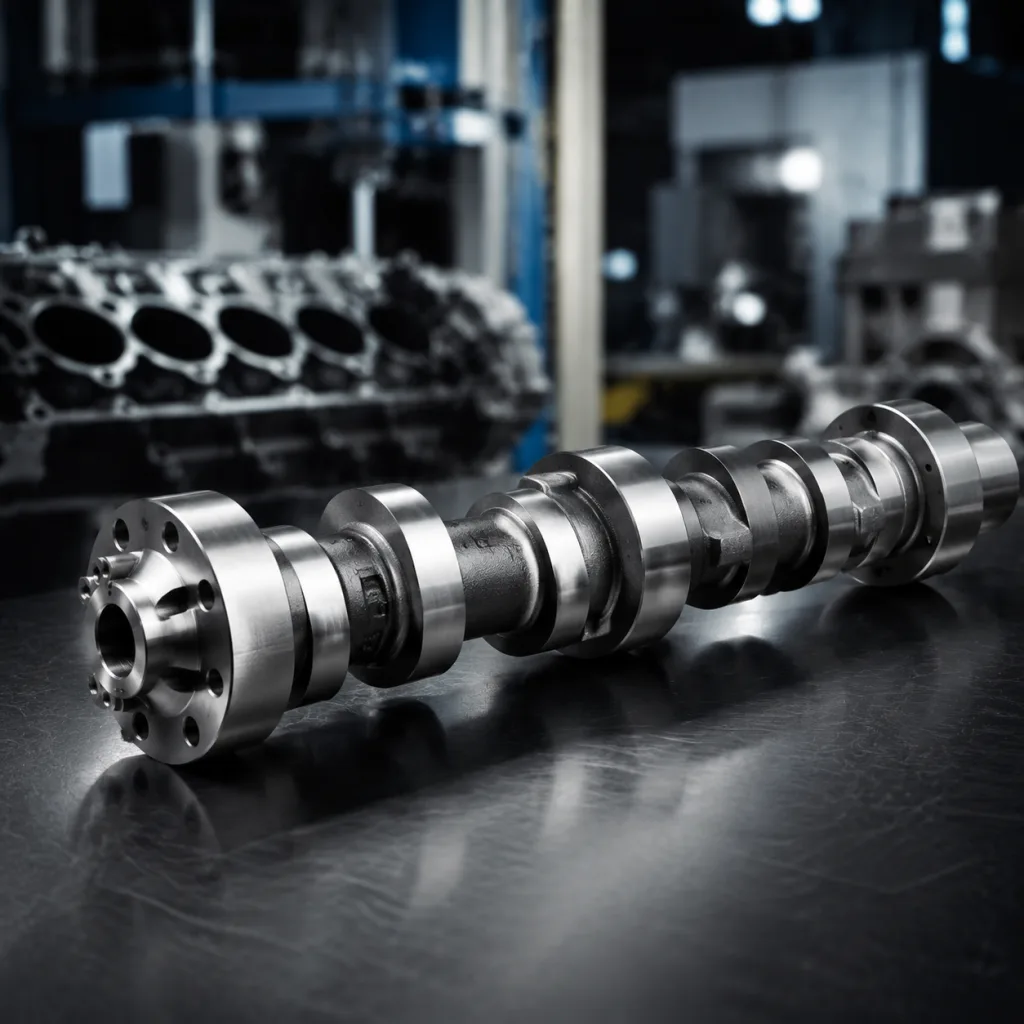
A **camshaft for Fiat Doblo replacement** has to do more than fit into place. It needs to reproduce the original valve-event geometry, bearing-journal sizing, drive interface, lubrication drillings, and axial location before it goes into service. For procurement teams, the real question is not just whether the part installs, but whether it delivers the same dimensional, metallurgical, and surface-performance characteristics across repeat orders and across batches shipped to different markets. That matters because a camshaft is a highly loaded valve-train component. Small deviations in lobe lift, lobe phasing, journal diameter, hardness depth, or straightness can affect idle stability, injection or combustion timing correlation, wear rate, and overall service life.

Driventus supplies aftermarket engine components for B2B buyers who need stable specification control, inspection records, and predictable packaging for warehouse and workshop channels. We manufacture in Taizhou, Zhejiang, under IATF 16949:2016 and ISO 9001:2015 quality systems, with process control aligned to serial production. Driventus is an independent aftermarket manufacturer; brand names are referenced for fitment only.

This article outlines how buyers should assess a direct replacement, including OE cross-reference handling, fitment-critical dimensions, inspection points, validation tests, and the shipment documents that should accompany each order. For distributors, importers, and repair-network purchasing teams, the goal is straightforward: source a camshaft for Fiat Doblo replacement that installs correctly, keeps valve timing within tolerance, performs consistently, and helps reduce avoidable warranty exposure.

What a replacement camshaft must match

A correct replacement is defined by geometry, material condition, and functional compatibility, not by appearance alone. For Fiat Doblo applications, buyers should confirm the cam profile, lobe separation and indexing, base circle, journal diameters, overall length, drive type, thrust-control features, oil-feed design, and sensor or trigger-wheel arrangement where applicable. Valve lift and phasing need to stay within the engine family’s intended operating window. Even a small angular error can shift cylinder-event timing enough to affect cold start, emissions behaviour, or DTC occurrence on engines that use position-correlation logic.

In day-to-day sourcing, a camshaft for Fiat Doblo replacement must match the installed engine version, not simply the vehicle badge. Doblo platforms cover multiple model years, petrol and diesel layouts, and running production changes. That is why engine code, build year, valve-train type, and OE number history should be checked together before approval.

Fitment-critical features to verify

  • Journal diameter and roundness: Typical control on ground journals is in the low hundredths of a millimetre; excessive diameter, taper, or out-of-round can collapse oil clearance or reduce hydrodynamic film stability.
  • Lobe lift and profile shape: Cam lift error changes valve opening area and duration. On direct-replacement programmes, buyers should request measured lift or lobe-height values against a master sample or drawing.
  • Lobe-to-lobe indexing: The angular relationship between lobes is critical. Indexing is typically checked in degrees relative to datum features so cylinder events stay synchronized.
  • Base circle diameter: This directly affects lash, hydraulic tappet preload, or follower relationship depending on engine design.
  • Axial location of thrust surfaces: Thrust-face position and width control end float and maintain correct alignment to the seal, sprocket, and sensor features.
  • Overall shaft length: Length errors can affect seal lip track, drive engagement depth, or end clearance in the carrier or head.
  • Straightness over full length: Camshaft runout is commonly controlled to a few hundredths of a millimetre at support points; excess bend raises local bearing load and can accelerate lobe and journal wear.
  • Drive-end compatibility: Sprocket seat, keyway, dowel, bolt pattern, taper, thread, or slot geometry must match the intended installation exactly.
  • Trigger wheel or sensor interface: Where used, tooth count, angular position, and mounting offset must match the ECU strategy.
  • Oil-hole position and cleanliness: Cross-drillings and feed holes must align with the original lubrication path and be free of burrs, blocked media, or grinding debris.
  • Surface hardness on lobes and journals: Hardness outside the specified window can lead either to rapid wear or to brittle edge chipping; many aftermarket programmes specify lobe hardness in the approximate HRC 52-62 range depending on material and process.

Why visual matching is not enough

Two shafts can look nearly identical on a bench and still differ in lobe phasing, hardness case depth, journal finish, or drive-end geometry. That is why procurement should not rely on photographs or basic catalog descriptions alone. A controlled drawing, approved sample, CMM or form-measurement report, and hardness record provide a much safer basis for repeat ordering.

If the part is supplied against an OE reference such as OE 06A107065, the buyer should still verify actual dimensions against the sample, print, or approved data sheet. OE cross-reference is useful for fitment control, but it does not replace dimensional validation. For a reliable camshaft for Fiat Doblo replacement, the commercial cross-reference and the measured geometry both need to line up.

Specification data buyers should request

Procurement teams should ask for a controlled data sheet before placing a repeat order. For a camshaft for Fiat Doblo replacement, the minimum file set should define what is being made, how it is being controlled, and what evidence the supplier can provide for each lot. Without that baseline information, the risk of inconsistency, field returns, and fitment disputes rises quickly.

At minimum, buyers should request material grade, manufacturing route, heat-treatment method, hardness range, dimensional tolerances, surface-finish expectations, inspection method, and traceability format. This is especially important when buying under an OE-equivalent aftermarket programme rather than an OEM production contract.

</tr></thead><tbody> </tbody></table>Documents that strengthen sourcing control

A stronger procurement file for a camshaft for Fiat Doblo replacement may also include:

  • Supplier drawing or specification sheet with revision control
  • First article inspection report for new or revised production
  • Hardness test record or sample certificate
  • Runout or straightness report
  • Surface-finish record for journals and lobes
  • Visual standard for grinding burn, burrs, edge condition, and corrosion
  • Packaging specification, including VCI or oil-based anti-corrosion protection
  • Part number cross-reference table with supersession notes

Why this matters for repeat orders

When a programme moves from sample approval to regular replenishment, undocumented assumptions become expensive. One buyer may expect a certain anti-rust oil level, while another warehouse may need a specific barcode symbology, carton count, or inner-pack format. If those details are not controlled, they tend to drift over time.

For buyers managing multi-country inventories, consistent packaging labelling and batch traceability matter just as much as the part itself. Stable part number mapping reduces returns and helps prevent mis-picks between closely related engine variants. In short, if you want a dependable camshaft for Fiat Doblo replacement, treat the specification pack as part of the product.

Validation tests that reduce warranty risk

A replacement camshaft should be validated with both dimensional and functional checks. Dimensional inspection confirms that the part matches the approved sample or drawing. Functional and material-related checks help confirm that the part can withstand the operating environment once installed in the engine.

For B2B buyers, validation is what separates a part that merely fits during installation from one that performs consistently across service intervals. A camshaft for Fiat Doblo replacement should therefore be approved through a structured inspection plan, not a single visual check.

Typical validation steps

1. Incoming dimensional inspection against the master sample or controlled drawing. 2. Journal measurement for diameter, roundness, taper, and spacing. 3. Lobe measurement for lift, base circle, nose height, and profile consistency using a form tester, CMM, or dedicated cam-check fixture where available. 4. Hardness testing on lobes and journals, commonly by Rockwell or microhardness method depending on the process. 5. Crack detection such as magnetic particle inspection for ferromagnetic parts where the control plan requires it. 6. Runout verification across the full shaft length, typically using V-blocks and dial indicator or equivalent fixture. 7. Visual inspection for grinding burn, chatter marks, burrs, scoring, edge damage, thread defects, and rust. 8. Oil-hole cleanliness check to ensure no abrasive, metallic chips, or washing residue remains. 9. Drive-end fit check to confirm sprocket, gear, dowel, or fastening compatibility. 10. Packaging and corrosion-protection review before dispatch.

How each test reduces field problems

  • Dimensional inspection reduces installation failures and mismatch returns.
  • Profile and phasing checks reduce timing-related drivability, noise, and engine-management issues.
  • Hardness testing helps control premature lobe or journal wear.
  • Crack detection lowers the risk of fracture linked to casting, heat treatment, or grinding damage.
  • Runout verification reduces uneven loading, abnormal bearing wear, and oil-film disruption.
  • Cleanliness control protects the engine from early contamination-related damage after installation.
  • Packaging review helps prevent corrosion or impact damage during storage and transport.

Batch approval versus one-time approval

A common sourcing mistake is to validate only the first sample and assume future batches will be identical. In practice, ongoing lot control matters. Buyers should define whether each batch needs full dimensional review, reduced sampling, or certificate-based release tied to periodic audits. A practical aftermarket approach is to keep full first-article approval for launch, then require ongoing lot checks on critical characteristics such as journal size, runout, hardness, and key drive-end dimensions.

The article previously referenced standards such as SAE J2527 and ECE R-83, but those are not camshaft-specific validation standards and are not the right basis for direct camshaft approval. For this product category, buyers are better served by a control plan built around drawing tolerances, hardness verification, runout measurement, crack inspection where applicable, and process capability on critical features. The key procurement point is simple: a camshaft for Fiat Doblo replacement should be supported by measurable evidence, not broad claims of compatibility alone.

How Driventus controls repeatability

Driventus manufactures engine and powertrain parts under IATF 16949:2016 and ISO 9001:2015. For replacement buyers, the main benefit is repeatability across production lots. A camshaft for Fiat Doblo replacement must not only meet target dimensions on the first approved sample; it also needs to keep meeting them after repeat machining cycles, raw material replenishment, grinding-wheel changes, washing cycles, and export packing across multiple shipments.

We control machining, grinding, cleaning, inspection, and packing through a documented production flow so dimensional drift, visual defects, or packaging inconsistencies can be identified before shipment. For distributors and importers, that matters because warehouse performance depends on receiving the same specification every time, not a slightly different interpretation of the part with each reorder.

Core repeatability controls

  • Approved incoming material specification: Raw material is checked against defined requirements before entering production.
  • Process routing control: Machining, heat-treatment-related steps, grinding, washing, and final packing follow documented sequences.
  • In-process dimensional checks: Critical features such as journals, lobe dimensions, overall length, thrust locations, and drive-end details are monitored during production.
  • Grinding and finish control: Functional surfaces are checked for dimensional accuracy and finish after grinding.
  • Final inspection with batch traceability: Finished parts are linked to lot identification for downstream quality review.
  • Cleaning and corrosion-protection verification: Components are checked before packing to reduce storage and transit risk.
  • Packing verification: Labels, quantity, inner protection, and outer carton condition are reviewed before dispatch.

Why this matters for channel supply

Our buyers in the EU, UK, US, Canada, Australia, and Brazil often need mixed-channel supply. The same part may go to a distributor, a repair network, an e-commerce replenishment warehouse, or a regional parts hub. In each case, the product itself must remain the same, even if the packaging or paperwork follows customer-specific instructions.

That is why repeatability is not only a machining issue. It also includes:

  • Stable part number mapping
  • Carton and pallet consistency
  • Batch-level traceability
  • Export document accuracy
  • Label readability for warehouse scanning
  • Corrosion resistance through shipping and storage cycles

For programmes requiring private label, application-specific marking, or non-standard carton formats, these details should be frozen in the approved specification before mass supply begins. That reduces the chance of claims caused by mixed labels, incorrect inner quantities, or channel-specific misidentification.

You can review our catalog, our quality system, and custom manufacturing if a private-label or application-specific version is required. For broader engine coverage, see engine components.

Buying checklist for Fiat Doblo programmes

When sourcing a replacement camshaft, use a controlled checklist before purchase order release. This is especially important when the same vehicle line carries multiple engine codes, fuel types, valve-train layouts, or model-year changes. A disciplined review process helps buyers avoid the most common causes of claims: wrong application mapping, incomplete technical data, and insufficient batch control.

For any camshaft for Fiat Doblo replacement, the purchasing decision should combine fitment verification, quality evidence, and logistics readiness. The part is only fully approved when all three are aligned.

Procurement checklist

  • Confirm engine code, displacement, fuel type, and build range from the vehicle or service record.
  • Verify OE cross-reference and supersession status so old and new references are not mixed incorrectly.
  • Match sample dimensions to the supplier drawing or approved data sheet.
  • Request hardness, runout, and surface-finish data for the critical features.
  • Confirm drive-end design, sensor arrangement, and oil-hole configuration where applicable.
  • Check whether first-article approval is needed before blanket release.
  • Confirm packaging quantity, barcode format, lot code, and corrosion protection.
  • Review lead time, replenishment window, and safety-stock assumptions.
  • Validate sample fitment before large-volume approval.
  • Define the claim-handling and traceability process in case field feedback is received.

Questions buyers should settle before ordering

1. Is the supplier quoting by vehicle model only, or by engine-specific fitment? 2. Are all critical dimensions controlled on a drawing or data sheet? 3. Does the supplier provide batch traceability and inspection evidence? 4. Will the packaging work for your warehouse and downstream channel? 5. Is the sample you approved exactly the same configuration that will ship in production?

For importers and distributors

If your programme serves multiple countries or customer types, add a commercial review alongside the technical checklist. Confirm carton markings, language requirements, customs document expectations, and whether private-label packaging changes the corrosion-protection method or inner-pack layout.

If your programme needs a non-standard surface treatment, oil-hole configuration, or packaging format, Driventus can support custom manufacturing for qualified B2B accounts. Driventus is an independent aftermarket manufacturer; brand names are referenced for fitment only. With the right approval process, sourcing a camshaft for Fiat Doblo replacement becomes more predictable, more scalable, and less exposed to avoidable warranty cost.

Frequently asked questions

Yes, OE references help narrow the fitment search, but the buyer should still confirm measured dimensions, hardness range, drive-end geometry, sensor features, and application-specific details against the approved sample or drawing.

Ask for a packing list, batch traceability, inspection record, and material or hardness data where applicable. For regulated markets, also confirm REACH (EC) No 1907/2006 compliance status as required by your programme.

No. Driventus is an independent aftermarket manufacturer; brand names are referenced for fitment only. We supply OE-equivalent replacement parts for B2B customers.

If you need a replacement camshaft with controlled fitment and batch traceability, contact Driventus to review your application and supply requirements: /contact.html

Request a Quote
Item What to verify Typical procurement note
Base materialChilled cast iron, ductile iron, or alloy steel as applicableConfirm material designation and approved substitute policy
Manufacturing routeCast-then-ground or forged/bar-machined-then-groundAsk whether lobes are integral or separately processed
Heat treatmentInduction hardening, chill casting, nitriding, or equivalent routeRequest process summary and control limits
HardnessLobe and journal hardness range, plus case depth where relevantRequest test location, method, and acceptance criteria
StraightnessFull-length runout / bend controlRequire measured values, not nominal only
Surface finishLobes and journals after grindingAsk for Ra target, often around Ra 0.2-0.8 μm on ground functional surfaces depending on design
Critical dimensionsJournal diameter, overall length, thrust face, lobe height, phasingMatch to approved drawing or master sample
Drive-end detailsKeyway, bolt pattern, taper, dowel, gear or sprocket seatRequire dimensional sketch or detailed photos
Oil featuresOil-hole size, location, and deburringConfirm inspection method and flushing step
CleanlinessResidual abrasive or machining debrisRequire post-wash inspection standard
TraceabilityBatch code and production date linkageConfirm label format and carton-level identification