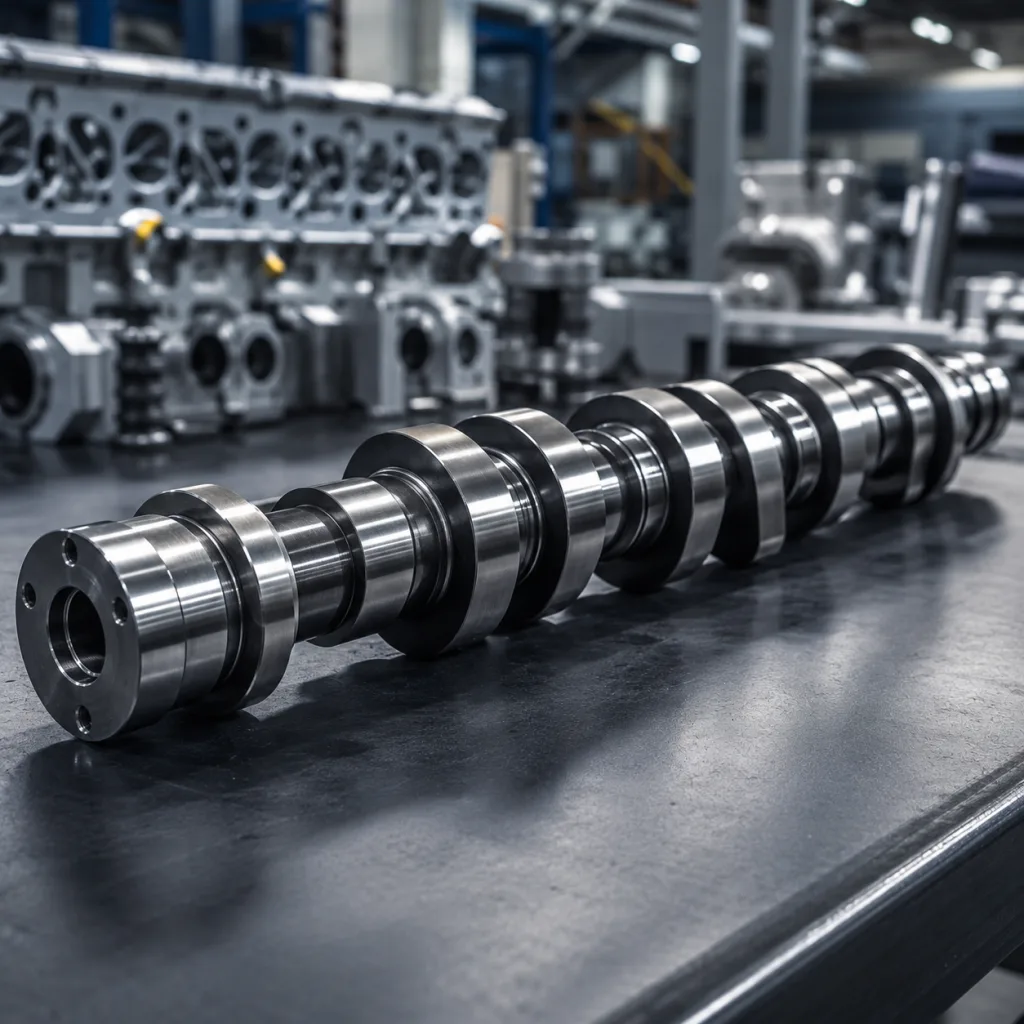
Camshaft for Land Rover Range Rover Sport OE Equivalent
A camshaft for Land Rover Range Rover Sport OE equivalent needs to do more than match a broad fitment listing. It has to align with the original design intent. For procurement teams, that means checking lobe profile, base circle, journal diameters, total indicated runout (TIR), timing phasing, surface hardness, and confirmed compatibility with the engine code, cylinder bank, and valvetrain layout. Even small deviations can shift valve events by several crank-angle degrees, change effective valve lift, raise tappet or follower contact stress, and lead to rough idle, DTCs, emissions non-conformance, or accelerated wear. In short, sourcing decisions should rest on verified specifications, controlled inspection, and precise application matching rather than description-only catalog data.
Driventus supplies replacement engine components for B2B programs and validates critical dimensions against controlled drawings, OE references, and approved samples where available. Driventus is an independent aftermarket manufacturer; brand names are referenced for fitment only. For distributors, repair chains, importers, and private-label programs, the goal is straightforward: a camshaft that installs without modification, meets documented inspection criteria, and performs consistently from batch to batch. In that context, a camshaft for Land Rover Range Rover Sport OE equivalent is not just another replacement part. It is a valvetrain component that must preserve timing accuracy, lubrication conditions, contact geometry, service life, and supply consistency across ongoing purchasing cycles.
What OE-equivalent means for a Range Rover Sport camshaft
OE-equivalent is not the same as a visual copy. It means the part meets the functional, dimensional, and material-performance requirements needed for proper installation and engine operation. That distinction matters with camshafts because a shaft can look correct and still cause timing error, abnormal wear, unstable idle, fault codes, oil-film problems at the journals, or early valvetrain failure if key geometry falls outside tolerance.
For a camshaft application, buyers should confirm:
Overall shaft length and journal-to-journal spacing
Journal diameter, roundness, and taper
Lobe lift, base circle, and opening/closing ramp profile
Lobe-to-lobe and lobe-to-drive-end phasing
Drive-end geometry such as keyway, dowel, flange, reluctor, or VVT interface
Surface finish and hardness after heat treatment or surface hardening
Compatibility with hydraulic lash adjusters, roller followers, bucket tappets, or rocker systems
A correct replacement should maintain the same valve timing window and contact conditions as the original part-number family, subject to engine code and revision level. This matters even more on modern Land Rover Range Rover Sport engines, where emissions calibration, variable valve timing hardware, and valvetrain loading can vary by engine family and model year.
From a B2B sourcing standpoint, OE-equivalent also means the supplier can demonstrate how conformity is maintained from sample stage through serial production. Typical controls include controlled drawings, characteristic-specific tolerances, process routing, heat-treatment parameters, hardness verification, and traceability by batch or lot code. Without that structure, an initial sample may pass while later shipments drift in journal size, lobe indexing, or surface finish.
For procurement teams, the best starting point is to match the OE reference, engine variant, and build range before releasing an order. If you need support across multiple platforms, see our catalog and our quality system.
Key specifications buyers should verify before ordering
The specification review should be completed before sample approval and again before any production PO is issued. Core control points usually include dimensions, geometry, hardness, surface condition, and inspection records. A disciplined review process helps buyers avoid a common problem: approving a part based on a broad fitment claim instead of valvetrain-critical data.
Specification item
Why it matters
Typical buyer check
Journal diameter
Controls bearing fit and oil clearance
Outside micrometer at defined journal positions
Journal taper/out-of-round
Affects oil film stability and wear
Multi-point measurement around each journal
Lobe lift
Determines valve opening amount
Compare with OE drawing, CMM, or master sample
Base circle
Influences lash and follower geometry
Profile or diameter check by fixture/CMM
Lobe phasing
Affects valve timing and engine response
Indexed fixture or cam measuring machine
Total indicated runout (TIR)
Influences vibration and contact pattern
V-blocks with dial indicator or dedicated fixture
Surface hardness
Supports wear resistance on lobes and journals
HRC or HV report with process record
Surface finish
Affects lubrication and scuff resistance
Roughness check, typically Ra on journals/lobes
Cleanliness and preservation
Reduces early wear and corrosion risk
Washing, rust-preventive oil, and packaging review
</tr></thead><tbody> </tbody></table>In practice, buyers should look beyond a simple pass/fail statement. For example:
Journal diameters should be measured at multiple axial and circumferential points to confirm size, taper, and out-of-round. On precision shafting, this is typically reported in hundredths or thousandths of a millimeter, not just nominal diameter.
Lobe geometry should be checked not only for peak lift, but also for opening ramp, nose radius, and closing ramp consistency relative to the approved master profile. A lobe with correct maximum lift but incorrect flank form can still create noise, impact loading, or poor hydraulic lash behavior.
Timing features such as keyways, dowel holes, trigger wheels, tone-ring seats, or sprocket mounting faces should be verified from a defined datum structure rather than by visual comparison.
Hardness and heat treatment should be reviewed together, because an acceptable surface hardness value alone does not confirm adequate case depth, induction pattern, or microstructure.
Runout should be checked after final grinding and, where distortion risk exists in the process route, again before packing.
For European and export programs, buyers commonly request traceability aligned with IATF 16949:2016 and ISO 9001:2015 quality records. Where chemical compliance is part of the requirement, confirm REACH (EC) No 1907/2006 status for relevant process materials, coatings, preservatives, and packaging.
A practical purchasing step is to define a sample approval package before releasing production. That package may include dimensional reports, hardness results, material certification, lobe profile data, marking photos, packaging specifications, and an agreed incoming inspection plan for future batches.
Application control for Range Rover Sport fitment
Range Rover Sport camshaft replacement requests often go wrong when the buyer matches only the vehicle model name. The correct part depends on engine family, cylinder bank, fuel type, emissions level, model year, timing system architecture, and whether the shaft is intake or exhaust. Two vehicles sold under the same badge can require different camshafts because of changes in VVT strategy, journal dimensions, trigger geometry, lobe pattern, or cylinder head design.
A buyer should confirm at least the following before placing a PO:
1. Engine code, displacement, and fuel type 2. Intake or exhaust position, and left/right bank where applicable 3. Cam drive type and sprocket, flange, or phaser interface 4. Valvetrain hardware used in the application, such as bucket tappet, roller follower, or rocker arrangement 5. OE reference number or a verified cross-reference tied to the exact engine family and build range
These checks matter because the camshaft has to work within the complete operating system around it. For example:
An intake camshaft may differ from an exhaust camshaft not only in lobe design, but also in trigger pattern, dowel orientation, or phaser coupling features.
A camshaft designed for hydraulic lash adjustment can require different ramp rates and surface finish control than one used in a different follower arrangement.
Engines equipped with variable valve timing generally require tighter control of angular indexing between the lobe set and the phaser mounting datum.
Mid-cycle engineering changes can alter the OE reference even when displacement and the basic model description stay the same.
For importers, warehouse distributors, and repair-group buyers, the most effective approach is to build a fitment matrix that combines vehicle platform, engine code, bank or position, OE reference, and known build-range notes. This reduces returns, prevents workshop delays, and improves downstream catalog accuracy.
If your sourcing team manages mixed vehicle lines, a controlled cross-reference file is far more reliable than model-name-only listings. For broader engine program support, you can also review our catalog and engine components.
Testing and validation that reduce warranty risk
A camshaft should be validated as a functional valvetrain component, not simply treated as a machined shaft. At minimum, procurement teams should request the following evidence:
Incoming material certificate for the forging, casting, or bar-stock feed material, as applicable
Heat-treatment or surface-hardening verification
Dimensional inspection report on defined critical characteristics
Runout and lobe geometry checks
Surface hardness confirmation at specified locations
Surface finish verification on journals and lobes
Packaging and corrosion-protection method
These records help show that the part was produced under control, but warranty risk drops further when validation reflects real service conditions. A more complete approval process may include:
Master-sample comparison to confirm key dimensions, timing features, and working geometry
First article inspection (FAI) for initial sample approval
Process capability review on critical characteristics for higher-volume programs
Profile measurement using a cam measuring machine, CMM, or equivalent fixture where required
Marking and traceability checks so field issues can be linked back to lot data
Transit packaging review to prevent corrosion, impact damage, or mixed-part shipment during export handling
Where practical, buyers may also define acceptance criteria for items such as journal size bands, lobe index tolerance, hardness range, and maximum TIR. The exact values depend on the engine family, manufacturing route, and the buyer’s approved drawing or master sample. For B2B programs, the key point is simple: do not rely on generic claims such as "tested" or "OEM quality" without supporting inspection data.
It is also good practice to define what happens after approval. Buyers should agree on requalification triggers such as raw material source changes, heat-treatment route changes, grinding wheel specification changes, tooling renewal affecting lobe profile, or revisions to washing and preservation methods. When those triggers are documented, supplier and buyer can maintain program stability over time instead of treating each shipment as an isolated lot.
Driventus can support documented sample approval and production control for aftermarket and OEM-oriented programs through custom manufacturing.
How Driventus supports sourcing teams
Driventus manufactures engine and powertrain components in Taizhou, Zhejiang, with export experience in more than 60 countries. For camshaft sourcing, our production and quality teams focus on repeatability across batches, dimensional control of valvetrain-critical features, and stable packaging for long-distance freight.
What procurement teams typically receive:
OE cross-reference review before sampling
Production control documentation for agreed critical characteristics
Batch identification and traceability
Export-ready packing for wholesale and distribution channels
Support for private-label or program-specific requirements
For B2B buyers, this support matters most where sourcing risk is highest: initial application review, sample validation, first bulk order, and repeat replenishment. A reliable supplier should be able to confirm what is being quoted, which features are controlled, which inspection method is used, and how future production stays aligned with the approved sample.
Driventus works with customers that may need different supply models, including:
Distributors requiring stable cross-reference management and consistent batch quality
Repair chains needing dependable fitment and lower return rates across multiple branches
Importers and wholesalers looking for export packaging, labeling control, and shipment coordination
Private-label programs that need customized packing, branding, and documentation standards
If your team is comparing suppliers for a replacement program, the main decision criteria should be dimensional conformance, application accuracy, process control, and responsiveness to sample feedback. Unit price matters, but with a camshaft application the larger cost driver is often warranty exposure: workshop labor, engine teardown time, stock returns, and reputational damage caused by poor fitment or unstable batch quality.
You can request a quote for sample pricing, batch MOQ, and lead time details.
Frequently asked questions
No. OE-equivalent means the part is engineered and controlled to match the required fit, function, and critical dimensions for the application. It does not mean the part is produced by, branded by, or officially endorsed by the vehicle manufacturer.
Confirm the engine code, displacement, fuel type, intake or exhaust position, left/right bank if applicable, OE cross-reference, journal dimensions, lobe profile or lift, drive-end features, and timing geometry. Do not rely on the model name alone.
Yes. Driventus supports B2B programs with sample approval, batch traceability, controlled documentation, and custom manufacturing options for distributors, repair chains, importers, and OEM-oriented buyers.
If you need a camshaft for Land Rover Range Rover Sport OE equivalent supply review, send your engine code, OE reference, position, and annual volume target. Our team can confirm fitment and next steps at /contact.html