camshaft · 2026-05-28

Camshaft for Buick Encore OE Equivalent: Buyer Guide

Procurement teams buying a camshaft for Buick Encore OE equivalent need more than a part that looks correct. The replacement must match the OE profile, bearing journal dimensions, lobe timing, surface finish, and sensor-related features used by the engine variant. Small deviations can affect valve timing, idle quality, emissions performance, and long-term wear. For Buick Encore applications, the exact camshaft specification depends on engine code, model year, and whether the engine uses intake, exhaust, or dual cam timing arrangements. Driventus supplies replacement engine components for B2B buyers and validates parts against dimensional and functional requirements before shipment. Driventus is an independent aftermarket manufacturer; brand names are referenced for fitment only. This article explains how to assess OE equivalence, what to verify on drawings and samples, and which standards matter when you source replacement camshafts for distribution, service networks, or engine remanufacturing.

What OE equivalent means for a Buick Encore camshaft

OE equivalent means the camshaft must match the vehicle’s original functional and dimensional requirements without claiming OEM approval. For procurement, that usually means the part is interchangeable at installation and performs within the same operating window as the original component.

Key items to confirm before ordering:

  • Engine code and model year
  • Intake, exhaust, or matched set application
  • Number of lobes and lobe phasing
  • Journal diameters and overall length
  • Thrust face location and surface hardness
  • Trigger wheel, reluctor, or timing reference features
  • Packaging and traceability requirements

For Buick Encore programmes, buyers often work from VIN-based catalogues, OE 06A-type references, or internal service part lists. The safest approach is to validate the drawing against a known-good sample and confirm that the part meets the vehicle’s mechanical envelope. Driventus can support OE cross-checking using production drawings, inspection reports, and sample comparison.

Dimensional checkpoints procurement should verify

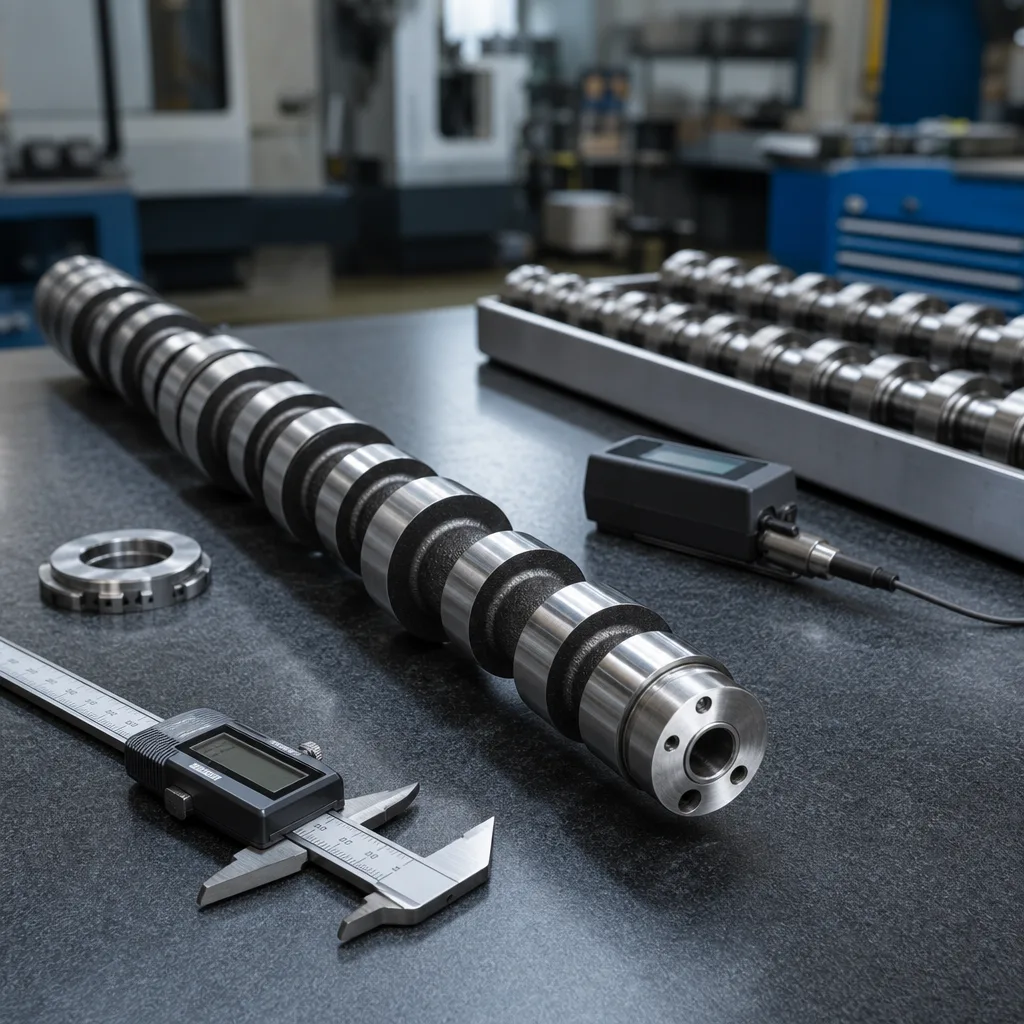
A camshaft is a precision rotating component. A small error in one critical dimension can make the part unusable, even if the box description is correct. Buyers should request a dimension sheet and compare it with the OE sample or service specification.

</tr></thead><tbody> </tbody></table>For replacement work, ask for PPAP-style dimensional records, hardness results, and first-article inspection data. If the supplier cannot provide these documents, the part may still fit, but the risk profile is higher for fleet and remanufacturing channels.

Materials, heat treatment, and surface finish

Material and heat treatment determine durability as much as geometry does. Most production camshafts use cast iron or forged steel, followed by controlled hardening of lobes and journals. The correct process depends on the original engine design and duty cycle.

Important sourcing questions:

  • What base material is used: cast iron, chilled cast iron, or steel?
  • Are the lobes induction-hardened or chilled?
  • What is the target hardness range on functional surfaces?
  • Is final grinding done after heat treatment?
  • Is the surface roughness controlled for bearing and lobe wear?

Published quality and compliance references matter. Buyers commonly request conformity to IATF 16949:2016 and ISO 9001:2015 for production control, and they may also require REACH (EC) No 1907/2006 declarations for the EU market. If the application sits inside emission-related service work, compatibility checks should consider ECE R-83 requirements where relevant to the vehicle configuration. Driventus documents these controls within its quality system.

How to validate fitment before releasing a purchase order

Validation should happen before volume purchase, not after the first customer complaint. For a Buick Encore replacement programme, a basic pre-release check should include physical comparison, lab review, and vehicle-level confirmation.

Recommended validation steps

1. Confirm exact engine and model year from the VIN or service record. 2. Compare the supplier drawing with the OE sample or reference part. 3. Check all critical dimensions with calibrated gauges. 4. Review hardness, microstructure, and surface finish data. 5. Inspect packaging, traceability, and lot coding. 6. Install a sample set and verify cranking, idle quality, and scan data. 7. Confirm there are no abnormal noises, DTCs, or timing deviations after road test.

For remanufacturers and distributors, a controlled sample run is the most efficient way to reduce return rates. Driventus can support pilot builds, gauge reports, and fitment verification through custom manufacturing when a standard part must be adjusted for a specific programme.

Why supplier controls matter for aftermarket replacement

A camshaft is not a commodity part if the application is engine-critical. Buyers should review the supplier’s process controls, not just price and lead time.

Areas to audit:

  • Incoming raw material traceability
  • Heat-treatment process control
  • In-process dimensional inspection
  • Final runout and surface checks
  • Packaging protection against corrosion and impact
  • Lot traceability from melt or bar stock to shipment

Driventus operates as a vertically integrated manufacturer in Taizhou, Zhejiang, and exports to more than 60 countries. That matters because integration shortens the chain between engineering change control and final inspection. Buyers can review our catalog and, for broader engine sourcing, the engine components range. The goal is not only interchangeability, but repeatable batch quality across multiple replenishment cycles.

When to specify a custom camshaft instead of a direct replacement

A direct OE-equivalent part is the right answer when the engine remains stock and the buyer wants standard service compatibility. Custom work is more appropriate when the programme has changed duty cycle, export market requirements, or remanufacturing constraints.

Use custom manufacturing when you need:

  • A revised surface treatment for higher wear resistance
  • A different packaging or labelling format for your network
  • A modified trigger wheel or sensor interface
  • A controlled design change for a legacy engine family
  • A private-label or programme-specific cross-reference structure

If your requirement extends beyond a direct replacement, Driventus can support custom manufacturing with engineering review, sample approval, and controlled production. For pricing, lead time, and sample requests, request a quote.

Frequently asked questions

No. Driventus does not claim OEM approval or endorsement. Driventus is an independent aftermarket manufacturer; brand names are referenced for fitment only.

It means the part matches the original functional and dimensional requirements closely enough to install and operate as intended in the specified engine application.

Ask for dimensional drawings, hardness data, surface finish values, traceability records, and a sample for fitment validation against the target Buick Encore application.

If you need a verified replacement programme for a Buick Encore camshaft, send your application details and sample requirements. Our team can confirm fitment, documentation, and commercial terms at /contact.html

Request a Quote
Checkpoint What to verify Typical procurement risk
Overall lengthEnd-to-end match within specified toleranceBearing misalignment
Journal diameterMain bearing fit and oil clearanceOil pressure loss or seizure
Lobe lift and profileValve event timing and liftMisfire, low power
Base circleCorrect valve lash geometryNoise, incorrect clearance
Thrust locationAxial control in the headExcess end play
Sensor trigger featureSignal count and positionStart failure, DTCs
Surface hardnessWear resistance on lobes and journalsAccelerated wear