Camshaft Fiat OE Equivalent: Replacement Fitment Guide
Procurement teams usually look for an OE-equivalent camshaft when they need a replacement that matches fit, function, and service life without paying for a branded part. For Fiat applications, the sound sourcing approach is to compare the supplied camshaft with the OE reference, controlled drawing, or verified master sample, then confirm the lobe profile, journal geometry, cam phasing, timing-end interface, material grade, surface treatment, and batch traceability. Driventus is an independent aftermarket manufacturer; Fiat and other brand names are referenced only for fitment identification.
That distinction matters. A camshaft may locate correctly in the cylinder head yet still change valve opening events, idle stability, emissions behaviour, fuel consumption, valve-train noise, or follower wear if profile height, centreline angle, hardness, or oiling details fall outside specification. In B2B purchasing, the risk is not just a returned part. It is workshop labour, vehicle downtime, claim handling, and installer confidence across hundreds or thousands of units. A defensible buying process starts with dimensions, checks the metallurgy, and validates the part before volume release. Done well, it gives distributors, importers, fleet maintenance buyers, and private-label programmes a technical file they can stand behind as parts move through multiple workshops and markets.
What OE-equivalent means for a Fiat camshaft
A camshaft Fiat OE equivalent is not a loose compatibility claim. It should match the target OE part's installed function closely enough that the engine stays within its intended operating envelope for valve timing, valve lift, overlap, lubrication, noise, and wear. The goal is straightforward: give the buyer a replacement camshaft that fits the intended Fiat engine family without changing the service outcome expected from the original reference.
For sourcing teams, OE-equivalent should be treated as a controlled technical position, not catalogue shorthand. The supplier should be able to identify the target OE reference, engine code, drawing revision, or verified master sample used for development. They should also state which critical-to-function features are inspected before release. This is especially important where different Fiat engine variants share similar external geometry but use different cam profiles, reluctor positions, cam sensor targets, timing sprockets, or valve-train components.
In practice, buyers should require alignment on the following points:
- Journal count, journal spacing, journal diameter, bearing width, and thrust location
- Lobe lift, base circle, nose radius, flank form, lobe width, and taper where specified
- Intake and exhaust lobe centreline, angular phasing, and reference datum for timing checks
- Oil-feed holes, oil grooves, end plugs, threaded ends, dowel positions, and gear or sprocket interfaces
- Cam sensor, reluctor, slot, keyway, or trigger-wheel features used by the engine management system
- Material family, casting or forging route, heat treatment, and surface-hardening process
- Surface finish on journals, lobes, thrust faces, seal surfaces, and follower contact areas
- Packaging, corrosion protection, labelling, barcode data, and batch identification for export shipments
The strongest files connect the commercial part number to a technical record: target reference, inspection plan, material route, approved sample, and change-control history. If the supplier cannot show how the part was matched to the reference, the word equivalent has little value in a purchase order. A distributor may still receive a part that looks correct on the shelf, but it may not deliver repeatable fitment once workshops begin installing it across mixed model years, engine codes, and regional variants.
Dimensional checks that matter most
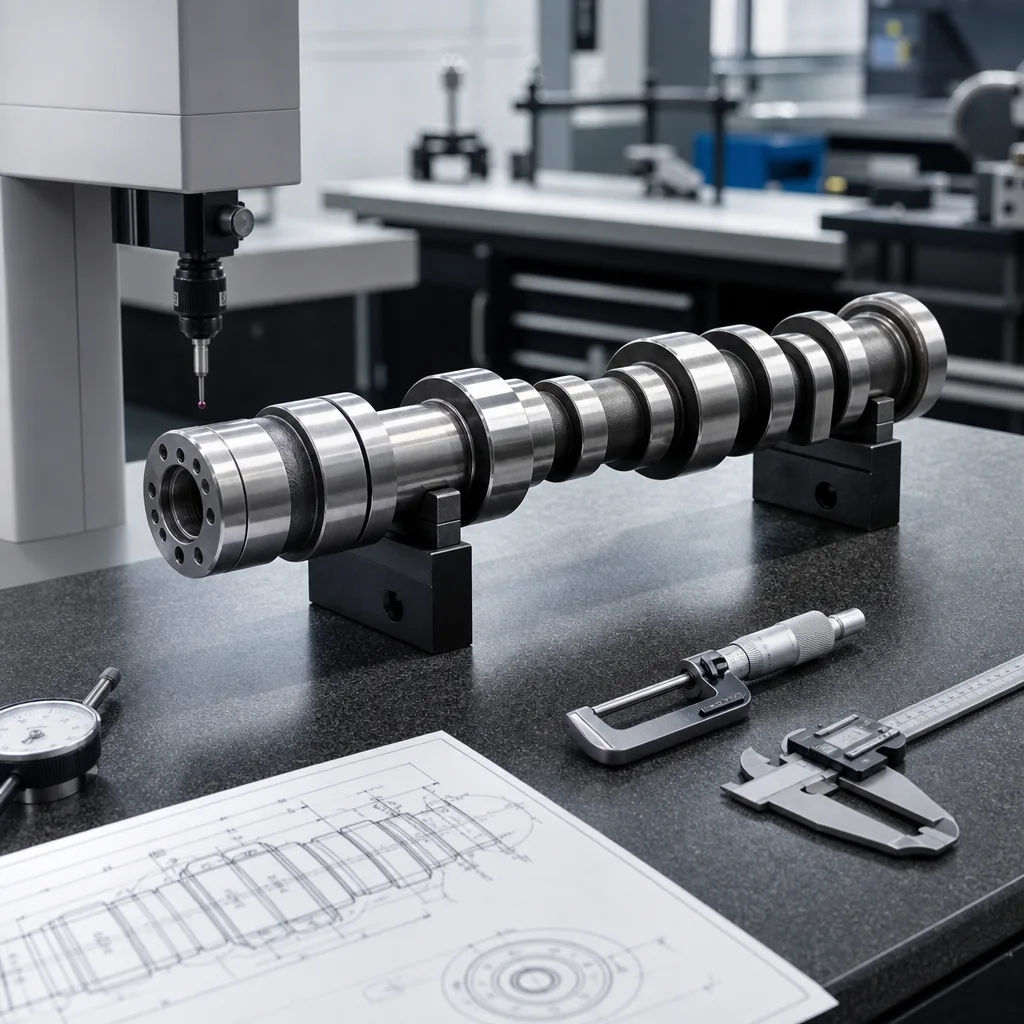
The critical measurements are the ones that can change valve events, bearing clearance, oil control, or installation accuracy. A visual match is not enough. Differences in base circle, lobe lift, lobe centreline, journal diameter, or runout can lead to noisy operation, incorrect hydraulic lifter preload, low oil-film stability, difficult starting, diagnostic faults, or premature lobe and follower wear.
The inspection plan should separate general dimensions from controlled characteristics. Overall length, end shape, and visual condition matter for handling and fitment, but lobe geometry and journal geometry usually decide whether the camshaft behaves like the target part inside the engine. For Fiat applications, the buyer should also verify the exact timing interface used by the engine family, such as gear, sprocket, pulley, locating dowel, keyway, reluctor, slot, or cam sensor reference feature.
| Check item | Why it matters | What to verify |
|---|---|---|
| Lobe lift | Directly affects valve opening and cylinder filling | Compare full lift to OE drawing or verified master sample |
| Base circle | Affects valve lash, hydraulic compensation, and installed profile height | Measure on a calibrated cam profile system |
| Lobe centreline and angular phasing | Controls valve opening and closing events | Verify against the defined cam datum or timing-end reference |
| Nose radius and flank form | Influences follower contact stress, acceleration, and noise | Compare the complete profile curve, not maximum lift only |
| Journal diameter and roundness | Controls bearing clearance and oil-film thickness | Check against the tolerance band and out-of-round limit |
| Journal spacing and coaxiality | Affects installation load and bearing alignment | Confirm position from the shaft datum and alignment across all journals |
| Total indicated runout | Impacts vibration, oil clearance, and bearing wear | Inspect on centres or V-blocks with a stated acceptance limit |
| Thrust face width and finish | Controls axial location and end float | Match OE geometry, flatness, and surface condition |
| Oil holes and grooves | Support lubrication to journals and valve-train parts | Confirm position, diameter, groove width, cleanliness, and deburring |
| Timing end features | Determine assembly position and ECU synchronisation | Check keyway, dowel, slot, thread, sprocket seat, and sensor feature position |