camshaft · 2026-05-29

Camshaft Dodge Supplier: Sourcing Rules for Buyers

Buyers looking for a Dodge camshaft supplier usually need more than a line item in a catalogue. They need controlled geometry, documented heat treatment, repeatable lead times, and a factory that can support audits and post-shipment traceability. Driventus manufactures engine and powertrain components for aftermarket, OEM, and repair-chain customers. Driventus is an independent aftermarket manufacturer; brand names are referenced for fitment only. For procurement teams, the practical questions are direct: does the cam profile match the target application, can the supplier prove material and hardness, and will the supply plan hold through seasonal demand? The sections below set out the checks we use for sampling, production approval, compliance, and custom manufacturing.

What buyers should lock down before sourcing

A camshaft programme fails when the buyer and supplier are discussing the wrong definition of fit. Before you quote, confirm the engine family, valve train layout, intended fuel and emissions calibration, and whether the part is for aftermarket replacement, private label distribution, or an OEM/Tier-1 build.

Use this checklist at the quotation stage:

  • Target application and engine code
  • Lift, duration, lobe separation, and phasing targets
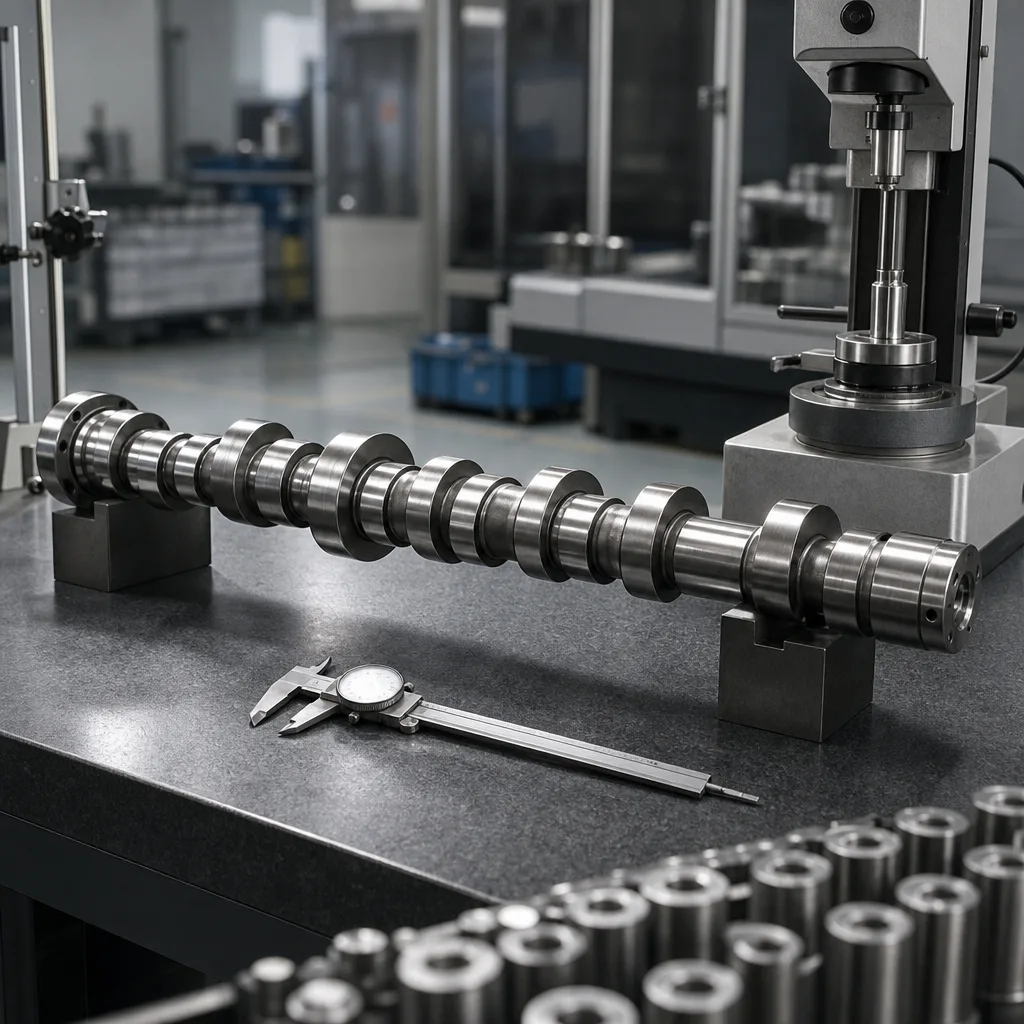
  • Journal diameters, runout, and end play limits
  • Material route: billet steel, forged steel, or cast iron
  • Required finish on lobes and journals
  • Packaging standard for export and warehouse handling
  • Annual volume, forecast split, and reorder trigger

For a broader range of parts, see our catalog, the quality system, and custom manufacturing. If you need a commercial starting point, use request a quote.

Dimensional control and sample approval

A credible source should provide measured evidence, not only a declaration of compliance. For a production sample, ask for a dimensional report that matches the drawing revision and identifies the gauge method used.

</tr></thead><tbody> </tbody></table>If the sample passes, lock the inspection method into the purchase order. That reduces disputes later when the same part is re-run after a tooling or batch change.

Materials, heat treatment, and compliance

Material choice drives wear life, noise, and consistency across batches. For many engine programmes, buyers will see billet steel, forged steel, or chilled cast iron depending on the application, target volume, and cost model. What matters is not the label alone, but the recorded process route.

A defensible quality package usually includes:

  • Material certificate linked to the heat or batch number
  • Heat-treatment record for hardness and case depth, where applicable
  • Surface condition record for lobes and journals
  • Traceability from raw material to finished shipment
  • Conformity declaration for chemical restrictions under REACH (EC) No 1907/2006

For quality management, ask whether the plant is operated under IATF 16949:2016 and ISO 9001:2015. If the camshaft is part of a broader engine calibration package, the buyer should also document the validation basis used for the programme, including any emissions-linked requirements where ECE R-83 applies.

Lead time, MOQ, and commercial risk

Supply performance matters as much as the part itself. A low price does not help if the order is late, the pallet spec is weak, or the supplier cannot repeat the same batch six months later.

Buyers should agree these points before award:

  • MOQ by part number and by tooling state
  • Standard lead time for sample, pilot, and mass production
  • Forecast commitment window and release schedule
  • Incoterms, carton count, and pallet configuration
  • Spare capacity for seasonal demand spikes
  • Corrective action response time after a nonconformance

For export programmes, ask for a named contact for documentation, packing, and dispatch. That reduces delay at customs and at the receiving dock. If you need a sourcing path for multiple engine components, review our catalog and then request a quote once the forecast is stable.

Custom manufacturing and factory audit readiness

When the required profile is not a standard catalogue item, custom manufacturing is usually the fastest route to a controlled result. The useful question is not whether a supplier can make one sample. It is whether the factory can repeat the same geometry, hardness, and finish after the first hundred or first ten thousand pieces.

For OEM and private-label work, ask for:

  • Control plan and inspection frequency
  • Gauge list with calibration status
  • Lot traceability and retention sample policy
  • First article approval and pilot-run sign-off
  • Corrective action process for dimensional drift

A plant audit should confirm the same things the paperwork claims: process control, traceability, and change management. If you are comparing suppliers, start with the quality system, then review custom manufacturing for build-to-print work, and finish with request a quote once the technical brief is locked.

Frequently asked questions

Yes, if the application, drawing revision, and validation scope are defined. We support private label and B2B supply, with brand names referenced for fitment only. Packaging, labelling, and traceability can be set to the buyer's specification.

Request material certificates, dimensional inspection reports, hardness data, and lot traceability. For controlled programmes, also ask for the plant's IATF 16949:2016 and ISO 9001:2015 evidence, plus any programme-specific validation records.

We review the target engine family, target volumes, and inspection limits first. After sample approval, we confirm tooling, lead time, and release terms so the run can move from pilot to repeat production without changing the control plan.

If you are qualifying a new source or comparing samples, [request a quote](/contact.html)

Request a Quote
Control point What the buyer should verify Typical evidence
Lobe profileLift and duration match the approved printCMM data or lift chart
Journal geometryDiameter, concentricity, and runout are stableInspection report
Surface finishWear risk is controlled during break-inRoughness measurement
Timing featuresKeyways, sprocket interface, and phasing are correctFirst article record
PackagingParts arrive free from corrosion and impact damagePacking specification