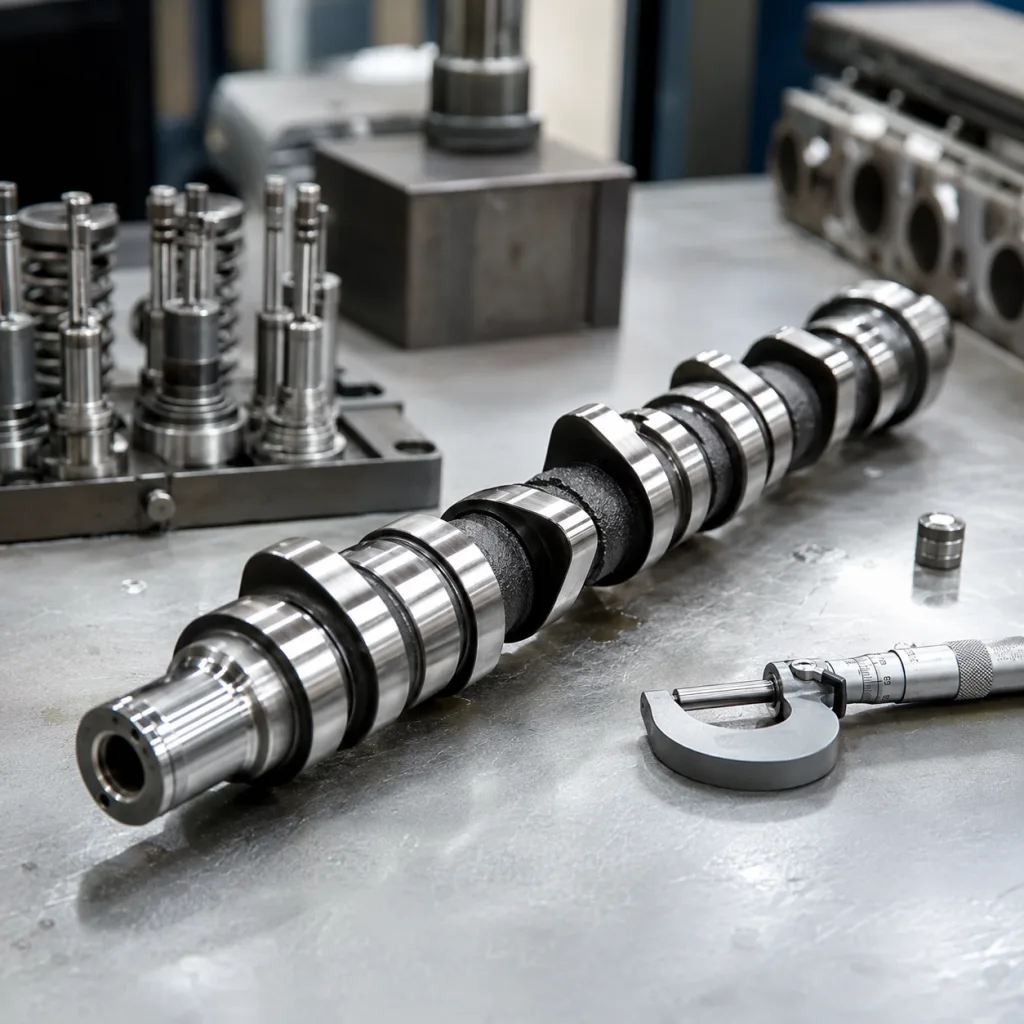
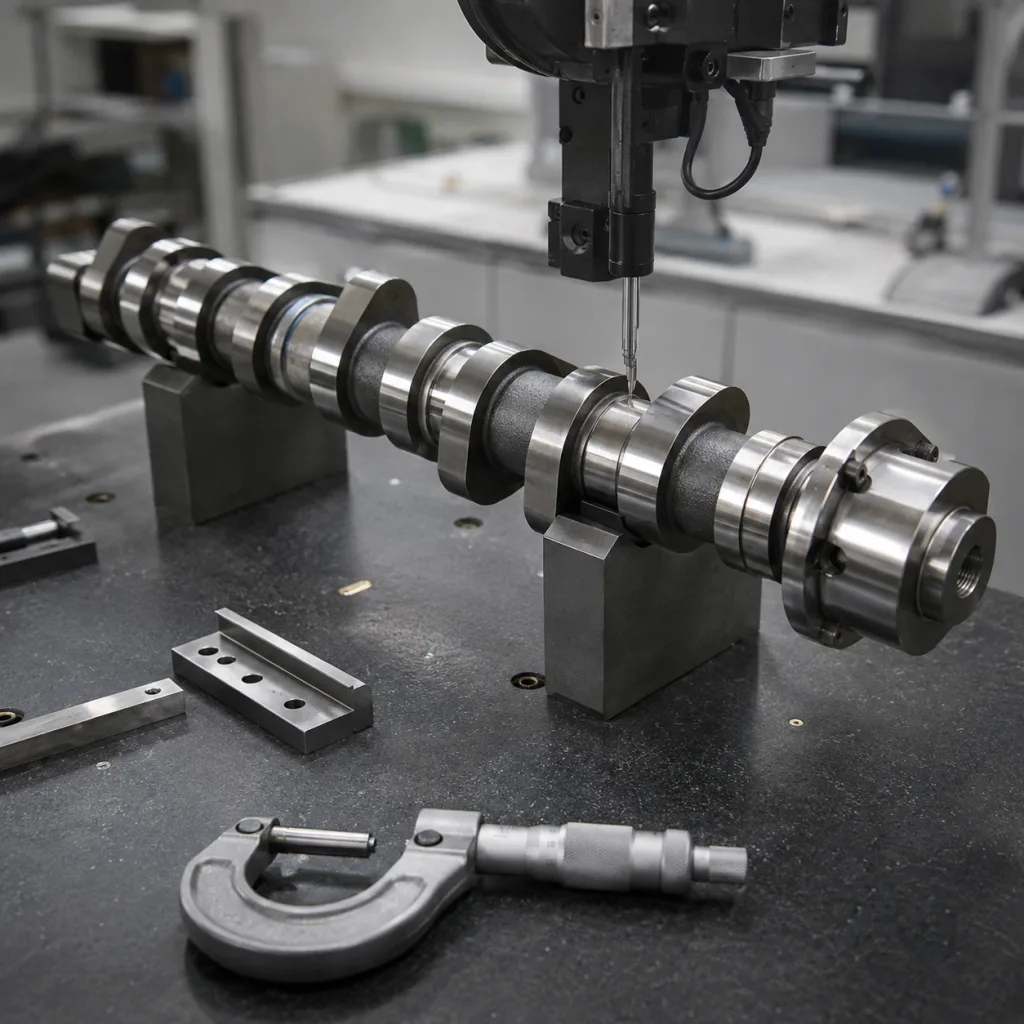
Camshaft Buick replacement sourcing is primarily a question of fitment discipline, dimensional control and validation—not brand substitution. Buyers need a camshaft that follows the original lobe profile, journal geometry, oiling features, timing interface and surface finish closely enough to restore valve timing, lubrication stability and durability without installer rework. For aftermarket distributors, repair-chain procurement teams and private-label importers, the main commercial risks are catalogue mismatch, mixed applications, soft or poorly finished lobes, transit corrosion, weak packaging and incomplete traceability. Driventus manufactures engine and powertrain components in Taizhou, Zhejiang, under IATF 16949:2016 and ISO 9001:2015 systems that support process control, inspection records and corrective action. This guide outlines the technical checks procurement teams should use when evaluating Buick-fitment camshafts, including OE cross-reference handling, metallurgical controls, validation testing, packaging and inbound inspection. Driventus is an independent aftermarket manufacturer; vehicle brand names are referenced for fitment identification only.
Fitment Scope and OE Cross-Reference Discipline
Buick applications vary by engine family, model year, market, emission configuration and valvetrain layout. A camshaft listed for one displacement or production period should not be assumed to fit another engine with a similar commercial name. Procurement teams should require an application table that separates engine code, displacement, fuel system, production year range, intake or exhaust position where applicable, and the timing drive interface.
For replacement programmes, OE part-number cross-references should be treated as fitment references rather than proof of interchangeability. If a buyer provides only a generic or partial OE reference, it should be checked against drawings, sample parts or an approved application database before order release. Driventus does not claim approval, authorization or endorsement by any vehicle manufacturer.
Useful sourcing checks include:
Confirm intake/exhaust position for dual overhead camshaft applications.
Check journal count, journal diameter, thrust control location and oil-hole position.
Match lobe count, firing-order relationship and valve lift requirement.
Separate hydraulic lifter, roller follower and flat tappet applications.
Maintain cross-reference revision records for each private-label SKU.
Buyers can compare available engine component coverage through our catalog, including related timing and valvetrain components when a kit approach is required.
Dimensional Match: What Buyers Should Specify
A replacement camshaft should be controlled by functional dimensions, not only by total length, application notes or the packaging label. Small deviations in base circle, lobe taper, journal concentricity, oil-hole position or thrust width can cause noise, low oil pressure at the bearing, accelerated lobe wear or incorrect valve timing.
Control point
Why it matters
Typical procurement evidence
Overall length and thrust face width
Controls axial location
Drawing or first-article report
Journal diameter and roundness
Maintains oil film and bearing clearance
CMM or micrometer inspection record
Lobe lift and base circle
Sets valve lift and lash relationship
Profile measurement report
Lobe separation and indexing
Controls valve timing
Cam profile trace or timing report
Oil-hole diameter and position
Prevents lubrication starvation
Visual plus dimensional inspection
Timing interface geometry
Avoids timing error during installation
Gauge check or mating-part verification
Surface roughness on journals
Reduces bearing wear
Roughness test record
</tr></thead><tbody> </tbody></table>For production supply, Driventus typically supports drawing-based inspection plans, sample matching, PPAP-style documentation where requested by OEM or Tier-1 customers, and batch traceability for aftermarket distributors. The required documentation level should be agreed before tooling, sampling or private-label packaging approval so that commercial launch timing and quality evidence stay aligned.
Materials, Heat Treatment and Surface Finish
Camshaft construction depends on application load, follower type, lubrication conditions and engine architecture. Common manufacturing routes include chilled cast iron, ductile iron, forged steel or billet steel, selected according to wear load, machinability, strength requirement and cost target. Procurement teams should avoid specifying material by assumption; the replacement part should meet the functional requirement of the original design and the duty cycle expected in the target market.
Key technical controls normally include:
Chemical composition verification by heat or batch.
Hardness testing on lobes and journals after heat treatment.
Case depth or chill-depth checks where the process requires them.
Straightness control before and after final grinding.
Magnetic particle or equivalent crack inspection where agreed.
Controlled grinding burn checks for hardened surfaces.
Rust prevention compatible with sea freight and warehouse storage.
Surface finish is especially important on bearing journals and lobe contact faces. A visually bright surface is not enough evidence of function. Buyers should ask for measurable roughness limits, hardness ranges and inspection frequency. For camshafts paired with flat tappets or high-contact-pressure followers, lobe metallurgy, surface treatment and break-in compatibility should be reviewed with the supplier before volume release.
Driventus manufacturing controls are managed under its documented quality system, including incoming material checks, in-process inspection, final inspection and nonconformance handling.
Validation Testing for Replacement Confidence
Replacement parts for Buick-fitment programmes should be validated against both dimensional risk and service risk. The exact test plan depends on annual volume, engine family complexity, follower type, warranty exposure and whether the order is for open aftermarket distribution or a controlled repair-chain network.
A practical validation plan may include:
First-article dimensional inspection against drawing or approved sample.
Cam profile measurement for lift, duration relationship and lobe indexing.
Hardness mapping across lobes and journals.
Metallographic checks for chill depth, case condition or microstructure where relevant.
Runout and straightness measurement after finish grinding.
Trial assembly with matching bearings, followers, timing sprocket or phaser interface.
Engine bench, rig or durability testing for high-volume programmes.
Packaging vibration and corrosion-resistance checks for export routes.
Published management standards such as IATF 16949:2016 and ISO 9001:2015 are relevant because they define expectations for process control, traceability, measurement discipline and corrective action. They do not replace part-specific validation. For chemical compliance, importers should also assess material declarations against REACH (EC) No 1907/2006 where products are placed on the EU market. Emissions regulations such as ECE R-83 may be relevant to the vehicle system, but a camshaft supplier should not claim compliance for the complete vehicle unless the relevant vehicle-level testing has been performed by the responsible party.
Packaging, Traceability and Import Control
A technically correct camshaft can still create warranty cost if it arrives corroded, mixed by application or damaged at the timing end. Export packaging should protect precision surfaces from humidity, impact and abrasion throughout container shipping, inland transport, customs handling and distributor storage.
Procurement teams should define packaging and traceability in the purchase specification, not after a claim occurs. Recommended controls include individual anti-rust wrapping, journal and lobe protection, rigid end support, carton drop resistance, batch labels, scannable part references and pallet-level packing lists. For private-label supply, artwork approval should be separated from engineering approval so that label changes do not disturb fitment data.
For importers managing several Buick-related SKUs, batch segregation is critical. Similar camshafts may differ only by sensor trigger, oil hole, thrust width or lobe profile. Mixed inventory can lead to incorrect installation even when the outer carton looks correct. Driventus can support distributor-specific labelling, neutral packaging, barcode formats and shipment documents when agreed during order setup.
Buyers planning broader engine component sourcing can review custom manufacturing options for drawings, samples, private-label programmes and application-specific packing requirements.
Supplier Evaluation Checklist for Procurement Teams
For a camshaft Buick replacement programme, supplier evaluation should combine commercial data with part-specific technical evidence. Price comparison without dimensional reports, material controls and process capability gives an incomplete view of landed risk.
A concise supplier checklist:
IATF 16949:2016 and ISO 9001:2015 certification status and scope.
Confirmed fitment table by engine, year range and camshaft position.
Drawing, approved sample or reverse-engineering control plan.
Material grade, heat-treatment route and hardness specification.
Cam profile inspection capability and records.
Journal runout, roughness and diameter inspection method.
Batch traceability from raw material to finished carton.
Export packaging standard, corrosion protection period and pallet specification.
Private-label artwork control and change approval process.
Corrective action process for field claims, including containment timing.
Commercial terms should also cover minimum order quantity, sample lead time, production lead time, spare carton labels, incoterms, documentation language and retention sample policy. For distributors in the EU, UK, US, Canada, Australia and Brazil, these controls reduce the probability of catalogue disputes, border delays, repeat claims and repair-chain downtime.
For active projects, share the OE reference convention, engine application list, annual forecast and any sample photos before quotation. That allows the supplier to confirm whether the request can be met from existing tooling or requires engineering review.
Frequently asked questions
Provide the engine application, model year range, intake or exhaust position where relevant, OE reference convention, target annual volume, packaging requirement and any approved sample or drawing. Photos of the timing end, sensor trigger and journals help reduce fitment uncertainty before sampling.
Sometimes, but coverage should be confirmed by engine code, production period and functional geometry. Similar engines may use different lobe profiles, thrust locations, oil holes or timing interfaces. Treat each cross-reference as provisional until verified by drawing, sample inspection or validated application data.
No. IATF 16949:2016 and ISO 9001:2015 support process control and traceability, but fitment depends on part-specific dimensions, material, heat treatment and validation. Certification should be reviewed together with inspection reports, cam profile data and packaging controls.
For replacement camshaft sourcing, send the application list, OE reference convention and forecast volume so Driventus can review tooling, validation and packaging requirements. You can [request a quote](/contact.html) or contact the team directly at /contact.html