Camshaft for Audi TT Aftermarket Replacement Guide
A camshaft for Audi TT aftermarket replacement must reproduce the valve timing, journal geometry, lobe profile, surface hardness, lubrication features, and sensor-interface details of the original application. For importers, distributors, and repair-chain buyers, the risk is broader than a wrong part number. Poorly controlled camshafts can cause premature lobe wear, noisy valve-train operation, oil starvation at the journals, timing-correlation faults, and inconsistent warranty results from one batch to the next. This guide explains the sourcing checks that matter when purchasing Audi TT replacement camshafts in volume. It focuses on OE-equivalent dimensional control, metallurgy, validation testing, packaging, documentation, and compliance evidence that procurement teams can verify before approving samples or production orders. Driventus supplies engine and powertrain components for B2B aftermarket programs and OEM-style private-label projects. Driventus is an independent aftermarket manufacturer; brand names are referenced for fitment only.
Fitment Scope and OE-Equivalent Replacement Requirements
Audi TT applications include several petrol engine families, especially turbocharged inline-four platforms with multi-valve cylinder heads. A replacement camshaft should be sourced against the exact engine code, intake or exhaust position, cam sensor trigger design, timing interface, and valve-train configuration. Two camshafts can look nearly identical on the bench while still differing in lobe phasing, trigger-feature position, journal diameter, or end machining. Those small differences can create timing-correlation faults, hard starting, poor running, or diagnostic trouble codes after installation.
For a camshaft for Audi TT aftermarket replacement, fitment confirmation should include:
- Vehicle platform, model year range, and engine code.
- Intake or exhaust camshaft position.
- Number of lobes and journal count.
- Camshaft overall length and journal diameters.
- Cam sensor trigger wheel or machined timing feature.
- Sprocket, adjuster, or timing chain interface.
- Compatibility with hydraulic tappets, bucket followers, or roller finger followers, depending on engine design.
Cross-reference data is useful as a screening tool, but it should not be treated as a production drawing. Generic references and part-family conventions may point buyers in the right direction, yet final approval still depends on dimensions, photographs, sample checks, and application notes. Procurement teams should also confirm whether the part is supplied as intake only, exhaust only, or as part of a matched engine-specific program. Related Driventus engine parts can be reviewed in our catalog and the engine component range at /products/engine-components.html.
Material, Heat Treatment, and Machining Controls
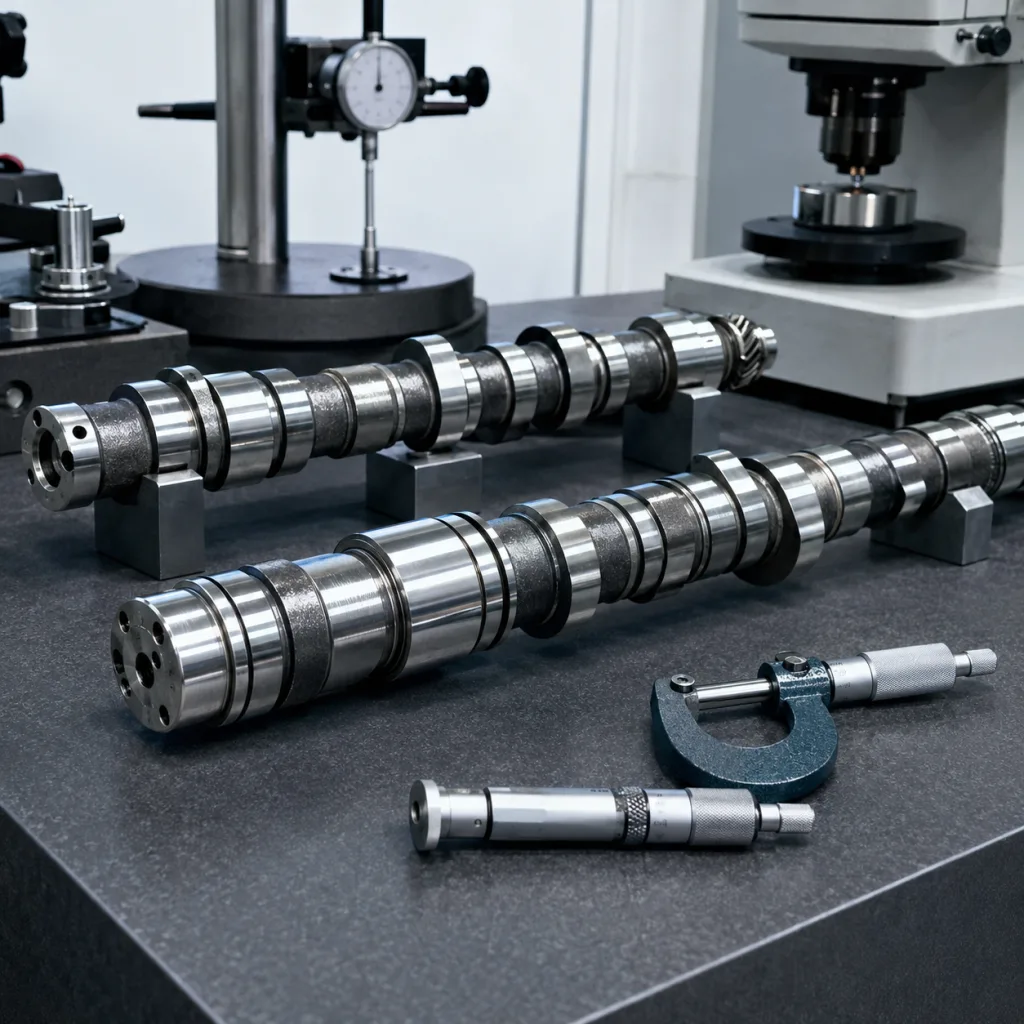
Camshaft durability depends on the base material, lobe hardening method, oil-film retention, geometry control, and surface finish. For aftermarket replacement, Driventus validates camshafts against the drawing-controlled requirements of the target application rather than changing lift or duration for performance claims. The goal is stable OE-equivalent service behaviour: correct timing, low valve-train noise, controlled wear, and predictable fitment across repeat orders.
| Control point | Procurement check | Typical target evidence |
|---|---|---|
| Base material | Cast iron, chilled cast iron, or forged steel according to application | Material certificate and batch traceability |
| Lobe hardness | Wear resistance after heat treatment or chilling process | Hardness test report by batch |
| Journal geometry | Diameter, roundness, taper, and runout controlled to drawing | Dimensional inspection report |
| Surface finish | Low friction at journals and lobes | Roughness measurement record |
| Oil feed features | Chamfers and oil passages free from burrs and blockage | Visual and functional inspection |
| Timing features | Correct phasing relative to keyway, slot, trigger, or end feature | Fixture-based angle check |
| Buyer type | Typical priority | Useful supplier evidence |
|---|---|---|
| Aftermarket wholesaler | Catalog coverage and price stability | Fitment table, carton data, batch inspection |
| Import distributor | Compliance and shipment reliability | REACH support, packing specification, HS code data |
| Repair chain | Low return rate and installation consistency | Failure analysis process and clear part marking |
| OEM or Tier-1 project | Controlled engineering change process | APQP records, drawing review, capability study |