Camshaft for Alfa Romeo Giulia Replacement: Sourcing Guide
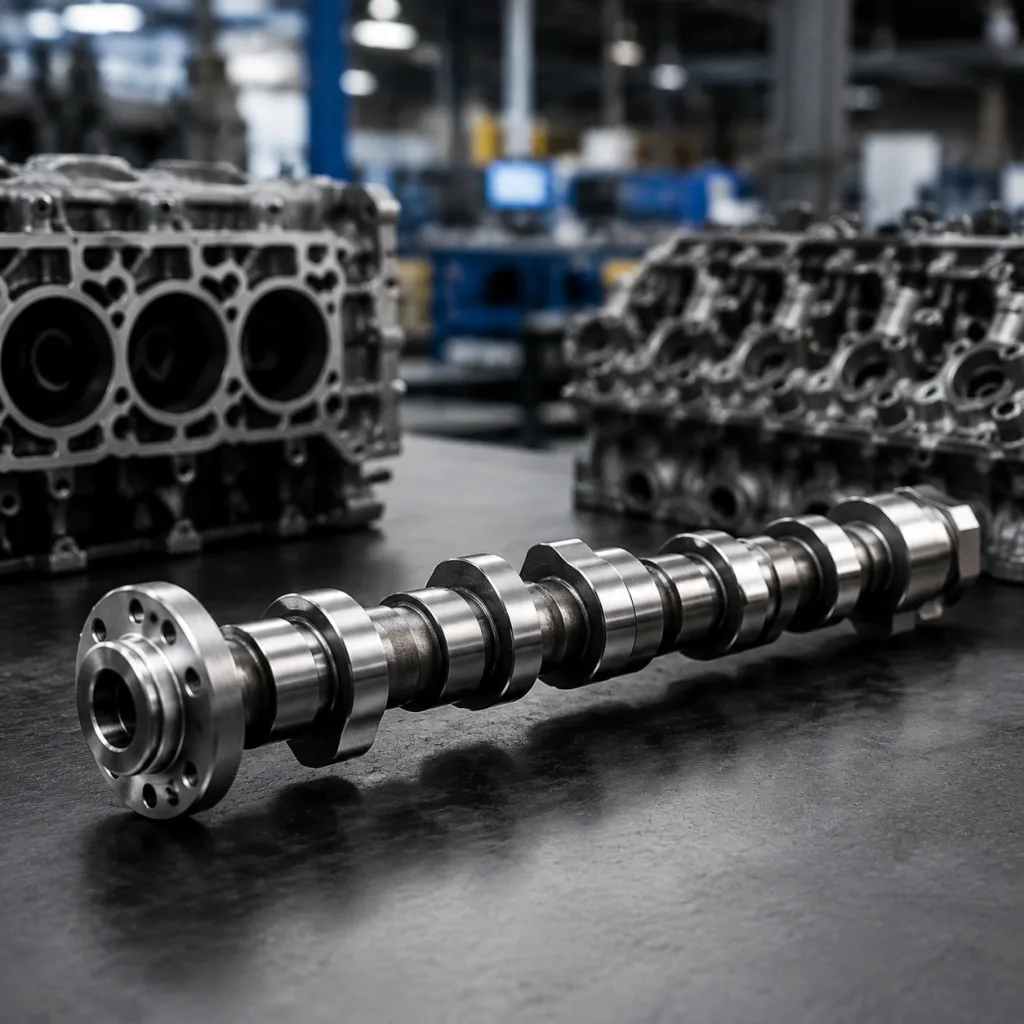
A camshaft for Alfa Romeo Giulia replacement should be specified by engine code and camshaft position, not by the Giulia nameplate alone. The part must match the original cam profile, journal geometry, timing reference, cam-phaser or drive interface, sensor features, oil-feed details, and surface condition for the exact engine variant. For procurement teams, distributors, repair chains, and fleet buyers, the real risk is not the model name; it is the variation across engine families, intake and exhaust positions, variable-valve-timing layouts, production revisions, and market-specific calibrations.
The right replacement camshaft preserves OE-equivalent fitment, lobe lift and duration, base-circle diameter, angular phasing, journal oil clearance, timing synchronization, and consistent inspection results across lots. A shaft can look almost identical and still be wrong if the base circle, lobe centerline, trigger feature, journal spacing, thrust face, oil groove, dowel location, or end machining is different. Those small differences can lead to installation interference, incorrect valve events, abnormal wear, diagnostic fault codes, cam/crank correlation errors, valve-train noise, unstable oil film, or premature warranty claims.
Driventus supplies engine components for aftermarket and B2B programmes, with manufacturing controlled under IATF 16949:2016 and ISO 9001:2015. Driventus is an independent aftermarket manufacturer; vehicle brand names are referenced for fitment identification only. This guide explains what to verify before purchase, which OE-equivalent specifications matter most, how to assess materials and testing evidence, and how to compare replacement camshafts for Giulia applications without relying on marketing claims, generic listings, or unverified cross-references.
What to verify before ordering a replacement camshaft
Select a replacement camshaft by engine code, valve-train layout, camshaft position, and measured dimensions rather than by model name alone. Alfa Romeo Giulia applications may include different petrol and diesel engine families depending on model year and market, including turbocharged petrol variants and diesel variants with different timing, sensor, and valve-train arrangements. Each engine family may use its own cam profile, timing-drive interface, variable-cam-phasing arrangement, oil-feed design, and sensor reference. Intake and exhaust camshafts are normally position-specific and should not be treated as interchangeable unless the original specification explicitly confirms identical geometry and timing references.
Before releasing a purchase order, collect the vehicle and engine data and compare it with the supplier’s drawing, catalog record, or inspected sample. This step matters even more when sourcing for multiple workshops or regional distribution, where one incorrect catalog mapping can generate repeated returns across many locations.
Key checks before purchase:
VIN or vehicle build data where available
Vehicle model year, production date, and destination market
Exact engine code and displacement
Petrol or diesel application, including turbocharged variant where applicable
Intake or exhaust camshaft position
Cylinder head and valve-train layout, including roller finger follower, tappet, rocker, or hydraulic lash arrangement where relevant
Number of lobes and lobe arrangement
Lobe lift, base-circle diameter, and lobe centerline data if available
Sensor trigger feature, tone pattern, slot, notch, or reference mark configuration
Bearing journal diameter, journal count, journal width, and journal spacing
Overall length and end-machining style
Thrust face, groove, oil passage, oil-feed drilling, or dowel-pin details
OE reference, when available, used for cross-checking only
OE references and interchange numbers are useful for narrowing the search, but they are not proof of compatibility on their own. An interchange number may appear in a marketplace or cross-reference table for unrelated applications, or it may apply only to a different engine family. Procurement teams should confirm that the reference is relevant to the specific Giulia engine being sourced and that the supplier’s part matches the real application requirements by drawing, inspection report, or master-sample comparison.
When comparing offers from factories, mills, exporters, or trading companies, ask for dimensional drawings, sample inspection records, and clear application notes. A sound technical offer should identify camshaft position, critical dimensions, material route, surface-hardening method, and inspection standard. For procurement teams, this reduces the chance of receiving a visually similar part that fits into the cylinder head but fails during timing setup, oil-clearance verification, break-in, or early service life.
OE-equivalent specifications that matter
In replacement sourcing, OE-equivalence means matching the original functional envelope, not simply producing a part that resembles the original. The camshaft controls valve opening, lift, duration, overlap, and closing events, so even a small change in lobe profile or timing reference can affect combustion, emissions behavior, idle quality, boost response, drivability, and engine management calibration. A suitable replacement should preserve the intended valve event unless the buyer is deliberately sourcing a validated performance or engineering-change component.
The most relevant specification items are listed below.
Spec item
What to confirm
Why it matters
Application identity
Engine code, camshaft position, and revision level
Prevents wrong-engine and intake/exhaust mix-ups
Journal diameter
Measured to supplier drawing or approved master sample with stated tolerance
Prevents incorrect oil clearance, bearing-fit issues, and seizure risk
Journal count and spacing
Location, width, and oil-feed alignment of all bearing journals
Ensures correct cylinder-head support and lubrication alignment
Overall length
End-to-end dimension including machined drive or sensor features
Ensures correct head fitment, thrust location, and end clearance
Thrust surface
Width, face finish, groove, and thrust-control geometry
Controls axial movement and reduces timing-drive or phaser noise
Lobe lift and base circle
Compare with OE print, master sample, or validated profile data
Ensures correct assembly with timing hardware and variable timing actuator
Oil passages
Hole diameter, groove location, chamfering, and cleanliness
Maintains lubrication at journals, phaser feed points, and follower contact areas
Surface hardness
Confirm by process route and batch test report at lobes and journals
Affects wear resistance and compatibility with follower material
Case depth or hardened layer
Confirm where induction hardening, chilling, or nitriding is used
Prevents rapid wear after grinding or during high-load operation
Runout
Measured between centers or on V-blocks with calibrated equipment
Impacts timing stability, friction, oil-film uniformity, and NVH
Surface roughness
Journal and lobe finish values where required, typically reported as Ra
Supports oil-film formation and reduces early scuffing
Cleanliness and finish
No scoring, pitting, burrs, dents, grinding burns, cracks, blocked oil holes, or corrosion
Reduces installation problems and premature failure
</tr></thead><tbody> </tbody></table>For European and export programmes, ask whether the material and surface treatment support relevant compliance expectations such as REACH (EC) No 1907/2006. Also confirm whether the manufacturing record supports traceability by batch, heat, or lot number. This is particularly important when the camshaft is part of a formal aftermarket programme with repeated replenishment, because the first shipment and later shipments must be comparable in dimensions, hardness, finish, and packaging protection.
For emissions-related applications, a verified replacement camshaft should not alter the calibrated valve event unless the application specifically requires it and the buyer has validated the change against the vehicle system. In practice, the replacement should allow the engine control unit, camshaft position sensor, crankshaft position sensor, variable valve timing system, phaser oil control, and mechanical timing components to operate as intended. Any supplier claiming broad compatibility should be able to explain how the profile, phasing, and reference geometry were verified.
Materials, process control, and testing
Replacement camshafts are commonly produced from chilled cast iron, ductile iron, cast steel, or forged steel, depending on the original design, operating load, engine speed range, follower type, surface-hardening method, and cost target. Confirm the material route against the original camshaft or a validated equivalent, because material choice affects the follower contact pattern, lubrication regime, hardening depth, grinding process, and expected wear behavior.
A sourcing decision should not rest on a broad description such as “steel” or “cast iron.” Buyers should ask how the material is controlled, how the lobe and journal surfaces are hardened or treated, and how the finished part is inspected. In B2B programmes, process stability matters as much as the first sample; the same specification has to be repeated across production lots.
Typical process controls include:
Incoming material verification and heat, melt, or batch identification
Controlled casting, forging, or blank preparation route
Straightening control before and after heat treatment where required
CNC machining of journals, ends, oil passages, grooves, thrust faces, and drive features
Induction hardening, chilling, nitriding, carburizing, or other surface-hardening process where required by design
Controlled heat-treatment parameters and hardness verification at lobes and journals
Precision grinding of lobes, bearing journals, and thrust surfaces
Chamfering, deburring, and edge finishing at oil holes, slots, and machined transitions
In-process dimensional inspection at defined control points
Final runout, lobe profile, base circle, lift, journal, and visual checks before packing
Magnetic-particle, crack-detection, or equivalent surface-defect checks where specified
Anti-corrosion oil, VCI protection, end caps, separators, or other protective packaging for storage and export transit
For buyers, testing evidence is far more useful than general claims about quality. Request documentation that can be tied to the actual production lot or approved sample. A practical technical file should include:
1. Incoming material certificates or material confirmation 2. Heat-treatment or hardening process record, where applicable 3. Hardness readings by batch and by critical surface location, using a defined method such as HRC, HV, or HB according to the material route 4. Case-depth or hardened-layer confirmation where required 5. Dimensional inspection reports for journals, journal spacing, length, thrust features, oil holes, and end features 6. Lobe profile, lift, base-circle, and angular phasing verification against drawing or master sample 7. Runout measurement results and inspection method 8. Surface roughness data for journals and lobes where applicable 9. Visual inspection criteria for grinding defects, burrs, cracks, dents, blocked oil holes, scoring, and corrosion 10. Packaging method, corrosion-prevention method, and shelf/storage instructions 11. Traceability information linking the finished part to batch, lot, heat, or production date code
If a supplier cannot provide lot traceability, the part is difficult to qualify for repeat purchase because failures cannot be isolated to a production window or process variation. Traceability also helps purchasing, quality, and engineering teams communicate clearly if a claim occurs. Driventus operates under documented control systems aligned with IATF 16949:2016 and ISO 9001:2015, supporting repeatable production, controlled inspection, calibration management, nonconforming-material control, and structured documentation for aftermarket and OEM-adjacent programmes.
How to avoid fitment mistakes on Giulia applications
Fitment errors often start with the assumption that all Giulia engines share the same camshaft. They do not. Two parts may have the same general appearance while differing in lobe timing, trigger geometry, end machining, oil-feed details, thrust-control design, or actuator interface. In a workshop, that can mean a part that appears installable but then creates timing alignment issues, sensor faults, cam/crank correlation codes, abnormal valve-train noise, poor starting, engine warning lights, low power, or accelerated wear after a short service period.
The safest approach is to treat every Giulia camshaft request as an engine-specific and position-specific sourcing task. The supplier should confirm whether the part is for intake or exhaust, whether it is compatible with the relevant timing system, and whether the sensor or actuator features match the original. If the original camshaft is available, a side-by-side inspection can reveal differences that a generic catalog image will miss.
Practical inspection checklist:
Match the engine code on the vehicle record, service data, VIN decode, or original documentation
Confirm production year and market version where this affects engine configuration
Confirm intake versus exhaust camshaft location
Compare the number, location, and orientation of all lobes
Compare base-circle diameter and lobe lift with a gauge, micrometer, or profile record where possible
Compare trigger wheel, sensor notch, slot, or reference feature count and angular position
Check bearing journal count, diameter, width, and spacing
Inspect thrust surfaces, grooves, oil holes, chamfers, and end-machining features
Check that oil-feed holes are open, deburred, and aligned with the cylinder-head lubrication path
Compare the original part number and any casting, laser, or stamped marks where available
Check that the packaging label, part number, and purchase order description match the camshaft position and engine code
Confirm whether related timing components, phaser bolts, seals, followers, lash adjusters, or oil-control components should be replaced at the same time
Procurement note
For fleet operators, regional distributors, and workshop-group buyers, it is often worth requesting one sample unit before any volume release. The sample should be bench-checked against the original camshaft or master sample, measured against the drawing, and trial-installed where possible. Record installation feedback, including timing alignment, sensor recognition, axial end clearance, oiling alignment, phaser response where applicable, and noise after initial operation.
If the application requires related engine components, sourcing them together can simplify packaging, lead-time planning, and quality documentation. See our catalog and engine components for adjacent parts that may need to be reviewed with the camshaft, such as timing components, valve-train parts, seals, phaser-related hardware, or other engine components.
Why validation matters for replacement supply
A camshaft is not a commodity fastener. Its performance depends on profile accuracy, surface finish, hardness, lubrication compatibility, dimensional stability, axial control, and correct synchronization with the engine management system. For that reason, validation should include both dimensional and functional checks before the part is approved for repeated B2B supply.
For a single repair, a mismatch creates one claim. For a distributor, repair-chain, or fleet programme, the same mismatch can trigger repeated warranty returns, labor disputes, inventory freezes, campaign-level rework, and reputational damage. A structured validation process reduces these risks by confirming that the camshaft is suitable before the buyer commits to volume orders.
A sensible supplier validation file should include:
Application confirmation by engine code, camshaft position, and revision level
Sample inspection against OE dimensions, drawing, or approved master sample
Lobe lift, base circle, profile, and duration-related geometry comparison where data is available
Angular phasing and timing-reference confirmation
Trigger-feature verification against sensor and ECU synchronization requirements
Visual examination for grinding burns, cracks, dents, burrs, scoring, blocked oil holes, or corrosion
Hardness results at critical lobe and journal areas
Case-depth or hardened-layer data where relevant to the material route
Runout data and measurement method
Journal, thrust face, oil-feed, and end-feature dimensional data
Surface roughness values where required
Packaging and preservation review for warehouse storage and export transit
Traceability to batch, lot, heat, or production date code
Agreed acceptance criteria for future shipments
For buyers managing regional distribution, this validation reduces warranty risk and supports internal approval through engineering, quality, purchasing, and aftersales teams. It also defines what happens if a shipment is disputed: the buyer and supplier can compare parts against agreed data rather than relying on subjective appearance checks.
Review the supplier’s quality system before placing repeat orders. A credible supplier should be able to explain inspection flow, calibration records, gauge control, nonconforming-material containment, corrective-action process, and traceability. If a project requires different lobe timing, sensor features, surface treatment, labeling, or packaging, custom manufacturing may be appropriate after engineering review, sample approval, and documented validation.
Commercial buying signals for B2B replacement programs
When sourcing a camshaft for Alfa Romeo Giulia replacement for wholesale, fleet, or repair-chain supply, evaluate commercial terms alongside the technical file. A lower unit price is not helpful if the part creates fitment claims, installation delays, high return rates, inspection rework, or inconsistent replenishment. The strongest buying decision combines verified fitment, stable quality documentation, predictable logistics, and clear communication before the purchase order is placed.
Recommended buying criteria:
Written application confirmation by engine code, model year range, market, and camshaft position
Dimensional conformity to drawing, OE sample, or approved master sample
Clear statement of material route and surface-treatment process
Inspection data for journals, lobe profile, base circle, phasing, runout, hardness, and finish
Defined quality acceptance criteria before mass shipment
Sample approval process with signed inspection results or golden-sample retention
Stable lead time for repeat orders and forecasted replenishment
Minimum order quantity aligned with the buyer’s sales channel and stocking plan
Clear carton labeling, part-number marking, and batch identification
Export packaging suitable for sea, air, or warehouse transit, with corrosion protection and part separation
Export documentation for the destination market
Claim-handling process, response time, return-sample requirements, and evidence requirements
Ability to support sample approval before volume release
Procurement teams should also consider total landed cost. That includes unit price, but also packaging quality, defect risk, incoming inspection workload, freight efficiency, customs documentation, inventory reliability, claim administration, and technical support. A camshaft that arrives with poor labeling, mixed applications, inadequate preservation, or missing lot identification may cost more to sort and claim than the apparent purchase-price saving.
Driventus supplies B2B buyers across aftermarket distribution, OEM and Tier-1 channels, and multi-location repair networks. For procurement teams, the conversation can move beyond generic availability to measured compliance, sample approval, lot traceability, and forecasted replenishment. If you are building a replacement programme for Giulia applications, start with request a quote and provide the engine code, camshaft position, OE reference if available, sample photos or measurements if possible, target order quantity, destination market, required documents, and any packaging or labeling requirements.
Frequently asked questions
No. The engine code, intake or exhaust position, production details, and sensor or actuator features must be checked. Model name alone is not enough for a camshaft replacement because different Giulia engine variants can use different camshaft designs.
Ask for dimensional drawings or inspection reports, material confirmation, hardness data, lobe profile or lift verification, phasing confirmation, runout inspection, surface-finish information where applicable, packaging details, and batch traceability. These are basic checks for repeat procurement.
No. Driventus is an independent aftermarket manufacturer; vehicle brand names are referenced for fitment identification only.
If you are qualifying a replacement programme, send the engine code, camshaft position, OE reference, target order volume, destination market, required inspection documents, and packaging requirements for review. Use our team to confirm fitment and sourcing options at /contact.html.