clutch kit · 2026-06-04

Clutch Kit Subaru Aftermarket Replacement: Buyer Guide

A clutch kit Subaru aftermarket replacement needs to match far more than the visible diameter of the friction disc. Procurement teams should confirm disc outside diameter and thickness, spline count and major diameter, hub offset, damper clearance, pressure plate clamp load, release bearing height, pilot bearing requirements, and flywheel interface before approving a supplier. In Subaru applications, small dimensional differences can change pedal effort, release travel, bite point, gear engagement, noise, and service life. A replacement kit should install to an OE-equivalent standard without shimming or machining, then pass dimensional, bench, and vehicle validation before release to production or distribution.

For B2B buyers, the sourcing question is not simply whether a kit can be installed once. The more useful question is whether every shipment will match the approved sample, maintain part-lot traceability, and reduce warranty exposure across the declared engine, transmission, model-year, and market range. That takes catalogue discipline, controlled facing materials, spline and bearing gauging, clamp-load control, lot inspection, and packaging that protects machined and friction surfaces through cross-dock, warehouse, and parcel handling.

Driventus supplies clutch kits for independent aftermarket channels and B2B buyers that need dimensional consistency, controlled material selection, and documented inspection. Driventus is an independent aftermarket manufacturer; brand names are referenced for fitment only. We build and inspect to IATF 16949:2016 and ISO 9001:2015 systems, with material and compliance considerations aligned to REACH (EC) No 1907/2006 where applicable. Buyers can review our catalog, compare specifications, and coordinate project requirements through our quality and OEM support teams.

What buyers should verify before replacing a Subaru clutch kit

For replacement sourcing, the decision is rarely about the disc alone. A usable clutch kit Subaru aftermarket replacement should be specified as a matched assembly, because the disc, cover assembly, release bearing, pilot support, and flywheel geometry together determine whether the transmission releases cleanly and whether the vehicle returns with drag, chatter, noise, or premature wear.

Verify these points before approving a part number:

  • Disc outer diameter, inner diameter, facing thickness, and usable friction area
  • Hub offset, marcel height, damper spring layout, and clearance to flywheel bolts
  • Input shaft spline count, major diameter, minor diameter, and spline engagement length
  • Pressure plate cover bolt circle, locating dowels, cover height, and installed height
  • Clamp load, diaphragm spring geometry, lift curve, and release travel window
  • Release bearing inner diameter, outer diameter, face profile, operating height, and guide-tube fit
  • Pilot bearing or bushing OD, ID, width, material, and crankshaft bore fit
  • Flywheel type, step height, friction-surface finish, runout, and resurfacing allowance
  • Applicable engine code, transmission code, production year, drive configuration, and regional fitment notes

If the vehicle uses cross-reference data in your catalogue, PIM, or ERP system, confirm the full kit configuration rather than a single component number. A disc with the same outer diameter may still have the wrong hub offset, torsional damper package, or spline form. A pressure plate may bolt to the flywheel yet carry a different release height or clamp-load curve. A release bearing that looks similar can still change fork position or diaphragm contact radius. Those mismatches can lead to incomplete disengagement, clutch drag, difficult shifting, abnormal pedal effort, or diaphragm overtravel.

A correct match should install without shimming, grinding, slotting, spacer changes, or clutch fork modification. That is the baseline for a true aftermarket replacement, not a partial fit. For distributors and repair-chain buyers, the goal is repeatable interchangeability across the stated application range, backed by precise fitment notes, supersession control, and revision history.

Validation point at receiving inspection

Use incoming inspection on 100% of pilot lots, then move to AQL-based sampled inspection only after stable production history is proven. At minimum, check spline fit with go/no-go gauges or a master input shaft, hub side clearance, disc lateral runout, pressure plate stack height, release bearing rotation noise, axial play, and fastener thread engagement where bolts are included. For high-volume distributors, these checks reduce returns caused by incomplete kit matching and help separate installation-related claims from supplier quality issues.

Typical clutch kit contents and measurable differences

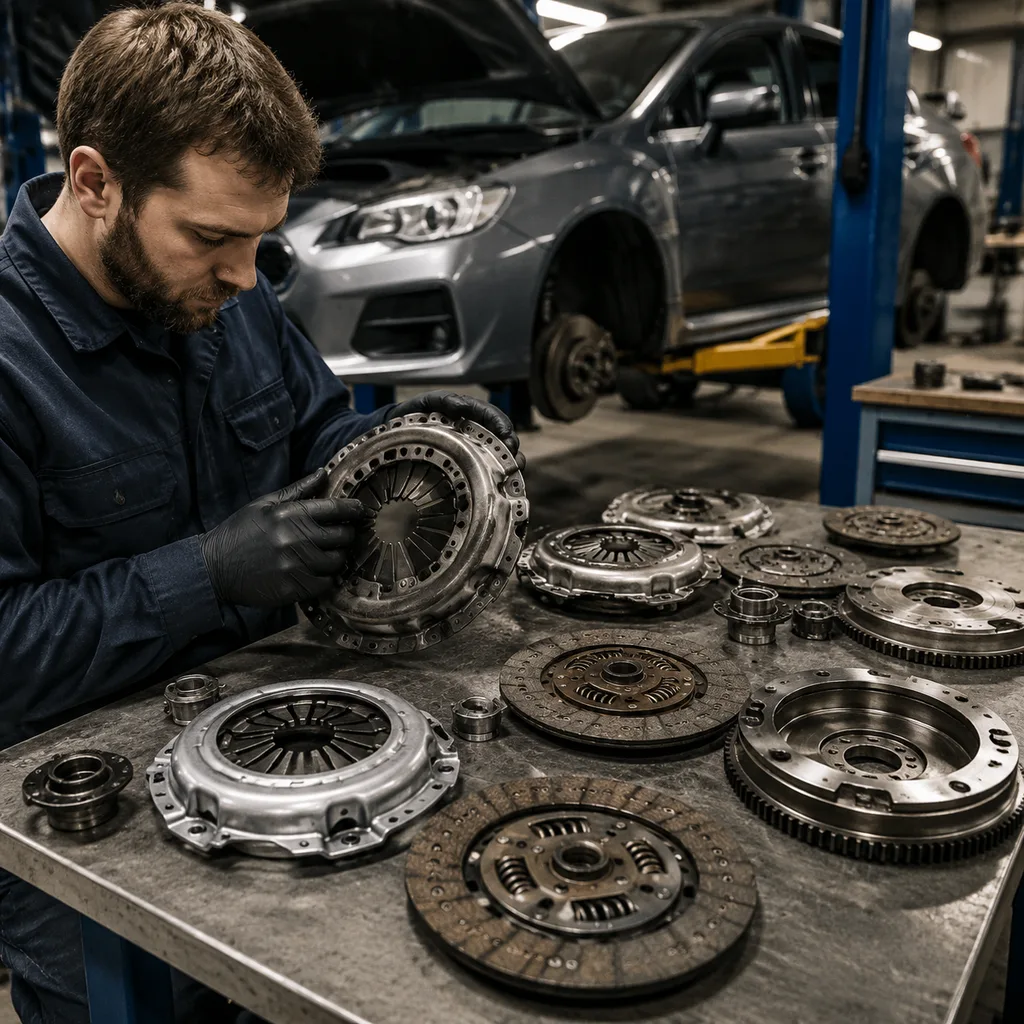
A Subaru clutch kit usually includes the friction disc, pressure plate, release bearing, and an alignment tool. Depending on the application and commercial scope, the kit may also include a pilot bearing or bushing, grease sachet, flywheel or pressure plate bolts, an installation sheet, or a recommendation to replace hydraulic components. The exact bill of materials should be locked in the purchase order, master data, carton label, and barcode record so buyers, warehouse teams, and installers all see the same kit configuration.

</tr></thead><tbody> </tbody></table>Material selection matters as much as geometry. Molded organic facings are common for daily-use replacement programmes because they offer progressive engagement, stable cold performance, lower noise, and moderate flywheel wear. Woven organic facings may be used where smoother modulation is required. Ceramic, sintered, or semi-metallic facings can raise torque margin and heat resistance, but they may increase chatter, driveline harshness, flywheel wear, and customer complaints in normal commuting use. For replacement supply, the right choice depends on OE duty cycle, vehicle mass, engine torque, final-drive characteristics, end-user complaint history, and the market’s tolerance for changes in pedal feel. It should not rest on a generic performance claim.

Buyers should also confirm whether the kit is designed for a solid flywheel, dual-mass flywheel, or a specific flywheel conversion arrangement. Mixing a disc damper design with the wrong flywheel type can create idle rattle, harsh engagement, or accelerated hub fatigue. If the programme covers multiple Subaru engine or transmission variants, maintain separate master data wherever spline count, disc offset, release bearing height, cover geometry, or pilot bearing dimensions change. Combining similar-looking kits under one stocking number can seem efficient at first, but it often increases catalogue disputes and warranty cost later.

Dimensional control, tolerances, and validation testing

A credible clutch supplier should document dimensional control on the characteristics that affect fit, release, torque transfer, and durability. For a clutch kit Subaru aftermarket replacement, the most important controls are usually the interfaces: the spline and hub, the pressure plate mounting face, the diaphragm spring, the release bearing contact surface, and the pilot support. Small variation in these areas can create large field symptoms.

For replacement programmes, buyers should ask for evidence of:

  • Hub and spline gauges used for in-process checks, including go/no-go or master-shaft verification
  • Disc thickness, facing parallelism, lateral runout, and balance inspection
  • Hub offset, damper spring clearance, rivet height, and marcel consistency control
  • Pressure plate cover runout, pressure ring flatness, bolt-hole position, and installed height inspection
  • Clamp load verification by lot or defined sampling plan, with test stand calibration records
  • Diaphragm finger height, release load, lift curve, and release travel measurement
  • Rivet retention, burst strength, facing bond shear, and hot/cold torque capacity testing
  • Release bearing noise, axial play, radial clearance, rotation smoothness, and grease condition checks
  • Pilot bearing dimensional and rotation checks where included
  • Coating thickness, corrosion resistance, oil contamination control, and surface cleanliness controls
  • Packaging controls to prevent brinelling, impact damage, humidity exposure, and friction-surface staining

Validation should include thermal cycling, repeated engagement durability, torque capacity confirmation, overspeed or burst testing where required, and corrosion exposure for markets with long storage times or winter road conditions. Vehicle-level checks should confirm launch feel, shift quality, release point, pedal load, noise, vibration, and post-test condition of the disc, pressure ring, diaphragm fingers, release bearing, pilot bearing, and flywheel contact pattern. Where customers specify their own programme requirements, PPAP-style sample approval, dimensional reports, material certificates, and control plans should be tied to the approved revision.

Lot traceability is just as important. Buyers should be able to connect finished kits to friction material batches, steel stamping or casting lots, diaphragm spring lots, bearing supply lots, production dates, inspection records, and packaging dates. For compliance-sensitive markets, material declarations should be available for REACH (EC) No 1907/2006 review where applicable. If your team audits suppliers, compare the inspection record against the declared part family, revision level, bill of materials, and approved sample, not just the carton label.

Driventus can support customers that need dimensional correspondence for aftermarket replacement use, including OE-equivalent packaging for warehouse and repair-chain distribution. For higher-volume programmes, inspection plans can be aligned with customer requirements so pilot-lot approval, production control, and shipment documentation follow a consistent format.

How aftermarket replacement affects procurement decisions

Replacement sourcing is different from performance upgrading. Procurement teams usually need three outcomes: predictable fitment, low return risk, and supply continuity. The approved part therefore has to be interchangeable across the stated vehicle range, supported by accurate catalogue data, stable revision control, and packaging that works in real distribution conditions.

When comparing suppliers, assess these items:

1. Catalogue accuracy by engine code, transmission code, model year, market, drive configuration, and chassis notes 2. Dimensional reports for the critical interfaces, including disc, cover, bearing, pilot support, and flywheel interface 3. Certification scope under IATF 16949:2016 and ISO 9001:2015, including whether the clutch kit process is inside the audited scope 4. Traceability for raw material, friction facings, bearings, finished lots, and shipment batches 5. Friction material specification, substitute-material approval rules, and change-control process 6. Packaging and labelling suitable for cross-dock, warehouse pick, returns handling, and e-commerce fulfilment operations 7. Minimum order quantity, lead time, forecast flexibility, safety-stock options, and carton-level barcode requirements 8. Response time for technical clarification, claim review, catalogue corrections, and supersession updates 9. Ability to support regional specifications, private label, or kit-content changes without uncontrolled substitutions

The lowest unit price is not always the lowest landed cost. A clutch kit that creates more fitment queries, installation disputes, or warranty returns can consume the margin saved at purchase. Buyers should compare total programme cost, including inbound inspection time, claim handling, repacking, obsolete stock exposure, catalogue correction work, and emergency replacement shipments when a kit has to be quarantined or corrected.

Revision control deserves close attention in aftermarket replacement supply. If a diaphragm spring supplier changes, a friction facing is reformulated, a release bearing source is substituted, or a cover stamping tool is revised, the buyer should know whether the change affects dimensions, release load, contact radius, noise, or durability. Require a defined change notification process for approved programmes, particularly where the kit is sold under a distributor’s own part number or linked to a chain-store warranty policy.

If your programme needs a special friction blend, logo-free packaging, customer carton design, barcode structure, or a market-specific bill of materials, use our custom manufacturing service. That is the practical route when the standard catalogue does not cover a regional application, when a distributor needs private-label supply, or when purchasing teams want to consolidate several related clutch kit references under a managed sourcing project.

Why technical documentation reduces warranty exposure

Warranty cost usually rises when fitment information is incomplete or when the installer cannot confirm the correct kit before the transmission is removed. For a clutch kit Subaru aftermarket replacement, a common failure mode is mismatch between the release system and the pressure plate geometry: bearing height, fork position, diaphragm finger height, and hydraulic travel must work as a system. Disc misalignment during installation is another frequent issue. Other causes include incorrect flywheel machining, excessive flywheel runout, contaminated friction surfaces, wrong pilot bearing selection, and reuse of worn hydraulic or release components. Better documentation before the part reaches the repair bay can reduce many of these problems.

A procurement-ready supplier should provide:

  • Product drawings or dimensional sheets for critical interfaces
  • Complete kit-content list with included and excluded components
  • Application data by engine, transmission, build year, drive configuration, and regional variant
  • Test summary by part family or approved programme, including clamp-load and release-travel checks
  • Material declaration and friction facing information where applicable
  • Country-of-origin and traceability records
  • Quality certificates and certification scope statement
  • Packaging specification, carton quantity, label format, barcode data, and pallet configuration
  • Installation notes covering alignment, flywheel condition, bearing position, hydraulic inspection, and torque guidance
  • Claim review process with required photos, measurements, mileage, installation notes, and returned-part handling

This documentation helps purchasing, quality, catalogue, and warranty teams work from the same evidence. It also helps distributors protect their customer relationships. When a claim occurs, clear records make it easier to determine whether the issue came from part mismatch, installation error, transport damage, contamination, flywheel condition, or an actual manufacturing defect. Without those records, every field complaint takes longer and costs more to resolve.

Driventus publishes our quality system information so buyers can review controls before sampling. For broader engine and powertrain programmes, our catalog also includes related components that help consolidate sourcing under fewer vendors. That can simplify inbound inspection, reduce administration, improve fill rate on repeat orders, and make technical support more consistent across product lines.

Driventus is an independent aftermarket manufacturer; brand names are referenced for fitment only.

Frequently asked questions

No. It must be fit for its intended aftermarket application, accurately described, and supported by appropriate quality and compliance documentation. Driventus does not claim vehicle manufacturer approval or endorsement.

Ask for disc dimensions, spline data, hub offset, clamp load, release bearing height, pilot bearing dimensions, friction material information, quality certificate scope, traceability format, and exact kit contents. That reduces fitment and warranty risk.

Yes. We support custom manufacturing, packaging changes, barcode requirements, and market-specific kit configurations when the technical scope and approval sample are defined in advance.

Review the specifications in our catalog, then contact our team for fitment confirmation, sampling, or programme support: /contact.html

Request a Quote
Component Key check Why it matters
Friction discOD, ID, thickness, spline count, hub offset, damper layoutControls engagement quality, gearbox fit, torque transfer, and torsional vibration
Pressure plateClamp load, lift curve, cover height, bolt circle, dowel positionAffects torque capacity, release point, pedal load, and diaphragm travel margin
Release bearingOD, ID, face width, bearing height, contact radiusDetermines contact with fork, guide tube, and diaphragm fingers
Pilot bearing/bushingOD, ID, width, material, lubrication conditionSupports input shaft alignment and prevents drag, vibration, or input-shaft noise
Alignment toolSpline match and pilot diameterReduces installation error during transmission refit
Fasteners, if includedGrade, thread, length, coating, head styleSupports correct clamp-up, torque retention, and corrosion resistance
Installation documentsTorque values, flywheel notes, release-system warningsReduces claim risk from incorrect assembly