Connecting Rod Cadillac Wholesale: Sourcing Checklist
When buyers search for connecting rod Cadillac wholesale supply, availability is only one part of the decision. The bigger risk is whether the supplier can repeat rod geometry, material condition, fastener preload, and lot traceability across production runs without creating bearing-clearance or pin-fit problems downstream. For engine rebuilders, distributors, and import teams, qualification should start with the Cadillac engine family and engineering data, not catalogue photos or broad application claims. Confirm center-to-center length, big-end housing bore, small-end bore or bushing ID, side width, cap register, bolt specification, weight class, surface treatment, and any required coating before approving volume production. Ask how lots are identified, which features are checked 100% versus by AQL sampling, how gauges are calibrated, how inspection records are retained, and how nonconforming rods are quarantined or reworked. Driventus is an independent aftermarket manufacturer; brand names are referenced for fitment only.
What wholesale buyers should verify first
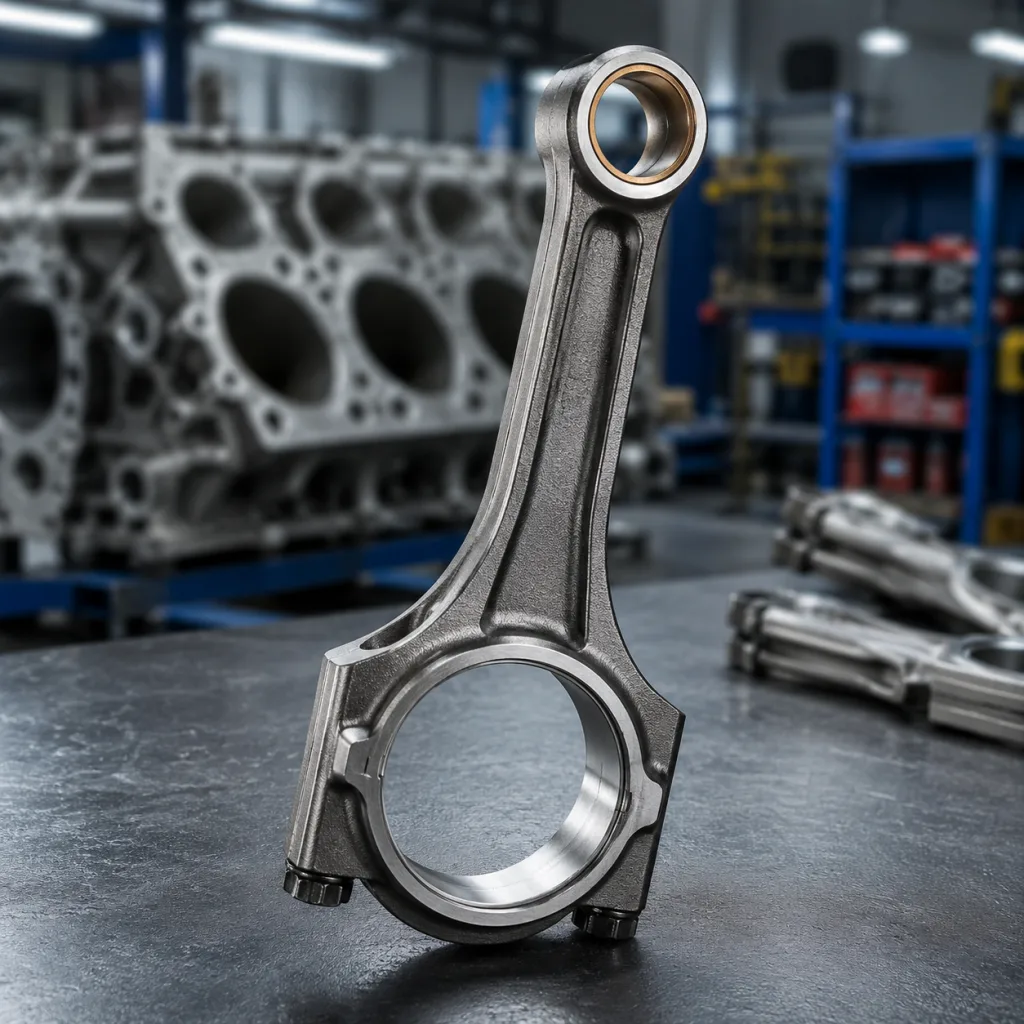
Before you approve a repeat order, lock down the dimensions and performance points that directly affect crankshaft, bearing, piston-pin, and fastener assembly. A Cadillac connecting rod can look correct in a listing and still fail the job if the housing bore, cap register, side clearance, or bolt preload specification is outside the approved range.
Use these verification points as your first filter:
- Center-to-center length, with the production tolerance stated on the drawing or inspection plan
- Big-end housing bore size after cap torquing, including roundness, taper, and bearing seating geometry
- Big-end side width and chamfer detail for crankshaft cheek clearance
- Small-end bore or bushing ID, pin-fit class, oil-hole position, and bushing material if applicable
- Beam profile, forged or machined construction, and weight class for matched sets
- Cap design, register type, bolt grade, thread form, torque-plus-angle or stretch specification, and locking method
- Surface condition, including shot peening, nitriding, phosphate, anti-rust oil, or other specified treatment
- Marking method for lot control, part number, orientation, and customer-specific identification
Ask the supplier to confirm which characteristics are measured on every rod, which are checked per lot, and which are verified only at first-article approval. For high-risk features such as big-end bore and bolt preload, many buyers require 100% final verification or documented fixture checks. If those basics are not recorded, your receiving team inherits the risk at inbound inspection and the cost shows up later in bearing noise, rebuild delays, returns, or customer claims.
Stock, semi-custom, or full custom
Wholesale buyers usually need one of three supply models, and choosing the wrong one creates avoidable cost. Stock parts are fastest when the fitment is already validated and packaging is acceptable. Semi-custom production is useful when the rod geometry is proven but you need controlled changes to bolts, finish, carton count, private-label marking, or documentation. Full custom is the right path when the program requires a new center distance, housing bore, beam section, fastener package, balance target, or application-specific inspection plan.
For a controlled connecting rod Cadillac wholesale program, capable suppliers should define measurable targets instead of using broad claims such as "high strength" or "OE quality." Typical requirements include:
- Center distance held to the approved drawing or master sample, with gauge method identified
- Big-end and small-end bore roundness, taper, and concentricity maintained within the agreed inspection limits
- Big-end and small-end side faces machined cleanly so rod side clearance can be controlled during assembly
- Weight spread controlled to the customer limit for matched sets, piston-and-rod pairs, or cylinder-bank kits
- Burr-free edges, consistent chamfers, and no machining marks on bearing seating surfaces beyond the approved finish limit
- Heat treatment, shot peening, or surface treatment repeated to the same process window for every lot
- Lot traceability from forging, billet, or bar stock through machining, inspection, final packing, and shipment
If you are stocking across multiple sales channels, semi-custom often provides the best balance. It preserves the validated fitment while tightening details that matter commercially, such as barcode format, country-of-destination labeling, pack quantity, inner-box protection, and warranty traceability. For private-label programs, ask whether the supplier can support repeat runs under the same control plan rather than one-time prototypes, because repeatability is what protects margin.
Material and dimensional control
Cadillac buyers often compare replacement rods by appearance, but visual similarity is not a meaningful quality check. Two rods can look nearly identical while differing in beam section, cap alignment, bore geometry, bushing finish, fastener clamp load, or residual stress. Those differences can affect oil clearance, pin fit, fatigue life, and how consistently the engine assembles.
The supplier should be able to explain the base material, forming process, heat treatment, and inspection method used to keep the part consistent. At minimum, you want clarity on:
- Raw material type and grade, such as forged steel, machined billet steel, or specified alloy bar stock
- Material certificate or heat number traceability back to the steel batch or forging lot
- Heat-treatment route and hardness control, with hardness range and test location defined where applicable
- Dimensional inspection points on the big end, small end, cap register, side faces, bolt seats, and oil holes
- Measurement method, such as CMM, air gauge, bore gauge, go/no-go fixture, or calibrated micrometer check
- Weight control process, including whether rods are balanced individually, in matched sets, or to a batch-average target
- Surface finish requirements on bearing seats, pin bores, thrust faces, and bolt seating areas
- Corrosion protection or coating specification for ocean freight, bonded storage, or long warehouse dwell time
Receiving teams should compare measured values against the approved drawing, PP sample, or retained master sample, not against a photo or generic listing. That distinction matters because many sourcing problems come from parts that are close enough to pass a quick visual check but not close enough for a clean engine build. A disciplined export supplier also keeps the route from raw material to packed carton visible, which reduces disputes when inventory is split across several destinations or when a customer asks for proof of consistency after installation.
Quality system and factory evidence
For wholesale purchasing, quality is only useful when it can be audited. A supplier should not just say that parts are inspected; they should be able to show what was checked, how it was measured, when it was checked, and how the records connect back to the shipped lot. That is especially important for a connecting rod program, where a bore or fastener issue can create engine damage and weak traceability makes containment much harder.
Records buyers should ask for
Keep the request focused on records that influence fit, liability, and repeatability:
- First-article or approved-sample dimensional report covering center distance, bores, side widths, cap fit, and bolt-seat features
- Material declaration, mill certificate where available, and heat or batch traceability information
- Heat-treatment, hardness, shot-peening, or coating verification if those processes are specified
- Inspection instructions used during machining, cap assembly, bolt tightening, final gauging, and packing
- Gauge list or calibration status for critical measuring equipment
- Packing specification for master carton, inner box, separators, anti-rust protection, and pallet configuration
- Photo or diagram of part marking, barcode, orientation mark, and lot-code placement
- Customer-specific test requirement, such as hardness check, balancing record, surface-finish reading, or salt-spray requirement for coating validation
Ask how nonconforming rods are tagged, segregated, reviewed, and released after rework. The answer shows whether the factory has a real containment process or only a general promise of quality. For importers and distributors, this documentation is also useful after arrival because it lets your team reconcile received stock against the purchase order, packing list, carton labels, and inspection report without relying on memory or informal notes.
How to build a usable quote request
A good quote request reduces back-and-forth and produces a price that reflects the real production path. If the supplier receives only a part number, they are forced to guess at fitment, inspection level, fastener supply, packaging, and label requirements, which usually leads to revisions later. A usable request gives the factory enough information to confirm engineering feasibility, tooling status, production schedule, and commercial terms before the order is placed.
Include these items in the request package:
- Cadillac engine family, displacement, model-year range, application notes, and any known OE reference points
- Drawing, 3D file, physical sample, or retained reference part for dimensional comparison
- Required center distance, big-end bore, small-end bore or bushing ID, side widths, and bolt specification if already known
- Target annual volume, initial order quantity, reorder pattern, and forecast if available
- Required material grade, forging or billet preference, finish, coating, or heat-treatment expectation
- Fastener requirement, including whether bolts, nuts, or studs are supplied with the rod
- Packing format, pieces per inner box, master-carton quantity, barcode standard, label language, and pallet limits
- Testing or compliance needs, including inspection reports expected with shipment
- Destination country, Incoterms, delivery window, and any split-shipment requirement
For buyers managing multiple channels, the practical benefit of a strong quote package is fewer exceptions at import clearance and warehouse receiving. Clear labels, consistent lot codes, and a defined inspection standard reduce the time spent sorting, relabeling, or checking mixed cartons after arrival. It also gives procurement a cleaner basis for comparing suppliers, because each quotation is tied to the same technical scope rather than to different assumptions.
Frequently asked questions
Provide the engine family, drawing or sample, target annual volume, initial order quantity, and packing or labeling requirements. If the part is being sourced by reference only, include the OE number, vehicle application, and any notes about material, finish, bolt specification, bushing, or surface treatment. If you only have a physical sample, we can measure center distance, big-end and small-end bores, side widths, cap design, and weight before final pricing so the quotation reflects actual geometry instead of a catalogue assumption.
Yes. We can compare center distance, big-end housing bore, small-end bore or bushing ID, end widths, oil-hole position, weight class, cap design, and fastener specification against the reference part. That allows us to confirm fitment compatibility without using brand names as approval claims. If the application needs exact matching for a rebuild program, we recommend sending both the old part and the target drawing so the comparison is based on measurable data rather than appearance.
Lead time depends on stock availability, tooling status, material procurement, heat treatment, machining capacity, inspection scope, and packaging requirements. Custom marking, special coatings, matched-weight sets, added test reports, nonstandard carton counts, or revised barcode labels can also add time. We confirm schedule after drawing review and sample confirmation so the commercial offer matches the actual production path and shipping plan.
Send your drawing, target volume, and test requirements, then [request a quote](/contact.html).
Request a Quote