cabin filter · 2026-06-13

Cabin Filter Replacement: OE-Equivalent Sourcing Guide

Cabin filter replacement is a high-volume service category, and small sourcing mistakes quickly become warranty claims, installer complaints, or retail returns. Common issues include poor fit in the HVAC housing, weak edge sealing, collapsed pleats, odour complaints, excessive airflow restriction, carbon dust, and damaged packaging. For distributors, repair chains, and private-label programmes, the sourcing target is therefore broader than unit price. The filter must match the OE envelope, seal correctly under blower load, retain particulate or activated carbon media without shedding, and remain stable through warehousing, mixed-carton handling, and sea freight. This guide gives procurement teams practical criteria for comparing cabin air filter suppliers, covering dimensional matching, media selection, validation testing, compliance documents, packaging controls, and production-release checks. Driventus manufactures filtration and engine-related service parts for export programmes from Taizhou, Zhejiang, under IATF 16949:2016 and ISO 9001:2015 process controls. Driventus is an independent aftermarket manufacturer; brand names are referenced for fitment only.

Replacement Intent: What Must Match OE Fitment

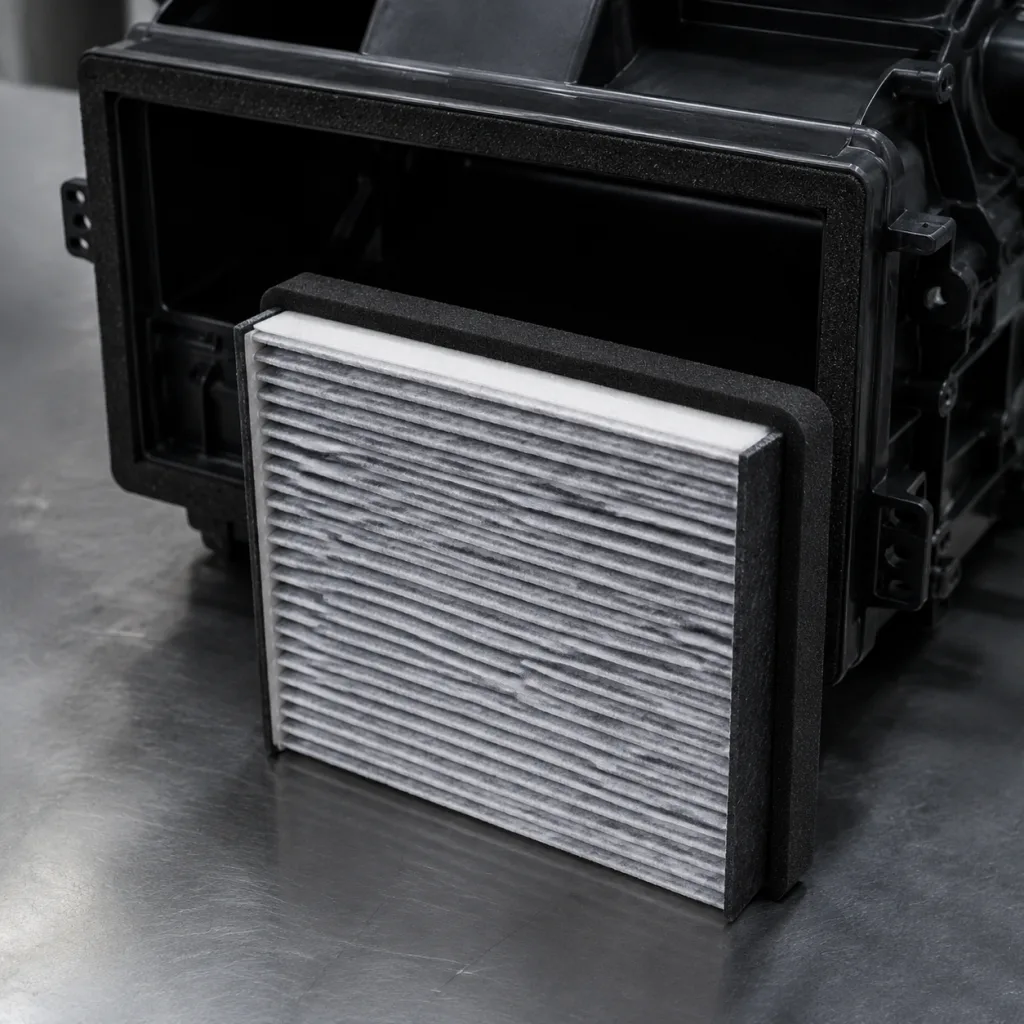
For B2B replacement programmes, the first requirement is controlled fit. A cabin filter that is 2 mm too short may allow dust bypass along the frame edge. A filter that is too thick may deform during installation, overload a pull tab, or return as a fitment complaint. Buyers should treat OE-equivalence as a measurable specification, not a catalogue phrase.

Critical matching points include:

  • Overall length, width, and thickness measured under an agreed compression condition
  • Frame geometry, including corner radii, pull tabs, ribs, clips, and foam seals
  • Airflow direction marking and installation orientation
  • Pleat count, pleat height, pleat spacing, and resistance to pleat collapse
  • Media support, including melt-blown layers, non-woven backing, scrim, or carbon bonding
  • Housing compression force and edge-seal recovery after storage
  • Clearance for curved housings, sliding trays, and glovebox-side installation paths

When buyers provide drawings, samples, or OE part-number cross-references, Driventus maps each reference into an internal specification sheet. Generic VAG-style references such as OE 06A… or Japanese-style references such as OE 11251… are used only for fitment identification when supplied by the customer. They do not imply approval, endorsement, or supply status with any vehicle manufacturer.

For range planning, buyers can compare dimensions and applications across our catalog. For private-label or non-standard media builds, custom manufacturing can cover frame tooling, carbon loading, packaging, carton structure, and pallet specifications.

Media Options and Objective Trade-Offs

Cabin filter replacement programmes usually rely on particulate, activated carbon, or multi-layer enhanced media. The right choice depends on climate, road dust level, service interval, fleet usage, and end-market price position. Denser media can improve particle capture but may increase pressure drop. Higher carbon loading can support odour reduction but adds cost, weight, and a greater need for carbon-retention control.

</tr></thead><tbody> </tbody></table>Procurement teams should define the intended claim level before approving media. For example, “activated carbon” should be supported by a stated media construction and carbon-loading control, while anti-allergen or antibacterial positioning may require third-party evidence depending on the destination market. Vague claims create avoidable risk in catalogue copy, packaging artwork, and marketplace listings.

For regulated chemical content, request material declarations aligned with REACH (EC) No 1907/2006 for EU supply. Packaging inks, plastics, adhesives, non-woven layers, and activated carbon binders should all be included in supplier compliance review. Claims related to cabin air quality should not be confused with vehicle emissions standards such as ECE R-83, which applies to vehicle pollutant emissions rather than cabin filtration performance.

Dimensional and Performance Checks Before Approval

A sourcing approval should combine sample measurement, installation trial, and airflow performance review. The purpose is to reduce return risk before mass production, especially where one reference is sold across several vehicle applications or regional HVAC housing variants.

Media type Typical construction Procurement advantage Watch point
Particulate non-wovenSynthetic fibre, electrostatic or mechanical captureLower cost, broad application coverage, stable storageLimited odour adsorption
Activated carbonNon-woven layers with carbon granules or bonded carbon sheetSupports odour and gas adsorption positioningCarbon shedding and pressure drop must be checked
Multi-layer anti-allergen styleFine fibre layer, support layer, optional carbonHigher-value private-label rangeClaims require evidence and market-specific wording
Heavy-duty fleet mediaReinforced frame and higher dust-holding mediaBetter durability for taxi, ride-share, and commercial useMay reduce airflow if not validated

</tr></thead><tbody> </tbody></table>For large range launches, Driventus recommends a golden-sample process. One approved sample is retained by the buyer and one by the factory. Critical dimensions, media construction, sealing details, markings, and packaging attributes are locked before production. Any change to media, adhesive, frame, label, colour box, or carton structure should trigger sample resubmission.

Validation records should connect to the factory’s quality system, including incoming material inspection, in-process checks, final inspection, and batch traceability. IATF 16949:2016 and ISO 9001:2015 do not define cabin filter dimensions or filtration efficiency targets, but they provide a framework for controlled production, corrective action, document control, calibration, and supplier management.

Packaging, Labelling, and Range Management

For distributors and repair chains, packaging failures can be as costly as product failures. Cabin filters are light, crushable, and often shipped in mixed cartons with heavier service parts. A strong sourcing specification should define protection from the individual filter wrap through to the export pallet.

Recommended packaging specification:

  • Individual polybag or paper wrap to prevent dust contamination
  • Rigid or semi-rigid colour box sized to avoid pleat compression
  • Installation arrow visible on the product and packaging
  • Barcode, SKU, cross-reference list, quantity, and country-of-origin statement as required
  • Master carton burst strength matched to pallet stacking plan
  • Desiccant or humidity controls where long sea freight storage is expected
  • Pallet pattern, corner protection, stretch film, and maximum stack height defined before shipment
  • Artwork revision control for private-label and multi-language ranges

Labelling must be accurate, consistent, and neutral. Brand names should appear only where legally permitted for fitment reference, and catalogue cross-references should not suggest OE approval unless written authorization exists. Driventus is an independent aftermarket manufacturer; brand names are referenced for fitment only.

Range management also affects cost and service level. Buyers should separate high-volume references from long-tail coverage. High-volume parts may justify dedicated tooling, printed colour boxes, local safety stock, and stricter forecast review. Long-tail references may be better handled with shared packaging architecture, controlled minimum order quantities, and periodic consolidation. For multi-country distribution, language panels, recycling symbols, chemical compliance marks, and importer details should be reviewed before artwork approval.

Supplier Audit Questions for Replacement Programmes

A replacement-focused audit should test whether the supplier can repeat the approved part, not simply produce one good sample. Procurement teams should review process control, incoming material stability, tooling maintenance, packaging checks, change management, and corrective action records.

Practical audit questions include:

  • Are filter dimensions measured using calibrated gauges, and are records retained by batch?
  • Is media sourced from approved suppliers with defined incoming inspection criteria?
  • Are activated carbon weight, distribution, and bonding checked during production?
  • Is there a documented change-control process for media, frame, adhesive, markings, and packaging?
  • Can the supplier provide inspection reports by SKU, batch, and shipment?
  • Are non-conforming parts segregated and logged before rework or scrap?
  • Are export cartons tested for compression, drop handling, and humidity exposure?
  • Can the supplier support mixed-SKU consolidation and private-label artwork control?
  • Are complaint trends reviewed by reference number to identify repeat fitment or packaging issues?

Driventus operates as a vertically integrated Chinese manufacturer serving aftermarket distributors, OEM and Tier-1 supply chains, and repair networks in 60+ countries. For cabin filter replacement projects, this structure supports drawing review, sample matching, production inspection, private-label coordination, and export documentation from one manufacturing base. It does not remove the need for buyer-side application validation, especially where vehicles have regional HVAC housing differences.

Purchasing Checklist Before Production Release

Before issuing a purchase order, buyers should close the technical and commercial gaps in writing. Many sourcing problems occur when a sample is approved informally but the purchase order does not define the media, tolerances, packaging, cross-references, or inspection plan.

Use this release checklist:

  • Confirm the application list and any OE cross-reference format supplied by the buyer
  • Approve drawings or measured sample reports for each SKU
  • Define media type, colour, carbon content if applicable, and frame material
  • Set tolerance limits for length, width, thickness, seal features, and tab position
  • Approve airflow direction markings, pull tab design, label position, and print durability
  • Lock packaging artwork, barcode data, carton size, carton strength, and pallet plan
  • Request REACH (EC) No 1907/2006 declarations where EU supply is intended
  • Request certificate copies for IATF 16949:2016 and ISO 9001:2015 systems
  • Define AQL level, retained samples, inspection photos, and shipment documents
  • Confirm lead time, MOQ, mixed-container plan, spare packaging allowance, and reorder process

A structured release process is especially important when moving from spot buying to a private-label filter line. It gives category managers a fair basis for comparing suppliers and gives engineering or quality teams objective criteria for rejecting non-conforming production. It also reduces avoidable disputes by linking the approved sample, purchase order, inspection report, and shipped goods to the same written specification.

Frequently asked questions

The main risk is poor dimensional matching. Small deviations in length, width, thickness, seal geometry, or tab position can cause bypass, installation damage, weak HVAC airflow, or customer returns. Buyers should approve measured samples and retain golden samples before production.

Often yes, if the frame and media thickness match the housing and pressure drop remains acceptable. Procurement teams should validate airflow, carbon retention, odour-reduction positioning, and packaging cleanliness before switching a range from particulate to carbon media.

Request drawings or sample reports, batch inspection records, packaging specifications, REACH (EC) No 1907/2006 declarations where applicable, and copies of IATF 16949:2016 and ISO 9001:2015 certificates. Shipment photos, retained samples, and artwork approvals help resolve later claims.

If you are building a replacement filter range or validating a private-label programme, share your SKU list, drawings, or approved samples. Driventus can review fitment, media, packaging, and export requirements when you [request a quote](/contact.html)

Request a Quote
Check item Recommended procurement control Typical risk if skipped
Length and widthMeasure against drawing or approved sample at 20 ± 5 °CEdge bypass, loose fit, rattle
ThicknessCheck free height and compressed heightDifficult installation or poor seal
Seal geometryVerify foam density, adhesive position, and recovery after compressionDust bypass or housing interference
Pleat stabilityInspect after vibration and carton compressionCollapsed pleats, uneven airflow
Initial pressure dropTest at agreed air velocity and compare with retained sampleWeak HVAC airflow complaints
Dust-holding trendCompare media loading curve against target sampleShort service life
Carbon retentionShake and wipe test on carbon mediaBlack dust in packaging or vents
Tab and markingVerify pull tab strength and airflow arrowInstaller error and returns
Packaging fitDrop and compression check for inner box and master cartonCrushed filters on arrival