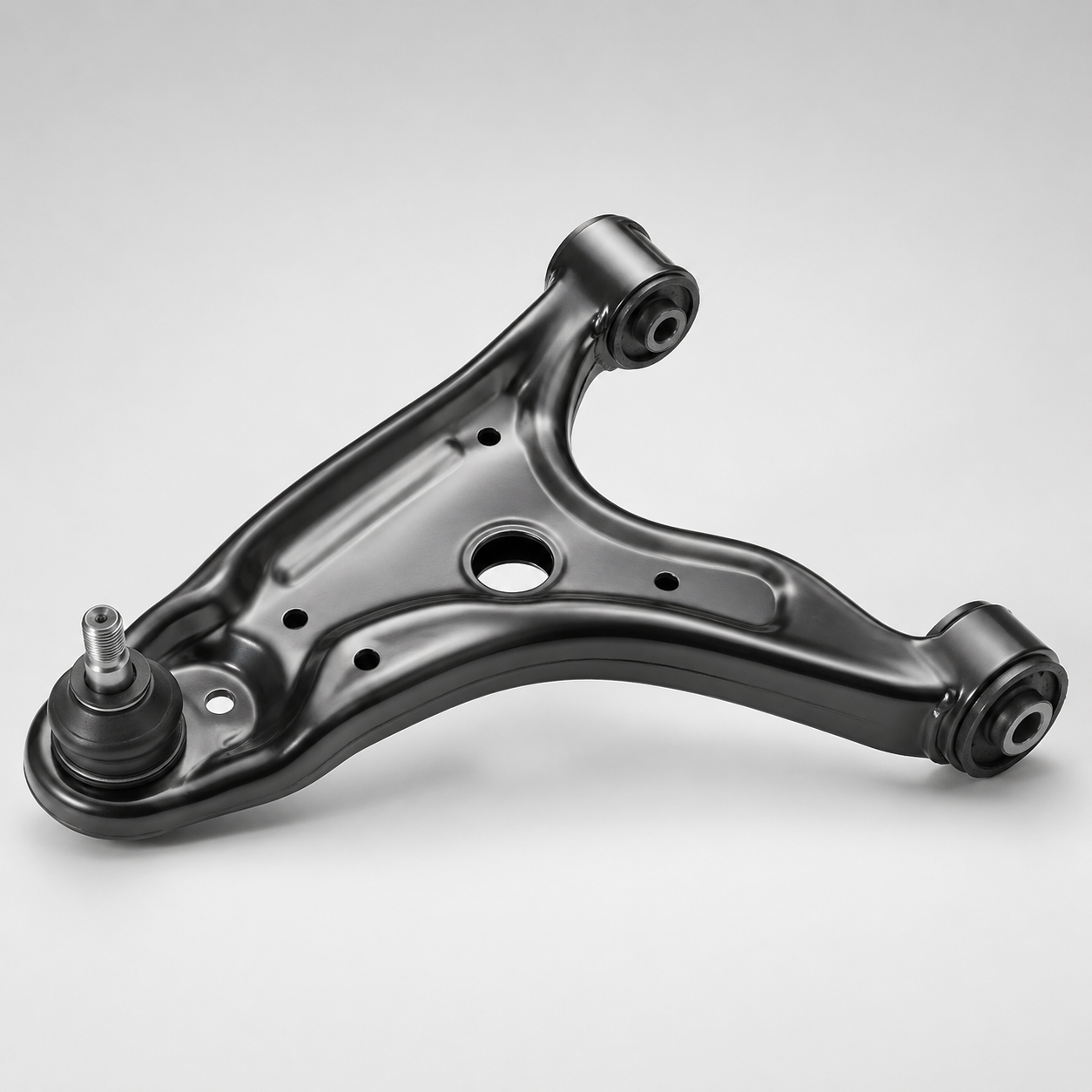
A lower control arm is a safety-critical suspension component. It controls wheel position, manages bushing movement, influences braking stability, and has a direct effect on tyre wear. For procurement teams, the decision is never just about price. It is about dimensional repeatability, weld integrity, ball joint durability, corrosion resistance, packaging discipline, and batch traceability. A part that installs cleanly but drifts out of specification after 20,000 km can turn into claims, workshop friction, and brand damage.
This guide is built for B2B buyers sourcing lower control arm programmes at volume. It focuses mainly on stamped and forged steel assemblies used in the aftermarket and service-channel supply, while noting where other constructions make sense. The practical aim is simple: define what matters before RFQ release, compare suppliers on a common technical baseline, and avoid the failure modes that usually surface too late.
The most effective sourcing teams do one thing early: they translate broad claims such as "OE quality" into measurable requirements. That means centre distances, hole tolerances, taper sizes, hardness windows, corrosion hours, torque ranges, packaging counts, lot coding, and capability targets. Once those are locked, lower control arm quotations become comparable. Until then, they are mostly marketing language dressed up as engineering.
Start with the RFQ logic, not the part photo
Most lower control arm purchasing mistakes begin before supplier comparison starts. The part is defined too loosely, catalogue data is assumed to be correct, and visually similar references get grouped together. That is how an apparently simple RFQ turns into fitment returns.
A usable sourcing file should map the lower control arm by vehicle platform, side, axle position, bushing design, ball joint layout, and any bracket, stop, or sensor-mount variation. On many programmes, the real issue is not manufacturing quality but application confusion: two arms can look nearly identical and still differ in pivot spacing, taper angle, or bracket clocking.
Before releasing an RFQ, buyers should confirm:
Fitment coverage: exact chassis code, engine or axle weight class, drivetrain where relevant, and model-year split
Critical dimensions: pivot centre distance, ball joint stud angle, arm profile clearance, mounting-hole diameter, and bracket position
Assembly content: bare arm, arm with bushings, arm with ball joint, or full hardware kit
Material route: stamped steel, forged steel, cast steel, or aluminium alloy
Surface protection: e-coat, zinc flake, powder coating, or multi-layer finish
Traceability: part marking plus matching outer-carton identification
Compliance documents: material declaration, REACH (EC) No 1907/2006 status, packaging spec, and market-specific chemical reporting where required
Also define what is *not* interchangeable. Front lower and rear lower arms on multi-link systems are often confused by weak naming conventions. Left- and right-hand variants should be frozen at quotation stage, not clarified after artwork approval.
To make the RFQ commercially meaningful, convert the file into numbers. A buyer may request pivot centre distance within ±0.30 to ±0.50 mm, mounting-hole diameter within ±0.10 mm, bracket position within ±0.50 mm, and ball joint taper dimensions checked either 100% at critical setups or through SPC-controlled sampling. For rubber components, a common request is bonded rubber hardness in the 55 to 75 Shore A range depending on application, typically with a production window around nominal ±5 Shore A. If the lower control arm includes a preinstalled ball joint, thread size, stud effective length, and boot material should be listed in the technical file.
Lot logic matters too. A typical aftermarket launch may begin at 100 to 300 pcs per reference for fitment and market validation, then move to 300 to 1,000 pcs per reference depending on arm size, packaging density, and left/right balance. Price usually moves more with annual volume, tooling amortisation, and assembly content than with small differences in steel weight. A lower control arm supplied complete with two bushings and one ball joint may cost 20% to 50% more than a bare arm, but it can reduce labour time, SKU complexity, and mismatch risk.
Where private label, kit content, or market-specific variants are involved, review the supplier's custom manufacturing capability early. That is often where RFQs either become precise or become expensive later.
For wider line planning, buyers can also review our catalog to compare related chassis categories and align sourcing standards across the range.
Choosing the construction: where lower control arm cost really comes from
The right lower control arm construction depends on load, vehicle class, target warranty exposure, and road environment. Not every market needs the same answer.
Construction type
Typical advantages
Typical risks to control
Common buyer use case
Stamped steel welded arm
Competitive cost, efficient high-volume production, good dimensional control with stable tooling
Weld consistency, edge corrosion, bushing bore distortion after welding
High-volume aftermarket programmes
Forged steel arm
High strength, strong impact resistance, good fatigue performance
Higher material cost, tighter casting and machining control, different crack/failure behaviour
Premium passenger vehicle platforms
</tr></thead><tbody> </tbody></table>For most aftermarket lower control arm references, stamped steel remains the default because it balances cost, durability, and production efficiency. But the material label by itself proves very little. A disciplined stamped-and-welded process can outperform a weak forged or cast route.
What buyers should actually ask for is evidence on:
Base material grade and thickness range
Flatness and positional tolerance at mounting points
Weld process control, qualification method, and inspection frequency
Bushing press-fit interference window
Ball joint housing retention method
Coating thickness range and adhesion data
Heat treatment status where relevant
If the lower control arm includes bonded rubber bushings, the rubber deserves equal scrutiny. Poor compound control or weak bonding changes NVH, braking feel, and durability even when the steel body is acceptable. In fleet, taxi, utility, and rough-road markets, that subcomponent often decides the claim rate.
The same reference may also need different commercial positioning. A budget line may accept a simpler finish and shorter corrosion target. A premium distributor programme may ask for upgraded coating, tighter packaging, and a larger validation package to support a longer warranty period.
In practical terms, stamped steel lower control arm assemblies commonly use 3.0 to 6.0 mm sheet depending on vehicle class. Forged versions start from billet or forged blanks and usually require local machining on bores and tapers. Buyers should ask for the actual grade, not generic wording such as "carbon steel." On welded assemblies, bore roundness after welding and cooling is important because heat input affects bushing and ball joint seating. Typical controlled press-fit interference for a metal-shell bushing may be around 0.08 to 0.20 mm, while ball joint retention may use similar interference plus staking, circlip, or swaging depending on design.
Corrosion protection is another real cost driver. An economical e-coat system may target 15 to 25 μm film thickness. More demanding programmes may require a zinc-rich pretreatment plus e-coat or topcoat system at 20 to 35 μm total dry film thickness. Budget aftermarket business may accept lower salt-spray performance, but premium EU or Canada-focused supply often expects 240 to 480 hours without severe red rust on defined areas, and some programmes ask for 720 hours on witness panels or coupons. On a lower control arm, edges and weld seams fail first, so buyers should ask where thickness is measured and whether internal areas are protected.
In short: construction choice is not just piece price. It changes field risk, freight density, tooling life, and replenishment flexibility. A forged lower control arm may cost more ex-works but make sense in severe-duty service. A well-controlled stamped arm may still be the best cost-per-kilometre answer for mainstream passenger vehicles.
Failure modes to screen out before launch
A lower control arm rarely fails in a dramatic, obvious way at first. More often, it creates noise, alignment drift, corrosion complaints, installation difficulty, or premature play. That is why visual inspection alone is not a buying method.
The smarter question is: what goes wrong in the field, and which validation step would have caught it?
Recommended validation checkpoints
Test item
What it verifies
Typical procurement relevance
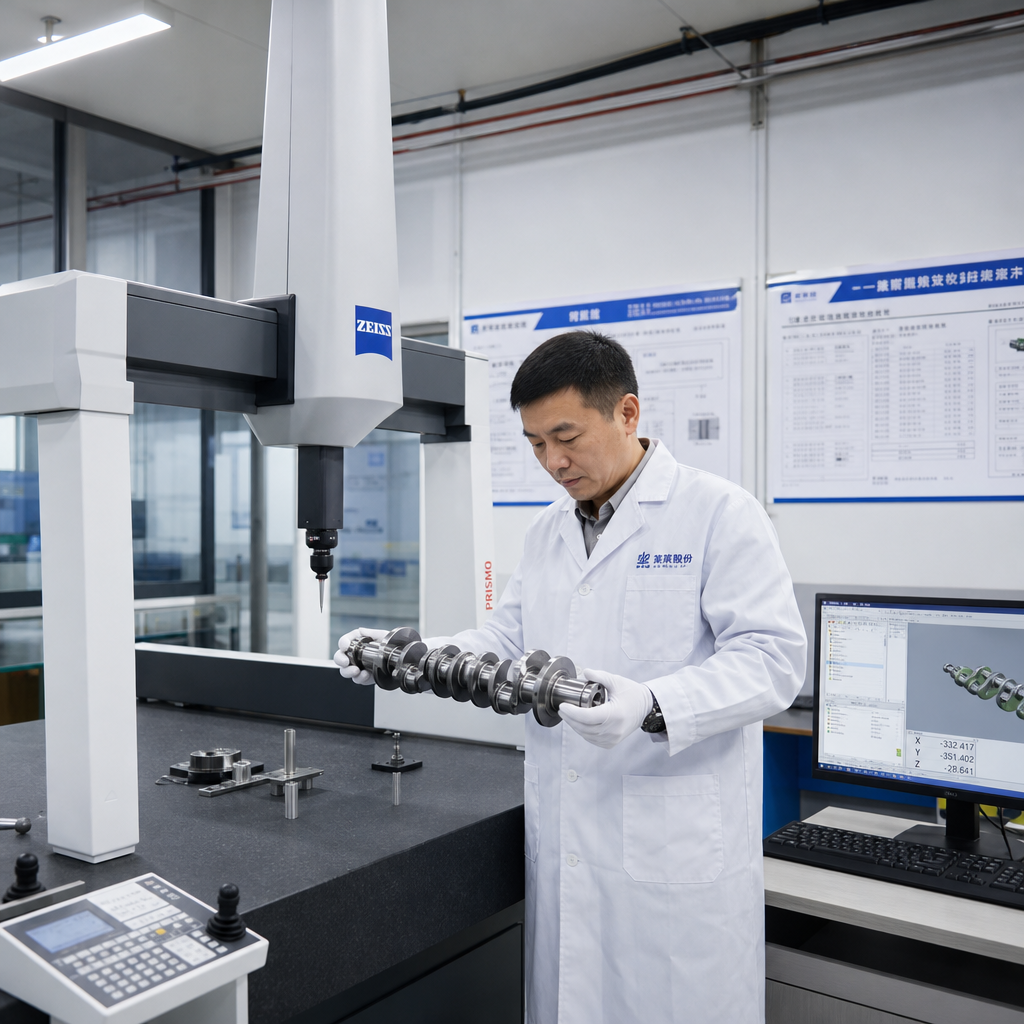
Dimensional inspection on fixtures or CMM
Mounting geometry and interchangeability
Reduces installation rejects and alignment complaints
Fatigue testing
Resistance to crack initiation and propagation under cyclic load
Critical for service life and warranty control
Ball joint articulation torque
Smooth movement within design window
Helps prevent looseness or overly stiff steering feel
Ball joint pull-out / push-out
Retention security
Safety-critical verification
Bushing radial/axial stiffness check
Compliance behaviour and NVH control
Important for ride, alignment stability and braking response
Salt spray corrosion test
Coating durability
Important for EU, UK, Canada and coastal markets
Weld inspection and destructive sectioning
Fusion quality and heat-affected-zone consistency
Especially important for stamped welded arms
</tr></thead><tbody> </tbody></table>Some applications also need impact or abuse testing, especially where the lower control arm will see overloaded vehicles, poor roads, or harsh fleet use. Fatigue alone does not always predict those outcomes.
While no single global standard defines every passenger-vehicle lower control arm validation step, process discipline should align with IATF 16949:2016 and ISO 9001:2015. Chemical and material reviews should consider REACH (EC) No 1907/2006 where relevant. Buyers sometimes cite broader automotive standards, but for this product family the most useful evidence is application-specific fatigue, dimensional, corrosion, weld, and retention data.
Sample origin matters as much as the report. One lab-tested sample proves little. Better evidence is lot-based testing tied to production tooling and normal process conditions. If the supplier has changed tooling, rubber source, ball joint source, or coating line since original approval, the lower control arm may need partial or full revalidation.
For dimensional control, buyers should ask whether the supplier uses a fixture, a CMM, or both. A practical launch expectation is first article inspection on 5 to 10 pcs per cavity/tool setup, then SPC on critical dimensions with a target Cpk ≥1.33 on stable features and 100% check on selected safety-critical characteristics where needed. Key dimensions usually include pivot centre distance, ball joint centre location relative to pivots, bracket clocking, hole position, and taper geometry.
For fatigue testing, ask for load direction, frequency, load ratio, and acceptance criteria. Depending on vehicle class, endurance targets may range from 300,000 to 1,000,000 cycles under defined loading with no crack propagation beyond agreed limits. Impact or curb-strike style tests may add a one-time overload event after cyclic conditioning. Reports should state fixture orientation and whether bushings and ball joints were production parts or substitutes.
Ball joint performance needs more than retention force. Articulation torque windows matter because installers and drivers feel them immediately. Buyers may request start/run torque at room temperature, then repeat checks after environmental exposure. For bushings, radial and axial stiffness curves are more informative than a single pass/fail number, particularly on vehicles sensitive to braking shimmy or harshness.
Corrosion validation should include film thickness readings, adhesion results, and neutral salt spray exposure defined by the agreed standard and witness location. For welded lower control arm assemblies, macro-etch sectioning at selected welds is useful to confirm throat size, penetration, and fusion consistency. Many buyers require destructive weld checks at launch and periodic verification by lot or shift.
A strong launch pack for a lower control arm usually includes drawing balloon results, material certificates, rubber property data, ball joint validation, weld records, coating results, capability studies, part marking format, packaging validation, and retained golden samples. Without that, comparing supplier durability claims is guesswork.
Fitment and catalogue control: the quiet driver of return rate
Lower control arm sourcing often fails in the catalogue before it fails on the road. Small geometry differences create large installation problems, and weak cross-reference control feeds return cost directly into the warehouse.
A robust fitment-control process should include:
Mapping by OE reference where available, for example a customer RFQ may cite an OE 06A107065-style number as a starting point
Side-specific verification for left-hand and right-hand assemblies
Clear separation of front lower and rear lower positions on multi-link systems
Confirmation of ball joint taper dimensions and stud thread specification
Check of bushing orientation marks and bracket clocking angle
Validation against an actual vehicle, OE sample, or confirmed engineering drawing rather than catalogue images alone
Avoid vague language such as "fits most models." Professional lower control arm purchasing needs a formal application list with platform codes, production years, engine notes where relevant, and any regional restrictions. Even within one nameplate, suspension changes can appear across facelifts, engine weight classes, or build plants.
Cross-reference discipline matters commercially as well. If the supplier cannot keep clean links between internal part numbers, customer numbers, OE references, and labels, warehouse errors follow. For repair-group supply, ask whether barcode control, installation instructions, and carton labels can be aligned with your ERP structure.
Revision control is just as important. When a lower control arm supersedes an earlier design, the supplier should show how fitment notes, carton artwork, part marking, and system data are updated together. Otherwise old and new information circulates at the same time.
Driventus maintains documented inspection and process controls within its quality system, which is relevant for buyers building supplier approval and audit files.
To reduce miscataloguing, insist on a fitment master file with at least: internal part number, customer SKU, OE cross references, side, axle position, platform code, production date range, engine or GVW notes where relevant, and a photo or drawing reference. Ideally it should also include critical dimensions such as pivot spacing, ball joint taper major/minor diameter, stud thread specification, bushing OD, and bracket offset. That gives the catalogue team something real to compare before consolidating lower control arm references.
Good suppliers do not build cross references from online data alone. They combine OE mapping, physical sample comparison, dimensional measurement, vehicle trial fit, and revision review. Buyers should ask whether a new lower control arm reference came from an actual OE sample, a reverse-engineered CAD model, or only image matching. The last option carries obvious return risk.
Label requirements should also be specific. Common controls include 1D barcode or QR code, customer part number in human-readable format, batch or lot code, quantity per carton, and country of origin. If left and right arms are often ordered together, a colour dot or oversized side marking can reduce picking errors. Even a 0.5% reduction in picking mistakes matters at scale.
Finally, define supersession rules. If a lower control arm changes because of a bushing revision, coating upgrade, or bracket correction, the supplier should state whether old and new versions are fully interchangeable, whether mixed stock is allowed, and what cut-in date applies. Catalogue control is not admin. It is warranty prevention.
Supplier comparison framework: price, lead time, and hidden risk
The cheapest lower control arm source is not automatically the lowest-cost source. Once claims, replenishment instability, packaging damage, and tooling drift enter the picture, the ranking often changes.
Use this checklist when comparing suppliers:
MOQ by reference: confirm whether mixed-model consolidation is possible in one shipment
Lead time: separate tooling lead time, sample lead time, and repeat-order production lead time
Tooling ownership: define ownership, maintenance responsibility, storage location, and revision approval process
Incoming material control: verification records for steel, rubber compounds, and ball joint components
For distributor programmes, stable replenishment usually matters more than headline capacity. Ask for monthly output by part family, not only total factory capacity. A supplier may have high overall production but limited real availability for your lower control arm range because tooling is shared, coating slots are tight, or subcomponent supply is unstable.
Dependency on outside processes is another decision point. If ball joints, rubber bushings, machining, or coating are outsourced, buyers should understand how those sub-suppliers are controlled. A lower control arm assembly is only as stable as its weakest linked process.
Packaging should be treated as a quality control item, not a logistics afterthought. Metal-to-metal contact inside cartons can damage coating before the goods ever reach the customer, then the market reads it as corrosion failure.
When discussing a new programme, buyers can request a quote with target annual volume, application list, validation scope, and destination market. That level of input produces more reliable pricing and reduces later specification drift.
Commercial ranges should be stated clearly. Typical aftermarket MOQ for a lower control arm is often 100 to 300 pcs per reference for existing tooling, increasing to 500 to 1,000 pcs where private label packaging, hardware kits, or low-rotation references are involved. For launches, many suppliers will allow mixed-reference consolidation to fill a pallet or container layer if annual volume supports it.
Lead time should be broken down:
Tooling or engineering sample lead time: often 30 to 60 days for simple copy-tooling changes, longer for new forgings or new checking fixtures
PPAP or first-article sample lead time: commonly 15 to 30 days after tooling readiness
Repeat production lead time: often 30 to 45 days ex-works for stable references, but sometimes 60 to 90 days when outsourced coating, shutdowns, or imported subcomponents are involved
Price logic should be transparent. Ex-works cost usually shifts with annual volume, steel weight, assembly content, coating spec, packaging type, and whether tooling cost is amortised into the piece price. A lower control arm programme asking for 240-hour salt spray, plain carton packing, and stock labels will normally price differently from one requiring 480 to 720-hour corrosion performance, colour-box retail packing, hardware kits, and customer-specific laser marking. Buyers should compare landed cost, not only the initial quote.
On quality assurance, ask for actual control points. Strong lower control arm suppliers can show steel cert review, rubber hardness checks, ball joint incoming inspection, weld parameter control, fixture gauging, press-fit force monitoring, coating thickness checks, and final audit records. Buyers often require a final inspection level such as AQL 0.65 or 1.0 for critical defects and AQL 1.5 or 2.5 for major or minor cosmetic items, depending on programme sensitivity.
For packaging, define carton quantity, net and gross weight, separator type, VCI bag use if needed, pallet size, stacking limit, and drop-test expectation. A common export control is keeping carton weight below 20 to 25 kg to improve handling and reduce in-transit movement of the lower control arm. Container loading plans should also show how mixed references are separated so left/right pairs and superseded versions are not confused.
Finally, ask what inventory the supplier actually holds. A strictly make-to-order lower control arm supplier may quote aggressively but create stockout risk. Buyers serving fast-moving distribution channels often prefer a source that carries safety stock of common bushings, ball joints, or finished references, even at a slightly higher nominal price.
The buying mistakes that create claims six months later
Most lower control arm problems are avoidable. They come from weak definition, unbalanced comparisons, or informal change control.
The common ones are familiar:
1. Approving by appearance only A visually similar lower control arm may use a different ball joint angle, stud thread, pivot spacing, or bushing hardness.
2. Ignoring coating performance A part suited to dry inland markets may not survive Canadian or Northern European winter exposure.
3. Combining unlike applications under one SKU This creates fitment confusion, warehouse errors, and return cost.
4. No retained golden sample Without an approved master sample, dimensional drift and claim analysis are harder to resolve.
5. No packaging specification Metal-to-metal contact in cartons can damage the finish before delivery and trigger unnecessary disputes.
6. Treating the ball joint or bushing as secondary On a lower control arm assembly, subcomponents often drive field complaints even when the arm body itself is dimensionally correct.
A stronger approach is to lock the technical file before the first production order: drawing or measured-sample data, test plan, finish requirement, marking layout, packaging method, and revision history. That matters even more when one buyer serves multiple regions with different climate exposure and warranty expectations.
Claim-handling rules should also be agreed in advance. If a field issue appears, both sides should know how suspect stock is quarantined, which samples are retained, what workshop evidence is required, and how dimensional or metallurgical checks will be run.
Several mistakes are commercial, not technical. One is accepting a low quote without checking whether it includes bushings, ball joint, nut, washer, and carton inserts. Another is comparing suppliers on piece price when one quote assumes 500 pcs MOQ and another assumes 2,000 pcs MOQ with a different corrosion target. Lower control arm sourcing only becomes comparable when MOQ, coating spec, packaging style, and warranty assumptions are normalised.
Another avoidable error is failing to set numerical acceptance criteria. If the PO says only "test according to OE standard," disputes are almost guaranteed. If it states pivot spacing ±0.30 mm, coating 20 to 30 μm, salt spray 480 h, bushing hardness 65±5 Shore A, ball joint pull-out minimum as agreed by drawing/test plan, and carton quantity 4 pcs with separators, the lower control arm programme has a usable release basis.
Buyers should also avoid skipping pilot orders. A sensible sequence is prototype or engineering sample, then small pilot lot, then first container or consolidated commercial release. Even a straightforward lower control arm programme often reveals packaging weakness, label gaps, left/right imbalance, or fitment-note errors during pilot stage.
Finally, do not let change control go informal. If the supplier wants to change steel source, rubber compound, weld fixture, ball joint supplier, or coating line, that change should trigger documented review and, where necessary, partial revalidation. Many field issues start not with the approved lower control arm design, but with an unmanaged process change months later.
Frequently asked questions
Request fitment data, dimensional inspection records, material specifications, corrosion test results, fatigue or durability data, batch traceability format, packaging specifications and certification details aligned with IATF 16949:2016 and ISO 9001:2015. For a lower control arm assembly with preinstalled components, include ball joint and bushing validation records as well. In practice, buyers should also ask for first-article results, critical-dimension tolerances, coating thickness data, hardness reports, part-marking format, carton labels and sample retention rules.
Yes. Stamped steel is widely used for lower control arm programmes because it offers a practical balance of cost, durability and production efficiency. The key is process control: tooling stability, weld quality, bushing fit, ball joint retention and coating performance must all be validated for the specific application. Buyers should ask for actual sheet thickness, steel grade, weld checks, bore tolerances and corrosion-hour targets rather than relying on the material description alone.
Use approved master samples, confirm exact application mapping, specify corrosion targets, verify ball joint and bushing test results, and require batch-level traceability. Clear packaging standards, controlled catalogue data and lot-based validation records also help reduce warranty exposure on lower control arm programmes. It also helps to run a pilot lot before full launch, define measurable tolerances and require change-notification approval for any material, tooling or sub-supplier change.
If you are comparing suppliers for suspension programmes, Driventus can review your application list, technical requirements and target volumes. Contact our team to discuss sourcing options at /contact.html