Buy Car Parts Online: B2B Sourcing Guide
Buying replacement components through online channels can shorten sourcing cycles and widen supplier choice, but it also shifts more verification work onto the procurement team. Before a volume order is placed, buyers need to confirm fitment data, production capability, material control, packaging durability, export documentation and after-sales support. The risk is not limited to an incorrect part number. It can include inconsistent machining, weak sealing surfaces, unstable casting quality, poor carton strength, missing batch traceability or incomplete compliance files. This guide is written for distributors, wholesalers, import managers and multi-location repair chains that need repeatable supply of aftermarket replacement parts. It explains how to evaluate online listings, compare supplier types, request validation evidence and build a purchasing file that supports both commercial and technical decisions. Driventus is an independent aftermarket manufacturer; brand names and OE-style numbers are referenced for fitment identification only.
Start With Fitment Data, Not Price
The fastest way to create avoidable claims is to treat a product title as the fitment authority. When teams buy car parts online, the first check should be the vehicle application and the cross-reference logic behind the listing. Confirm model year range, engine code, displacement, fuel type, emission level, transmission notes and market region before discussing volume price.
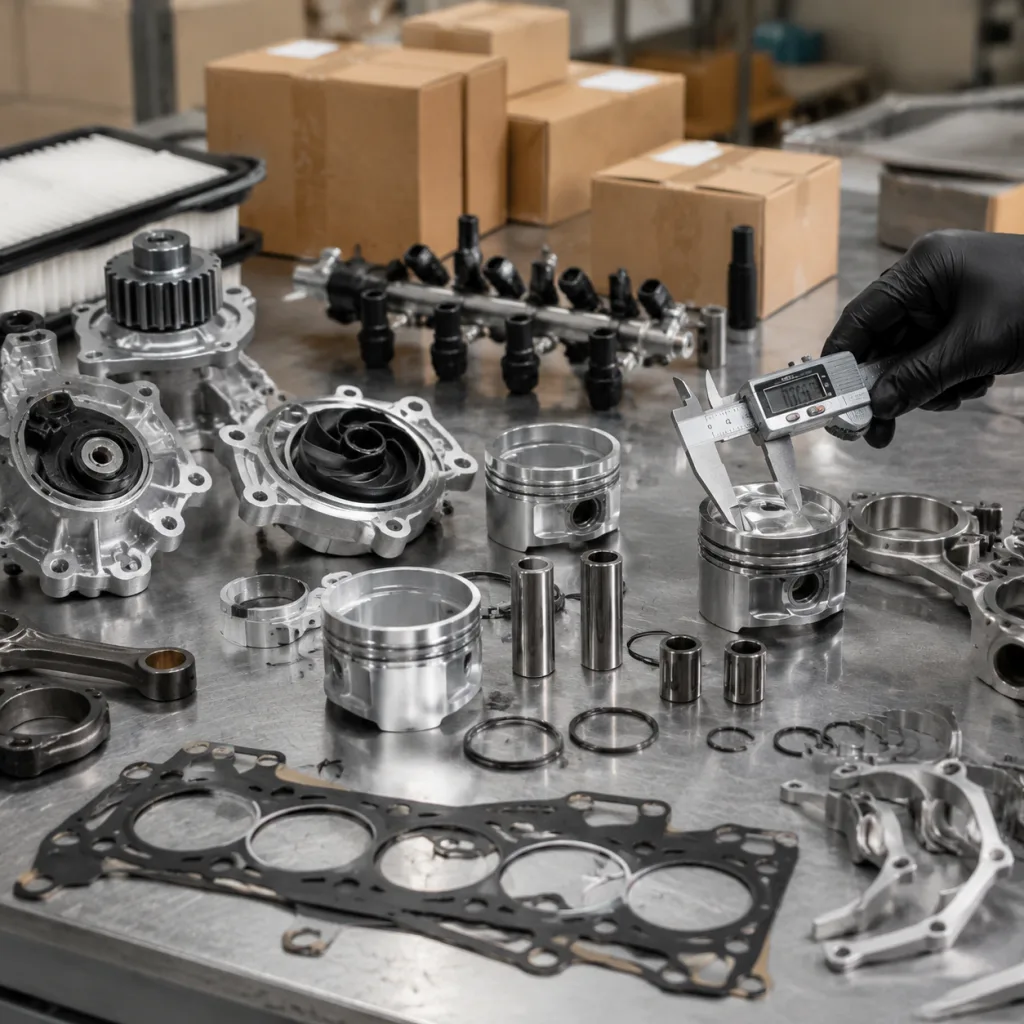
For engine and powertrain parts, a one-character difference in engine code can change compression height, gasket thickness, crank sensor pattern, oil-channel layout or water pump impeller design. A supplier should be able to provide an application table in spreadsheet format, not only a web page screenshot. The file should include the supplier part number, OE-style reference where applicable, vehicle application, engine details and exclusion notes.
Useful checks include:
- Match engine code and production year, not only vehicle model name.
- Review dimensional drawings for machined parts such as pistons, crankshafts and pumps.
- Confirm whether accessories are included, such as gaskets, bolts, O-rings or sensors.
- Require batch identification on the product, label or packaging for traceability.
- Keep a controlled cross-reference file for each import programme.
If a listing uses a number such as OE 06A107065, treat it as a fitment reference for comparison, not as evidence of approval, origin or endorsement by any vehicle manufacturer.
Online Supplier Checks for Import Buyers
An online storefront can be useful, but it does not replace supplier qualification. Buyers should verify whether the seller is a trader, assembler, specialist factory or vertically integrated manufacturer. Each model can be valid, but the risk profile is different. A manufacturer with in-house casting, machining, assembly and inspection control can usually provide stronger batch consistency and clearer corrective-action records.
| Checkpoint | What to Request | Why It Matters | |
|---|---|---|---|
| Business scope | Export licence, company registration, factory address | Confirms whether the seller can legally export and support audits | |
| Quality certification | IATF 16949:2016 and ISO 9001:2015 certificates where applicable | Shows a structured quality management system | |
| Process control | Control plan, inspection flow, equipment list | Helps assess repeatability across batches | |
| Product evidence | Drawing, material grade, test report, sample photos | Reduces risk of generic or mismatched supply | |
| Traceability | Batch coding method and retention period | Supports claims analysis and recall containment | |
| Export support | HS code, carton marks, pallet plan, document samples | Prevents customs and warehouse delays |
| Supplier Type | Typical Strength | Main Risk | Best Use Case |
|---|---|---|---|
| Marketplace reseller | Fast quotation and broad range | Limited factory control and weak traceability | Small trial orders or obsolete references |
| Trading company | Range consolidation across categories | Variable factory sources between batches | Mixed containers with many low-volume SKUs |
| Specialist manufacturer | Process knowledge and technical records | Narrower product range | Critical engine, gasket, pump or turbocharger programmes |
| Vertically integrated manufacturer | Better control of casting, machining and assembly | MOQ may be higher for custom items | Stable distributor and repair-chain supply |