Brake pads and rotors replacement cost is often searched as a consumer repair question, but professional buyers need a wider cost view. A repair chain may focus on fitted price, technician efficiency, and low comeback rates. An aftermarket distributor needs landed unit cost, margin protection, stable cross-reference coverage, and dependable supply. An OEM or Tier-1 buyer needs traceable materials, controlled processes, and validation evidence before adding a friction product to a programme.
For procurement teams, the useful question is not only what a workshop charges a driver. It is how pad formulation, rotor metallurgy, coating, packaging, freight, warranty exposure, and compliance requirements affect the total cost per axle set. This article explains the main cost drivers, typical price bands, and specification checks for brake pad and rotor sourcing. Driventus is an independent aftermarket manufacturer; brand names are referenced for fitment only.
Typical Cost Bands by Sales Channel
Retail repair pricing normally combines parts, labour, workshop margin, consumables, tax, disposal, and warranty allowance. B2B sourcing is built from different layers: pad set price, rotor pair price, packaging, pallet utilisation, duty, inland freight, claims rate, payment terms, and inventory carrying cost.
The table below gives directional ranges for one passenger-car axle set. Figures vary by vehicle class, market, specification, order volume, and currency movement, so they are best used for benchmarking rather than as quotations.
Channel or cost layer
Passenger car front axle
SUV / light commercial front axle
Cost notes
Factory pad set, semi-metallic or low-metallic
USD 4–14
USD 7–22
Depends on formulation, backing plate coating, shim design, sensor lead, clip kit, and MOQ
Factory rotor pair, grey cast iron
USD 18–55
USD 32–90
Depends on diameter, ventilation, coating, machining tolerance, casting quality, and weight
Ocean freight, duty, insurance, warehousing, local transport, and inventory finance
Repair-chain fitted price to end user
USD 180–450
USD 260–650
Includes labour, margin, tax, disposal, consumables, road test, and warranty reserve
</tr></thead><tbody> </tbody></table>For high-volume programmes, procurement teams should separate purchase cost from failure cost. A pad set that is USD 0.80 cheaper can become more expensive if it increases noise complaints, dust dissatisfaction, uneven wear, or technician rework. Buyers can review fitment coverage through our catalog and request costed samples against target applications.
What Changes the Parts Cost
The largest variables in brake pads and rotors replacement cost are material specification, vehicle segment, and validation depth. A compact-car solid rear rotor has a very different cost base from a ventilated front rotor for a heavy SUV. Pad formulation also changes raw material cost, pressing parameters, curing time, and production control requirements.
Key cost drivers include:
Pad friction formulation: ceramic, semi-metallic, low-metallic NAO, and non-asbestos organic compounds use different fibre, resin, lubricant, abrasive, and filler packages.
Backing plate accuracy: stamping flatness, slot position, ear geometry, coating thickness, and burr control affect fitment, rattle risk, and noise performance.
Noise hardware: multi-layer shims, chamfers, slots, abutment clips, and wear sensors increase unit cost but can reduce warranty exposure.
Rotor casting quality: carbon content, pearlite structure, hardness distribution, cooling control, and inclusion control affect durability and machining stability.
Rotor finish: Geomet-type coatings, painted hats, oil packing, and VCI packaging influence corrosion resistance, shelf presentation, and storage life.
Batch size and tooling: low MOQ, fragmented SKU coverage, special hardware, and frequent changeovers increase inspection time and production cost.
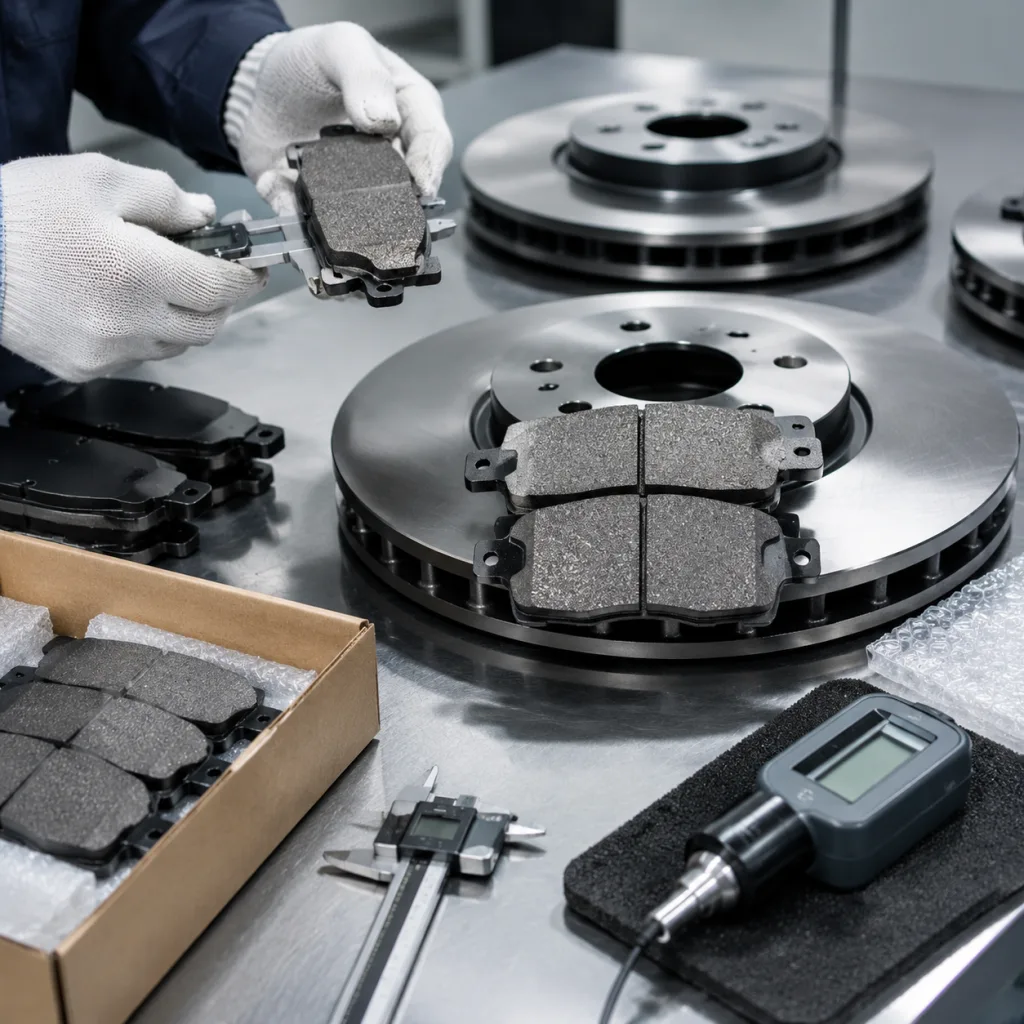
A cost review should cover drawings and critical-to-quality features, not only sample appearance. For brake pads, common controls include plate thickness, total pad thickness, shear strength, compressibility, friction stability, noise hardware retention, and post-cure process records. For rotors, buyers normally check disc thickness variation, lateral runout, parallelism, hardness, balance, surface finish, and coating adhesion.
Driventus brake components are managed under IATF 16949:2016 and ISO 9001:2015 procedures through our documented quality system. These systems do not replace part-specific validation, but they provide the framework for process control, traceability, corrective action, and supplier management.
Labour, Warranty, and Total Installed Cost
For repair chains, labour can exceed the part cost. A front axle brake service may include wheel removal, caliper inspection, pad and rotor replacement, hub cleaning, slide pin lubrication, torque procedure, electronic parking brake handling, bedding guidance, and road testing. Corroded fasteners, seized calipers, damaged wheel bearings, or diagnostic reset procedures can add labour time and raise the final fitted price.
For distributors and importers, the parallel cost is warranty handling. Each claim can involve replacement parts, freight, workshop labour reimbursement, customer-service time, stock investigation, and loss of account confidence. This is why the lowest purchase price is not always the lowest programme cost.
</tr></thead><tbody> </tbody></table>Procurement teams should define whether they are buying a value line, mainstream aftermarket line, severe-duty fleet line, or private-label premium line. The target cost and validation depth should match the channel. A taxi fleet, mountain-region repair chain, towing application, or light commercial vehicle programme may need higher fade resistance and greater rotor thermal capacity than a low-mileage urban passenger-car range.
Standards and Validation Evidence to Request
Brake friction products need credible test evidence because subjective road feel is not enough for sourcing approval. Published standards help buyers compare products consistently and reduce disputes when a claim occurs.
Relevant references can include:
SAE J2522: commonly used for brake effectiveness and friction behaviour evaluation on a dynamometer.
SAE J2527: widely used for brake squeal noise propensity assessment.
ECE R-90: replacement brake lining assembly requirements for relevant markets.
ECE R-13 and ECE R-13H: braking performance regulations for commercial and passenger vehicle categories.
ISO 9001:2015: quality management system requirements.
IATF 16949:2016: automotive quality management system requirements for organisations in the supply chain.
REACH (EC) No 1907/2006: chemical substance compliance relevant to EU market supply.
Buyers should request test summaries that identify the part family, formulation code, vehicle or inertia category, test date, sample condition, and acceptance criteria. A generic statement that a pad is “tested” is not enough for a sourcing file. Useful evidence includes friction coefficient range, fade and recovery behaviour, wear rate, noise occurrence, shear strength, compressibility, thermal response, and rotor compatibility.
For rotors, the validation package should include casting chemistry, hardness range, microstructure review, dimensional inspection, runout, thickness variation, balance, and salt-spray or corrosion checks when coated products are specified. For mixed programmes, the pad and rotor should be validated as a system: an aggressive pad can accelerate rotor wear, while a low-dust pad may need a compatible rotor surface finish to maintain pedal feel and bedding consistency.
Sourcing Checklist for Costed Programmes
A reliable quote needs more than an annual volume estimate. The more precisely a buyer defines the programme, the more accurately suppliers can control cost, tooling, documentation, and lead time.
Before requesting pricing, prepare the following information:
1. Target vehicle applications: model years, engine variants where relevant, axle position, brake system type, and regional fitment differences. 2. Reference samples or drawings: pad outline, backing plate, hardware, wear sensor type, rotor diameter, height, PCD, centre bore, and minimum thickness. 3. Commercial structure: MOQ by SKU, annual volume, shipment frequency, packaging type, Incoterms, currency, and payment target. 4. Compliance requirements: ECE R-90 where applicable, REACH (EC) No 1907/2006 declarations, and market-specific labelling. 5. Quality documentation: PPAP level if required, control plan, inspection reports, material certificates, change-control rules, and traceability requirements. 6. Brand positioning: economy, standard, fleet, low-dust, coated rotor, severe-duty, or private-label range.
For private-label or application-specific programmes, Driventus can support custom manufacturing covering friction material selection, rotor machining parameters, packaging, labelling, and batch documentation. Early technical alignment reduces re-sampling rounds and prevents the common problem of quoting one specification while the customer expects another.
Cost benchmarking should also include packaging density. Brake rotors are weight-intensive products, so carton strength, pallet pattern, container loading, and corrosion protection can influence landed cost. A slightly higher carton price may reduce transit damage, repacking work, and warehouse claims.
How Buyers Should Compare Quotes
When comparing suppliers, do not judge brake pads and rotors replacement cost from the ex-works price alone. A technically complete comparison should normalise specification, quality evidence, logistics, service response, and claim handling.
Use a like-for-like quote sheet that includes:
Pad formulation family and hardware content
Rotor grade, coating, and anti-corrosion packing
Critical dimensions and inspection tolerances
MOQ, lead time, and sample timing
Packaging dimensions, gross weight, and pallet quantity
ECE R-90 status where applicable
REACH (EC) No 1907/2006 declaration availability
Warranty process and claim evidence requirements
Currency, Incoterms, validity period, and tooling charges
For high-volume distributors, a phased sourcing model is usually safer than an immediate full-range switch. Start with fast-moving SKUs, complete sample validation, monitor returns and installer feedback, then expand into long-tail coverage. Repair chains can run controlled branch trials before national rollout. OEM and Tier-1 buyers should align APQP, PPAP, special characteristics, and change-control expectations before commercial nomination.
The keyword attracts consumer searches, but procurement value comes from reducing total cost per successful brake job. Stable fitment, consistent friction behaviour, low noise risk, corrosion-resistant packing, clear documentation, and responsive claim handling can matter more than a small unit-price difference. Driventus is an independent aftermarket manufacturer; brand names are referenced for fitment only.
Frequently asked questions
For end-user repair pricing, labour and workshop margin are often major drivers. For B2B sourcing, the main drivers are pad formulation, rotor size and weight, coating, packaging, order volume, freight, duty, compliance work, and warranty exposure. Buyers should compare landed cost and claim rate, not only factory unit price.
For high-volume programmes, yes. Pad friction material and rotor metallurgy interact during bedding, wear, noise generation, heat cycling, and pedal feel. Validating the pair can reduce vibration, squeal, dust, and premature wear complaints. This is especially important for fleet, SUV, towing, and severe-duty applications.
Request drawings or verified dimensions, material and inspection reports, applicable ECE R-90 evidence, REACH declarations for EU supply, packaging specifications, traceability method, control plan, and sample test results. For automotive supply programmes, IATF 16949:2016 and ISO 9001:2015 certification should also be reviewed.
If you are comparing brake pad and rotor programmes for distribution, repair-chain supply, or private label, share your target SKUs, volumes, and compliance requirements to [request a quote](/contact.html).