BMW Brake Replacement: OE-Equivalent Parts for B2B Buyers
BMW brake replacement demand remains strong across Europe, North America, Australia and Brazil because of large vehicle parc, performance-oriented driving profiles and routine wear on discs, pads, wear sensors and hydraulic parts. For B2B buyers, the sourcing decision goes well beyond unit price. A dependable programme must control fit accuracy, friction stability, noise behaviour, corrosion protection, packaging strength and batch traceability. Parts that match a catalogue reference but vary in disc thickness, runout, backing-plate geometry or material quality can quickly lead to installer complaints, returns and warranty exposure. This article outlines practical sourcing criteria for aftermarket brake components intended for BMW applications. It is written for import managers, category buyers and sourcing engineers who need OE-equivalent replacement coverage without implying vehicle manufacturer approval. Driventus is an independent aftermarket manufacturer; brand names are referenced for fitment only.
Replacement Scope for BMW Brake Applications
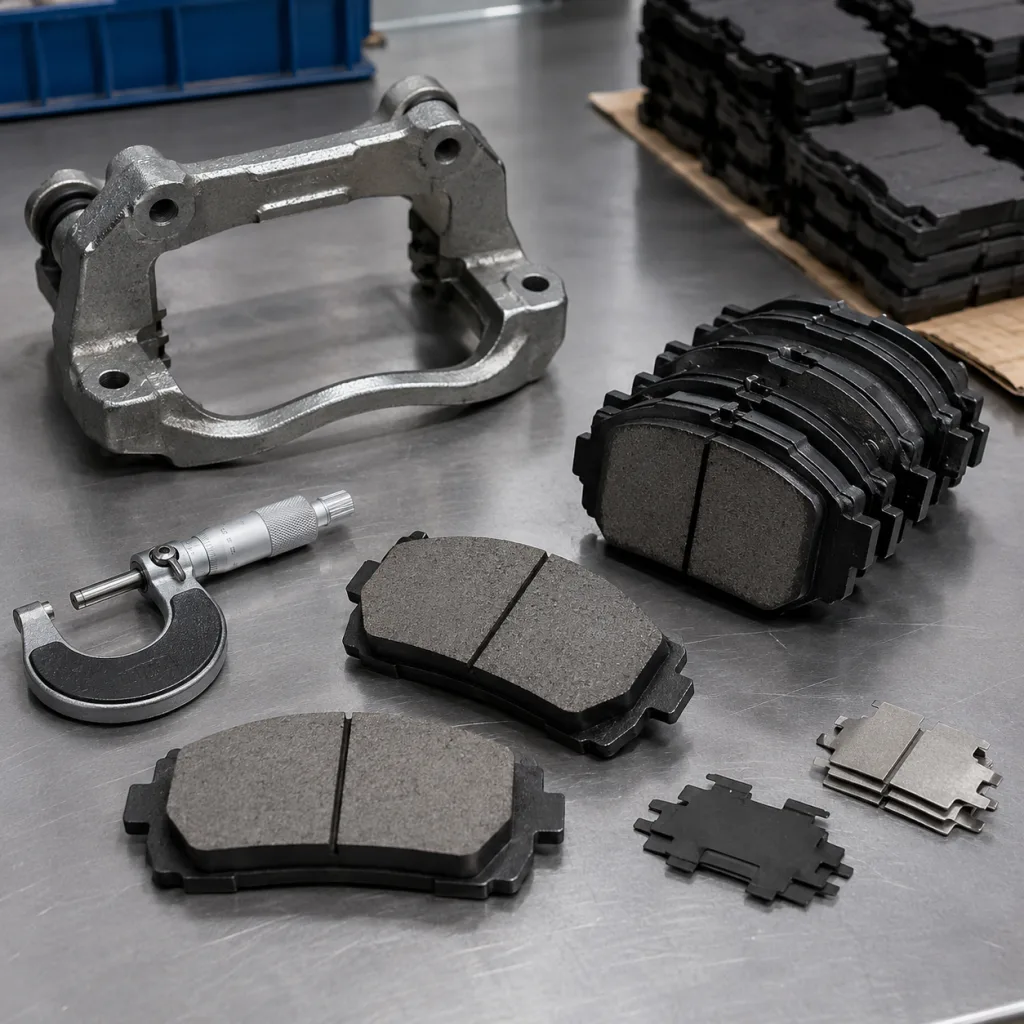
A complete BMW brake replacement programme usually covers more than pads and discs. Distributors often need coordinated front and rear axle coverage, wear sensors, pad accessory kits, caliper repair items and brake hydraulics. The right assortment depends on local vehicle parc, steering position, engine variant, brake package and production year.
Common B2B replacement lines include:
Brake discs: ventilated or solid construction, coated or uncoated finish, hub-centric fitment
Disc brake pads: low-metallic, semi-metallic or ceramic formulations matched to market expectations
Caliper repair kits: boots, seals, guide pins, retaining springs and related hardware
Brake hoses: crimp integrity, pressure resistance, correct end fittings and routing compatibility
Master cylinders and wheel cylinders where applicable to the target model range
A stronger programme also separates fast-moving service parts from slower, platform-specific references. This helps buyers protect availability on core applications while avoiding excess inventory on niche variants. Buyers can review broader brake and chassis coverage through our catalog. For private-label or fitment-gap projects, custom manufacturing can be used when buyers provide drawings, samples or validated cross-reference data.
Dimensional Match and OE-Equivalent Fit
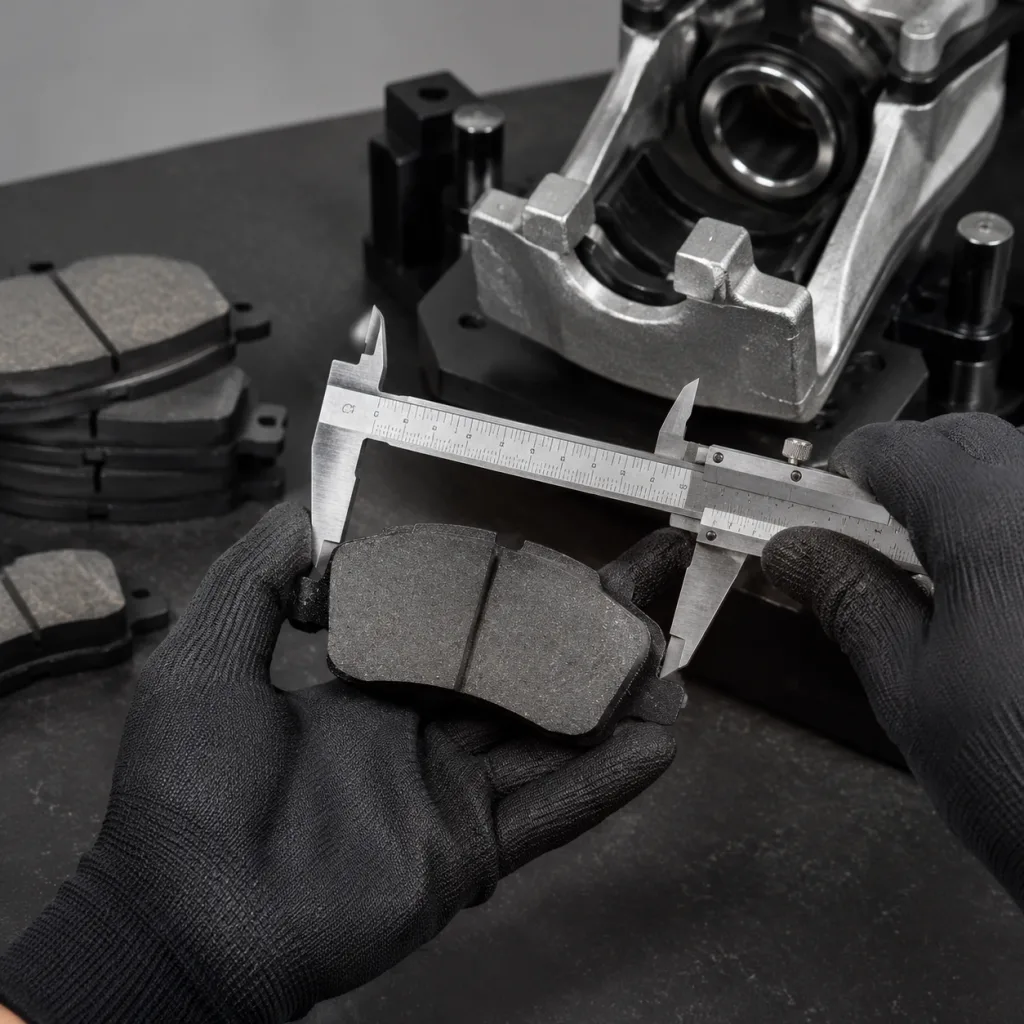
Brake parts are safety-critical, and fitment tolerance is narrow. For BMW brake replacement, catalogue cross-reference alone is not enough. Incoming samples should be checked against measured dimensions, hub interface, bolt pattern, pad backing-plate geometry, sensor slot location and caliper clearance.
Key dimensional checks for brake discs and pads:
Item
Typical Control Point
Why It Matters
Disc outer diameter
Drawing-controlled
Caliper and pad sweep alignment
Disc thickness
Drawing-controlled
Heat capacity and caliper piston position
Lateral runout
Tight production control
Pedal pulsation and uneven pad transfer
Hub bore
Application-specific
Centring accuracy and vibration control
Pad backing plate
Tooling-controlled
Caliper fit and noise risk
Chamfer and slot layout
Application-specific
NVH and bedding behaviour
</tr></thead><tbody> </tbody></table>For replacement programmes, a supplier should provide dimensional inspection records by batch rather than relying only on catalogue claims. The records should include first-article inspection, in-process checks and final sampling before packing. Buyers should also confirm critical tolerances on coating thickness, disc parallelism, balancing and sensor fit where the application requires it. Where OE part-number cross-references are used, they should be treated as fitment references only, not as evidence of approval by the vehicle manufacturer.
Material, Friction and Corrosion Requirements
A reliable brake replacement line must balance friction coefficient, wear rate, disc compatibility, dust level and noise behaviour. Market priorities differ. European buyers often focus on low noise, clean braking feel and applicable ECE requirements. North American distributors may give more weight to broad coverage, corrosion coating and predictable bedding. Brazilian and Australian buyers often need packaging and surface protection suitable for long shipping routes, port delays and mixed storage conditions.
Useful specification points include:
Disc metallurgy: grey cast iron grade, hardness range and microstructure control
Surface finish: consistent friction-face roughness to support controlled bedding-in
Coating: zinc-flake or equivalent anti-corrosion systems where required
Pad friction material: stable performance across normal service temperatures
Backing plate: accurate stamping, shear strength and anti-rust treatment
Shim system: rubber-coated, multilayer or mechanically retained design according to application
Adhesive and scorching process: controlled curing to reduce early fade, smoke and odour
Specifications should be clear enough to compare suppliers on measurable criteria, not just product descriptions. Published standards and regulations should also be referenced accurately. ECE R-90 applies to replacement brake linings and certain replacement brake discs and drums in relevant markets. SAE J2527 is widely used for brake dynamometer effectiveness and fade evaluation. SAE J2521 is used for disc brake squeal noise evaluation. REACH (EC) No 1907/2006 is relevant for restricted substances in materials supplied to the EU.
Validation Testing Buyers Should Request
For BMW brake replacement sourcing, validation should be documented before a distributor adds new SKUs. A supplier does not need to claim vehicle manufacturer endorsement to demonstrate technical control. It should provide test evidence linked to part families, materials, tooling and production batches.
Recommended validation package:
Dimensional report: full drawing comparison or sample reverse-engineering record
Material certificate: cast iron chemistry, hardness and microstructure for discs
Friction test summary: coefficient stability, fade and recovery data
Shear strength test: pad friction material bond integrity
Compressibility test: pedal feel and consistency indicator
Noise evaluation: dynamometer or road-based NVH screening where required
Salt spray or coating test: corrosion resistance for coated discs and backing plates
Packaging drop test: export carton and pallet durability for long-distance freight
Buyers should ask how often each test is repeated and how results are linked to shipment lots. One-time development reports are useful, but ongoing process control is what protects repeat orders. Driventus operates under IATF 16949:2016 and ISO 9001:2015 controls. Buyers can review our quality system when assessing supplier capability, traceability, inspection discipline and corrective-action management.
Commercial Sourcing Notes for Distributors
Brake parts have high SKU complexity. A distributor may need several hundred references to cover BMW applications by platform, engine, axle, brake package and production date. Before launch, procurement teams should define the target range by sales velocity, vehicle parc, competitive position and warehouse capacity.
Commercial items to confirm before purchase order release:
MOQ by SKU and by mixed container
Lead time for existing tooling versus new development
Private-label packaging artwork, barcode format and carton strength
Pallet height, gross weight and moisture protection for sea freight
Batch traceability on part, inner box and master carton
Warranty handling process and evidence required for claims
Cross-reference data format for ERP and TecDoc-style catalogue loading
Buyers should also decide whether to source complete matched axle sets or individual components. Axle kits can reduce installer error and improve order value, but they require accurate inclusion of sensors, accessories and installation notes. Individual SKUs offer flexibility and easier substitution, but they increase catalogue maintenance. For a balanced programme, high-moving brake pads and discs can be stocked locally, while slower references can be scheduled by forecast, seasonal demand or consolidated shipment.
How Driventus Supports Replacement Programmes
Driventus manufactures engine and powertrain components in Taizhou, Zhejiang, and supports B2B buyers with adjacent replacement-part sourcing programmes, including brake system components through controlled supply and quality processes. For brake system projects, our role is to help distributors and importers build a technically consistent aftermarket range with reliable documentation, packaging and export support.
Support can include sample matching, drawing review, inspection reporting, private-label packaging, consolidated shipment planning and corrective-action follow-up. For new projects, buyers should provide sample parts, target references, annual forecast, destination market and compliance requirements. If the project includes BMW brake replacement coverage, the specification should separate disc, pad, sensor and hardware requirements by axle and application.
Driventus is an independent aftermarket manufacturer; brand names are referenced for fitment only. We do not claim approval, endorsement or original equipment status from any vehicle manufacturer.
Frequently asked questions
Verify dimensions, application data, material reports, friction performance, corrosion protection, packaging strength and batch traceability. Cross-references should be checked against samples or drawings, not used as the only approval basis.
ECE R-90 is important for replacement linings and certain discs or drums in applicable markets. SAE J2527 and SAE J2521 are commonly used for performance and noise evaluation. REACH (EC) No 1907/2006 is relevant for EU material compliance.
Yes. Project support can include private-label packaging, barcode requirements, sample matching, inspection reporting and export documentation. MOQ, tooling status and lead time depend on the SKU range and destination market.
For brake system sourcing, send target references, samples or drawings and your destination market requirements. To discuss coverage and pricing, [request a quote](/contact.html).