brake pad · 2026-06-15

BMW Brake Pads Replacement: B2B Fitment and Validation

BMW brake pads replacement demand is shaped by broad parc coverage across 1 Series, 3 Series, 5 Series, X1, X3 and X5 applications, plus regional variation in brake packages and wear-sensor configurations. For distributors, importers and repair-chain buyers, the main sourcing risk is rarely friction material cost alone. It is the ability to hold accurate fitment, consistent pedal feel, low-noise performance and complete batch documentation across many front and rear axle SKUs. Driventus supplies independent aftermarket brake pads for B2B programmes where OE-equivalent geometry, tested friction behaviour and controlled packaging are central to the buying decision. This guide explains how procurement teams can specify replacement pads for BMW applications, what validation evidence to request, and how to review suppliers before adding SKUs to a regional range. Driventus is an independent aftermarket manufacturer; brand names are referenced for fitment only.

Replacement Intent: Fitment First, Friction Second

For BMW brake pads replacement programmes, application accuracy should come before formulation preference. A pad set may use a suitable friction compound and still fail in the field if the backing plate profile, abutment geometry, sensor slot position, chamfer layout or accessory kit does not match the target vehicle.

Procurement teams should define each replacement SKU by axle position, caliper type, wear-sensor requirement, electronic parking brake compatibility where relevant, and rotor diameter range. This discipline matters because BMW model names can cover multiple brake packages depending on engine, drivetrain, market, production year and trim level.

A complete sourcing file should include:

  • Vehicle application list by model, generation, year range, axle and drivetrain where applicable
  • OE part-number cross-reference format where available, such as OE 34… or OE 34 11… references supplied by the buyer
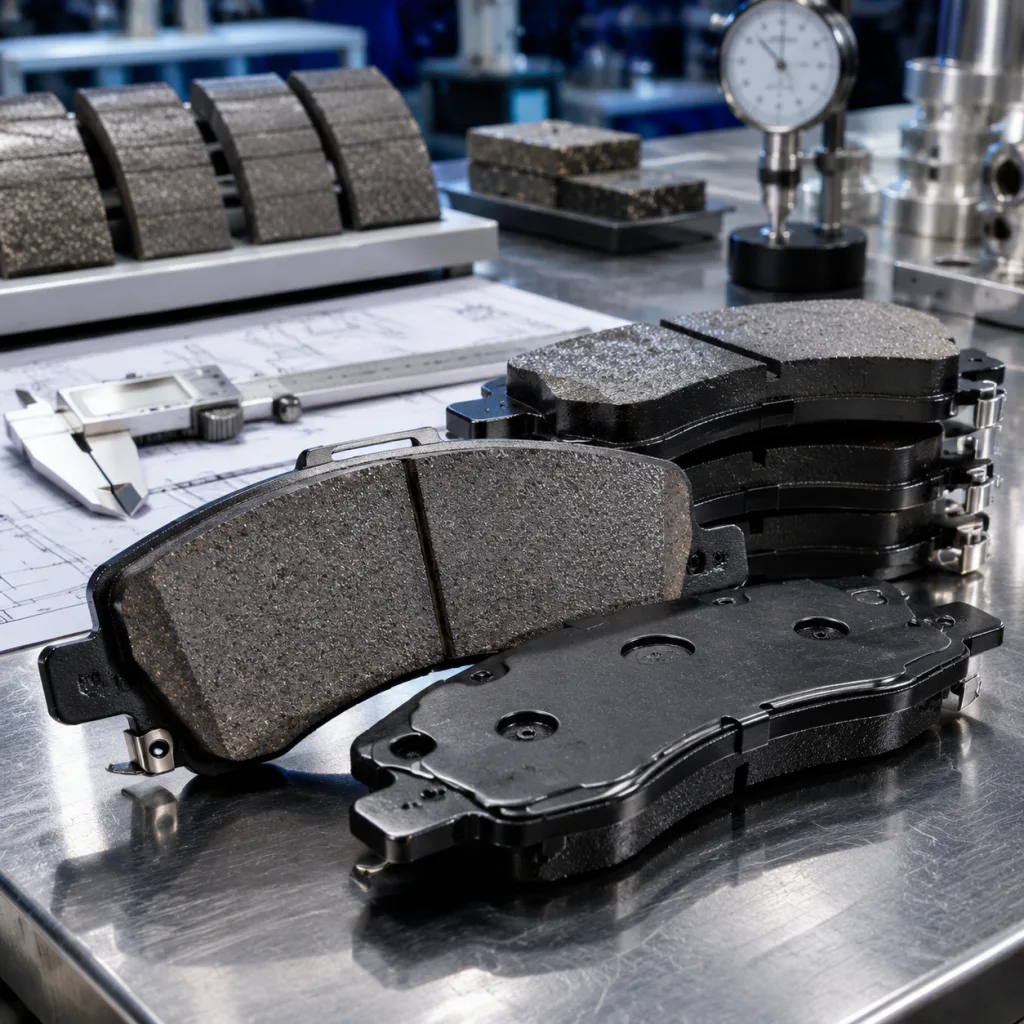
  • Pad outline drawing with backing plate length, width and thickness
  • Friction material thickness and total assembly thickness tolerance
  • Hardware content: clips, bolts, shims, wear sensor or sensor-ready pad design
  • Packaging configuration for wholesale, e-commerce fulfilment or repair-chain replenishment

Driventus can align pad sets with buyer-supplied application data and drawings through custom manufacturing when a distributor needs private-label coverage, market-specific accessory kits or controlled consolidation across similar applications.

Key Specifications Buyers Should Freeze Before RFQ

An RFQ for replacement pads should not rely on model names alone. BMW coverage can be fragmented by caliper supplier, performance package, production split and regional homologation. Freezing the specification before quotation reduces wrong-fit claims, avoids late tooling changes and gives the supplier a clear basis for validation.

</tr></thead><tbody> </tbody></table>For public product range review, buyers can start with our catalog, then submit target SKUs, expected annual volumes and required packaging format. For controlled procurement, Driventus recommends approving drawings, golden samples and inspection criteria before confirming production tooling or batch packaging.

Validation Testing for OE-Equivalent Replacement Pads

Replacement pads for BMW applications should be supported by repeatable test evidence, not visual comparison alone. The objective is OE-equivalent service behaviour for the intended aftermarket segment, without claiming vehicle manufacturer approval or endorsement.

Relevant validation references include SAE J2522 for dynamometer-based brake effectiveness evaluation and SAE J2527 for brake squeal noise procedures. ECE R90 is also relevant for replacement brake lining assemblies sold into regulated markets where conformity requirements apply. Environmental and material compliance may require screening against REACH (EC) No 1907/2006 for restricted substances, depending on destination market and customer specification.

Specification item Typical procurement requirement Why it matters
Backing plate outlineMatched to approved drawing or sampleControls caliper fit, abutment contact and pad movement
Total pad thicknessBuyer-defined tolerance, commonly controlled within tenths of a millimetrePrevents drag, installation refusal or premature wear warning
Friction code and formulationCeramic, low-metallic, semi-metallic or NAO by market needBalances dust, noise, fade resistance and rotor wear
Shim designRubber-coated, multilayer or bonded shimReduces NVH complaints and supports stable contact pressure
Chamfer and slot patternMatched to reference sample or engineering requestInfluences bedding, noise behaviour and edge durability
Wear sensor interfaceSensor included or sensor-ready slotRequired for many BMW front and rear applications
Accessory kitClips, bolts and installation hardware as specifiedSupports repair-chain installation consistency
Label dataSKU, batch, application and country-of-origin fieldsSupports traceability, warehouse handling and import review

</tr></thead><tbody> </tbody></table>Driventus operates under IATF 16949:2016 and ISO 9001:2015 frameworks. Buyers can review the quality system before supplier onboarding, including documentation control, incoming inspection, in-process checks and final inspection records.

Friction Material Choices by Market Requirement

The right formulation depends on customer expectations, rotor metallurgy, climate, vehicle weight and warranty policy. A pad designed for low dust in urban use may not be the best option for high-temperature driving, mountain routes or heavier fleet operation. Procurement teams should avoid selecting only by a headline coefficient of friction, because noise behaviour, compressibility, fade resistance and rotor wear also affect commercial success.

Common aftermarket formulation options

  • Ceramic formulations: commonly selected for low dust, stable noise behaviour and cleaner wheels. They are frequent choices in North American and Australian aftermarket programmes where comfort is prioritised.
  • Low-metallic formulations: used where initial bite, heat transfer and fade resistance are important. They can generate more dust or noise if shim, slot and chamfer design are not well controlled.
  • Semi-metallic formulations: suitable for heavier vehicles, performance-oriented applications or markets where temperature resistance is prioritised over dust reduction.
  • NAO formulations: used in comfort-led applications where low noise, moderate rotor wear and smooth pedal feel are key purchasing criteria.

BMW platforms include compact passenger cars, sedans, SUVs and higher-output variants, so one friction recipe should not be assumed across all axle loads. For X-series rear applications with electronic parking brake requirements, buyers should also confirm bedding characteristics, parking hold performance and compatibility with the intended hardware kit.

For multi-country programmes, Driventus can map formulation options against local buyer requirements, climate, warranty tolerance and price band. The final choice should be documented in the sourcing file so future reorder batches stay aligned with the approved specification.

Packaging, Traceability and Import Controls

Brake pad procurement is often won or lost after the technical sample is approved. Importers and wholesalers need packaging that survives freight, labels that scan correctly, and batch traceability that works across warehouse, branch and customer-service systems.

A practical B2B packaging specification should define:

  • Inner box size and crush resistance for dense pallet loading
  • Pad protection: paper wrap, plastic sleeve or formed tray by buyer requirement
  • Inclusion of installation leaflet, accessory bag and sensor where specified
  • Barcode type, SKU code, batch code and production date format
  • Carton quantity, pallet height and gross weight limit
  • Neutral, private-label or distributor-branded artwork approval process
  • Country-of-origin and compliance markings required by destination market

For repair chains, kitting accuracy is critical. A missing clip or wrong sensor can stop a service bay for 20–40 minutes and create a branch-level return, even when the pad itself is dimensionally correct. Driventus uses batch-level inspection and packing checks to reduce accessory omissions, with inspection criteria agreed during PPAP-style sample approval where requested by the buyer.

For regulated markets, import managers should confirm whether ECE R90 documentation is required for the specific destination and product category. Documentation requirements should be agreed before mass production, not added after shipment booking.

Supplier Review Checklist for BMW Brake Pad Programmes

A replacement pad supplier should be assessed on engineering discipline, process control, documentation quality and response speed. Price matters, but poor fitment data or unstable friction batches create higher downstream costs through warranty credits, stock quarantine, emergency resupply and customer-service workload.

Use this checklist before awarding a multi-SKU brake pad range:

  • Confirm IATF 16949:2016 and ISO 9001:2015 certification scope and expiry dates
  • Request drawings or measured sample reports for each high-volume SKU
  • Review friction material test evidence and batch control method
  • Confirm ECE R90 status where the destination market requires it
  • Check REACH (EC) No 1907/2006 declaration process for EU and UK programmes
  • Approve accessory kit content with photographs and part-level packing list
  • Define AQL, first-article inspection and retention-sample requirements
  • Agree lead time, MOQ, reorder schedule and private-label artwork process
  • Validate carton drop protection and pallet loading for sea freight
  • Set corrective-action response time for wrong-fit, noise or accessory claims

For BMW brake pads replacement sourcing, the strongest RFQ packages include application data, expected annual quantity, target market, formulation preference, documentation requirements and warranty return thresholds. This gives the factory enough information to quote accurately and select the correct friction, hardware and packaging configuration.

Driventus is an independent aftermarket manufacturer; brand names are referenced for fitment only. For SKU review, sample matching or a private-label range, buyers can request a quote.

Frequently asked questions

Yes. Driventus can review buyer-supplied application lists for common BMW passenger car and SUV platforms, then match pad geometry, wear-sensor requirements, hardware kits and packaging. Availability depends on target SKUs, annual volume, certification needs and destination market documentation.

Buyers should request dimensional reports, friction performance data, noise evaluation where available, shear strength results, material compliance declarations and packaging inspection records. For regulated markets, confirm whether ECE R90 documentation applies before production.

No. Driventus does not claim approval or endorsement by any vehicle manufacturer. Driventus is an independent aftermarket manufacturer; brand names are referenced for fitment only. Parts are specified for aftermarket replacement programmes using buyer-approved fitment and validation criteria.

Share your target BMW brake pad SKUs, destination market and annual volume for a technical sourcing review. Start the discussion at /contact.html

Request a Quote
Test or control point Typical evidence requested Procurement value
Dynamometer performanceFriction stability, fade and recovery dataConfirms braking consistency across temperature cycles
Noise evaluationSAE J2527-style squeal assessment or internal NVH reportReduces warranty returns from repair chains
Shear strengthBond integrity result for friction material to backing plateSupports safety margin during high-load use
CompressibilityBatch result against buyer limitControls pedal feel and bedding behaviour
Dimensional inspectionFirst-article and batch inspection reportConfirms fitment against approved drawings
Corrosion resistanceSalt-spray or coating evaluation by specificationProtects inventory during transport and storage
Material complianceREACH declaration where requiredSupports EU and UK import documentation