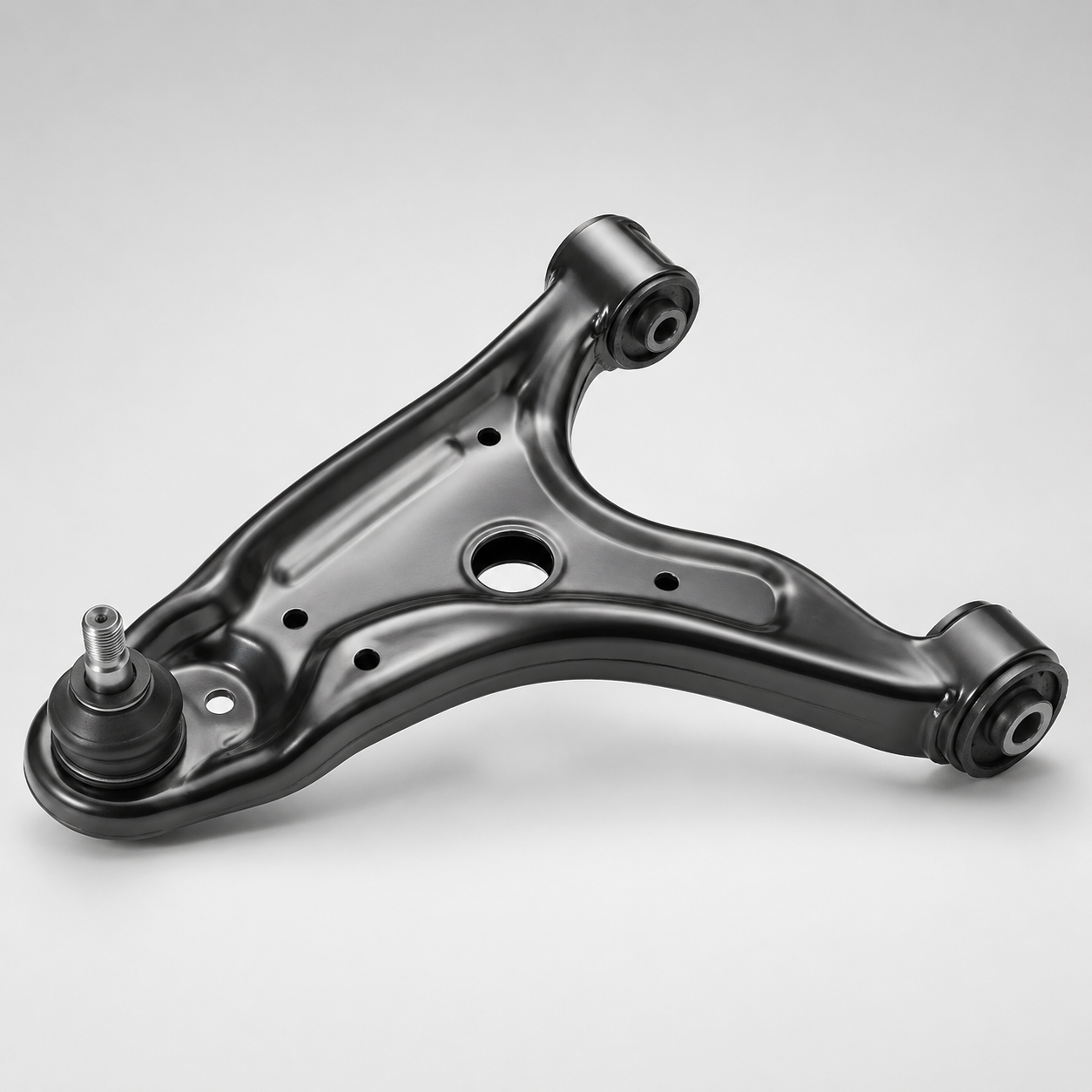
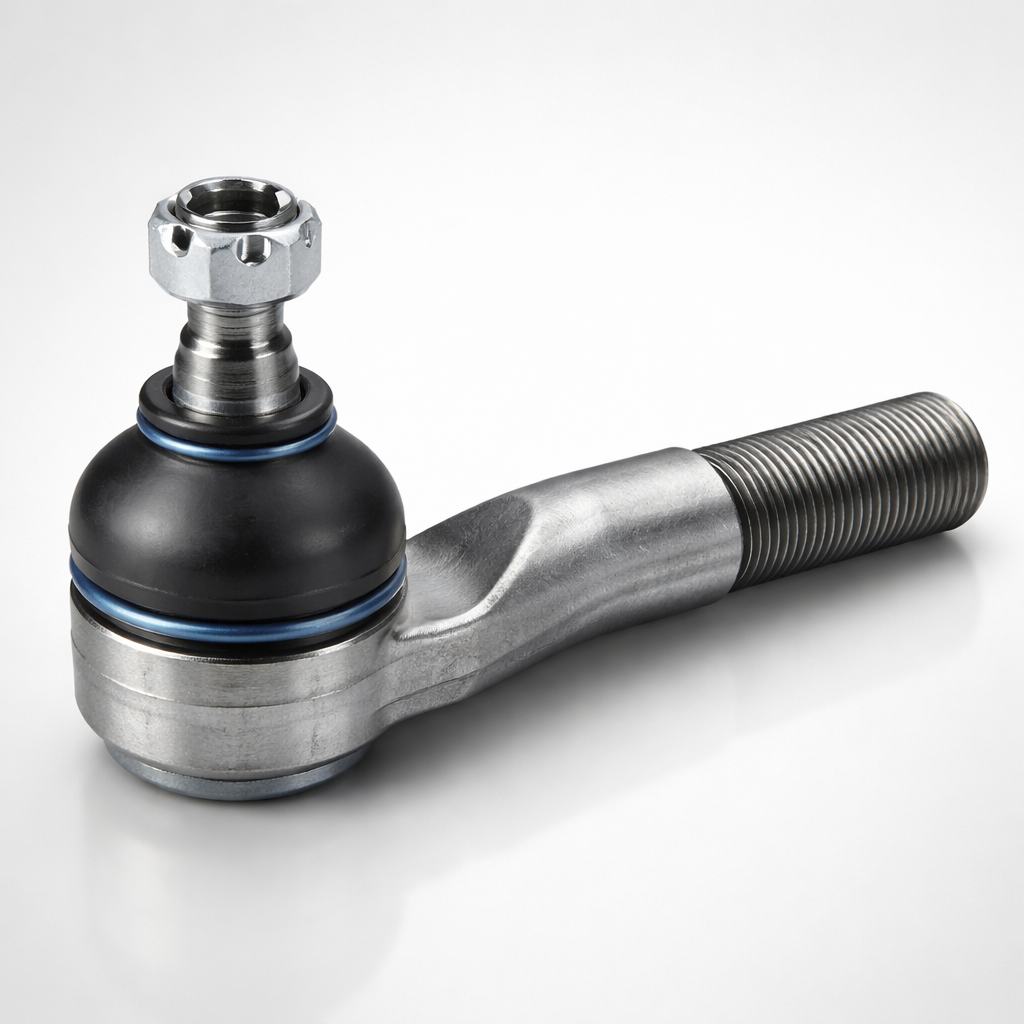
Arm control replacement is a category where small errors create expensive downstream problems. A few tenths of a millimetre in the wrong place can turn into difficult installation, steering pull, early bushing failure, or repeat workshop claims.
That is why this purchase decision should not start with unit price. It should start with risk: which features can fail in the field, which checks prove OE-level fit, and which supplier controls keep the approved sample from drifting in later batches.
For procurement teams, a practical review usually comes down to six questions: Does the geometry match? Are the bushings and ball joints built to the right spec? Is the material route appropriate for the application? Is there current validation data? Can the supplier repeat the result at production scale? And does the quotation clearly define what is actually included?
This article approaches arm control replacement from that angle rather than as a generic checklist. It breaks the decision into approval criteria, common failure modes, material trade-offs, test evidence, and repeat-order controls that matter to distributors, repair chains, and private-label programmes. Driventus is an independent aftermarket manufacturer; brand names are referenced for fitment only.
Start with the failure modes, not the sample photo
A visually similar part can still be wrong in the ways that matter most. With arm control replacement, buyers should begin by asking what could go wrong after installation, then work backward to the features that prevent it.
The main approval points are usually these:
Mounting geometry: centre-to-centre distances, ball joint stud position, bushing sleeve orientation, bracket offset, and left/right symmetry where mirrored parts are used
Material route: forged steel, cast steel, cast aluminium, or stamped steel selected for the application load, weight target, and corrosion environment
Bushing specification: rubber hardness, void pattern, bond integrity, sleeve concentricity, and compression-set behaviour
Corrosion protection: e-coat, phosphate, zinc flake, or powder-coat systems with defined film-thickness windows
Traceability: batch code, cavity or line identification, inspection records, retained samples, and link to sub-supplier material lots
The commercial risk is rarely the first sample. It is lot-to-lot variation. A part that passes first-article review and then drifts three orders later can cost far more than any initial price saving. That is why documented process control matters as much as the drawing itself. A structured quality system aligned to IATF 16949:2016 and ISO 9001:2015 helps because it supports control plans, nonconformance handling, and corrective action.
Before approval, technical review should also be translated into clear commercial terms:
Pilot sample quantity: often 3-10 pcs per SKU for dimensional and installation review
Trial order MOQ: commonly 50-200 pcs for stocked aftermarket references when tooling already exists
Mass-order MOQ: commonly 200-500 pcs per SKU, or mixed-container programmes based on carton multiples
Lead time logic: 30-45 days for repeat orders with existing tooling and packaging; 45-70 days when new labels, cartons, or validation are involved
Price logic: unit price should reflect material route, included hardware, coating type, annual volume band, and packaging spec
A usable quotation should make scope explicit: arm assembly only, or assembly plus nut, pinch bolt, grease fitting, barcode label, inner bag, export carton, and pallet configuration. Without that detail, supplier comparisons become unreliable.
Which OE-fit errors create claims fastest?
Not every dimensional miss causes the same damage. Some issues show up at installation. Others pass the workshop and return later as noise, alignment complaints, or shortened service life. For arm control replacement, buyers should focus on the dimensions that move vehicle geometry or overload the elastomer and joint system.
Check point
Typical buyer concern
Why it matters in service
Pivot bore centre distance
Hole spacing outside drawing tolerance, often more than ±0.30 mm to ±0.50 mm depending on platform
Causes fit-up difficulty and alignment deviation
Ball joint stud taper
Taper mismatch with mating knuckle, for example 1:8 or 1:10 seat mismatch
Leads to poor seating or unsafe retention
Bushing axis angle
Sleeve clocking error above agreed limit, often controlled within ±1°
Introduces preload and early rubber tearing
Bracket thickness
Stack-up variation at mounting point, often held within ±0.20 mm
Affects clamp load and installation torque response
Joint articulation torque
Too high or too low versus approved window, such as 0.8-2.5 N·m depending on design
Changes steering feel and accelerates wear
Protective coating thickness
Uneven or insufficient coverage, commonly controlled around 15-30 μm for e-coat systems
Reduces salt-spray durability
</tr></thead><tbody> </tbody></table>A strong sourcing review checks these at assembly level, not only on separate components. Installed position affects camber, caster, toe behaviour, and NVH. Small errors can have visible field consequences.
In a PPAP-style review, what should be controlled?
Even when a formal Production Part Approval Process is not contractually required, many importers still ask for equivalent records:
Key-characteristic balloon drawings with nominal dimensions and tolerance bands
Material certificates for arm body, sleeves, studs, and welded brackets
Hardness and tensile records where applicable
Rubber-to-metal bond test data and bushing hardness readings in the specified Shore A range
Coating thickness and corrosion test reports, often targeting 240-480 hours neutral salt spray depending on market position
End-of-line inspection criteria, AQL level, and sampling plan for routine release
These records are especially useful when extending our catalog for private-label or regional distributor programmes.
From a control-method standpoint, buyers should also ask how each feature is checked:
Centre distance: CMM, dedicated fixture, or go/no-go gauge
Bushing clocking: fixture with angular reference pins
Stud taper and thread: ring gauge, taper gauge, and thread gauge
Press-fit depth: digital depth gauge with workstation limits
Final appearance: 100% visual check for coating voids, boot cuts, and wrong hardware
For higher-risk references, some buyers also request capability data on special characteristics such as pivot spacing, taper seat position, and bushing press depth, with Cpk ≥ 1.33 as a common post-stabilisation target.
Choose the construction by use case, not habit
Different arm constructions solve different problems. The right choice depends on duty cycle, vehicle segment, market position, and how much risk the programme can absorb.
Construction type
Common application
Main advantages
Main controls required
Stamped steel welded assembly
Passenger vehicles, high-volume lines
Competitive cost, mature process, easier MOQ for broad ranges
Casting integrity, heat treatment, bushing press-fit control
</tr></thead><tbody> </tbody></table>This is where many sourcing programmes become too generic. A stamped steel welded arm may be the best commercial answer for a broad passenger-car range. A forged steel arm may be the safer answer where impact resistance matters more than piece price. A cast aluminium arm may support a weight-sensitive application, but only if the supplier can hold tighter process discipline around casting integrity and press fits.
Validation priorities should also match actual use:
Winter-road markets usually place more weight on corrosion resistance
Poor-road or fleet use tends to prioritise fatigue strength and bushing durability
Mid-range private-label programmes often need the best balance between landed cost and claim exposure
Published compliance requests can apply indirectly. Chemical compliance enquiries commonly refer to REACH (EC) No 1907/2006 for substances of very high concern. Buyers may also request declarations covering coating and elastomer materials from the upstream supply chain.
For platform-specific needs, custom manufacturing may include drawing review, hardness adjustment, coating selection, package design, and barcode configuration.
Commercially, the material route should be approved with the same discipline as the technical spec:
Stamped steel welded arms: usually most competitive at scale, but fixture drift and weld variation can create geometry claims if controls are weak
Forged steel arms: higher machining cost, but often preferred for severe-duty applications
Cast aluminium arms: significant weight advantage, but typically tighter process control, higher scrap sensitivity, and potentially higher MOQ
A buyer-ready comparison sheet should confirm at least the following:
Commercial item
What to confirm
MOQ
Per SKU, per mixed order, and per pallet or container programme
Unit price break
Example bands such as 100 pcs, 300 pcs, 500 pcs, and 1,000 pcs
Tooling status
Existing, modified, or new tooling with ownership terms
Validation cost
Included in unit price or charged separately for new references
Lead time
Sample lead time, first order lead time, and repeat order lead time
Packaging cost
Included standard export pack or separate private-label packaging charge
</tr></thead><tbody> </tbody></table>That comparison matters because the lowest quoted unit price is often not the lowest total sourcing cost once validation, relabelling, mixed-SKU MOQ, and warranty exposure are included.
Ask for proof that survives a warranty review
For arm control replacement, “tested” is not enough. Buyers need to know what was tested, how many samples were used, whether the parts came from pilot build or production lots, and what pass criteria were applied.
A practical validation file may include:
Dimensional inspection: CMM or fixture-based checks on critical mounting points, commonly 3-5 pcs for pilot review and periodic audit thereafter
Ball joint tests: pull-out force, rotational torque, axial play, and radial play, with before/after durability comparison
Bushing tests: hardness, bond strength, compression set, and durability cycling
Coating checks: film thickness, adhesion, and neutral salt spray exposure
Road simulation or rig testing: repeated load cycles representing service conditions, especially for severe-use references
This evidence helps reduce three common claim sources:
1. Installation interference caused by geometry drift 2. Premature noise linked to low-grade bushing compounds 3. Joint looseness caused by inconsistent stud and seat machining
In many EU procurement environments, the expectation extends beyond the individual test result. Teams also look for a documentation mindset: dated reports, sample IDs, lot traceability, and repeatable technical files. While ECE R-83 relates to emissions rather than suspension parts, buyers often expect a similar level of record discipline across supplied components.
The useful questions are specific:
How many samples were tested from each lot?
Were the samples taken from pilot build, mass production, or retained stock?
What were the acceptance limits for articulation torque, radial play, and pull-out force?
Was salt spray performed on coated assemblies or only on separate coupons?
Were fatigue or durability tests run to a target such as 100,000-300,000 cycles depending on application?
If a supplier cannot answer with current reports and identifiable sample records, the commercial risk usually moves back to the importer.
How to make repeat orders less unpredictable
The first shipment proves a supplier can make the part once. The repeat order proves whether they can control it.
A structured sourcing questionnaire helps expose repeat-order risk early:
What are the controlled critical dimensions and their tolerance bands?
Which subcomponents are made in-house and which are outsourced?
Is there batch traceability for bushings, ball joints, and coatings?
What is the reaction plan when a lot fails audit inspection?
How are packaging and dunnage designed to prevent boot damage and coating abrasion?
Can the supplier support barcode, label, and carton changes for distributor programmes?
Packaging deserves more attention than it usually gets. A technically acceptable arm control replacement part can still arrive with torn dust boots, chipped coating, or mixed left/right assemblies if carton design and internal protection are weak.
Driventus supports aftermarket replacement programmes across multiple component categories and can align technical review, inspection points, and private-label requirements with customer sourcing needs. Buyers can review our catalog for wider range planning, and drawing-based or packaging adjustments are typically handled through custom manufacturing.
To make repeat orders more predictable, define the operating rules before the PO is released:
MOQ policy: whether mixed references are accepted in one order, and what minimum applies per SKU versus per shipment
Price validity: whether quoted pricing is fixed for 30, 60, or 90 days and how steel, aluminium, or rubber cost changes are handled
Lead-time trigger: whether production lead time starts from PO date, deposit receipt, artwork approval, or sample sign-off
Inspection rule: whether pre-shipment inspection is buyer-managed, supplier self-release, or third-party audited
Claim handling: target response time for 8D report, sorting action, replacement parts, and debit-note review
Packaging specification: units per inner box, carton gross weight limit, pallet pattern, and labelling format including barcode symbology
A practical repeat-order flow often looks like this:
1. Buyer confirms drawing or approved sample status for the SKU 2. Supplier issues quotation with MOQ, packaging, and lead-time assumptions 3. Buyer releases PO and artwork or label approval if private label applies 4. Supplier submits pilot or pre-shipment inspection records for agreed control items 5. Goods are released against approved packaging and traceability marks
That level of process discipline becomes more important when one supplier is handling several part families under a distributor programme, because it reduces avoidable errors in labels, carton mix, and version control.
Frequently asked questions
Ask for dimensional reports, material certificates, rubber hardness data, bond test results, coating reports, fitment cross-references, and batch traceability records. If available, request PPAP-style documentation, CMM results for key characteristics, salt-spray reports, and recent validation data from pilot or mass-production lots. A usable supplier file should also clarify MOQ, packaging specification, and lead-time assumptions for the quoted SKU.
Use drawing comparison, installation geometry checks, sample inspection, articulation testing, and field feedback data. OE-equivalence in the aftermarket is demonstrated by measurable fit, function, and durability rather than vehicle manufacturer endorsement. In practice, buyers should compare nominal dimensions, tolerance bands, bushing hardness, taper specification, and test results instead of relying on appearance alone.
Control arms include exposed coatings, ball joint boots, and machined interfaces. Poor internal carton support can cause abrasion, boot damage, and mixed-part errors during transport, increasing return rates even when production quality is otherwise acceptable. Buyers should confirm unit orientation, partition or sleeve protection, carton quantity, pallet stability, and barcode labelling before approving repeat shipments.
If you are reviewing sourcing options for suspension and steering hard parts, Driventus can provide technical data, sample support, and programme discussion. To discuss your requirements, please [request a quote](/contact.html).