White Smoke From Exhaust: Exhaust Manifold Gasket Checks
White smoke from the exhaust can point to several faults, but an exhaust manifold gasket should be checked early when the smoke appears after a repair, cold start, or load change. A leaking gasket can allow combustion gases to escape at the manifold joint, create a ticking noise, and distort local heat patterns around the head and manifold. It does not usually create coolant steam by itself, so the technician should separate smoke colour, odour, temperature, and operating conditions before replacing parts. For procurement teams and workshop buyers, the key is to match the gasket material, port geometry, and thickness to the engine family, then confirm fitment with OE cross-reference data such as OE 06A107065 where applicable. Driventus is an independent aftermarket manufacturer; brand names are referenced for fitment only. Our parts are produced under IATF 16949:2016 and ISO 9001:2015 systems, with export supply for multi-market repair and distribution channels.
What white smoke usually means
White smoke is commonly associated with coolant entering the combustion chamber, but it can also be temporary condensation on cold start. Before blaming the exhaust manifold gasket, check the operating pattern.
Symptom
More likely cause
Typical clue
Thin white vapour for 1–3 minutes
Condensation
Disappears as exhaust warms
Persistent sweet-smelling white smoke
Coolant intrusion
Coolant loss, misfire, pressure in cooling system
Smoke after manifold work
Leak at joint or adjacent seal
Noise, sooty tracks, hot gas smell
White haze under load only
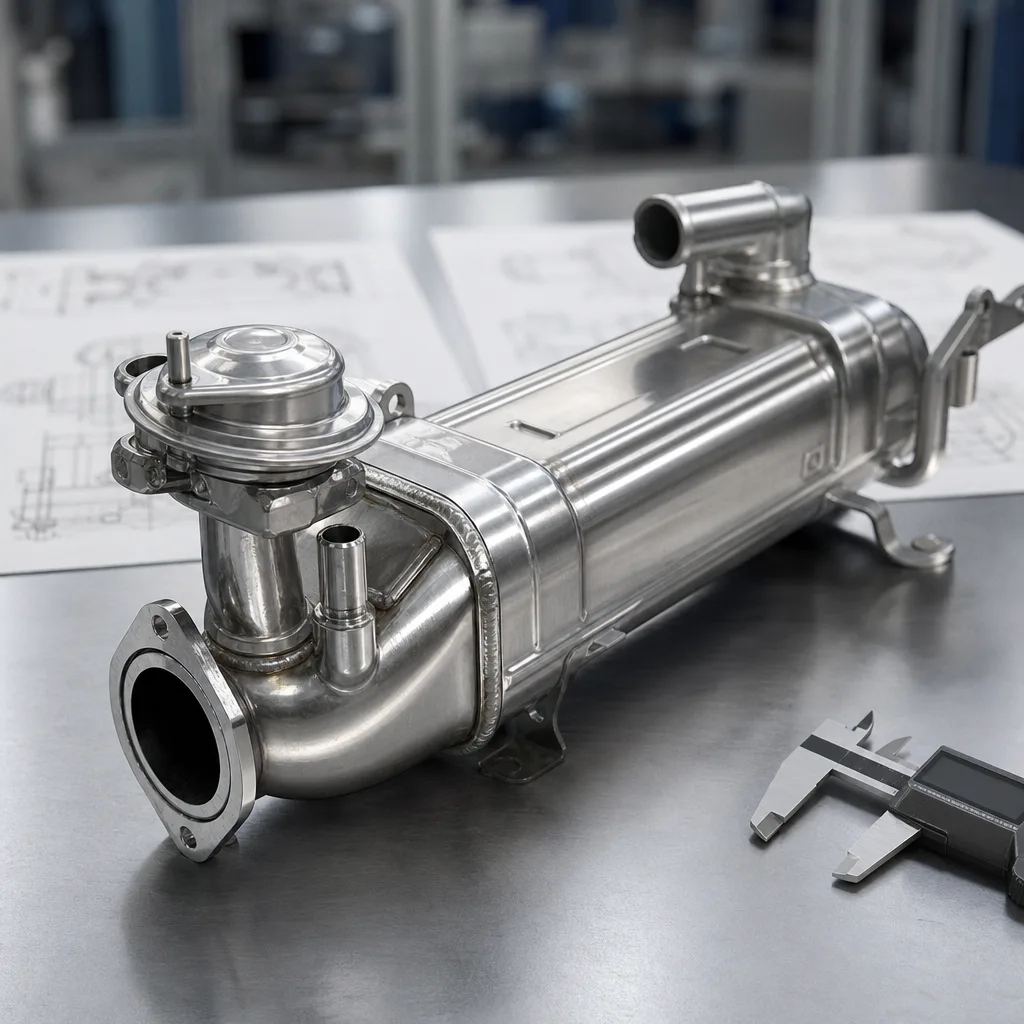
Turbo, head gasket, or EGR-related fault
Load-sensitive, repeatable
</tr></thead><tbody> </tbody></table>An exhaust manifold gasket fault usually shows as escaping exhaust gas, not coolant steam. In diagnosis, separate the exhaust path from the cooling circuit. If coolant is present, inspect the cylinder head, intake manifold, EGR cooler, turbocharger seals, and adjacent hoses before ordering a gasket alone.
How an exhaust manifold gasket can affect symptoms
A damaged or poorly seated gasket can create a leak path between the cylinder head and manifold. That leak can change backpressure, raise local temperatures, and trigger noises that are sometimes mistaken for engine misfire or smoke-related issues.
Common gasket-related signs
Ticking or puffing noise during cold start or acceleration
Soot streaks around the manifold flange
Burn marks near the head or heat shield
Exhaust smell in the engine bay
Oxygen sensor readings that do not stabilise quickly
The gasket itself does not create white smoke in the tailpipe. However, if the leak is near a turbocharger or adjacent pipework, it can alter airflow and make another problem more visible. On diesel applications, a leak may also affect aftertreatment performance and increase visible plume under certain ambient conditions.
Inspection steps before replacement
Use a structured inspection to avoid unnecessary returns and rework.
1. Confirm the smoke colour in daylight. True white vapour disperses quickly; blue or grey smoke lingers. 2. Check coolant level after the engine cools. Record any loss over several drive cycles. 3. Inspect the manifold flange, studs, and heat shields for soot or looseness. 4. Listen for a ticking sound from the manifold area during cold start. 5. Review recent work. Head machining, manifold resurfacing, or reused fasteners can cause sealing failure. 6. Compare the old gasket to the replacement. Verify port count, bead profile, thickness, and locator features.
If the engine uses an OE reference such as OE 06A107065, cross-check the engine code, model year, and emissions package before ordering. Fitment mistakes are common when multiple exhaust or cylinder head variants share similar layouts.
Replacement criteria that matter to procurement teams
For a reliable replacement program, the gasket specification should match the engine family, service environment, and installation method.
Item
What to verify
Material
Multi-layer steel, graphite, metal-cored composite, or embossed steel as specified
Thickness
Match compression height and flange condition
Port geometry
Round, oval, rectangular, or multi-port alignment
Seal coating
Suitable for thermal cycling and surface finish
Temperature resistance
Confirm material suitability for exhaust service
Fastener interface
New studs/nuts where required by service procedure
Packaging
Traceability label, batch code, and part marking
</tr></thead><tbody> </tbody></table>For buyers in aftermarket distribution, the lowest landed cost is not useful if the seal fails after installation. A correct gasket should survive thermal cycling, vibration, and flange movement without combustion gas leakage. Driventus validates exhaust sealing components through dimensional inspection and fitment checks aligned with IATF 16949:2016 and ISO 9001:2015 controls.
Standards, validation, and compliance checks
Exhaust manifold gasket supply for export markets should be documented against recognised quality and material controls. For procurement review, ask for:
IATF 16949:2016 and ISO 9001:2015 certification status
Material declarations for REACH (EC) No 1907/2006 where applicable
Dimensional inspection reports and batch traceability
Salt spray or corrosion-related evidence when coatings are used
Thermal cycling or bench validation data from the supplier
When the application is sensitive to emissions performance, the gasket should not interfere with the sealing integrity required by the engine’s exhaust system design. In some programmes, related testing may reference ECE R-83 for vehicle emissions context or SAE J2527 for durability-type evaluation, but the gasket supplier should clearly state what was tested and under which conditions. Do not accept vague claims without test method, sample count, and acceptance criteria.
Sourcing guidance for aftermarket and OEM programs
For aftermarket distributors, repair chains, and Tier-1 supply support, the main sourcing risks are catalog mismatch, inconsistent thickness, and poor batch control. Buyers should align technical and commercial requirements before purchase.
Request OE cross-reference mapping for each engine application
Confirm country coverage and packing format for your warehouse system
Ask for sample approval before container orders
Verify whether a custom flange material or coating is required for a specific programme
Keep a controlled supersession list to prevent mixed inventory
If you need a production quote, use request a quote with the engine code, OE reference, sample images, and target annual volume.
Frequently asked questions
Usually not by itself. It more often causes exhaust leakage, ticking noise, and soot marks. White smoke is more commonly coolant vapour or condensation, so other systems should be checked first.
Confirm smoke colour, inspect coolant loss, check flange flatness, examine studs and heat shields, and compare the old gasket to the new one for port count, thickness, and locator features.
Use engine code, build year, OE reference, and gasket dimensions together. For shared platforms, verify the exact manifold and cylinder head variant before placing a bulk order.
If you are matching an exhaust seal for a specific engine family or need a verified cross-reference, send the OE number and sample details through /contact.html.