Wheel Bearing Repair Cost: What Buyers Should Expect
Wheel bearing repair cost is rarely just the price of a bearing. For procurement teams supporting repair networks, fleet maintenance operations, or aftermarket programmes, the real number is shaped by labour time, fit accuracy, warranty exposure, inventory strategy, and the risk of repeat work. A small passenger car with a press-in bearing behaves very differently from a van, pickup, or SUV using a complete hub unit.
This article breaks the topic into the questions buyers actually face: what a normal repair should cost, where invoices blow out, when a cheaper part becomes more expensive in the field, and how to compare quotations without missing hidden cost. Driventus is an independent aftermarket manufacturer; brand names are referenced for fitment only.
Start with the repair path: the fastest way to estimate wheel bearing repair cost
The cleanest way to estimate wheel bearing repair cost is not by brand or vehicle badge first. Start with the repair architecture. That usually tells you more about the invoice than the model name does.
Repair scenario
Typical parts scope
Typical labour time
Indicative total cost*
Press-in bearing only
Bearing, circlip, seals where required
1.5-3.0 hours
USD 180-450
Hub assembly replacement
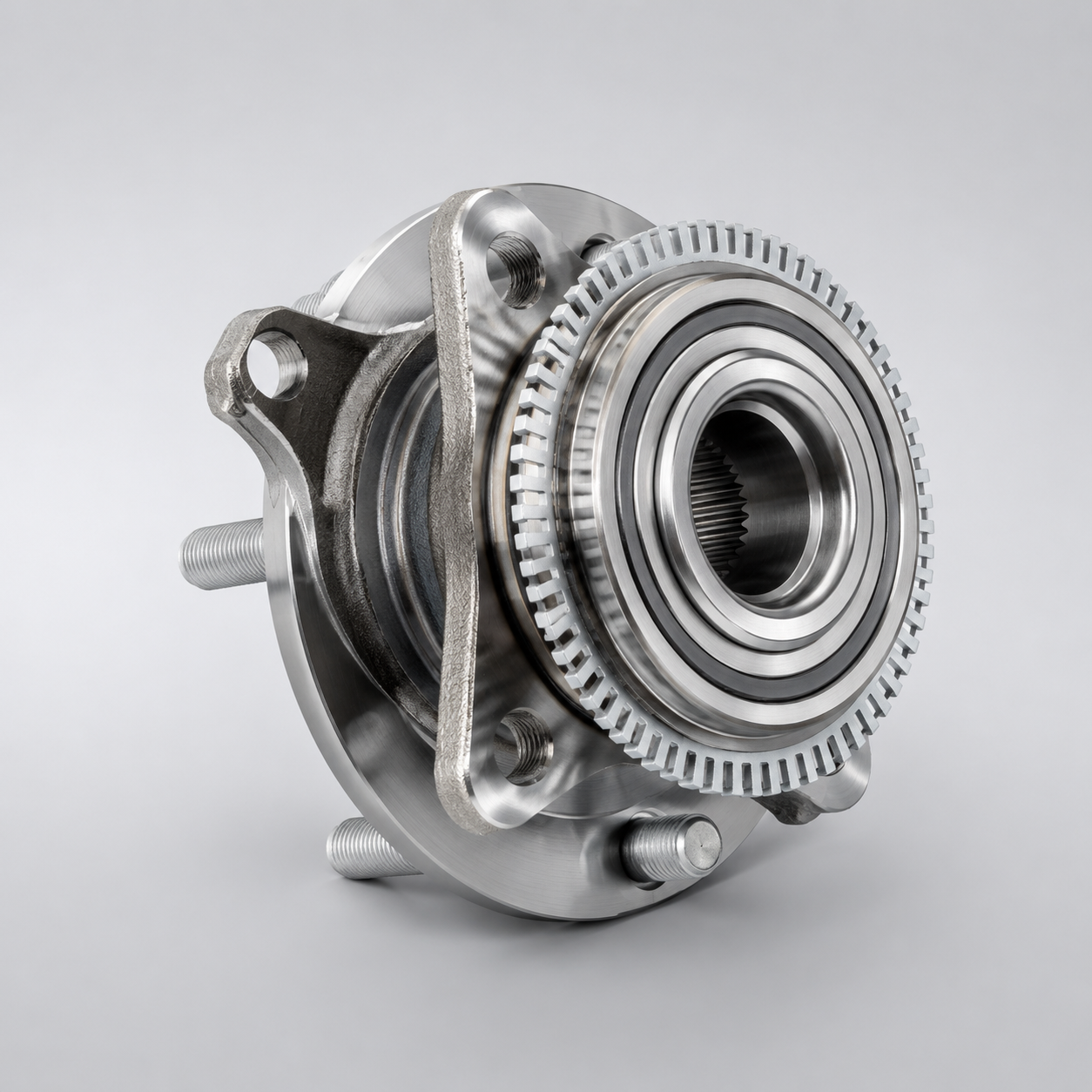
Pre-assembled hub with bearing and sensor ring where applicable
0.8-2.0 hours
USD 220-520
Heavy SUV / pickup hub unit
Larger hub, higher load rating, possible 4WD integration
1.0-2.5 hours
USD 280-650
Seized or damaged knuckle case
Bearing or hub plus related hardware and extra removal time
2.5-4.5 hours
USD 350-900
</tr></thead><tbody> </tbody></table>Why this matters: the same bearing failure can create very different workshop economics.
A hub-unit replacement often looks expensive on part price but saves time in the bay. A press-in bearing may be cheaper to buy, yet cost more to install once knuckle removal, pressing, cleaning, and race extraction are included.
For budgeting, most installed repairs break into three layers:
part cost
labour cost
risk allowance
In many independent workshops, labour rates of USD 70-160 per hour are common. Dealer or metro-market rates can run above USD 180-240 per hour. So a one-hour change in actual repair time can shift wheel bearing repair cost by USD 70-240 before extra hardware or diagnostics are added.
Typical aftermarket part-price bands are equally broad because the wheel end may be sold at different completion levels:
Gen 1 press-in bearing: commonly USD 12-45 ex-works, USD 25-90 wholesale landed, and USD 40-140 fitted-part retail equivalent, depending on size, seal design, and origin.
Gen 2/3 hub unit for passenger car: often USD 28-85 ex-works and USD 60-180 wholesale/garage supply.
SUV, van, or pickup hub unit: often USD 45-140 ex-works and USD 90-260 wholesale/garage supply, especially where integrated encoder rings, larger flange thickness, or higher bolt strength are required.
Associated hardware kit: axle nut, snap ring, bolts, dust cap, and seals can add USD 8-35 per job.
A practical budgeting rule: the part itself often represents only 20-45% of the final invoice. The rest is labour and complication risk.
In older fleets and salt-belt markets, many operators add a 10-20% contingency because “simple” wheel bearing jobs stop being simple when hubs seize, bores wear, or ABS parts are damaged during removal.
\*Indicative ranges reflect mixed workshop data across North America, the UK, the EU, and Australia. Taxes, alignment charges, and regional labour differences are excluded unless specifically included by the workshop.
Where invoices go wrong: the failure modes that push costs up
Buyers often ask why one quotation is reasonable and another is far higher for what appears to be the same repair. Usually, the gap comes from failure mode, not markup.
Main cost factors
Bearing design: Tapered roller, double-row angular contact, and Gen 1/2/3 hub-bearing units all carry different manufacturing and installation costs.
Vehicle platform: Compact passenger cars usually use lower-cost assemblies than vans, SUVs, and light trucks.
Workshop method: Press-in repairs require the right tooling, adapters, and technician skill. Hub units usually install faster but may cost more per unit.
Corrosion and disassembly risk: In road-salt markets, seized fasteners and stuck hubs regularly add labour time.
Related components: Snap rings, axle nuts, wheel speed sensors, seals, and one-time-use bolts may need replacement at the same time.
Post-repair operations: Torque verification, sensor checks, fault-code clearing, and wheel alignment can all affect the final invoice.
The biggest swing factor is often whether the job stays a standard bearing replacement or turns into a recovery job.
For example, a standard front hub unit on a passenger platform may need only 0.8-1.2 labour hours in clean conditions. A pressed bearing in an aluminium or cast-iron knuckle may need 1.8-3.0 hours once the technician removes the knuckle, presses out the old bearing, cleans the housing, checks the bore, and reassembles correctly. If the inner race remains stuck on the hub shaft, another 0.2-0.5 hours is common.
Three cost triggers are repeatedly underestimated:
1. Interference fit condition: Typical bearing outer-ring press fits are roughly 0.01-0.05 mm depending on application. If the bore is distorted or worn, removal becomes harder, installation becomes less predictable, and scrap risk rises. 2. Single-use hardware: Many axle nuts and flange bolts are torque-to-yield. Reusing them may save only USD 2-10, but the risk of preload error, looseness, or future noise is much larger than the immediate saving. 3. ABS-related rework: A damaged magnetic encoder or contaminated sensor face can add 0.3-1.0 hours of diagnostic time. In some markets, that extra labour exceeds the original part cost.
There is also a quoting difference buyers should spot early:
Menu-price model: fixed labour time for standard condition; corrosion extras billed separately.
Open-time model: actual time charged; useful for older fleets but harder to budget.
Blended model: standard labour plus a built-in allowance of 0.2-0.5 hours for high-risk applications.
So when wheel bearing repair cost jumps, the real question is not “why is this workshop expensive?” It is “what risk is this workshop pricing in?”
That distinction matters. A low quote may assume clean removal, no sensor damage, and no adjacent-part issues. Field conditions often prove otherwise.
Cheap part, expensive job: why quality changes the real cost per repair
A lower purchase price does not automatically mean a lower wheel bearing repair cost. In B2B programmes, part quality changes labour predictability, claim rates, and service life. That makes quality a cost variable.
Quality factor
Lower-grade outcome
Controlled-spec outcome
Cost effect
Raceway geometry
Noise, heat, reduced life
Stable running and load distribution
Fewer comebacks
Seal performance
Water ingress, grease loss
Better contamination control
Longer service interval
ABS encoder accuracy
Warning lights, signal drop
Stable sensor reading
Lower diagnostic rework
Dimensional tolerance
Fit problems in hub or knuckle
Predictable installation
Reduced labour time
Heat treatment consistency
Early fatigue or spalling
Better hardness stability
Lower warranty rate
</tr></thead><tbody> </tbody></table>This is where procurement decisions either protect margin or quietly destroy it.
If a bearing installs inconsistently, the workshop loses time. If an encoder ring gives unstable ABS signals, the branch absorbs diagnostic cost. If the seal system allows contamination, the fleet sees early repeat failure. None of those losses are visible in the unit price alone.
For supplier review, buyers should ask for evidence of process control under IATF 16949:2016 and ISO 9001:2015, plus material and compliance declarations where relevant, including REACH (EC) No 1907/2006 for EU supply chains.
Useful audit points include:
bearing steel grade and heat-treatment control
grease specification and fill consistency
seal material compatibility across operating temperatures
runout and clearance inspection records
corrosion protection on flange and mating surfaces
packaging protection against transit contamination
The underlying technical checkpoints are straightforward but commercially important:
Material: high-carbon chromium bearing steel such as 100Cr6 / SAE 52100 for rings and rolling elements, with controlled cleanliness and inclusion levels.
Hardness after heat treatment: commonly around HRC 58-64 for raceways, with controlled effective case/depth where induction-hardened components are used.
Running accuracy: application-dependent limits on radial runout and flange wobble; for many passenger hub units, buyers often request flange lateral runout controls in the low tens of microns.
Internal clearance / preload: controlled to application design window so the unit does not run hot after installation or create early cornering noise.
Grease fill: consistent fill mass, often within a narrow band such as ±5% of target, using grease suited to wheel-end temperature cycling, water washout resistance, and oxidation stability.
Seal validation: dust, splash, and salt-spray resistance, especially for export markets using de-icing chemicals.
Encoder ring performance: stable pole count, magnetic field consistency, and sensor gap behaviour to prevent intermittent ABS faults.
On a controlled production line, grinding, washing, greasing, seal insertion, encoder inspection, and end-of-line torque or rotation checks are recorded by batch. Some buyers also request PPAP-style dimensional records, Cp/Cpk data on critical characteristics, or 100% sensor signal checks for ABS-integrated units.
Those controls may add a small amount to the piece price. They can remove a much larger amount from warranty spend.
A simple benchmark helps: if a premium-spec hub costs USD 4-12 more but avoids even 1-2 warranty returns per 100 units, the saving in labour credits, freight, handling, and customer compensation often outweighs the buy-price difference.
You can review Driventus manufacturing controls in our quality system and explore fitment coverage in our catalog.
A practical budgeting model for distributors, fleets, and repair networks
If you manage a multi-branch repair group or aftermarket distribution business, the question is not just “what is the bearing price?” It is “how do we control total spend across a mixed vehicle parc?”
A useful way to plan is to segment by installation type and service risk, not only by vehicle brand.
Recommended cost-planning model
Fast-fit hub units for high-volume passenger applications where workshop bay time is the main cost driver.
Press-in bearings for price-sensitive channels with strong technician capability and access to correct press tools.
Premium corrosion-resistant options for northern EU, UK, and Canada applications where seizure risk is higher.
Sensor-critical references for ABS-integrated applications where return cost can exceed part margin.
For importers and programme buyers, the landed-cost model should include more than ex-works price:
ex-works or FOB unit price
freight and duty
branch stocking requirement
expected installer time
return and warranty allowance
failure-cost multiplier for emergency repairs
Many B2B buyers make this operational by separating SKUs into A/B/C velocity groups:
A items: high-turn references, typically stocked at 4-8 weeks forward coverage with local availability targets above 95%.
B items: medium-turn references, often 6-10 weeks coverage or shared regional stocking.
C items: long-tail applications, often purchased to order or held centrally to avoid dead stock.
MOQ, price, and lead-time logic should follow the programme type rather than one blanket policy:
Sourcing model
Typical MOQ logic
Typical lead-time logic
Price logic
Standard branded line
20-100 pcs per SKU or mixed-carton MOQ
2-6 weeks if stock-supported
Catalog or distributor tier pricing
Private-label mixed programme
300-1,000 pcs mixed order
30-60 days incl. packaging approval
Lower unit cost, added packaging/tooling setup
Custom-spec hub/bearing programme
500-2,000 pcs per item depending on validation
45-90 days after drawing/sample sign-off
Piece price linked to steel cost, seal spec, testing scope
Emergency replenishment
Lower MOQ if stock available
3-10 days by air or local warehouse
Higher freight-adjusted landed cost
</tr></thead><tbody> </tbody></table>One common sourcing mistake is comparing only ex-works piece price without pricing in lead time. A bearing that is USD 3 cheaper but adds 30 days of replenishment time may force extra safety stock and tie up more working capital than it saves.
The reverse is also true. A local or bonded-stock option may look expensive on paper but reduce wheel bearing repair cost in practice by cutting vehicle downtime and workshop rescheduling.
For fleet networks, a usable formula is:
Total programme cost = landed part cost + average labour cost + warranty reserve + downtime risk + inventory carrying cost
If average labour per bearing job is USD 140, landed part cost is USD 52, warranty reserve is 3%, and emergency downtime exposure averages USD 25 per event across the programme, a small failure-rate improvement changes annual spend quickly. On a 5,000-job yearly programme, reducing warranty incidents from 3.0% to 1.5% may justify a meaningfully higher unit buy price.
This is where supplier capability becomes financial, not just technical. Stable dimensions, batch traceability, and application-specific packaging reduce downstream labour, claims handling, and emergency replacement cost. If you require private-label lines or controlled specifications for a specific market, Driventus also supports custom manufacturing.
How to compare supplier quotations without missing the hidden costs
A good quotation should explain the installed-cost logic, not just the unit price. If it does not, buyers are left comparing numbers that are not truly comparable.
Use this checklist when reviewing offers:
Assembly scope: bearing only, hub unit, hardware kit, sensor ring, or axle nut included
Dimensional control: bore, outside diameter, width, flange runout, and fit consistency
Validation data: noise, endurance, and seal performance testing where available
Traceability: lot marking, inspection record retention, and non-conformance process
Compliance: quality management certification and material declarations
Packaging: anti-corrosion protection and clear fitment labelling for warehouse handling
Where workshop claims recur, ask for field-return analysis support. One failed bearing job can trigger replacement labour, customer downtime, vehicle recovery, transport disruption, and branch administration time. In that context, a 5-10% higher acquisition cost may still lower total operating cost.
Strong quotations should also clarify the commercial assumptions behind the price:
Incoterm: EXW, FOB, CIF, DDP, or local warehouse supply
MOQ by SKU and by mixed order
Sample policy: free samples, paid samples, or tooling/sample charges for custom items
Lead time: sample lead time, first-order lead time, and repeat-order lead time
Price validity: for example 30, 60, or 90 days, especially when steel prices are volatile
Warranty policy: replacement only, credit only, or labour contribution terms
Claim response window: for example initial 48-72 hour acknowledgement and 10-15 working day technical review
On the technical side, quotations are easier to compare when critical dimensions and acceptance criteria are listed. For wheel bearings and hub units, these may include:
Bore and outer diameter tolerance in line with drawing or bearing standard class
Hub flange runout / wheel-mount face runout limits
Stud press-fit specification and thread class
Sensor ring type: passive toothed ring or magnetic encoder
Rotational torque after assembly and grease fill
Salt-spray or coating performance on exposed flange surfaces where corrosion appearance matters
For buyers managing multiple workshops, a weighted scorecard is often more useful than a lowest-price comparison:
35% unit and landed cost
25% quality and validation evidence
15% lead time and delivery reliability
15% warranty/claim handling support
10% packaging and traceability
That approach prevents a low-price offer from winning when it is likely to create a higher wheel bearing repair cost later.
It also improves negotiation. If a supplier cannot reduce price, they may still improve programme economics by lowering MOQ, shortening lead time from 60 days to 35 days, or including hardware kits that save 0.1-0.2 hours of workshop handling time per job.
Driventus supplies engine and powertrain components as well as selected chassis-related aftermarket lines for international B2B customers. If you are benchmarking a current sourcing programme, you can request a quote with your target applications, annual volume, and required validation documents.
Frequently asked questions
The main reasons are labour rate, vehicle design, corrosion level, and whether the repair uses a press-in bearing or a complete hub unit. Costs also increase when sensors, axle nuts, seals, fault-code checks, or alignment are required.
Not necessarily. Lower-cost parts can increase fitting time, create noise complaints, or lead to repeat failures and diagnostic rework. For fleet and repair-network buyers, the better measure is total installed cost plus warranty exposure, not unit price alone.
Ask for IATF 16949:2016 and ISO 9001:2015 certification status, dimensional inspection records, traceability details, material compliance declarations such as REACH where relevant, and any available endurance, sealing, or sensor-performance validation data.
If you are comparing wheel-end sourcing options for distribution, repair chains, or private-label programmes, Driventus can review your target applications and commercial requirements. Contact our team here: /contact.html