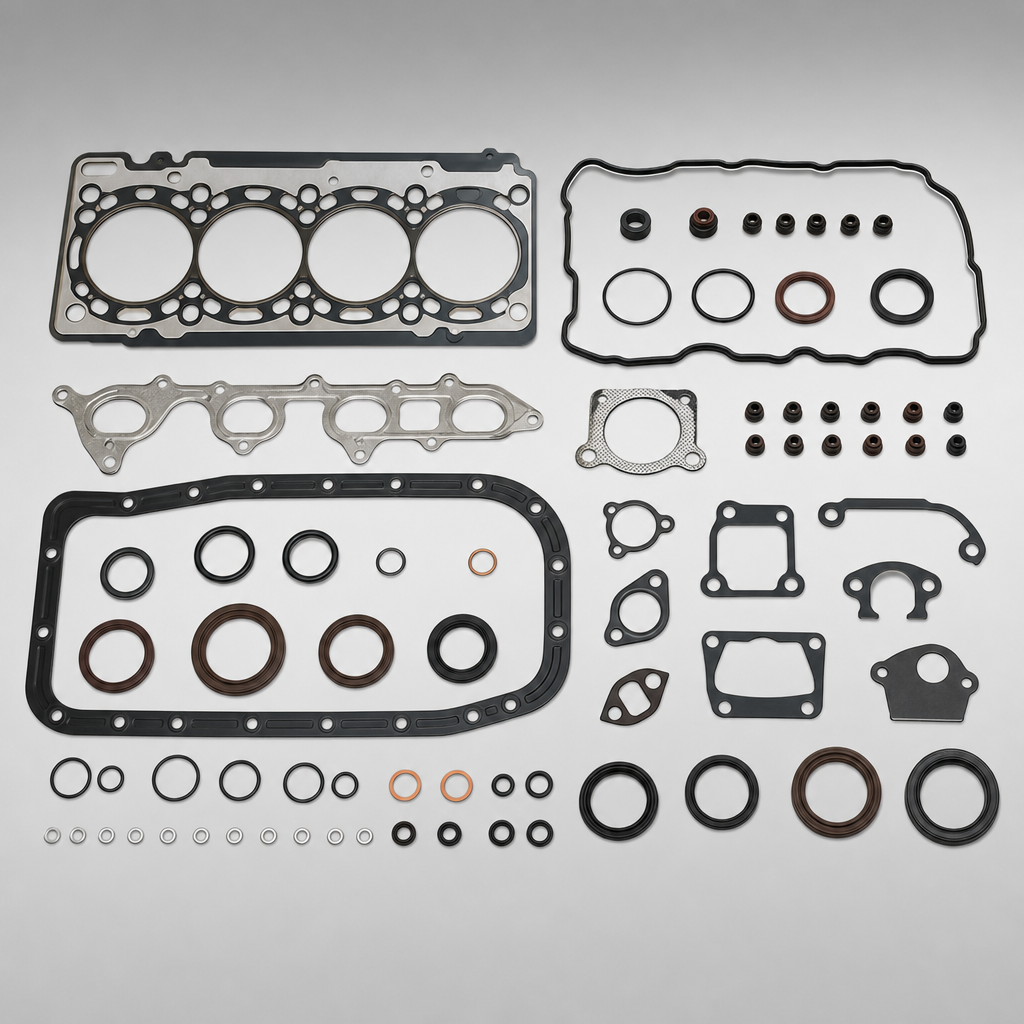
Exhaust manifold gaskets operate in one of the most punishing sealing zones on an engine. They face thermal cycling, flange movement, localized hot spots, vibration, and repeated clamp-load changes. For buyers, that means a cheap part can become an expensive one fast if it leaks, distorts, triggers warranty claims, or creates installation complaints.
So the real task is not judging whether a gasket looks acceptable on a bench. It is deciding whether the part will still seal across production variation, transport handling, and real engine heat. That requires measurable checks: material composition, dimensional control, compression behavior, traceability, and test evidence tied to the exact revision being quoted.
This article explains how to verify exhaust manifold gasket quality from a sourcing and supplier-management perspective. It is written for distributors, import managers, sourcing engineers, and quality teams that need a practical approval method for RFQs, supplier qualification, samples, and incoming inspection. The aim is to replace vague impressions with a repeatable decision standard before the part reaches mass purchase.
Decision Filter: Is the quoted material stack actually suitable?
The first question in how to verify exhaust manifold gasket quality is simple: what exactly is being quoted? Many problems start here. A supplier says "graphite gasket" or "metal gasket," but that description is too broad to support approval.
Exhaust manifold applications commonly use graphite-faced composite, multi-layer stainless steel (MLS), or a perforated steel core with facing material. Those constructions do not behave the same way under heat, clamp load, or flange irregularity. If the build changes, the sealing behavior changes.
Ask the supplier to confirm:
Base material grade and layer structure
Facing material type and thickness
Steel carrier thickness and hardness range where applicable
Maximum continuous service temperature claimed for the design
Whether the product is asbestos-free and compliant with REACH (EC) No 1907/2006
Batch traceability for raw materials and finished parts
A usable quotation should show controlled specification data, not broad sales language. If the supplier cannot state nominal thickness by layer, tolerance, and material grade, the part is not technically defined well enough to compare.
As a working reference, an MLS exhaust manifold gasket may use 2 to 5 stainless layers with total thickness often in the 0.80 to 1.80 mm range. A graphite-faced steel-core design may run closer to 1.20 to 2.50 mm depending on flange condition and bolt load. Stainless layers are often from SUS301 or SUS304 family material, while graphite facing thickness may be controlled to about +/-0.05 mm per side.
Check point
What to verify
Why it matters
Facing material
Expanded graphite, fibre composite, or coated steel
Affects heat resistance and micro-sealing ability
Core material
Stainless steel or perforated carbon steel
Influences blowout resistance and load retention
Thickness
Nominal thickness with tolerance, for example 1.50 +/-0.10 mm
Changes clamp load and fitment behavior
Bead or stopper design
Height consistency and location, for example 0.08 to 0.20 mm emboss
Controls sealing stress around ports
Coating
Anti-stick or anti-corrosion surface treatment
Supports storage life and installation stability
</tr></thead><tbody> </tbody></table>Also ask what temperature claim is tied to the exact build. A statement such as "high temperature resistant" is not enough. Buyers need a defined continuous or peak temperature backed by the actual construction.
If the part is sold against a cross-reference, confirm how the OE mapping is controlled. Use a format such as OE 11251... only when the original enquiry already uses that family. Loose cross-reference lists are a common source of wrong applications and unstable fitment quality.
This is where price should start to make sense. If one supplier is 18 to 30 percent below the market range, check whether steel grade, graphite density, thickness, or coating has been reduced. Low price often reflects a lighter build, not a more efficient factory.
Failure Mode Check: Where do bad gaskets usually go wrong on dimensions?
Dimensional errors create some of the most common field failures: exhaust leakage, hard installation, port obstruction, and repeat returns. If you want a repeatable method for how to verify exhaust manifold gasket quality, this is where measurement stops guesswork.
Review both the approved drawing and the physical sample. Measure or request records for:
Overall length and width
Port opening size and positional tolerance
Bolt hole diameter and centre distance
Thickness before compression
Bead height or emboss height where applicable
Edge finish and burr condition
A flatbed optical system, profile projector, or simple go/no-go fixture can catch port shift and bolt-hole offset quickly. Even a basic fixture check is better than visual estimation.
What failure usually looks like
Bolt holes do not line up cleanly, so installers force the gasket into place.
Port openings overhang into the gas path.
Sealing land is too narrow or uneven around one or more ports.
Burrs or delamination hold the gasket off the flange.
Thickness varies enough to change clamp load across the part.
Turn these into numbers wherever possible. Many buyer inspection plans use bolt-hole diameter tolerance around +/-0.10 to +/-0.15 mm for stamped metal parts, centre-distance tolerance around +/-0.15 to +/-0.25 mm depending on length, and port-position tolerance around 0.20 to 0.30 mm. Thickness tolerance is often held at +/-0.05 mm for thinner metal constructions and +/-0.10 mm for thicker composite types. Burr height above 0.05 mm on critical sealing edges is often treated as a reject signal.
Flatness matters too, especially on longer multi-port gaskets. A part can measure correctly on length and hole pitch but still bow enough to reduce sealing stress before installation. Many teams use a maximum out-of-plane deviation of 0.30 to 0.50 mm across full length as a practical incoming criterion.
A strong buyer-side fitment check is direct and fast: place the gasket on an actual manifold or a laser-cut checking plate and confirm that all bolts drop freely, no port edge intrudes into the gas path, and sealing land remains visible around each opening. For multi-port parts, buyers often require a minimum sealing land width of 1.5 to 2.5 mm depending on engine family.
Where the supplier works under IATF 16949:2016 and ISO 9001:2015, dimensional inspection records should be available by lot. Their quality system should show calibrated inspection methods, control-plan discipline, and traceability.
If the geometry is tight, ask whether the supplier uses dedicated fixtures or camera inspection. That may add cost, but it usually removes sorting cost later.
Data Review: Which test results matter more than appearance?
A gasket can look clean, flat, and well cut and still lose sealing stress after heat exposure. That is why how to verify exhaust manifold gasket quality cannot stop at appearance and dimensions. Buyers need performance data tied to the exact construction under review.
Useful verification items include:
Compressibility and recovery results
Heat ageing results after elevated temperature exposure
Weight loss or structural degradation after thermal cycling
Facing adhesion after temperature exposure
Leakage testing under clamp load
Corrosion resistance for metallic layers or coatings
The supplier should define the internal or external test method, sample condition, and acceptance criteria. If the supplier also manufactures related sealing and engine parts, it is worth checking whether the same process discipline appears across our catalog.
The key question is not "Do you have a report?" It is "Does this report match the same material stack, thickness, and tooling revision as the quoted part?" Generic reports are weak evidence.
Typical approval files may include heat exposure in the 400 to 650 C range depending on construction, followed by thickness retention, visual integrity review, and leakage checks. For sheet-based materials, compressibility and recovery are often reported as percentages under defined stress. For MLS parts, emboss height retention after thermal cycling can be more useful than compressibility alone.
Sample count matters. A report based on three coupons from one development batch says little about production stability. A stronger package uses at least 5 to 10 samples across multiple lots.
Leakage data also needs context. If a supplier says the gasket passed, ask under what surface pressure, flange roughness, clamp load, and temperature cycle. "No visible leakage" is not a sourcing standard. A usable result defines fixture conditions, cycle count, and the acceptance threshold.
For emissions-sensitive applications, sealing quality affects more than durability. Leakage upstream of sensors can alter readings, drivability, and compliance performance. ECE R-83 is not a gasket approval standard, but it does underline why exhaust sealing integrity matters in service.
This step affects timing as well. If the supplier already has current validation data for the same construction family, sample approval may move in 2 to 3 weeks. If heat ageing or leakage validation must be run from the start, technical approval can extend to 4 to 8 weeks. Buyers should separate production lead time from approval lead time in the RFQ.
Process Audit: What workmanship defects point to unstable production?
Visual inspection still matters, but only when it is done as a controlled defect review rather than a quick glance. Workmanship issues often expose process drift before formal data does.
Use a written defect standard for sample approval and incoming inspection.
Workmanship checklist
No warping, cracks, or surface dents
No exposed core separation at the edge
Uniform embossing or stopper profile
No blistering, flaking, or uneven coating
No contamination from oil, dust, or metal chips
Legible batch identification on packaging
Protective packaging that prevents bend damage in transit
Then move past the part and inspect the process. Ask:
Are cutting dies and emboss tools maintained to a documented schedule?
Is first-piece inspection recorded at each run start?
Are thickness and critical dimensions checked in-process?
Is nonconforming material segregated by lot?
Can the supplier provide PPAP-style documentation when required for OEM or Tier-1 projects?
For private-label or application-specific programs, custom manufacturing should include drawing control, revision management, sample approval, and packaging specification control. A good gasket design still fails in the market if production output shifts lot to lot.
Ask about inspection frequency. A credible answer may be first-off approval, then checks every 1 to 2 hours or every 300 to 500 pieces for thickness, key dimensions, and visual defects. If emboss tooling wears quickly, bead height may need a tighter check interval.
Also ask whether the supplier tracks Cp or Cpk on critical dimensions. You do not always need the exact numbers, but you do need to know whether the process is managed statistically or only sorted at the end.
Packaging belongs in the same review. Thin multi-port gaskets can leave the factory flat and arrive bent. Confirm carton quantity, layer protection, inner bag type, humidity protection for ocean shipment, and whether flat separators are used between stacks.
This is often where MOQ economics become clearer. Standard catalog parts may start around 200 to 500 pieces per SKU, while custom thickness or private-label packaging may push MOQ to 1,000 to 3,000 pieces because of setup, print, and inspection cost. If annual demand is limited, ask about blanket orders with scheduled releases.
Comparison Framework: Why one good sample does not qualify a supplier
One acceptable sample proves very little. It may come from a pilot batch with extra attention, selected material, and slower handling than normal production. In practice, how to verify exhaust manifold gasket quality means checking repeatability, not just one-time appearance.
Use this supplier qualification checklist:
Certification status: IATF 16949:2016 and ISO 9001:2015 validity
Raw material source control and incoming inspection records
Lot traceability from steel or facing material to finished carton
Defined AQL or internal outgoing inspection criteria
Heat lot and production date retention in records
Complaint handling and corrective action response time
Export packaging standard for humidity and deformation protection
Ability to retain golden samples and revision history
If possible, approve three production lots instead of one pilot lot. Compare thickness, mass, fitment, appearance, and packaging condition across all three. That gives a much better picture of supply stability.
Traceability should be practical, not theoretical. A strong system links raw material batch, press line or die set, inspection record, packing date, and carton label. If a field claim appears months later, the supplier should be able to isolate affected lots quickly.
Outgoing inspection logic matters too. Many factories use AQL-based release, but buyers should confirm what level is used and which defects are treated as critical, major, or minor. Port mislocation, missing layer, or severe warp should never be treated as cosmetic variation.
Commercial discipline belongs in the same comparison. Ask how raw-material price changes are handled if stainless steel, graphite, or coating costs move sharply. Clarify quote validity, triggers for adjustment, and standard lead time by order size. A common structure is 20 to 35 days for repeat standard parts and 35 to 60 days for custom packaging, new tooling, or first-run approval lots.
When total landed cost is calculated honestly, the cheapest unit price often stops looking cheap. A gasket that is $0.06 to $0.15 lower but creates sorting, emergency freight, or leakage claims is usually the more expensive sourcing choice over a full program year.
Step-by-Step Approval Flow Before You Place a Mass Order
A good approval process keeps purchasing, engineering, warehouse, and quality teams aligned. More importantly, it turns how to verify exhaust manifold gasket quality into a repeatable workflow instead of a debate.
1. Confirm application scope, cross-reference, and drawing revision. 2. Review material declaration and compliance statement, including REACH (EC) No 1907/2006 where relevant. 3. Inspect dimensions on approved samples. 4. Check workmanship against a written defect standard. 5. Review test data for heat exposure, leakage, and compression behavior. 6. Verify packaging, labels, and batch traceability. 7. Approve only after lot-to-lot consistency is demonstrated.
This workflow works for new supplier onboarding, annual supplier review, and incoming inspection setup.
To make it useful, attach numeric gates to each step. For example: drawing confirmed, material stack confirmed, thickness tolerance accepted, port and bolt-hole measurements approved on at least 5 sample pieces, flatness within limit, zero critical workmanship defects, test report matched to current revision, and packaging label linked to lot number.
For RFQ comparison, add a short commercial matrix to each approval file:
MOQ for standard production and MOQ for private-label packaging
Sample cost and whether it is refundable against mass order
Tooling cost, if any, and ownership terms
Unit price break at different volumes, such as 500, 1,000, and 5,000 pieces
Technical approval lead time versus production lead time
Inspection documents included with shipment, such as dimension report or material declaration
That makes supplier comparison easier. One factory may have the lowest headline price at 5,000 pieces but require a high MOQ and long validation time. Another may quote slightly higher yet offer faster sampling, lower startup MOQ, and stronger lot documentation.
As a working rule, do not move to mass purchase after one visually acceptable sample. Approve a pilot quantity, review at least one repeat lot, and lock the approved revision in writing. If steel source, graphite grade, coating, thickness, tooling, or packaging changes later, require resubmission before treating the new lot as equivalent.
Driventus manufactures engine and sealing components for export programs and independent aftermarket supply. For technical data, sample review support, or sourcing discussions for exhaust manifold gasket programs, use the request a quote page.
Frequently asked questions
Start with material and construction. That is the base decision in how to verify exhaust manifold gasket quality because heat resistance, sealing behavior, and durability all depend on the build. After that, confirm dimensional accuracy, bead consistency, flange coverage, and test data matched to the exact quoted revision. The most useful habit is asking for nominal values and tolerances instead of generic claims such as "high temperature" or "precision stamped."
No. Visual inspection can catch delamination, burrs, coating defects, warpage, and packaging damage, but it cannot confirm compression recovery, thermal stability, or leakage performance. It should sit alongside dimensional checks, traceability review, and validation data. A practical incoming plan usually combines visual review with measured thickness, flatness, bolt-hole position, and confirmation that the shipment lot matches the approved specification.
No. **IATF 16949:2016** and **ISO 9001:2015** show that a supplier has documented quality systems, but they do not prove that a specific gasket will perform in a specific engine application. Buyers still need application-level verification, sample measurement, and test evidence for the supplied part. Certifications reduce process risk; they do not replace drawing control, fitment validation, or lot-to-lot approval.
For buyer-side sample review, drawings, or production enquiries on exhaust manifold gasket supply, contact Driventus through /contact.html