Oil on the top of an engine can look like an EGR failure when the real source is a valve cover gasket, breather joint, filler cap, turbo intake hose, or intake seal. That matters commercially. A weak diagnosis turns low-cost sealing faults into expensive EGR claims, distorts warranty data, and pushes buyers toward the wrong stocking plan. This guide treats a valve cover oil leak egr valve complaint as a classification problem, not a parts-swapping exercise. It shows repair-chain buyers, distributors, and sourcing engineers how to separate external oil leaks from intake oil carryover and true EGR faults; how to set replacement rules; and how to brief suppliers before launch. Driventus manufactures engine and powertrain components in Taizhou, Zhejiang, including EGR valves and related sealing parts for aftermarket and OEM/Tier-1 programmes.
Decision Point: Is the EGR Actually the Source?
The EGR valve lives in a hostile area: hot exhaust gas, soot, condensate, thermal cycling, vibration, and packaging crowding. Exhaust-side temperatures at the valve body commonly sit around 250–450°C depending on engine load, so staining and residue near the assembly are not enough to condemn the part.
On many transverse petrol and diesel engines, the valve cover, positive crankcase ventilation path, turbo intake hose, intake manifold, EGR cooler, and EGR valve sit in the same visual zone. Oil travels. It follows casting ribs, harness clips, fastener bosses, heat shields, and gravity before it pools on the easiest surface to see. The visible wet patch may be 50–150 mm from the origin, and a 1–2 ml film can look worse after airflow spreads it through dust.
Use three buckets before any warranty decision:
External oil leak: oil escapes from the valve cover gasket, cam carrier joint, breather seal, oil filler cap, or fastener seals. Confirmation usually means cleaning the area, idling for 10–20 minutes, then adding a short road test and checking for fresh oil.
Intake oil carryover: oil mist from the crankcase ventilation system or turbocharger compressor side coats the EGR and intake tract internally. A light film is normal; pooled oil above 5–10 ml in a hose section should trigger breather, turbo, and blow-by checks.
EGR functional fault: the valve sticks, reports position deviation, leaks exhaust gas, fails an actuator test, or triggers emissions-related fault codes. An oily outer casting alone is not a failure mode.
Keep those buckets separate in distributor claims. A leaking valve cover gasket can soil a good EGR valve. A sticking EGR valve can occur with no external oil leak at all. Clear classification protects margin because an EGR assembly can cost 5–20 times more than a gasket, hose, or breather seal.
Failure-Mode Map for “Oil Around EGR” Reports
Field reports often arrive as short phrases: “oil around EGR,” “top-engine leak,” “EGR wet,” or “oil and soot near valve.” Those phrases are not diagnostic. The repair network needs a routine that produces evidence a technician, warranty clerk, and supplier engineer can read the same way.
Symptom or evidence
Likely source
Inspection method
Replacement implication
Fresh oil at valve cover perimeter
Valve cover gasket, cover distortion, or fastener seal
Clean with residue-free degreaser, run engine at idle for 10 minutes and 2,000 rpm for 3 minutes, inspect with lamp or UV dye
Replace gasket, fastener seals, or cover if distorted beyond service limit
Oil on EGR exterior but dry valve cover
Intake hose, breather joint, turbo oil carryover, or previous spill
Remove inlet duct and inspect internal oil film; check clamps, O-rings, and hose seating
Check breather and turbo system before EGR replacement
Soot and oil paste inside EGR throat
Normal soot plus oil mist, excessive blow-by, or restricted intake flow
Inspect PCV flow, crankcase pressure, compression trend, intake restriction, and service interval
Clean or replace EGR only if actuation or sealing fails
EGR position fault code with no external oil source
Check connector condition, terminal tension, pin corrosion, seal compression, harness strain, and 5 V reference/ground integrity before rejecting an electronic EGR valve.
This approach is most valuable when repeated valve cover oil leak egr valve complaints appear on the same engine family. Once evidence is standardized, return parts can be sorted by leak source, contamination type, and confirmed EGR performance instead of being bundled under a vague “oil leak” code.
Spec Deep-Dive: Oil Outside vs Deposits Inside
A valve cover leak rarely damages the EGR mechanism directly. The more realistic external risk is secondary contamination: oil reaches connectors, harness insulation, vacuum lines, or position-sensor areas. It softens some elastomers, traps dust, and can form a conductive film when mixed with road salt, coolant residue, or cleaning detergent. For electronic EGR units, buyers should ask whether connector seals, potting materials, and external plastics are validated against engine oil, fuel splash, salt mist, and heat ageing.
Internal contamination follows another route. Oil mist enters through crankcase ventilation or, on turbocharged engines, through the compressor-side intake. Mixed with exhaust soot, it forms carbon-oil paste on the EGR pintle, throttle flap, anti-shudder valve, diffuser surfaces, and intake runners. Even 0.5–1.0 mm of deposit on the valve seat can affect sealing on some designs. Heavier build-up can slow movement, restrict flow, reduce feedback accuracy, or stop full closure.
That distinction changes warranty coding. Heavy internal carbon-oil paste may point to engine operating conditions, breather performance, turbocharger condition, oil quality, long idle time, or extended service intervals. It is not automatically a manufacturing defect. Part-quality concern is more likely when the evidence shows actuator failure, poor shaft sealing, incorrect connector geometry, weak terminal retention, loose fasteners, air leakage across a machined face, or unstable position feedback.
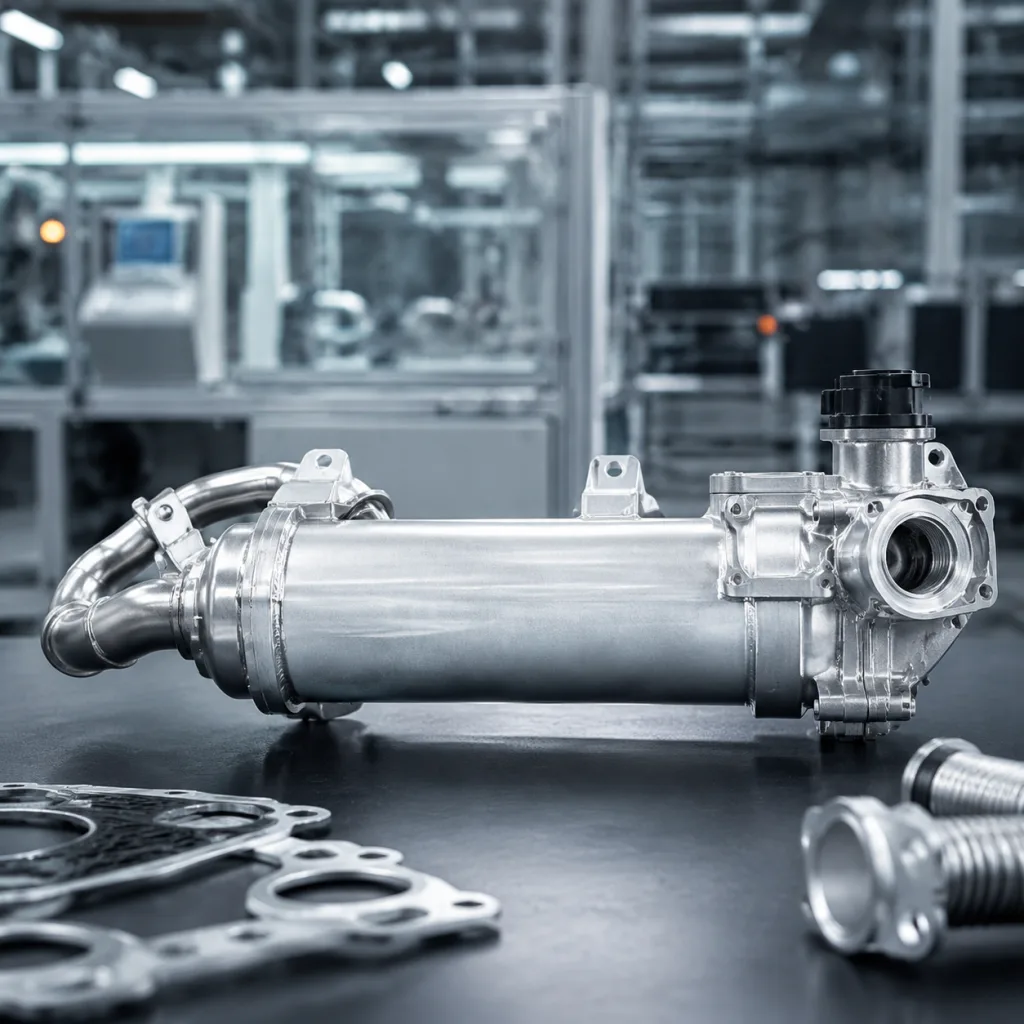
Driventus develops EGR valve programmes around dimensional match, actuator response, sealing integrity, thermal durability, corrosion resistance, and application fit. Drawing and sample reviews typically cover mounting-hole position, gasket-face flatness, port alignment, connector keying, valve travel, actuator calibration, and packaging protection. Product coverage can be reviewed through our catalog, including related engine management and engine components where applicable.
Replacement Rules That Stop Unnecessary EGR Claims
Set replacement rules before launch, not after returns begin. Otherwise, branches may fit a high-cost EGR assembly when the repair should have been a valve cover gasket, hose, breather seal, filler cap, or harness fix. A simple gate works well: approve EGR replacement only when there is one verified EGR functional failure or one verified EGR sealing/interface failure.
A practical replacement specification should include:
External leak repair: replace the valve cover gasket, cover assembly, oil filler seal, breather seal, or fastener seals when oil originates above or upstream of the EGR; check cover flatness and bolt torque sequence rather than reusing a warped plastic cover.
EGR gasket repair: replace EGR flange gaskets if soot trails, exhaust odour, pressure leakage, loose mounting, flange pitting, or flange damage is confirmed; review gasket thickness, coating, and crush pattern during return analysis.
EGR valve replacement: replace the valve only when actuation, position feedback, leakage, sticking, flow control, or electrical resistance is outside the applicable service limit; for many electronic units, buyers should require supplier test limits for response time, current draw, position deviation, and seat leakage.
Harness repair: replace connector seals or repair wiring when oil contamination, terminal spread, corrosion, insulation damage, or harness tension causes intermittent signal faults; do not classify these as valve defects without bench-test evidence.
Root-cause escalation: check crankcase pressure, PCV condition, turbocharger compressor seals, intake restriction, oil grade, and maintenance history if internal oil deposit level is abnormal or repeat failures occur within 3–6 months.
For imported aftermarket parts, request dimensional reports for mounting faces, connector keyways, gasket interfaces, valve stroke, port alignment, hose or cooler connections, and sensor or actuator location. Useful drawing tolerances include gasket-face flatness, bolt-hole position, port concentricity, connector fit, and valve travel. If no OE drawing is available, compare at least 3 OE parts and 3 supplier samples to build a practical baseline.
Validation evidence should cover thermal cycling, leakage, actuator endurance, vibration resistance, corrosion exposure, electrical load, and packaging protection. Common aftermarket starting points are 50–100 pieces for sample or pilot orders, 300–500 pieces per SKU for stable production, and 30–60 days for first mass production after sample approval, depending on tooling, casting, electronics, and packaging. Driventus operates under IATF 16949:2016 and ISO 9001:2015, with process controls described in our quality system.
Driventus is an independent aftermarket manufacturer; brand names are referenced for fitment only.
Supplier Controls: What Prevents Ambiguous Returns?
A supplier cannot control every installation error, engine-side leak, or maintenance-related deposit issue. It can control ambiguity. Good design records, testing, packaging, and traceability make a false warranty claim easier to identify and a real defect faster to correct.
For distributors in the EU, UK, US, Canada, Australia, and Brazil, this is not paperwork for its own sake. Warranty labour, customer support, freight, inspection time, and reverse logistics can erase the margin from several good units. On medium-value EGR programmes, one avoidable return can be expensive.
Useful controls include:
100% connector-fit, terminal-position, and keyway checks for electronic EGR valves, with go/no-go gauges for critical interfaces.
Leak testing of valve seats, coolant passages, exhaust interfaces, and shaft seals where the design includes them, with test pressure, hold time, and allowable leakage stated on the control plan.
Actuator response checks across defined temperature, voltage, and duty-cycle conditions, including low-voltage operation where vehicle battery condition is a common field variable.
Surface flatness control on gasket faces, cooler interfaces, and mounting flanges, with machining datum control and in-process SPC for high-volume SKUs.
Batch traceability by casting, machining, assembly, final test, packaging date, operator or line record, and key purchased parts such as motors, sensors, gears, and connectors.
Packaging validation to reduce flange damage, port contamination, coolant-pipe deformation, and connector impact during export transport; specify caps, bags, dividers, carton strength, and pallet stacking limits.
Materials and coatings need the same discipline. Depending on the destination and programme, buyers may request evidence aligned with REACH (EC) No 1907/2006, RoHS where electronics are in scope, and other substance-control requirements. Emissions-related vehicle compliance remains the responsibility of the vehicle and system application. ECE R-83 is commonly referenced for vehicle emissions type approval, but an aftermarket component supplier should not claim vehicle-maker approval unless it is formally documented.
For private-label or programme-specific requirements, Driventus can support custom manufacturing, including drawing review, sample validation, packaging specification, inspection documentation, control-plan alignment, PPAP-style records where agreed, and return-part analysis guidance.
Scenario: Approving a Programme With Oil-Leak Risk
Picture a distributor preparing to launch EGR valves for an engine family already known for top-end oil leaks. A price-only comparison is not enough. The programme file has to connect fitment, diagnostic rules, supplier test data, MOQ, lead time, price tiers, packaging, and warranty evidence.
Recommended approval checklist:
Confirm vehicle and engine fitment data, including model year range, engine code, fuel type, turbo configuration, emissions configuration, OE cross numbers, connector photos, and gasket type.
Compare sample dimensions against the OE envelope, gasket face, bolt pattern, connector, cooler connection, hose interface, valve stroke, and actuator position at closed/open commands.
Review test reports for actuator endurance, leakage, thermal cycling, corrosion resistance, vibration resistance, connector durability, and final electrical checks; ask for actual limits, not only “pass” statements.
Define warranty codes that separate valve cover leakage, EGR gasket leakage, internal deposits, electrical faults, actuator faults, shipping damage, installation damage, and no-fault-found returns.
Specify packaging to protect machined faces, ports, coolant or exhaust interfaces, sensors, and electrical connectors; confirm barcode, private-label, carton quantity, pallet height, and humidity protection.
Agree MOQ, lead time, price breaks, payment terms, labelling, traceability format, inspection level, and return-part evidence requirements before production release.
Build the commercial path in stages. Start with sample approval. Move to a 50–100 piece pilot order for fitment checks and claims monitoring. Scale to 300–500 pieces per SKU only after sales velocity and defect rate are stable. Price tiers at 100, 300, 500, and 1,000 pieces are useful, but the best tier depends on casting batch size, motor and sensor MOQ, machining setup time, and packaging complexity. Repeat orders often run 25–45 days after deposit or purchase-order confirmation; new SKUs, private labels, or tooling changes may need 45–75 days.
If the project includes multiple part families, cross-reference EGR valves with gaskets, valve covers, breather parts, turbo intake hoses, and intake seals. That lets the distributor sell the repair, not just the component most visible in the complaint.
For repeated valve cover oil leak egr valve claims, send photographs, fault-code records, mileage, installation notes, cleaning history, removed gasket condition, connector condition, and return-part notes. Driventus engineers can then classify the issue as EGR replacement, sealing-system repair, supplier corrective action, or further engine-side diagnosis.
Frequently asked questions
Indirectly, yes. External oil can contaminate connectors, vacuum lines, or harnesses near the EGR valve. It does not normally damage the EGR mechanism by itself. Internal sticking is more often linked to soot mixed with oil mist from crankcase ventilation or turbo intake carryover.
Not automatically. The area should be cleaned, the valve cover and breather path inspected, and EGR actuation tested. Replace the EGR valve only when movement, feedback, leakage, or electrical checks are outside the applicable service limits, and keep photos, fault codes, and bench-test results for warranty review.
Request dimensional inspection, leakage and actuator test records, material declarations where required, batch traceability, and evidence of certified quality management such as IATF 16949:2016 and ISO 9001:2015. Packaging, MOQ, lead time, price tiers, labelling, and warranty classification rules should also be agreed before launch.
If you need EGR valves, gaskets, or related engine components for a distributor or repair-chain programme, Driventus can review fitment, samples, MOQ, lead time, pricing tiers, and supply requirements. To discuss the application, [request a quote](/contact.html).