Used Auto Parts Online: Buyer Checks for Trade Orders
Buying used auto parts online can work for trade buyers, but only in narrow cases. The real decision is not "used versus new" in the abstract. It is whether the lower buy price survives fitment risk, grading inconsistency, hidden wear, returns, and field claims.
For distributors, repair networks, and importers, dismantled parts sit in a different control category from newly manufactured aftermarket supply. Engines, turbochargers, pumps, gaskets, and rotating assemblies are especially unforgiving because prior use history is rarely fully visible. A cheap unit can become an expensive line item after one failed installation, one labour claim, or one wave of wrong-fit returns.
A better way to assess used auto parts online is to start with the programme: annual volume, warranty tolerance, cosmetic expectations, lead-time pressure, and inspection capacity. This article breaks the topic into practical buying decisions: where used parts can make sense, where they usually fail the commercial test, what to verify before issuing a PO, and when a new OE-equivalent replacement is the safer sourcing route. Driventus is an independent aftermarket manufacturer; brand names are referenced for fitment only.
Start with the use case, not the listing
Used components make sense when the commercial downside is capped.
That usually means one of four situations:
Obsolete or end-of-life applications where fresh production is uneconomic
Low-risk cosmetic or non-safety parts where variation is acceptable
Short-term gap filling while new supply is delayed or being qualified
Controlled dismantling streams with consistent grading and donor records
These programmes tend to share the same traits: low annual demand, modest warranty exposure, and tolerance for cosmetic variation. If a buyer needs 20-50 units of an interior trim piece, mirror housing, or bracket for an ageing platform, buying used auto parts online may be more practical than opening a new run with a 300-1,000 piece MOQ.
The opposite is also true. Used stock becomes hard to defend when the part's failure mode is expensive, hard to detect, or likely to trigger labour claims.
Categories that usually fail that test include:
Turbochargers
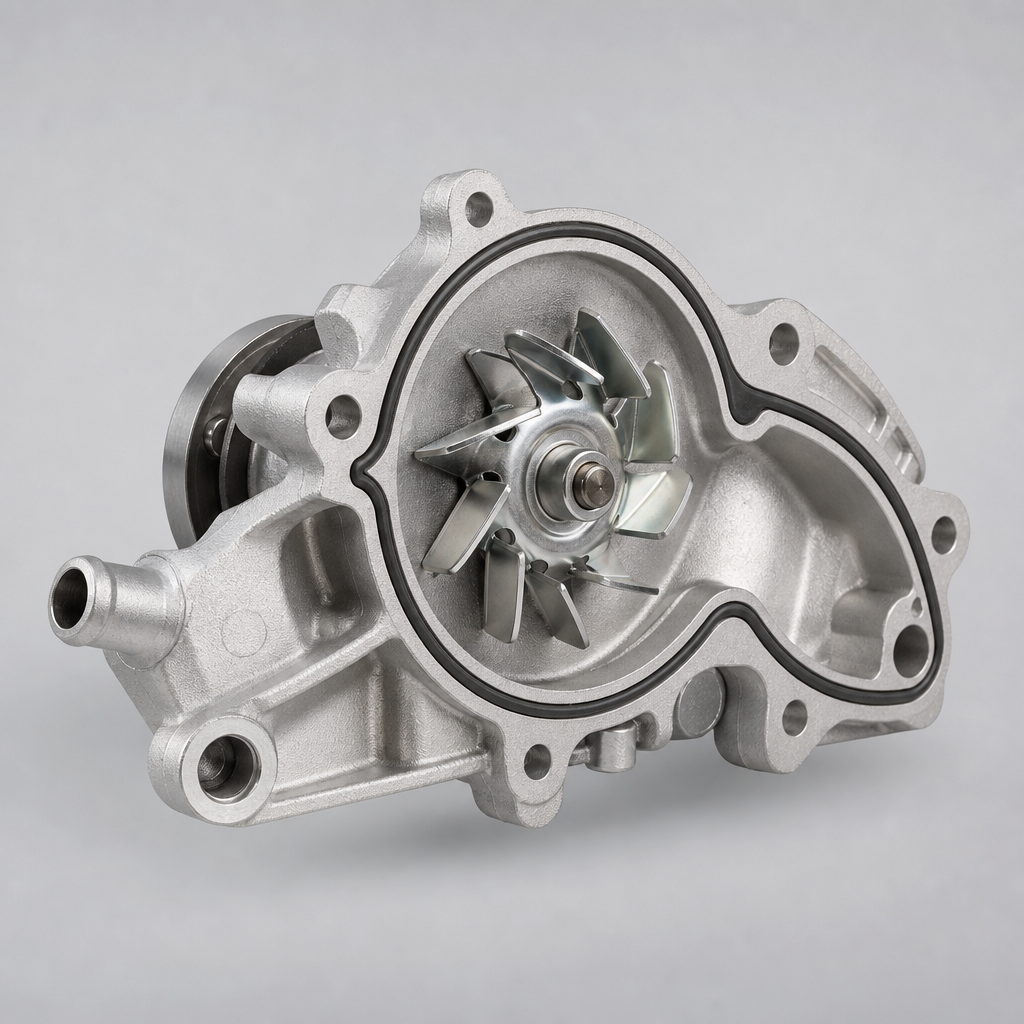
Water pumps
Crankshafts
Pistons and rings
Head gaskets and sealing sets
Timing components
In these groups, the attractive ex-works price often hides a much worse installed cost. A dismantled turbocharger bought at a 35-50% discount stops being cheap if even a small share of units produce shaft-play claims, oil leakage, or wheel damage after fitting. A used water pump with unknown seal life can wipe out the saving in a single job.
If the application is repeatable and the consequences of failure are high, review our catalog and the controls described in our quality system before treating salvage stock as the default answer.
Compare the real cost: used stock versus new aftermarket
When sourcing used auto parts online for trade supply, invoice price is only the first number. The number that matters is usable cost per installed unit.
Factor
Used part
New aftermarket replacement
Unit purchase price
Usually lower
Usually higher
Dimensional consistency
Variable
Controlled to drawing and process limits
Traceability
Often limited to breaker stock ID
Batch and production traceability possible
Cosmetic condition
Variable
Standardised
Residual service life
Unknown or estimated
Full service life expectation from new
Contamination risk
Higher
Lower with controlled cleaning and packing
Warranty predictability
Lower
Higher
Suitability for volume programmes
Limited
Better
</tr></thead><tbody> </tbody></table>For procurement teams, the biggest cost leaks are rarely the obvious ones. They are usually:
1. Returns per 1,000 units 2. Wrong-fit claims 3. Labour reimbursement exposure 4. Sorting and repacking time 5. Damage to downstream customer confidence
A straightforward buying model is to quote both sourcing routes on the same basis.
Used stock: unit price USD 42, MOQ 10, lead time 7-15 days, expected incoming reject rate 8-15%, inconsistent traceability
New aftermarket: unit price USD 58, MOQ 100, lead time 30-45 days, expected incoming reject rate below 1-2%, full lot traceability
At first glance, the used option saves USD 16 per unit. But add 10 rejects per 100 units, several wrong-fit returns, extra sorting labour, and two field claims, and the saving can disappear fast.
Use this formula instead:
Effective usable cost = (purchase cost + inbound freight + inspection labour + claims reserve + repacking) / accepted units
That calculation usually clarifies the decision. For multi-warehouse or multi-site programmes, new production is often easier to standardise and cheaper to manage over time, especially for engine and powertrain lines where sealing surfaces, shaft journals, balance condition, and housing geometry directly affect warranty results.
Pre-PO checks: what a serious buyer verifies first
A trade process for used auto parts online should resemble supplier qualification, not casual marketplace buying.
Descriptive language is not enough. Buyers need measurable acceptance points.
Flatness-sensitive faces: no visible gouges; warpage limit declared or checked against the relevant drawing
Shaft or journal surfaces: no blueing, no deep scoring, no out-of-round beyond agreed inspection capability
Threaded holes and studs: 100% thread integrity on critical mounting points
Electrical items: connector locks intact; no unacceptable pin corrosion
Housings: no welded repair unless explicitly approved in PO terms
Records worth requesting
Document or record
Why it matters
Part identification sheet
Reduces wrong-supply risk
Condition grading photos
Creates objective acceptance criteria
Inspection checklist
Shows what was actually examined
Test record, if applicable
Supports higher-value component purchases
Packing specification
Prevents transit damage disputes
Returns and warranty terms
Clarifies commercial exposure
</tr></thead><tbody> </tbody></table>Generic phrases such as "tested OK" should trigger follow-up questions.
Was the part fully degreased before inspection, or only wiped externally?
If pressure-tested, at what pressure and hold time?
Was shaft play checked by feel or by gauge?
Were sealing faces protected after cleaning?
Were units individually packed, bulk packed, or stacked loose?
If no structured inspection record exists, buyers should assume a higher failure rate and price that risk into the order. In many markets, that means holding a 5-10% claims reserve for mixed dismantled stock, versus a much smaller reserve for controlled new production.
Where stable repeat ordering matters, it can be more efficient to move directly to new supply or custom manufacturing with application-specific packaging and clearer process control.
Failure modes that make used parts a bad bet
Some categories look acceptable on a sales listing and still fail in service. That is the central risk with used auto parts online.
Engine and powertrain components
For rotating, sealing, or heat-stressed parts, visual inspection is not enough. Fatigue, distortion, contamination, and prior overload often show up only after installation.
These are not just technical concerns. They are commercial risk multipliers.
Typical buyer requirements in these categories may include:
Crankshaft runout control in the low hundredths of a millimetre range, with journal size checked against OE regrind limits
Turbocharger balance and shaft-clearance control backed by actual evidence, not just external photos
Water pump leak integrity confirmed by pressure or functional testing
Piston dimensional confirmation on skirt diameter, ring groove condition, and pin-bore wear
Gasket material integrity with no prior compression set or coating breakdown
Dismantled stock rarely supports these checks consistently at scale. That is why the apparent savings often collapse. A used turbocharger sold at USD 120-180 can become the most expensive option the moment one oil-seal failure creates a comeback. A reused head gasket has no reliable remaining sealing margin for trade resale.
For these programmes, buyers usually move to new parts produced under controlled systems aligned with IATF 16949:2016 and ISO 9001:2015. Where relevant, material and chemical compliance should also be checked, including REACH (EC) No 1907/2006 requirements.
If the line is engine-focused and warranty-sensitive, a direct new-supply route is generally more reliable than buying used auto parts online from dismantled stock. Relevant ranges are available in our catalog.
A step-by-step process to reduce claims and wrong-fit returns
The source matters, but the control method matters more. Buyers reduce risk by making the first order harder, not easier.
Recommended controls:
Build an approved-supplier list with documented grading rules
Use application-level SKU mapping, not free-text descriptions alone
Quarantine the first three consignments for receipt inspection
Track defect ppm, return ratio, and wrong-fit rate by supplier
Separate cosmetic acceptance from functional acceptance
Require sample approval before bulk release on higher-value items
A simple rule helps: if the part has a mating surface, rotating mass, internal bearing, or pressure seal, treat it as verification-intensive.
For used stock, a disciplined process often looks like this:
1. RFQ stage: send OE number, vehicle application, annual volume, target pack quantity, and acceptance criteria 2. Pre-shipment review: collect photos, grading summary, donor data, and any test records 3. Pilot lot: validate with a small buy, often 5-20 units depending on value 4. Incoming inspection: check fitment identifiers, damage points, cleanliness, and agreed functional features 5. Performance review: measure returns from the first installed batch before expanding repeat POs
For new aftermarket replacements, buyers should request:
Drawing or master-sample control
Critical dimension checks
Leak, pressure, or balance testing where applicable
Lot traceability
Packaging validation for export transit
Order size should match process capability. If a dismantler can grade consistently only across 30-50 units, issuing a 200-unit PO increases the chance of mixed donor condition and storage history. A manufacturer may ask for a higher MOQ, but usually offers tighter repeatability, more stable lead times, and cleaner replenishment planning.
That is why many buyers standardise on one audited manufacturing source for core volume and use used stock only as an exception path.
Scenario test: which sourcing route fits this programme?
A useful way to evaluate used auto parts online is to stop asking whether used stock is good or bad in general. Ask which route fits the programme in front of you.
Purchasing scenario
Used part
Remanufactured part
New aftermarket part
Obsolete application, low annual demand
Suitable
Suitable
Case by case
Multi-site repair chain, repeat demand
Weak fit
Better
Strong fit
Safety-critical or sealing-critical item
Avoid
Case by case
Preferred
Need for stable cosmetic presentation
Weak fit
Better
Preferred
Need for documented batch traceability
Weak fit
Better
Preferred
Lowest immediate cash outlay
Preferred
Mid
Higher
Lowest warranty risk
Weak fit
Mid
Preferred
</tr></thead><tbody> </tbody></table>A practical rule of thumb:
Used part route: best for low annual demand, flexible MOQ needs, and programmes that can tolerate cosmetic variation and heavier inspection
Remanufactured route: useful when the original core design must be retained but standardised rebuild and test controls still matter
New aftermarket route: strongest for stable demand, repeat replenishment, and tightly controlled return-rate targets
Typical market patterns reinforce that logic:
Used stock often has MOQ from 1-20 pieces, but supply is irregular and lead time can range from a few days to several weeks
Remanufactured supply may involve exchange-core logic, testing queues, and lead times around 2-6 weeks
New aftermarket production often requires MOQs such as 50, 100, or 300 pieces, but supports clearer scheduling, price breaks, and batch documentation
For most B2B buyers, the answer is not to eliminate used stock entirely. It is to confine it to low-risk exceptions while moving sealing-critical, rotating, and repeat-volume lines onto controlled production.
If you are reviewing sourcing options for aftermarket programmes, Driventus can support the comparison with product data, inspection controls, and export packing detail. See our catalog, review our quality system, or request a quote for a specific application.
Frequently asked questions
Sometimes, but only when the programme can absorb variability. Used auto parts online are usually more workable for obsolete, low-volume, or low-risk categories than for repeat-volume lines. When buyers need traceability, dimensional consistency, and predictable warranty performance, new aftermarket supply is usually easier to scale.
Engine, turbo, pump, sealing, and rotating components are typically the hardest to control. Hidden wear, distortion, contamination, and prior heat stress may not be obvious during a basic inspection. Any part involving shaft clearance, sealing pressure, flatness-sensitive faces, or unknown service history should be treated as high-risk.
Request fitment references, written grading criteria, inspection records, condition photos, testing evidence where relevant, packaging details, and clear warranty terms. Also confirm MOQ, available batch quantity, realistic lead time, and the likely reject rate within the lot. Without that information, the price comparison is incomplete.
If you are comparing dismantled stock with new aftermarket supply, we can provide application review, technical data, and export quotations for volume programmes. Contact our team to discuss your requirement at /contact.html